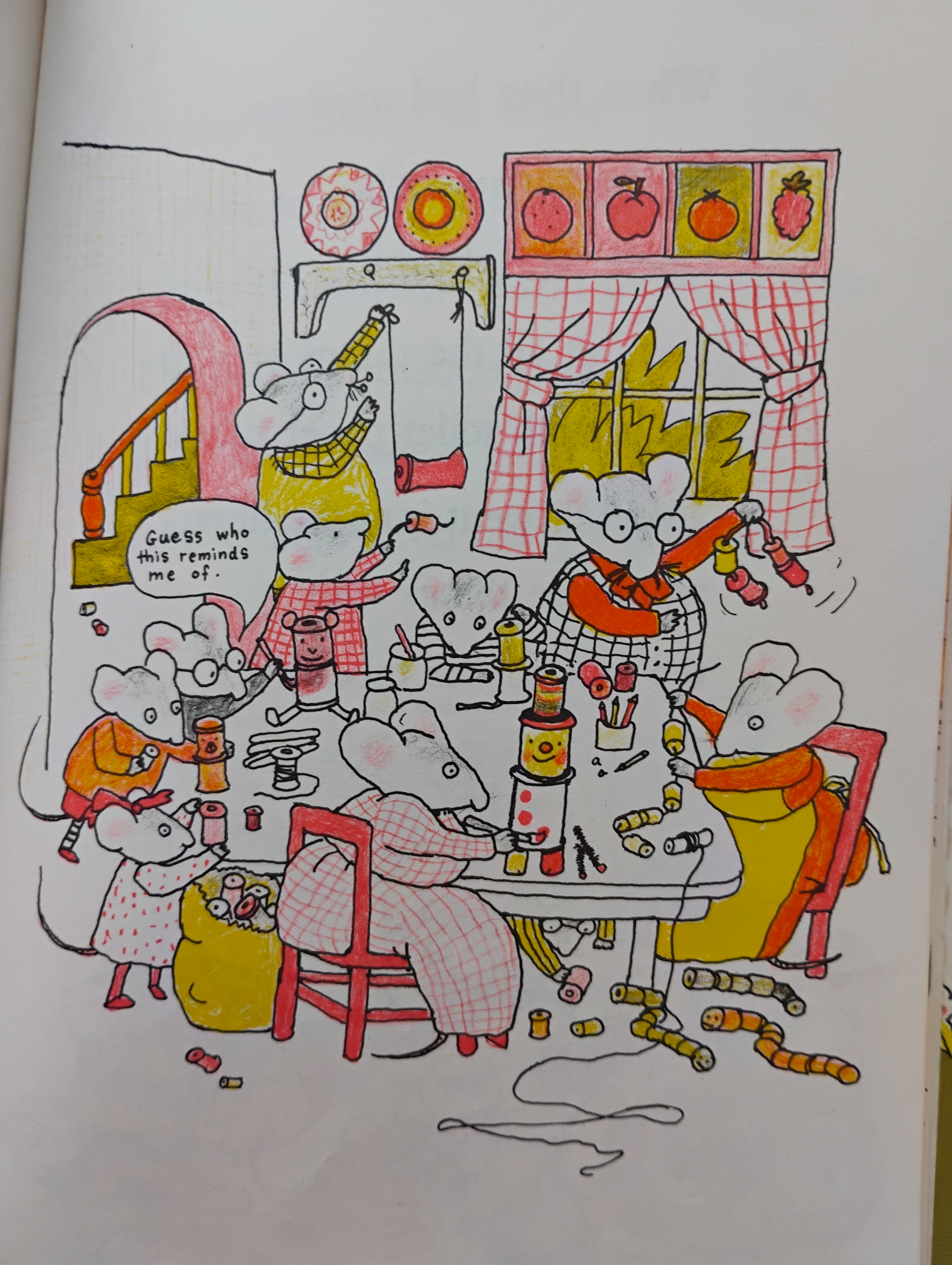
My neighbor Becky Teilhet was a baby whisper. When I had a baby, her first sleepover was at Becky’s house next door. Becky was a remarkable person, sweet and funny and a little mischievous and she had a beautiful, huge, loving heart. Her husband Justin is a ceramic artist. They made a living with art. Becky made beautiful quilts. Once, she loaned us a book she had read to their son Jay, called What Can You Make Of It? by Franz Brandenberg, illustrated by Aliki.
Published in 1977, the book depicts a family of field mice, who live in New York City (or near—the illustrations include a Zabar’s bag). The mice are preparing to move, and rather than get rid of their rubbish, they keep and move their collections of egg cartons, orange juice cans, yarn spools, old magazines, etc., which means they need seven moving vans. “Mr. and Mrs. Fieldmouse’s new house was an old house,” says the start of Chapter Two. Once inside the new old house, they must decide where to put all the rubbish. It lands in the garage. When Uncle Alfred and Aunt Kate come to visit in chapter three, the Fieldmouse family must clear out the garage so their visitors won’t have to park on the street. They lug the rubbish from the garage (“Garages are for cars,” says Mother Fieldmouse) into the new old house. The visitors arrive, and remark upon the nice new old house which has no place to sit down. In Chapter Four, Uncle Alfred—perched impossibly on the top of a tower of old magazines—says, “Look at all the things you can make with rubbish!” The field mice proceed to make lions, tigers, horses, bears, a top hat, then snakes, a trapeze, monkeys, a clown, a rattle, a family of elephants, a microphone, opera glasses, a hoop, a cannon, turtles, pedestals, cups, owls, a rabbit, and cages. “We have made a whole circus!” says Uncle Alfred. They take everything into the garage and present The Greatest Show On Earth.
Like my neighbor Becky, the illustrations are sweet and more than a little mischievous—these dear mice are always in motion, stuffing toilet paper tubes into bags, tripping over spools. It’s a fabulous book. (It’s out of print, but findable in libraries, and definitely findable on eBay or abebooks.) (Thank you, dear Becky.)
As soon as we read it, we decided to start a What Can You Make Of It? bin. We kept whatever seemed it would be useful. Our child made tons of creations from the bin. It became a reflex—if she needed something, someone would say look in the What Can You Make Of It bin!
#
I come from a family, a culture of rubbish-keepers. The central thing may be to find something to make from the leftovers. Letting it sit around and gather dust or take up space meant for other things will (eventually) stop working. To keep everything forever is not sustainable.
A lived life may be full of discarded rubbish. A day lived, memories, experiences. When I write memoir, I go to the bin, see what’s there, tape it together, arrange it with something else—trying, always, to see what I can make of it. If I make something, if I even try, even when it doesn’t turn out how I imagine, doesn’t that mean this life is more than just emptied and spent days? Doesn’t that mean it’s more than rubbish?

 Rebecca Kuder