
When the image is enough
I got an email from a writer friend who is working on a complicated memoir. She is stuck in the process. In her email, she described the self-doubt that crept in after witnessing a commercial agent dispensing what I consider toxic advice at a workshop. When another writer at the workshop described her own work-in-progress to the agent, because the described work falls outside the expected form for a self-help book, the agent said it was a bad idea and it would never sell.
To repeat: The agent said it was a bad idea and it would never sell.
When I think of this, a cliché tingles the back of my neck (clichés are based in truth, right?): the hair at the nape prickles, a shortcut for anger. Thanks, Agent. Way to shut a writer down! Here’s an adaptation of what I wrote back to my friend:
DISBELIEVE WHAT THAT AGENT SAID! WHATEVER MESHUGAS THE AGENT SAID, WRITE THE AGENT’S WORDS ON A PIECE OF PAPER AND THEN BURN IT!!!!!! KISS THAT ADVICE GOODBYE! That agent only has experience with commercial, old school, traditional publishing, and there is room for SO MUCH MORE in the world of writing. That agent doesn’t know everything! NO ONE knows everything!
From all I understand about writing a complicated memoir, you are in exactly the right spot—excavating the words, memories, feelings, and then shaping and giving it form is a messy and idiosyncratic experience. I know it’s incredibly rough. (I have sprawling, passionate fragments that I might some day shape into a whole memoir, but I’m not yet ready. Even the questions I have to uncover and ask in that process are too intimidating for now.) One message that emerged from all the writers at the Antioch Writers’ Workshop this summer is that EVERYONE operates in the world of self-doubt. EVEN keynoter Andre Dubus III said as much, and so did everyone else presenting. (“The faster I write, the more I’m able to outrun my self-doubt,” said writer Gayle Brandeis. I want to tattoo that line inside my eyelids.)
I’m coming to understand that self-doubt is our fuel.
Self-doubt keeps us honest and also helps us do the work. A paradox, because self-doubt can also cripple the writer. Many writers (more seasoned and articulate than I am) write about the plague of self-doubt. My advice (which I give freely to myself, yet have a hard time taking) is to acknowledge the self-doubt, realize that it’s part of the process, whether you’re writing work based on your direct experiences, or creating fictional worlds. Tie it up in a bundle, give it a name, and then laugh at it. Let it be your fuel.
Trudge through the snowstorm of self-doubt, and do the work (she tells herself).

For anyone following the story of my recent quitting Facebook, I need to confess what I did just now: I reactivated my Facebook account. I have found that completely not existing there (which is how deactivating an account reads to other users—as if Rebecca Kuder doesn’t exist) seems like it’s more a hindrance to me and my writing. This is another experiment, and we’ll see how it goes. I decided to re-activate and thereby re-exist in the weird place that’s not a place, and then log out and staying off for (at least) the rest of summer, and then will reapproach how or if I will use it.
I’ve never been a smoker, but this metaphor might explain: If Facebook was a lit cigarette in the ash tray on my desk, from which I could take a drag whenever I wanted (and I did, regularly, habitually, without thought), I intend that reactivating my account is allowing the pack of cigarettes to sit across the room, present, but untouched. That is my intention. (I will keep investigating this metaphor, to make sure it works, and to make sure I am working.)
I realize this post might be akin to telling you what I had for breakfast. Maybe I’m being a hypocrite, or undisciplined. Quite likely I’m the only one who cares about this shift in my relationship with Facebook. But in the interest of being honest, I needed to post what I did here.
THIS JUST IN: Facebook has gone too far. They conducted what seems to me a highly unethical experiment on their users, to wit, they, “manipulated the news feeds of over half a million randomly selected users to change the number of positive and negative posts they saw. It was part of a psychological study to examine how emotions can be spread on social media.“ Read this NY Times article for more information. Here’s some of the bunk under which they explain the experiment:
“The reason we did this research is because we care about the emotional impact of Facebook and the people that use our product,” Mr. Kramer wrote. “We felt that it was important to investigate the common worry that seeing friends post positive content leads to people feeling negative or left out. At the same time, we were concerned that exposure to friends’ negativity might lead people to avoid visiting Facebook.”
I had been taking a semi-break from Facebook, as I wrote about here. But I hadn’t fully disentangled myself. After reading that article, I deactivated my account. (If I want to reactivate an account, however, the helpful people at FB assure me that all I need to do is log in. I suppose if I were not still somewhat ambivalent, I would actually delete my account. But I’m not ready for that.) After I deactivated my account, I got this message:
| Hi Rebecca, |
| You have deactivated your Facebook account. You can reactivate your account at any time by logging into Facebook using your old login email and password. You will be able to use the site like you used to. |
“You will be able to use the site like you used to.” I suppose that’s factually true. But as I detox and regain my regular old brain (the one that used to be less distracted and harried, and less anxious…the one that reads and writes books), I doubt I will want to use it like I used to. Facebook had become, for me, a sort of shiny opiate. I don’t think I will choose to go back there on those terms.
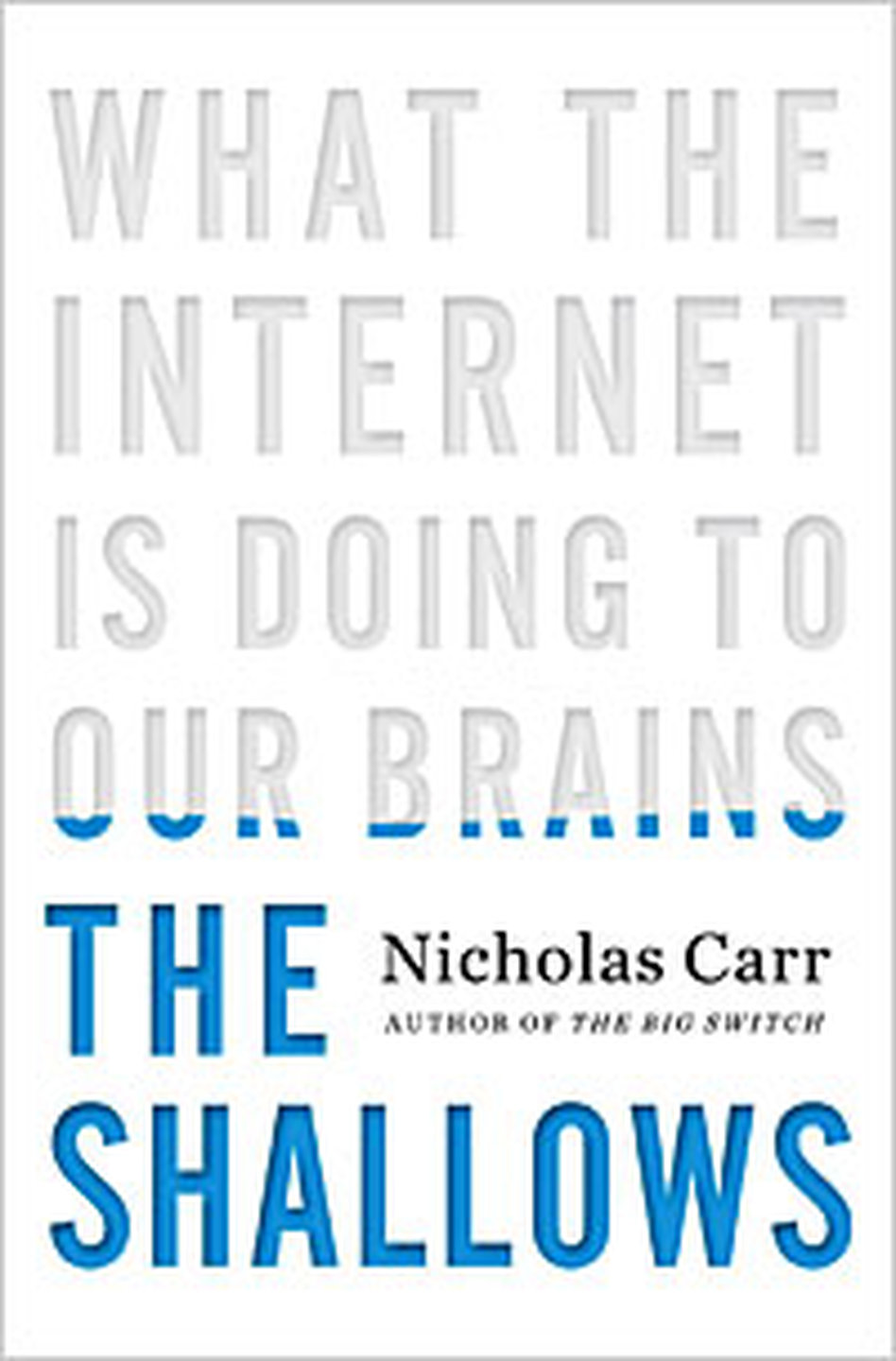
I am encouraging whoever I talk to about this issue to read The Shallows by Nicholas Carr. (About the book, Michael Agger at Slate wrote, “Nicholas Carr has written a Silent Spring for the literary mind.”) What I like is that Carr writes about how we have choices in how we use this technology. It sounds like if we step back, slow down, unplug, and act consciously, we can reclaim what is being lost as we click and click and click without thinking.
I apologize if I sound evangelical, but this seems very, very important, and I am just waking up from an unintentionally self-imposed nightmare, and I must talk about it.
According to an article on the NY Times, pediatricians are poised to become advocates for reading to babies. This movement aligns with what I’m reading in Nicholas Carr’s book, The Shallows. Specifically, from the NYT article:
With parents of all income levels increasingly handing smartphones and tablets to babies, who learn how to swipe before they can turn a page, reading aloud may be fading into the background.
“The reality of today’s world is that we’re competing with portable digital media,” said Dr. Alanna Levine, a pediatrician in Orangeburg, N.Y. “So you really want to arm parents with tools and rationale behind it about why it’s important to stick to the basics of things like books.”
Right on, Dr. Alanna Levine. Right on. This is also why we need to keep supporting libraries, by the way!
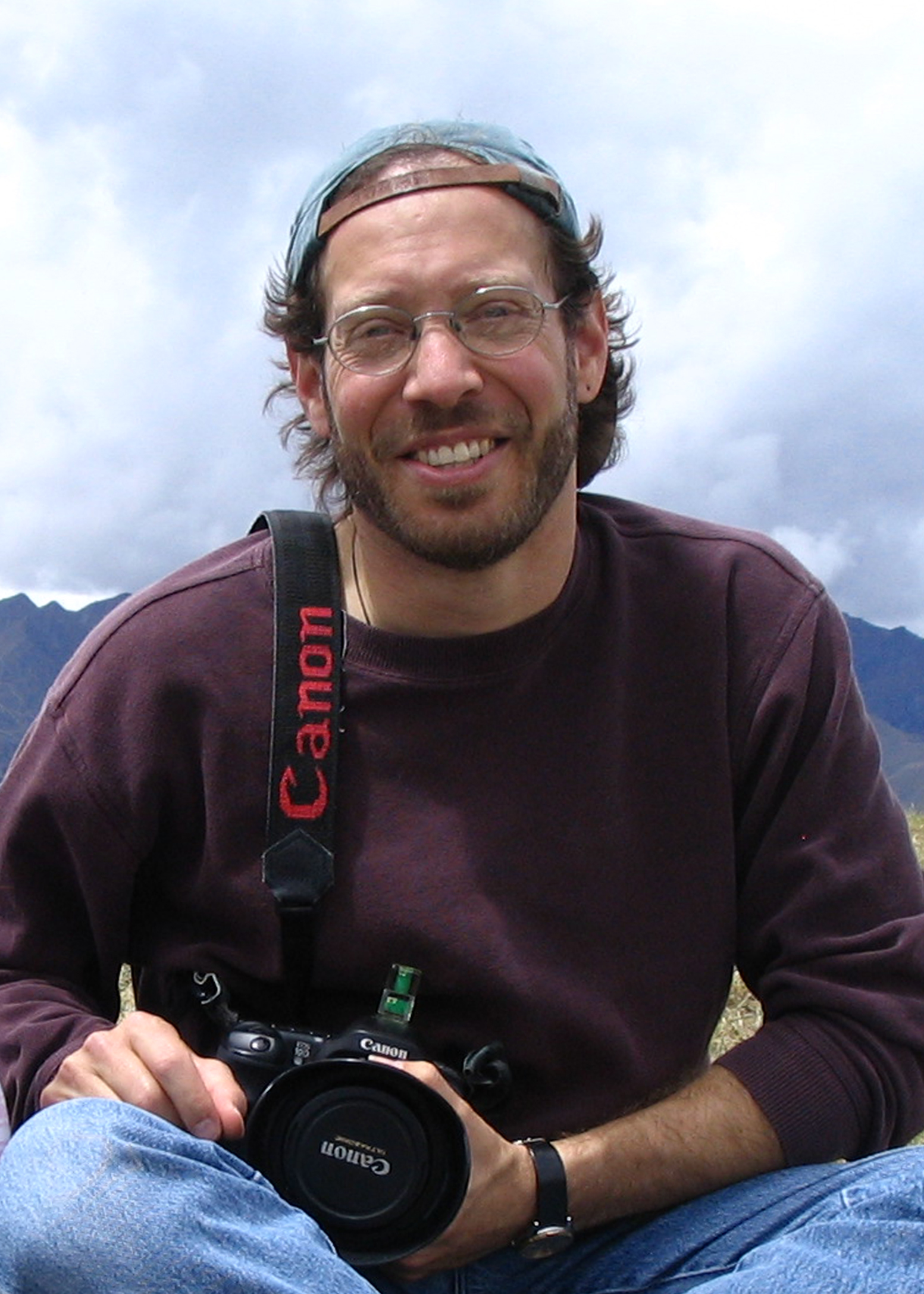
[For this post, I’m pleased to welcome the writer David B. Coe as my first guest blogger. David is among my favorite colleagues at the Antioch University Midwest Individualized MA program, where he works with graduate creative writing students. He’s a wonderful guide; I always learn something when I witness his interactions with our students. As part of his blog tour for the forthcoming A Plunder of Souls, he graciously agreed to write a post about something that new (and maybe most) writers feel pressure to do: build a platform. Here, David reflects on the oft-heard edict “Thou shalt build a platform!” from his perspective. —Rebecca Kuder]
David B. Coe:
This post grows out of an online conversation I’ve had with a student I’m mentoring. She is earnest, hard-working, and talented, a combination that bodes well for her ultimate success as a professional writer. I fully expect that she will be published before long.
She has spent part of this summer revising short fiction that we worked on last semester, and building what is commonly referred to as “a platform” for her future promotional efforts. She has been setting up accounts on Twitter, on Facebook, on Pinterest, on Google Plus, and also maintaining a blog. I’ve tried to be encouraging as she develops her social media identity and online presence, but I have also wanted to temper her ambitions in this regard with a bit of reality based in my own experiences.
As an academic exercise, I believe that maintaining a blog and experimenting with online accounts and social media is a worthy endeavor. In the long run, I’m hopeful that her efforts will pay dividends. She’ll be published someday, and then she’ll need that platform. In the short run, writing her blog, generating content on a weekly or even daily basis is great training for a writing career. Writers need to be creative on demand; it’s part of the job. Committing to a blog can be terrific preparation for the future to which she aspires.
But she is also reading a couple of books that I fear might be misleading her somewhat. The authors in question claim that aspiring writers should set up their social media/blogging platform so that it can be a foundation for future writing success. I believe they have this backwards. The fact is that for most writers, building any sort of audience with social media and blogging is next to impossible until they have work that has been published. Yes, there are examples of people who have built audiences for themselves with their blogs and THEN published. A couple of the more prominent authors who have done this happen to work in speculative fiction, as I do. But these authors were able to establish themselves as unique voices in what we used to call the blogosphere. They found niches for themselves and took full advantage of doing so, parlaying their fame into successful careers as authors of fiction. Put another way, they were exceptions to the rule.
I would never say that she cannot follow a similar path to success. For all I know, she will be the next exception. But I do feel obligated to say—if for no other reason than to be a corrective to the books she’s been reading—that the odds against such a path leading her to the career she envisions are steep indeed. She (and other aspiring writers) should not be discouraged if she doesn’t gain much traction with her fledgling blog, at least at first. I have never found much of a following for my own blog, and I had several novels and stories already published when I launched it.
There is a tremendous amount of content being generated each day on the web. Blog posts, Facebook posts, Tweets, etc. All of it matters to someone, but taken together it is all so much noise. Making oneself heard above that din is difficult for the best known author. For a writer who is just starting out, who has no name recognition, it’s next to impossible. If there was a secret formula to finding the perfect blogging voice that would enable a writer to stand out from the crowd, I would surely NOT tell any of you about it. I’d be using it myself! But alas, no such beast exists.
So what is an aspiring writer to do?
Write, of course. I have encouraged my student to continue her online work for now, to use the summer to set up her platform. But I’ve also warned her not to expect too much from it. And more to the point, I’ve advised her not to let blogging and social media keep her from more important things. If it comes to a choice between writing fiction and writing her blog, she should choose the former. Every time. I have seen too many authors become so obsessed with writing blog entries, so determined, beyond all reason, to post X number of times per week, that they completely lose sight of their fiction — you know, the stuff that might actually pay bills someday, the stuff that we care about so much it keeps us up nights wrestling with plotting ideas, the stuff that, more than likely, got us to start blogging in the first place.
I know what the books my student is reading are telling her (or at least I can imagine). But those authors are offering their advice with an ulterior motive: doing so enables them to sell their own books. For any aspiring writer, her fiction, her family, her health and sleep, are all WAY more important than building a platform. Trust me on this. Once an author has completed that first sale and can start to publicize something specific, she will have plenty of time to build a platform. That’s how I have approached the construction of my own platform, the end results of which you are welcome to view using the links below. (And yes, I’m aware of the irony . . .) But she should be in no rush; in case you didn’t know, the publishing industry takes its sweet time getting books out.
To repeat: As an exercise, for the purposes of familiarizing oneself with blogging and social media, doing this kind of work for a time makes all kinds of sense. But then get back to the stuff that matters: your fiction. And don’t sweat the rest of it too much. It’s just not worth it at this stage of the game.
*****
D.B. Jackson is also David B. Coe, the award-winning author of more than a dozen fantasy novels. His first two books as D.B. Jackson, the Revolutionary War era urban fantasies, Thieftaker and Thieves’ Quarry, volumes I and II of the Thieftaker Chronicles, are both available from Tor Books in hardcover and paperback. The third volume, A Plunder of Souls, will be released in hardcover on July 8. The fourth Thieftaker novel, Dead Man’s Reach, is in production and will be out in the summer of 2015. D.B. lives on the Cumberland Plateau with his wife and two teenaged daughters. They’re all smarter and prettier than he is, but they keep him around because he makes a mean vegetarian fajita. When he’s not writing he likes to hike, play guitar, and stalk the perfect image with his camera.
http://www.dbjackson-author.com
http://www.dbjackson-author.com/blog
http://www.facebook.com/dbjacksonAuthor
http://twitter.com/dbjacksonauthor
http://www.goodreads.com/dbjackson
http://amazon.com/author/dbjackson
The other day, I extricated myself from Facebook. Quitting Facebook has been on my mind for a long time, and I’ve been brewing a sort of confessional essay about why, but that’s still brewing. (In the previous sentence, I first typed, “Leaving Facebook…” but thought it was more apt to say “quit” because I don’t know if it’s possible to leave a place that isn’t a place.)
I’m using an addiction metaphor, which in my case fits. Facebook—which an aged relative erroneously but aptly once referred to as “Fishhook”—has become too visually and mentally noisy for me. I can’t be a casual/social drinker there, can’t (or haven’t been able to) limit myself to checking occasionally and not over-partaking. My time on Facebook leaves me feeling unbalanced and drained, hung over. As well, I’ve been reading The Shallows: What The Internet Is Doing To Our Brains by Nicholas Carr (which comes in the midst of my extended rumination about managing distraction in the digital age, reading David Ulin’s The Lost Art Of Reading: Why Books Matter In a Distracted Time, etc…) and I’m convinced that I need to step away from my unthinking daily dips into social media. I don’t like who I’m becoming over there. What I really hope to do is train my brain to focus and sustain a long narrative again, a.k.a. read a book, and, let’s say, write a book, without feeling constantly distracted.
I have lost count of how many people have told me they can no longer read a novel. People who used to be novel-readers and novel-lovers. It’s starting to really scare me, because reading fiction makes us more human.
Why did I finally quit Facebook the other day? A dear (actual, real-world) friend posted something that jumped the shark for me. I don’t blame her, and I don’t judge her. But when I saw her post, I thought, “Okay, I’m done!” I have yet to thank her, because I don’t know how to frame that thanks, but she inadvertently helped me hit bottom (to continue the addiction metaphor). So in a perverse way, I’m grateful to her. It was clearly my time. The post gave me an excuse, and a decision.
I feel a need to make a public confession about my addiction to Facebook, and my quitting, so that I am held accountable. So that if someone sees me at the virtual bar, they can call a cab and send me home. I hope that having witnesses will help me self-regulate. (If you are reading this, thank you.) It’s similar to how my “Hang Up And Drive” bumper sticker keeps me from answering the cell phone (or I risk being a hypocrite!) when I’m on the road.
I want my brain back. I want to believe my brain is plastic enough, and my will strong enough, that I can regain what really matters to me. There are many things I love about Facebook. That’s the problem: Facebook is too many things to me. It’s postcards from friends, pithy humor, relevant professional and personal articles and shares, community bulletin boards, event announcements, messages, a constant party, more. It’s an accumulation of “Likes,” ego strokes when I post something celebratory or clever. I will miss these things. I have noticed many events are no longer posted on websites or in newspapers, but only on Facebook. I will miss some events because I won’t be there. I hope my friends will still find me in other ways, will still include me. Meanwhile I resume the quaint practice of joining email lists rather than “Liking” Facebook pages.
One prompt for my desire to quit Facebook last fall when I read Kathryn Schultz’s article about Twitter. She discusses how a writer needs to sustain attention, and needs the cave of isolation that is writing a long narrative. In the article, Schultz writes:
I began this piece by noting that writing my book involved spending four years in a figurative cave. In my experience, and the experience of most writers I know, that cave is the necessary setting for serious writing. Unfortunately, it is also a dreadful place: cold, dark, desperately lonely. Twitter, by contrast, is a warm, cheerful, readily accessible, 24-hour-a-day antidote to isolation. And that is exactly the issue. The trouble with Twitter isn’t that it’s full of inanity and self-promoting jerks. The trouble is that it’s a solution to a problem that shouldn’t be solved. Eighty percent of the battle of writing involves keeping yourself in that cave: waiting out the loneliness and opacity and emptiness and frustration and bad sentences and dead ends and despair until the damn thing resolves into words. That kind of patience, a steady turning away from everything but the mind and the topic at hand, can only be accomplished by cultivating the habit of attention and a tolerance for solitude.
I am intentionally conflating my Facebook with her Twitter because Facebook is the social media platform to which I have given my time and energy, and it’s a true equivalent for me. I keep coming back to the idea of “a problem that shouldn’t be solved.” There’s an echo of Orwell’s cave in Schultz’s cave: she describes it as“the necessary setting for serious writing. Unfortunately, it is also a dreadful place: cold, dark, desperately lonely.” In Orwell’s cave, from his essay, “Why I Write,” “Writing a book is a horrible, exhausting struggle, like a long bout of some painful illness.” A human may not want to subject herself to such a place, such an illness, but if she wants to write a book, it must be done.
Schultz’s “problem that shouldn’t be solved” is also echoed in how I am raising my daughter. I am not here to solve the problem of my child’s boredom. No parent (no pacifier, no gadget) should be. Boredom is necessary for human development, problem-solving, and building anything based upon imagination (which I think encompasses most of living, actually). Boredom is another problem that shouldn’t be solved. With a creative mind, boredom solves itself. Boredom is necessary for writers.
We have a choice. We can accept or reject the stew, the default happy meal of overwhelming information to which we have access, and which we now assume is normal and somehow sustainable, and which we assume will somehow sustain us. I’ve been inadvertently assuming this too long; I don’t like this soup. I need other nourishment.
While I experience my detox from that part of my digital click-diction, while I brace myself against the tremors, likely you readers of my blog will be subjected to more about the transition. Perhaps I add to the noise and the too much, here on my blog. I hope you’ll bear with me.
If not, at least maybe you’ll read my novel someday.

I just wrote a note to one of my students, and thought it blog-worthy. I don’t think you need any back story, except that my student is writing a novel and the protagonist has some things in common with the writer, both having lost a beloved. Here’s what I wrote:
If you are comfortable with it (or maybe even if you’re a bit uncomfortable–stretching is really important!), spend some time reflecting on paper about your experience and how it might shape your approach to the protagonist’s loss. I think acknowledging this will be a way to make the protagonist’s story deeper and more authentic. (Do you know about method acting? It’s the parallel that comes to mind right now–where an actor accesses past experiences and emotions to help portray a character. In a weird way, this is similar. I think about this a lot as a writer, and do it fairly often, sometimes without realizing that’s what I’m doing.) I would really like to see this in your proposal. This linking who we are as humans to who we are as writers is the kind of reaching and growing that seems very appropriate in a graduate level writing program.If you were to sort of skirt around it or not really “own” it, it might not get to the richness that is possible by owning it.
Joan Didion gets at a related something in her essay, “On Keeping A Notebook.” Didion writes, “I think we are well advised to keep on nodding terms with the people we used to be, whether we find them attractive or not.” Otherwise, as she goes on, these former selves tend to haunt us.
And as usual: I need to follow my own advice.
I’m happpy to announce that my story, “Rabbit, Cat, Girl” was accepted by Resurrection House for XIII. Here’s something about the anthology XIII from the website: “When Mark Teppo, the founder of Resurrection House, acquired Underland Press, he wanted to start numbering the titles that would be released under the new imprint. Before doing so, he wishes to acknowledge and celebrate What Was and What Will Be. “Thirteen” is the first month of a new yearly cycle, wherein the old skins have been shed and the newborns are still learning to walk. “One” and “Three” make “Four,” which is the number of completion, of coming home, and of realizing the form that has been in process for some time. Nothing is true; everything is possible. And the more things change, the more they stay the same. The thirteenth Tarot card is Death, and he is the symbol of transformation and rebirth.
This is the genesis and root of XIII.”
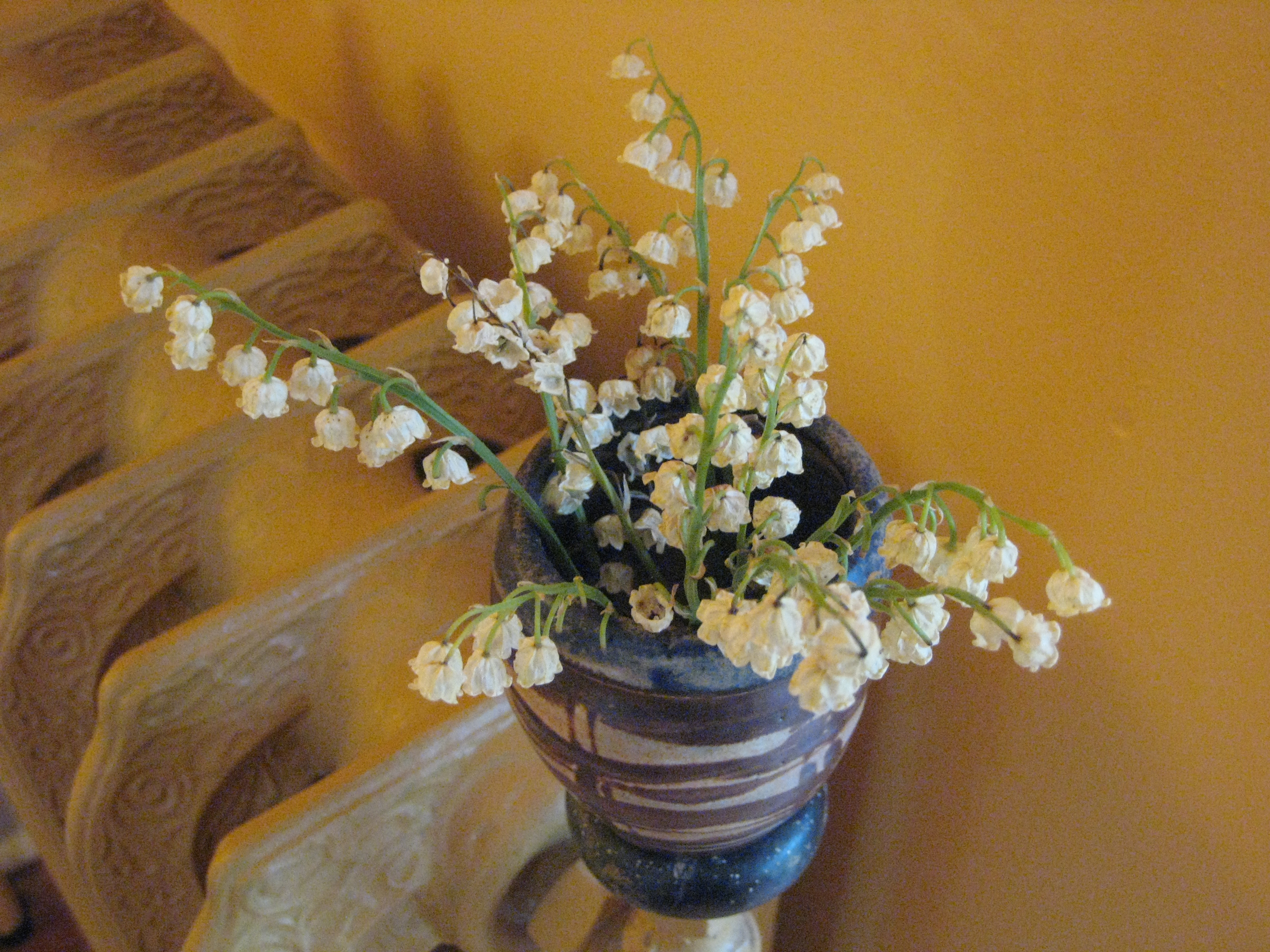
Ironic, to me, that when I heard the story had been accepted, in a vase in my house we had exactly what I describe in the story they’ll publish: “How lovely the lilies of the valley are, dead, brown-edged, drooping in the vase, the stem-slope curvier than when fresh, somehow more truly themselves, more graceful as they relax, tender bells now browning, baby hats tumbling off.”
Here’s another hint about the story. I’ll let you know when you can read more.
I just heard a report on our local public radio station about how a school in Houston is using healing circles to address conflicts.
Houston.
Teenagers.
Healing circles.
This is how to change the world.
 Rebecca Kuder