Now everything (about me and why I care about sentences) starts to make sense…
“Writers who are sticklers for control find the agreeable rigor that punctuation, sentence and paragraph construction impose on unruly thoughts and words.”
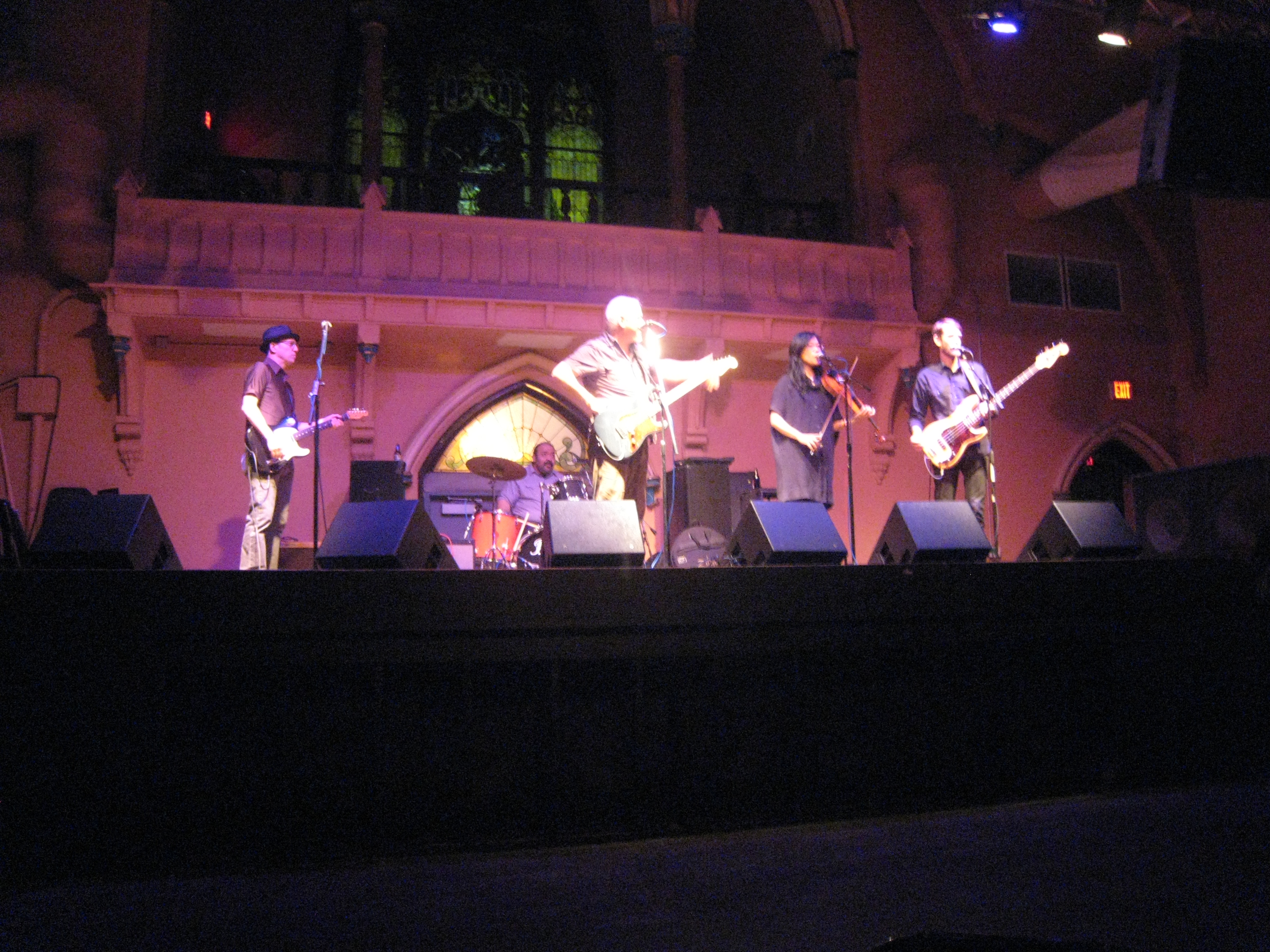
Daniel Knox opening for Langford et al at Southgate House Revival
Before I saw Jon Langford a couple weeks ago at the Southgate House Revival, I had read that Daniel Knox was going to open the evening. I went to Knox’s website to orient myself, but as often happens, I was interrupted before I could listen to anything. The night of the show, I wasn’t paying attention when an unassuming guy walked onstage and sat at the keyboard. I didn’t even notice until he began to sing. His gorgeous, haunting voice rippled among the waves of his musical score, working the tension between fancy croon and despair. Daniel Knox has alarming range in his voice. I don’t know what type of person I would expect to have brought those musical bones to the stage, but the contrast between the guy I saw and the revelation of his music added to the wonder. It was one of those moments of discovery when I learn there’s another entire world that has just casually walked into the room.
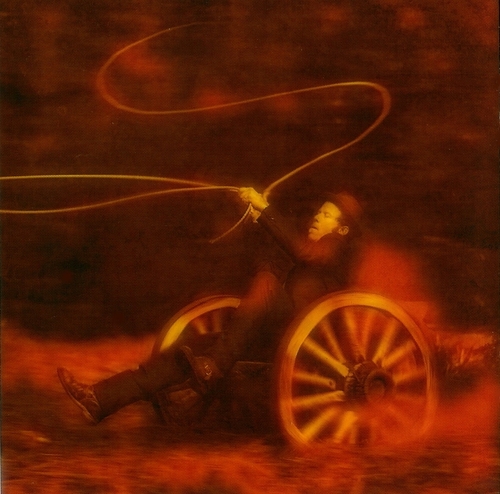
His set in Newport included the keyboard, supported by four overturned milk crates, and himself. After he played, I stumbled over some compliment to Mr. Knox at the merchandize table and bought his CD Evryman For Himself. On the ride home, I read the CD liner notes: Ralph Carney and others play with Knox. (“Ralph Carney?” I said to my husband. I know Carney from his work with Tom Waits, icon.)
The sound of Daniel Knox is theatrical, so I was not surprised to see he has collaborated on stage productions. Some of his songs make me think of Kurt Weill, some of Fiona Apple (Extraordinary Machine is her album I’m most familiar with, but Knox and Apple also seem to share a certain strain of hopeful bitterness), and there’s certainly some Waitsian sounds involved, too. Knox is another of these fabulous interdisciplinary aestheticians, whom, if I were hiring, I would invite to join the IA dream department. After finishing each song, he would toss the pages of music (which I suspect might have been props) to the floor behind him, a floor salad of inspiration.
Maybe because I had no idea what to expect, the milk crates supporting the keyboard added a layer of secrecy to the moment. It was a little like sitting in a basement in college, listening while a friend reads from her journal, finding perfectly-formed gems of humanity inside each line. Knox’s songs are like little sad 70s movies, minimal but complete stories with haunting soundtracks. His work is raw and fragile, but also strong like a metal building, an eternally-surviving frame surrounding a tiny, exquisite flower of pain. I scribbled some of these notes in the semi-dark as I listened, and one thing I wrote (my memory between the moment of going to his website weeks before and being interrupted and that evening at the church was so blurry), was, “and I don’t even know his name—I sat through the whole set not knowing his name!”
There was once a humble Vietnamese restaurant nearby our town. I used to like to get the noodle bowls there. On the menu, with the listing of choices, there was a note: For 50 cents extra, you could order “more interesting vegetables.” I always ordered more interesting vegetables, and although I can’t now recall which specific vegetables came for that half-dollar splurge, the term became shorthand in my house for more interesting anything, usually to do with books or movies or art or people.
Daniel Knox is one of those who deals in more interesting vegetables.
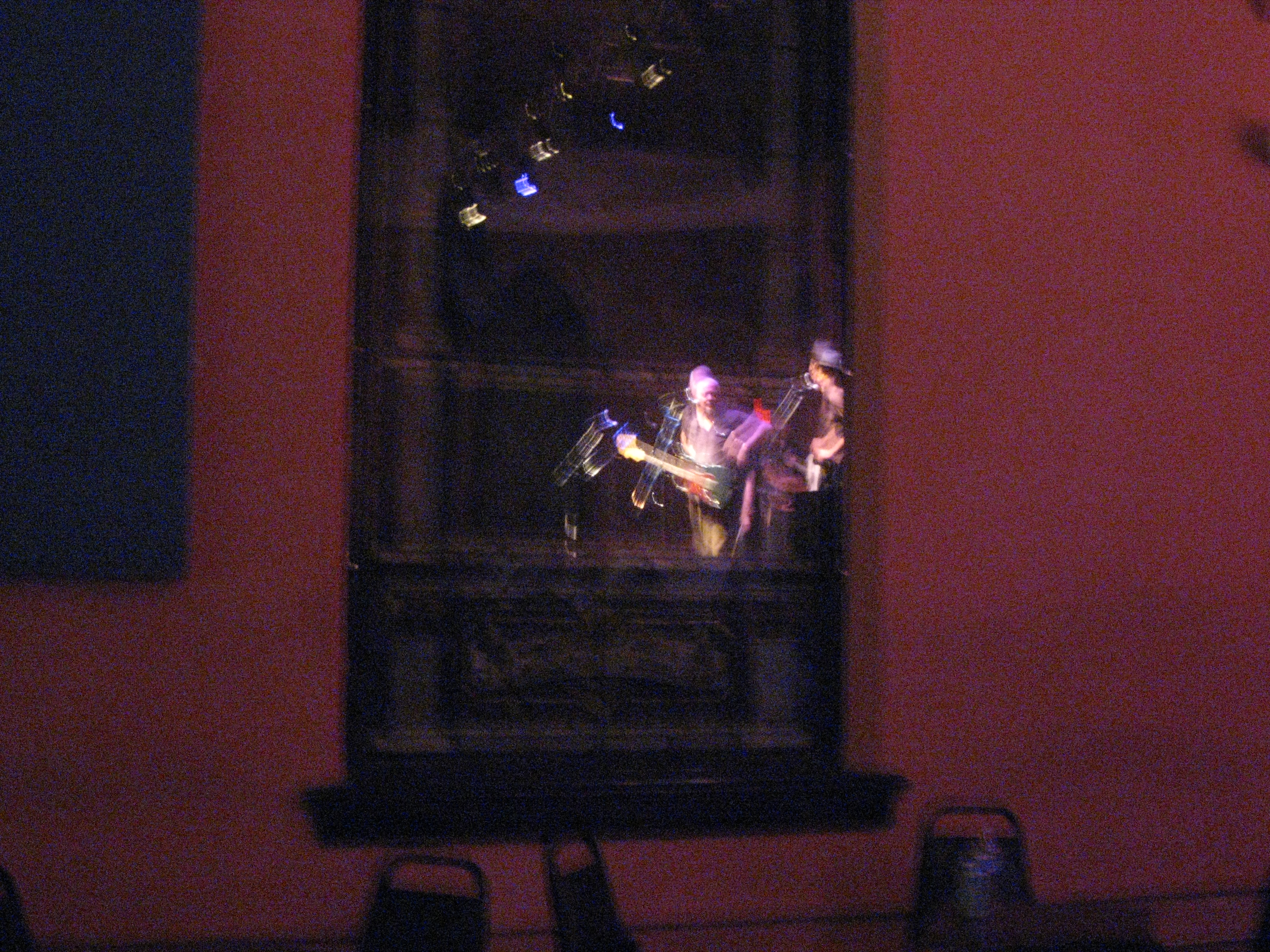
On April 9, I had the pleasure of seeing Jon Langford and Skull Orchard rock the stained glass out of Newport, Kentucky’s Southgate House Revival. (Okay, I’m exaggerating. The windows are still there, or they were when I left the church/club, as evidenced by this photo.)
Jon Langford and Skull Orchard at Southgate House Revival
While waiting for the bill at a pizza place nearby, I worried that by the time we got to the club, it would be packed. When my husband and I got to the church (on time, after all), Langford was in the bar, and we had a moment to say hello and chat. I’ve met him before, and it’s always a treat. Langford is irreverent, generous, and funny, full of the best of what humanity can be.
As an artist, Langford knows about layers. His paintings echo memories of musical icons, ragged images full of heart. Ragged like most adult humans, beneath the veneer. Langford knows there is a crack in everything, and he knows that’s how the light gets in. Doing a Waco Brothers song that night, they were “walking on hell’s roof, looking at the flowers” in a former church, adding layer upon layer. I blogged about Jon Langford and his work another time over here. That night’s was a “small perfectly formed” audience, Langford said. I guess for a weeknight, it wasn’t shocking that the place wasn’t full to the choir loft, but I wish the world were different and I wish that a guy who makes stuff like Langford makes would be valued over, say, (—insert manufactured popular music icon of your choice here—).
It might have been my ears which have been recently more attuned to how we cheat and don’t cheat death, but Langford tapped into something that keeps haunting me lately: We don’t have much time. Do something now. Do something you care about, something you can live with. Drain all the juice, stop equivocating (okay, he didn’t say all that, but he showed it), go. No point saving the good china for good. (I might be imposing ideas from other sources I’m colliding with right now. Like how you see a specific number everywhere, once you start to notice its importance.)
Stained glass window, reflecting.
But it does seem that Jon Langford’s songs are about how to be alive. How we decide to be, while we’re living. They are all about waking us up.
The Newport lineup included Bill Anderson, who I know from The Horsies, which was cool because, well, you can go watch The Horsies here. The cumulative power of the musicians in Newport (Langford, Anderson, Jean Cook, Joe Camarillo, and Ryan Hembrey) created something complicated and rich and decadent and shhh, secretly fragile, because it’s so rare. Whatever you want to call it, it was perfect, the air between those stained glass windows. And we of the small, perfectly formed audience were treated to a kick-ass set, uncensored stories, and other hijinks, perhaps because it was the final show on this part of the tour. The band were like ridiculously talented children, up on stage, playing for sheer fun.
That night felt like the best kind of party, celebrating sound, story, and full-on-why-go-halfwayism, and it’s just the kind of party that spring needs, and that I need, to blow out the cobwebs of winter and remind me that
I
am
alive.
p.s. Daniel Knox opened for Langford & Skull Orchard. The experience of seeing Daniel Knox is another story, which I will write about soon as I can.
Last Saturday, at the Antioch Writers’ Workshop seminar, Paths to Publication, my understanding about the revolution in publishing deepened. The thread through the day showed how the conversation has shifted: even those in traditional publishing now acknowledge (rather gracefully) that self-publishing is no longer simply what we used to know as vanity publishing and that there are about a thousand smart and thoughtful ways to do whatever a writer wants to do. This kind of event—involving agents, editors, and people who help others self-publish—would not have been as collegial and open even a couple years ago. It might have been because the people in the room were generous and respectful of each other, but I also think it has to do with the changing marketplace, and with the idea of literary citizenship.
Presenter Cathy Day teaches a course in literary citizenship at Ball State University. Day encountered the term on Dinty W. Moore’s post at Brevity. Though I’ve been thinking about literary citizenship for a while, and doing my part when I make time for it, the conversation on Saturday opened up how I had been thinking about the quest for a publisher. And beyond that, opened up how I had been thinking about what it is to be part of a literary community, to walk in the landscape of creative writing.
My epiphany, coming after the Association of Writers and Writing Programs (AWP) conference in Seattle (my first ever AWP conference) is interesting timing. I’ve been a lurker in the world of words. Depending on the day and my mood, I blame this tendency to lurk on being an introvert, or not knowing everyone, or not being connected, or being a slow reader, or not having read everything that I know somehow I should have read. (For instance, I feel a sense of shame when I look at the end of Francine Prose’s book Reading Like A Writer where she provides a four page list entitled, “Books To Be Read Immediately.”) At age 47, there are many areas in my life where I have grown comfortable taking charge, and where I feel a sense of balance. Approaching the public with my work is not one of them. But I woke on Saturday morning (before the AWW seminar) with a new clarity: 1) I want my work to be read, and 2) I don’t want to be at the mercy of others to make that happen. I’m not sure what these two facts will manifest. (Stay tuned.)
And as the day went on, I realized that getting published (which sometimes seems like the only thing, as a thirsty plant needs water) is a relatively small part of the work of a literary life. Yes, it’s nice to have recognition, and not to feel invisible. But there’s more to it than that. “Ask not what you can to do get published. Ask what you can do for books,” read Cathy Day’s first slide in her presentation on literary citizenship. A great place to start reframing things…
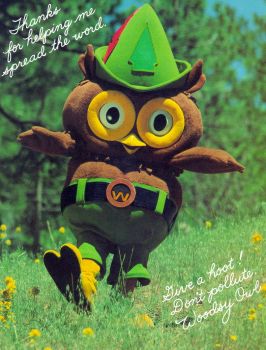
Literary citizenship seems a bit like taking care of the planet. But it goes beyond a literary version of Woodsy Owl’s “Give a hoot, don’t pollute!” It’s not just avoiding throwing a beer can out of your car window, and it goes beyond picking up the cigarette butts you see on the sidewalk. It’s composting, and taking the humus to the community garden. Earnest literary citizenship is a deeper way to care for the environment of books and words, and it is not self-serving, unless we think of maintaining the environment of books as a good thing in itself, and good for us humans (which it is). It’s giving thought (beyond our own writing) to what we give to the world, what we leave behind for future generations of readers…and it’s really about sustaining and contributing to a community.
(“We make the world. We make it!” I wrote a long time ago in a post here. It’s just now sinking in that this applies not just to the world but also to the world of books and words. We have a lot of work to do. I have a lot of work to do. But what else would I rather be doing?)
I’m grateful for all the presenters at Saturday’s AWW publishing seminar for a wonderful day: Jeff Herman, Deborah Herman, Kirby Gann, David Braughler, Steve Saus, and Cathy Day. As often happens at AWW events, early in the day, a sort of narrative thread emerged: Do your work, connect with others, practice the good form of nurturing books and supporting the community of writers, read the small print, you can do anything. Make something happen.
And finally after a long, oppressive winter, it’s spring.
This morning, with my daughter’s school I went to hear the Dayton Philharmonic concert perform several stories, including Peter and The Wolf. I was sleep-deprived, having worried overnight about a very scary situation a friend was going through–a reminder that we don’t get out of here alive. The strains of Peter and the Wolf hurled me back to childhood, and left me tearful…the music (as music will sometimes do) approached me from other human hearts (composer, musicians), reached into my body, held my wrung-out heart, exposing that red and tender mess to music’s melodic touch. Of course I cried.
At the end of the story of Peter and the Wolf, the characters parade to take the trapped wolf to the zoo. “What if Peter hadn’t caught the wolf? What then?” asks Peter’s grandfather.
I cried while I watched the story today in part because a friend from college, the roommate of my college boyfriend, went to the hospital last Christmas day because his stomach hurt. It was stomach cancer. Two weeks ago, despite the ever-youthful impish angel energy he carried with him so beautifully through the decades, after how many rounds of chemo and thousands of people circling him with love and support, he died. (The wolf was not caught. But my friend the imp-angel, in his final months, due to his loving, kind spirit, pulled back together a circle of friends whom I’d missed for years. One bright fact in this horrible loss, the light he shone on us.)
This morning I learned that last night’s freshest reminder of our damned mortality, my friend who I worried about while I did not sleep, might have cheated death awhile longer. This morning I pled in my journal , “Please let him be okay,” covered the page with scrawled hearts, as I often do when I’m wishing, but I might as well have written, more bluntly: “Please let him cheat death awhile longer.”
Each breath cheats death, doesn’t it? As I write this and as you read it, look at the two of us: just a couple of lucky, breathing cheaters.
As a child, the wolf was a scary dark force, who always slinked up at the same point in the symphony, on cue. This morning, watching the Dayton Philharmonic and the Dayton Ballet School amid an audience of school children, my adult mind was able to see a crucial nuance: The wolf is hungry.
The wolf is always hungry.
So hungry, in fact, that she swallows the duck whole. (If you listen closely, you can still hear the duck’s song. That’s called memory, children.)
But what if Peter hadn’t caught the wolf? What then?
When I was in graduate school, I gave a seminar on J.M. Barrie‘s Peter Pan. It’s one of my favorite books, in fact it’s maybe my favorite book, and reveling in the novel’s story and history was a joy. I’ve been waiting until I could read it to my daughter, suggesting it often, but she repeatedly refused. Wasn’t ready, or I was trying too hard. Then someone loaned us an audio book of Tinkerbell stories and I told Merida that we have to read Peter Pan (the original!) before she could listen to it. So a few days ago, she finally relented and we began The Great Book. Now she’s begging me to read more whenever we have time. After I read this passage from Chapter One, we had a funny conversation.
“Mrs. Darling first heard of Peter when she was tidying up her children’s minds. It is the nightly custom of every good mother after her children are asleep to rummage in their minds and put things straight for next morning, repacking into their proper places the many articles that have wandered during the day. If you could keep awake (but of course you can’t) you would see your own mother doing this, and you would find it very interesting to watch her. It is quite like tidying up drawers. You would see her on her knees, I expect, lingering humorously over some of your contents, wondering where on earth you had picked this thing up, making discoveries sweet and not so sweet, pressing this to her cheek as if it were as nice as a kitten, and hurriedly stowing that out of sight. When you wake in the morning, the naughtiness and evil passions with which you went to bed have been folded up small and placed at the bottom of your mind; and on the top, beautifully aired, are spread out your prettier thoughts, ready for you to put on.”
My daughter leaned over to me and said, “Do you do that?”
“By tracing it twice, I fell through the ice of Alice…” –Tom Waits
Today, I went ice skating for the fourth time in my life. The first time was in my late teens, and despite back then being a passable roller skater, my recollection of ice skating was that it was somewhat of a disaster. (After mostly falling, I had no urge to try it again.) Last autumn, when my daughter’s school had an ice skating field trip planned, they needed drivers. I signed up. I was anxious, but thought I would try skating again.
(It was fun! And who knew I’d have the opportunity, at age 47, to revise my long-believed story that I couldn’t ice skate?) I went on a second school skating trip last week, and again, had fun. Both times my daughter skated, she grew more and more comfortable on the ice, as children tend to do when they are learning. (It was odd but also fun to be learning alongside her.) I fell once and hurt my wrist, but not so badly that it scared me off that cold frozen ground.
When a friend suggested we take our kids skating today, I thought, Sure! (Ice skating twice in one week! And with bruises to prove it! I’m starting to feel like a jock.) Today, again it was fun, but alarming (and annoying) how many people had stopped in the flow on the ice, tossing up human obstacles in the way of us beginners. Why had they stopped? Posing for photos or taking photos.
On the ice.
As a novice, ice skating is an activity that forces me to focus on what I am doing at each moment. The present. (Remember that old friend, the present?) On the ice, if I start to have a conversation, or think about something else for more than a moment, if my focus is on anything other than my body and my balance, that’s when I tend to fall. (“To go skating on your name…and by tracing it twice…” sang Tom Waits, about to fall through. More about that song here.)
I love taking pictures; I understand the urge. Like skating, it’s fun. But there’s a balance to be found, especially as a parent. Accumulating roll after roll of photographs, as a new parent I realized I can either take pictures, or I can participate in my life. (Today I wanted to say to the posers and clickers, “Enough with the smart phones and selfies. Enough. Stop documenting and live your life.” But I was polite, and just said, “Excuse me,” as I skated around them.)
Maybe it’s time for a new bumper sticker: Hang up and skate.
When I watch this video of Sufjan Stevens doing his song “Chicago” on Austin City Limits, so many things coalesce for me…semi-obvious things that my friends would recognize as important to me (theatrical performance, my recent interest in wearing wings in public) and also things that no one knows, things that float and soar in the interior of my psyche, blind, nameless things, unnamable things, things that make me do the creative work I do, things that keep my heart beating.
(Sufjan Stevens, young wispy man, young crackle-voice, young echo of Clive Owen…oh, how you would have had me swooning back in those younger years, oh, how you now have me swooning for other reasons, less stirred, more steady…)
Oh, you dark dreams of adolescence that soured as you were neglected, decades later return on such iridescent wings, wings made silently in the caves of my heart, refined and fortified over time, now landing you dreams effortlessly, carrying (still!) you old larval friends, now winged on impossibly transparent magic. Bad metaphors don’t stand up but are somehow sustained by the sound of that old laughter, that trickster, Time. And Breath. And Sufjan Stevens sings:
I made a lot of mistakes
I made a lot of mistakes
I made a lot of mistakes
I made a lot of mistakes
“I love that song,” says my six-year-old daughter, who asked to watch the video on youtube, again.
(Me too, sweetie, thinks her mama, caught, deliciously, between the push and the pull of that trickster, Time.)
Sometimes the gratitude I feel at how wonderful life can be seems impossibly grand, too big for my being to hold. Today has been like that. Just a regular old great day of easy and beautiful moments with friends and family. Pancakes. Bacon. Coffee. Tea. Laughter. Sunshine. Children yelling from joy, clumping up and down stairs. Lights. Mud. The best part is those moments is sometimes their recognition. The wish to mentally store those feeling for the less lovely days when I need a reminder of how good life can be. Days like today reminds me of Leo Lionni’s book, Frederick.
I just read an interesting story about piece of history owned by a psychologist, Dr. Barry Lubetkin, who treats hoarders. From this New York Times article:
“A couple of weeks ago, Dr. Lubetkin was idly trawling the Internet for information on Homer and Langley Collyer, urban hoarders known in the 1930s and ’40s as the Hermits of Harlem.
Elderly scions of an upper-class Manhattan family, the brothers had barricaded themselves in a sanctuary of clutter at the northwest corner of Fifth Avenue and 128th Street.”
Turns out that Dr. Lubetkin owns the face of a clock that his father bought from the Collyers’ estate in 1947. (If you have not heard of the Collyers–and I had not until today–they were Homer and Langley Collyer, who, according to the oracle Wikipedia, “were eventually found dead in the Harlem brownstone where they had lived, surrounded by over 140 tons of collected items that they had amassed over several decades.”)
All this reminds me of a recurring dream. (There are two kinds of people in the world: people who recount their dreams to others, and people who cannot stand it when others recount dreams. If you are from the second category, please stop reading now.) My dream takes place in various settings, but the plot is always the same: I am looking around in a junk shop (or sometimes it’s an antique shop–there is a distinction, in life and in dream logic) and there, for sale, I see the Steiff and Schuco bears and various other toys (most often mohair stuffed animals) from my youth. I always have to buy them back, and it always seems strangely unfair. (And in a weird way, this recurring dream is one of the original germs that started me writing my novel, The Watery Girl.)
In real life, I still have those bears. I used to think I wanted to be buried with them. (I’m not kidding.) Interestingly (to me), lately I’ve been thinking about the difference between collector and hoarder. (There IS a difference, right?) For years now, my bears have been in boxes with the furniture and clothing I collected (and often made) for them when I was a child. Soon, I hope to realize the waking dream I have of setting up a dollhouse for them, so that I can look at them. So that they will haunt my waking as well as my sleep.
(And it’s not a coincidence that I write this post on the day that, at her request, I moved my six-year-old daughter’s dollhouse and all its contents from her room to the attic. She’s not ready to get rid of it yet, but she never plays with it, and wants more space in her room. There is something here. Something about generations, echoes, and ghosts…in finding this article about the clock face, and in my recurring dream plot, and in my writing this post today. Something that I need to mind.)






 Rebecca Kuder