Organizing my readings for fall classes, I picked a file folder from the stack I reuse at home. “Credit card info” was scratched out, and over it, written, in turquoise ink, “Tom Waits.” That’s what it did last time.
Some questions.
How was my life ever that simple? (And is it wrong to have a file folder entitled “Tom Waits”?)
(And what on earth did I file in that folder? Why can’t I remember?)
(To quote Joan Didion, “What kind of magpie keeps this notebook?”)
Last night, I watched “The Future is Unwritten,” a documentary about the life of Joe Strummer. I didn’t know much about Strummer beyond his music, and it was quite illuminating. One thing that sticks with me was when he said:
“I don’t have any message except: Don’t forget you’re alive.”
(And all day, the words from Jon Langford’s “Oh No, Hank!” –from Nashville Radio–have been also going through my head: “He’s somewhere out there, happy and alive.” It adds texture that the corn is actually as high as an elephant’s eye at the moment in my Ohio.)
From both legendary musical sources: Good message. It strikes me that Strummer (and maybe punk rock, and Langford too, while we’re at it, who’s still somewhere out there, possibly happy and actually alive) is/was about nothing less than, essentially, reclaiming humanity.
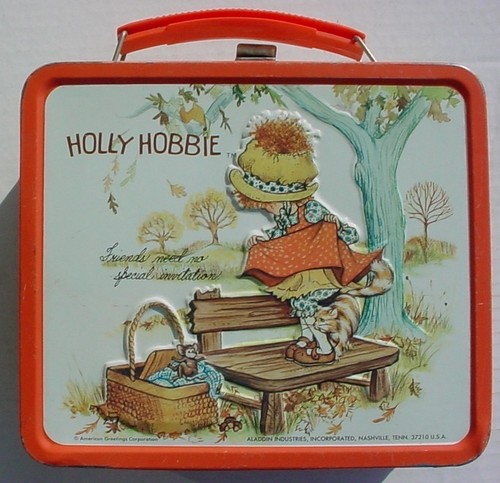
I seem to recall from my childhood Holly Hobbie, and maybe Peanuts…
Packing school lunch is on my mind again. Much less angst this year, in part because my daughter’s taste in food has recently expanded to include much more variety–even salad! Things mixed together! Maybe making lunches will be easier this year. Here’s what I wrote on the topic last fall, from much shakier ground. Enjoy!
**
Breast-shaped lunchbox
(September 11, 2012)
My four-and-three-quarters year old only child needed a lunchbox. She had been in half-day Nursery school the previous year, but after I got full-time work, my husband and I decided to enroll her for full days. She was fine with this plan, excited. (After the first year’s welcome picnic, she had said about her school, “I want to live here.”) But for several days after we had made the full-time decision, I felt trapped and agitated, grieving the loss of the era when she wouldn’t be in school all day. When I mentioned this to friends at the swimming pool, they recognized themselves in me: the anxiety more about mother than child, about my hesitation to let go.
When our daughter was a baby, our decisions about how to care for her were based on the desire to build a strong foundation of attachment. This included breastfeeding, wearing her continually in soft wraps, and co-sleeping (though sleeping was never guaranteed). After building this foundation, our intention is to encourage her independence, let her risk, and fall, and find her way.
So with full days approaching, it was time to find a lunchbox. My preference was something environmentally friendly, BPA-free (if plastic), easy for her to use, and easy for us to clean. Cute enough that she would be excited about it, but not emblazoned with some over-merchandized character. Goodbye Kitty: no billboard on my baby’s lunchbox. This increasingly mythic lunchbox would be an adventure. The container itself would reveal a culinary wonderland, encouraging my daughter to finish every morsel from each charmed and airtight compartment. Lunch would be a treasure hunt, and she would find delectable whole food gold and pearls. I got on the Internet.
A system! Yes, a system, with snap-on lids and stackability, a perfect feat of modern hipster design that would keep yogurt from spilling and keep fruit fresh and gorgeous. Controlled and tidy! No mere lunchbox, but a sculpture, a work of art, something beautiful to cradle the nutrition within. I would figure out how to make the magic food later.
I posted a Social Media status plea for advice. Friends responded with links; I moved through screen after screen of rainbow-hued vessels. The photographs made everything look smart, sassy, and simple.
I know this quest is a luxury. We have food to nourish our healthy child; we have a healthy child to send to school. Still, the iconic notion of LUNCHBOX so overwhelmed me that I did what I often do: procrastinate. I enjoyed the dregs of summer, went to the beach, and swam in the ocean with my family and friends, who told me to relax, and that every child leaves most lunch food uneaten.
A couple nights before the start of school, as my anxiety about my daughter being away from me for the bulk of her food day crested, remnants of Hurricane Isaac were approaching Ohio in the form of potential rain–desperately needed during our drought. (Yes, please, it’s dry up here, I thought, though I hoped storms would not disturb our sleep.) At bedtime, I talked with my daughter about the rain, which I’d accidentally referred to as “storms.” I got the Peters Atlas Of The World to show her how far Ohio is from Louisiana. As she paged through the color-coded thematic maps, with data about religions, illiteracy, and adults-to-children ratios, I explained that each map is a picture of the world.
“The whole world?” she asked.
“Yup,” I said.
On the map of the United States, I showed her the two-day, twelve-hour drive we’d taken from Ohio to the beach in North Carolina, represented in about one centimeter on the map. I saw her seeing how big the world is. I saw her world about to get bigger with the start of full days at school.
The next day, slightly frenzied, I bought a BPA-free sandwich box with a built-in ice pack, so whatever we sent with her would not spoil. Now I see the wisdom in the bento box–smallish sections for each snack-sized food. (I know my child is a grazer, and sensible enough to eat something rather than pass out on the playground. In the days of her early meals, she would toddle past the table as my husband or I held out a spoon. She would take a bite. We referred to this as street food.)
I talked to another writer, a sagely parent of older kids. I mentioned that my child, my infant, had begun full day Nursery school.
“Is this the first time she’s had lunch at school?” he asked.
“You hit it!” I said, and explained my dilemma. “So I’m writing an essay about it,” I said.
On the first day of school, my daughter ate one bite of her sandwich, and a few grapes. As usual, she ate the school snacks (crackers, chips, and fruit, but never the cheese, because it’s not our cheese). She had a walnut-sized piece of what our family calls “sticky food”: a homemade granola bar, made from tahini and other healthy stuff.
On the second day, she told me she ate a few bites of her fritter (an egg and cheese pancake with cinnamon, paprika, and turmeric, which has been a staple throughout her solid food-eating life) but when I unwrapped the foil, I saw no missing bites.
On the third day, I sent less food. She ate no green beans, but she ate grapes, and half of the one fritter I had cut into small pieces.
In the dark night, I realized that the child from my body, who still breastfeeds (ritual, nostalgia for the days when breasts yielded meals) was starting to experience the expanse of that map-centimeter’s journey, how the map is really so much smaller than the world. She would be thrilled with a Hello Kitty lunchbox. But from the center of my body came the urge to pack the whole of my nurturing into her lunchbox. That lunchbox would have to be bigger than the world. But even a breast-shaped lunchbox could not contain the complex, flawed, sometimes rejected and ignored nutrition of my love.
As my body navigates this maternal threshold, the things I am not doing become as important as the things I am doing. Inaction becomes action. I remind my body it doesn’t have to dash from work to make eleven-thirty pickup time. I know that I will miss big moments, maybe her first crossing of monkey bars. There is heartbreak. I cannot cook her lunch every day anymore, making sure everything on the plate is crisp; I cannot nag her, midday, to sit and eat.
The loss of control feels like a full force gale. Wanting her to soar and not wanting to let go, the mind battles the body, and usually wins, knowing that for her to grow and thrive, she needs me to let go.
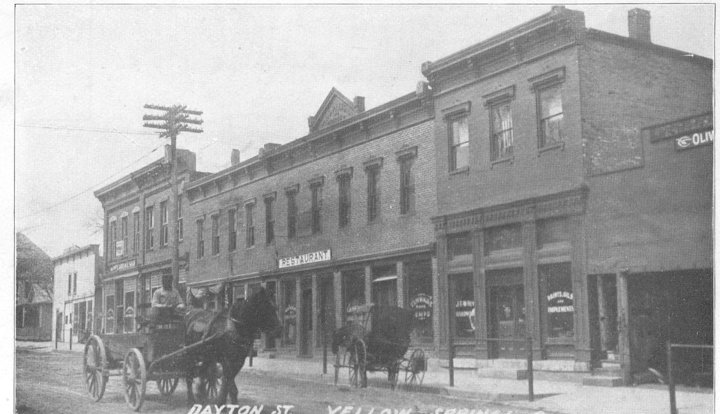
I grew up in a small town. Though we had our quirks and craziness, and we were not immune to death and grief, the town felt safe when I was a kid. It has felt safe to raise a kid here, too, and I am grateful to live in a true community, where people see each other, pay attention, and in the ways we can, take care of each other. Having moved within walking distance to town, this summer, I was looking forward to echoing my own childhood: biking with my kid, hot afternoons at the swimming pool, soft serve ice cream, fun. This sense of safety in my own town (yes, “my,” because I have a sense of investment and ownership in this place) is a cozy blanket I’ve enjoyed, and taken for granted, most of my life.
But since June, my security has been rocked by several situations that leave me feeling vulnerable. I think back to the moment of Truman Capote’s “nonfiction novel,” In Cold Blood; I think back to the moment when people began locking their doors.
Earlier this year, there was a rash of burglaries that had many in Yellow Springs feeling vulnerable. That situation ended in the arrest of a troubled man who grew up here. Add the accumulation of things that is making me feel vulnerable this summer:
1. On June 12, someone sprayed undiluted herbicide on the grass at the pool, opening a controversy in our small town that is still going on;
2. On June 27, reportedly, someone with a gun was seen near the outdoor education center at Glen Helen where my daughter had been a camper earlier in the summer, which turned out to be a hoax reported by a camp counselor, who was then put on administrative leave;
3. On July 11, a local man attempted suicide, which resulted in a police search and brief lockdown of my workplace during the Antioch Writers’ Workshop;
4. Last week, another local man, allegedly pissed off about the potential for a farm lab at Antioch College, threatened to shoot the members of the Village Council and was arrested (sorry, I couldn’t find a link to this story);
Notice: four of five of these summer situations involve guns, or the idea of guns. Big deal, right? This might not sound like much to people who live in larger cities, or dangerous parts of the world. For a town with population under 4,000 people, however, these are big, and rattling. I know people live (and even thrive) in war zones. But this summer’s accumulation of trauma in the village, the pile of things that shake our sense of safety, is palpable. It takes brute effort not to pass my worry and fear to my five-year-old daughter. (Oh, and, nothing to do with guns, but two difficult events this summer: 1. Camille Willis, Yellow Springs resident and mother of my dear childhood friends–and a second mother to me–died very suddenly during the second week of June. No gun involved, but the loss is central in wobbling my feeling of home, and safety. 2. Jimmy Chesire, beloved T-Ball coach, had a serious head injury. Luckily, he is healing well, and so there’s some bright spot in that fact.)
When I think about where to focus efforts for controlling the proliferation of guns, I don’t even know where to start. I know we also need deeper support for people who are afraid, for people who are in (mental, spiritual, emotional, physical) pain. I know it’s more complicated than “guns kill people” but I also know that if it weren’t so damn easy to get guns, guns would kill fewer people.
I’ve been brewing a blog post about this soup of summer grief. Today, after the latest event, I am sad and ragged. Sad and ragged for all the people who’ve been hurt and affected by these situations. I wish the bubble were sturdier.
The other day, for some reason I remembered Wishbone Russian dressing, which was my favorite when I was a child. Trying to recreate it, it occurred to me to use my friend Meui’s heavenly smoked paprika. What resulted is not quite Wishbone Russian, but much better in some ways, and I’m still experimenting.
I used a regular teaspoon, not a teaspoon measure. And you can make extra–it keeps well in the refrigerator.
With a fork, mix smoked paprika and honey and rice vinegar. Add olive oil slowly, whirring with a fork until it emulsifies. Add salt and pepper. Drizzle over salad greens and toss.
(To go for the Wishbone Russian flavor, I keep thinking it might benefit from celery seed, which I do not have in my spice cupboard. Or maybe I’ll use lemon juice instead of vinegar. Or maybe add some fresh tomato juice. Next time!)
Here’s a found poem, found in that I found this written in my Antioch Writers’ Workshop notebook from July 12, 2010 for my graduate school mentor, the novelist Jim Krusoe. I wrote this almost-poem in a morning class three years ago, before I learned more about how people write poetry, but today something about it seems quaint, and worth reiterating, so I am posting it. Bad poetry, admittedly, but its DNA is true.
Editing (for Jim Krusoe)
You said,
“Start here,”
lopping several pages
from the front of my story
like a severed limb
I had muscled
and exercised,
polished, toned.
The thing
(the now-partial body, I thought)
stood there.
I thought I saw blood–
not a Monty Python spurt,
but a trickle.
But I was wrong.
There was no blood.
It was a good cut, the right cut;
the story stood stronger
without those pages.
Today I have a headache, so I’m indulging in a short, cranky post. (I know my five true blog fans have missed me! Mama’s back!)
Today I heard spoken two expressions that, if I never hear them again, I will never miss. Both were uttered on my local NPR station, one in a national report, another by a local personality. To wit:
1) “(Just about anything)…comes into play.” As in, “That’s when the –whatever idea, trend, or phenomenon, which has nothing to do with a ball or birdie or other piece of sports equipment– comes into play.” I don’t mind sports metaphors per se, but this one is more tired than I am. I never need to hear it again; and
2) “To hang.” This was used thusly: “Hang with your friends…” Call me old school (another once-cool, now-tired label, surely!) but I’d prefer to “hang out” with my friends. I don’t want to simply hang with my friends or my enemies–I would rather not hang at all. I am tired, but I am not so tired that I don’t have the energy to add the short “out” at the end of “hang.” Otherwise, all I can think of is a noose/coming into play, which even on this headachey day has little enough appeal as to be nonexistent.
I’m happy to announce that my novel, The Watery Girl, is among the finalists for the Many Voices Project Prize for prose. Read more about New Rivers Press and the prize here.
I’m happy to announce that my essay about birthing my daughter, “Breeching Protocol,” was published in the latest issue of Midwifery Today (Issue Number 106, Summer 2013). The essay that was published in Midwifery Today was abbreviated, but you can read the entire essay on my website here.
(And may breech birth continue to be less and less of an automatic emergency, and more and more just another way to birth babies. With support and understanding, more breech babies can be born naturally. I know this is true.
For some time, I’ve been wanting to write about why I chose to send my daughter to The Antioch School. I just read a post on Unicyclist.com by Mike Hout about his visit to the school, and am invigorated despite not feeling I have enough time to say all I want to say about the subject. Mr. Hout’s posts from the website noted above are pasted below. As I read through them, I see a view of the school that is usually invisible to me.
Mr. Hout writes:
Wow, what a day off I had today. I have heard about this school many times over the years but not much recently. I used to see them in parades and such 15 or 20 years ago but, again, not much recently. Then this past weekend someone gave me a flyer about the school and the information talked about the use of unicycles in the programs. So, I drove to the school today on my day off to find out more about what was going on.When I pulled into their driveway I noticed their school sign had a unicycle in it. The “o” in Antioch was a wheel of a unicycle and they had a bear riding it. As I parked my car I saw an older garage type building and could see twenty some unicycles hanging from the ceiling. When I went in the front door there were four 5 foot unicycles and a 7 foot unicycle by the entranceway. Then I saw on the wall down the hallway another two dozen unicycles hanging on posts.
They do not have a school principal, they have a school manager. When I asked her who the adult leader was for the unicycles and who taught the kids how to ride……she said the children teach each other! This has been going on for years. Hardly anyone was around as almost the whole school was out on field trips. How about next Tuesday, my next day off? The school manager said 11:45 would be a good time to see them after lunch and during their free time. So, that is the next part to my adventure.
Meanwhile, if you get a minute. Look up the Antioch School in Yellow Springs. They are on Corry Street. Check out their bear riding a unicycle in their logo. Tell me what you think. Are their other schools like this?
Mr. Hout returned to visit, and wrote the following:
one week later…
I went back today and had a great visit. They were outside for about 45 minutes of recess and I was able to ride with nine or ten of them……..and one was on a five foot giraffe unicycle! I saw the bars all along one side of the building. Eighty feet worth of bars!!! And on the end of the building they have some taller bars for the kids to use for the giraffes. They also have a series of poles they ride to and back and forth on. It was all quite amazing.I might as well have been a unicorn. They said over and over comments like “I have never seen an adult ride” and “I cannot believe an adult can ride” and “Your seat is so high….I have never seen anyone with such long legs ride a unicycle” and “How DID you ever learn to ride?”
It was fun to show the teachers the post from chaugsby. They kept saying “Oh Christian! We remember him.”
They have a little narrow walkway around their playground and it is a bit bumpy but it provides a nice challenge for the better riders. Everyone was very welcoming and I hope to go back another time. Maybe next school year as they finish on June 1st and I have a busy May ahead of me.
Then, finally, Mr. Hout writes:
One other interesting thing is how the kids have developed their own set of words to describe what they are doing. When one saw me free mount she said “Oh! You can get on from the air.” Another one asked me if I could just “stay in one spot”. I showed her my idle and she said “Yes, that’s it!” A favorite game was when they would hold a hand together and do the “three leaf clover”….or “the four leaf clover” (depending on how many were involved). These were like pinwheels. And when one gal was riding around on her five foot unicycle she said “you are good enough that you could ride a five footer”. I told her I had a giraffe unicycle at home but it was a six footer because of my longer legs. “Ohhhhh!” she said in amazement.
The story of his visits is part of why I love that place. As a child who went to school there in the 70s (but never learned to ride the unicycle) and as a current parent of a Nursery schooler, it’s funny how normal it seems to me when I see children riding unicycles as part of the normal school day. I love what the unicycle symbolizes for the school. From the brochure posted on the school’s website:
The unicycle, says Bill Mullins, is a natural tool for learning. Riding it is not subject to parental advice or pressure, for the parents can’t ride one. It does require intense concentration and perseverance, but at the same time it offers immediate reward. The child can feel him/herself making progress. It is physically demanding, yet non-competitive. Even children who have avoided athletic activity find themselves mastering unicycle skills.
Everyone at the school who has ever wanted to ride the unicycle has been able to do so. And most importantly, they have taught themselves. The learning triumph theirs, self-rewarded.
I think often about the limits of extrinsic motivation: motivation that comes from outside, vs. inside, the child. The world is full of reasons for extrinsic motivation to seem important. (The word “unicycle” isn’t even in WordPress’s spell checker!) But the fire I want to stoke in my child is her own love of learning, not something I’m imposing on her. There are many ways to foster this natural curiosity and love for learning in a child. And many places to do it. I’m grateful that the Antioch School exists as one of those places where the child’s emerging, essential personhood is more important than how, what, and when we adults think they should be learning.



 Rebecca Kuder