If there’s one thing you can say
About Mankind
There’s nothing kind about man
You can drive out nature with a Mower
But it always comes roaring back again
OPTIMIST:
Splashy and head up
With rain in my ‘do
Why is each new task
A trifle to do?
Because I am living
A life full of dew.
(And I’ll get a blog post out of this yet!)
PESSIMIST:
Misery’s the River of the World
Misery’s the River of the World
Everybody Mow! Everybody Mow!
(Bandana’s soaked, Bandana’s soaked)
Misery’s the River of the World
Everybody Mow! Everybody Mow!
As you five swell followers might know, I’ve been writing an essay about my childhood home that was burned down in a planned fire exercise when I was sixteen. A rabbit figures in the story. Here are a couple of excerpts.
After their pyrotechnic work was done, house gone, I returned to the remnants, stood on the ashes. Near where the shed had been, I found one of my small wool Steiff rabbits, intact, unscathed. A tiny symbol of the phantom limb of home–does keeping hold of stuff I had before the house disappeared stand in for a home? When I hold that rabbit in my hand, I feel something stable and secure, but that’s too simple.
Then later in the essay:
Now I hold the Steiff rabbit that didn’t burn. I imagine again walking across the charred land, finding the thing, the size of a cotton ball, where our garage had been. How hadn’t I packed it? How hadn’t it been torched? I want to touch, smell, hear, see, consume the moment of finding that rabbit.
So telling truth, I pin that rabbit to a velvet board, and into a new ghost story I shove the cute animal, twist rabbits against type, make them sinister, keep writing. Everything must be lit, and burn, then melt, transmogrify: everything must milk and then feed that famished ghost, memory.
At a fabulous Yellow Springs yard sale this morning, I found two Steiff rabbits, and bought the pair for a mere $7. It was like my recurring dreams of finding pieces of my childhood Steiff collection at antique stores and having to buy them back, but in reverse: this morning they were not my rabbits, and I was awake. Now they are on (the one clean corner of) my desk.
Just more evidence that things keep turning and turning, but won’t let us forget: carbon replaces itself, surprises us, and continues to haunt…
I just heard this commentary by Rob Walker on WYSO, our local public radio station. The piece talks about this new notion that in order to be a successful entrepreneur, you must embrace failure as more than necessary: false starts and falls are desirable. Something on which to capitalize, figuratively, and literally (if you can get some speaking engagements out of it, that is.) As I listened, I realized that this kind of failure is what I’ve been doing for a long time, as I practice writing.
Idea after idea, word after word, draft after draft will in some way fail. It will not be perfect, it might not even be good. And yet all these things build up to something, I hope, and get me where I am now. I have a blog. A few lovely people read it. I have gotten things published over the years. I have gotten heartbreaking, beautiful rejection letters (and phone calls!) from agents who adore my novel but cannot envision a way to sell it.
Serious writers know that we must continually fail in order to get something good. It’s interesting to me that other creative innovators are starting to talk about this. Maybe I need to find one of these entrepreneurs who wants to fail fabulously, see if she will love my novel, and publish it.
I’m re-reading and pondering Michael Ondaatje’s book, In The Skin of A Lion. I love this book. For me, this is a book to read again and again, to study and learn from. This novel is an open apprenticeship. Any good novel might be like that: think about which novel yours might be. This one speaks to me.
Tonight, this passage from p. 157 seems like one definition of community:
“Alice had once described a play to him in which several actresses shared the role of heroine. After half an hour the powerful matriarch removed her large coat from which animal pelts dangled and she passed it, along with her strength, to one of the minor characters. In this way even a silent daughter could put on the cloak and be able to break through her chrysalis into language. Each person had their moment when they assumed the skins of wild animals, when they took responsibility for the story.”
"I can't drink this coffee til I put you in my closet..." Kirstin Hersh
Music to shed by.
Like a time machine, Kirstin Hersh’s song, “A Loon,” spins me back to the agitation and healing of the 1990s, perfect soundtrack for peeling off layers of emotional scar tissue.
Anger, barely contained within the sing-song, Hersh’s album, “Hips and Makers,” was a favorite for a certain slice of my therapy. When her song, “Your Ghost” reappeared and began to haunt me recently, I ordered a copy of the CD, which arrived today.
Listening to these songs is like listening to the echo of a loon calling back through the years. I love how opaque and personal some of her lyrics are; we’re invited into her head (I’m butchering the line breaks here, adding breaks to denote pauses in the sung song in “A Loon”):
Some store
I’m not going back there any more
wandered in
don’t think I’ll do that again
no I
don’t think I’ll do that again.
I swear you
look at me cross-eyed and I
don’t know what to do
no I
don’t know what to do
crazy loon.
(Then there’s this mad catharsis in the music, then this quiet little afterthought:)
There’s a room in his pallet
there’s a pillow for his head
sees an offshoot in his bottle
when he wants to see me dead
heirlooms
a loon.
Never thought I’d see that silly grin
never thought I’d see that fool again
never thought I’d like that lunatic.
Nothing left to dance around
what a hero
what a black and blue bird
what a loon a loon
what a loon a loon.
Loons nested on the pond by Med-O-Lark, where I worked as a camp counselor back in those days. Loons only nest on very clean water. Surrounded by teen angst, this loon pond was where I first heard of the Indigo Girls, where “Closer to Fine” and their other anthems blazed across me and rooted into my synapses.
Indigo Girls was for the surface; others helped peel off underlayers. Kirstin Hersh helped. Tori Amos, in “Little Earthquakes,” provided more obvious pumice. Still does, when needed.
Today I’m remembering the Ott Shop in Yellow Springs, Ohio, where I bought Steiff and Schuco bears as a child, and many other wonderful things. At some point when I was grown up, I found this photo in the box of YS News photos for sale, and bought it, and kept it. The little bears are still in my closet, in boxes.
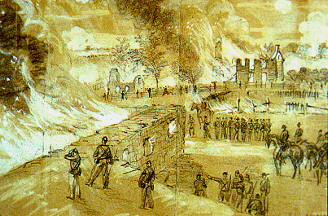
During the battle, the Confederates burnt Samuel Mumma's farmhouse, springhouse, and barn to prevent them from being used by Union Sharpshooters. This on-the-spot sketch was done by the Englishmen Alfred Waud.
Writing churns things up. That churning is one of the most fantastic things about writing, one of the things I love, but it’s not comfortable. Facing things, really looking at things, staring dumbly at things, that kind of minute and honest reflection, can be difficult and unpleasant. You can also find small treasures there. In working on an essay about stuff (literal stuff, the items that tumble from my closet, the towers of papers and important detritus spanning my surfaces) I realized I actually need to be writing about my phantom limb: my childhood house that’s no longer there. It was burned down in a fire training exercise. I’ve written about it in my novel, immortalized it here and there.
This time I decided to write a short story about the house, about a ghost in the house, about the fire…currently, the stuff of the story is a huge mess, but it’s been satisfying to make. Right now I’m just generating words, ideas, the raw junk that I will attempt to shape into a story. It’s all I want to do, but it’s so untidy, so simultaneously new and ancient. Like my surfaces, it’s cluttered, noisy.
Gary Perkins survived the 1974 Xenia tornado by hiding under a desk.
In 1974, I lived in Yellow Springs, Ohio, ten miles from Xenia. One of the worst tornadoes on record hit Xenia that spring. I remember only a few things about that day: hiding under a heavy blanket in my bathtub; a hail-ball the size of a softball (maybe smaller: I was a kid) that kept for a long time in my freezer; the way Xenia looked like a clearcut forest for years afterwards. Even as they recreated buildings, they couldn’t rebuilt trees.
I still live about ten miles from Xenia, a town that has traditionally been plagued by tornadoes. I’ve been processing my fear of tornadoes ever since 1974. They haunt my dreams and fiction. Last summer I wrote a poem (or something that might some day be a poem) about those springs of childhood, memories of many green skies. So, knowing there’d be “weather” tonight, upon hearing a continuous tornado warning siren, I interrupted bedtime reading to take my daughter, who hadn’t napped, down to the basement. I took the flashlight and phone, and my laptop, which is the only source of live information (live streaming TV station audio, as we don’t have cable) and explained calmly why we had to go down there, trying not to scare her. Within a few moments, she said, “I’m afraid!” She seemed to be trying on the costume of “afraid” more than feeling real fear. The storm passed (three-inch hail through Xenia, in fact) and we went back upstairs.
I imagine my fear of “weather” is something like what children of the Cold War grew up with: the duck and cover mentality. (You want to see something interesting, go here.) I need to work it out, find a way to let go of the freak-out while keeping myself and my family sanely safe. I don’t want to be alarmist about green skies. Just because I have a visceral memory of that time, I don’t want to pass it along to my daughter.
In the car this morning, listening to my daughter’s “mixed tape” (a CD, actually) that includes Jack Hardy’s song, “Blackberry Pie,” I got sad again about Jack’s passing. Since he died, I haven’t not been sad about it, but there are moments when there’s an upwelling I can’t ignore or fake my way out of. I told my daughter that it makes me happy and sad to hear Jack’s songs. After she informed me that I should not sing the song because, “I’m Jack Hardy and I get to decide who sings my songs,” we had an interesting conversation about how he wrote those songs, and how they are his, but he also gave them to us, so they are also ours. She agreed.
Here are the lyrics:
Blackberry Pie
i stopped all day to pick wildflowers
down by the banks where the blackberry grows
all in the shadows of the late autumn hours
all in the brambles and the late blooming rose
i picked all of the white ones and picked all the blues
for those are the ones that would go with her dress
and i'll dance tonight, wear holes in my shoes
'til i am the one that she loves the best

(chorus:)
so dally down where the river runs
where the forest bathes the senses clean
dally down where the fiery sun
and the rhythm moon makes a faery dream
and you might think that my heart would lie
that many a girl had caught my eye
but my heart all along belongs to the girl
who baked me a blackberry pie

though i've stayed single all of these years
'tween the twisting rope and the wounding wind
never staying long enough to see the spring
where i had seen the harvest in
and i don't give a tinker's damn for the road
though many they say i'm bound to roam
and i just might be the last one in
though i will be coming home

(repeat chorus)

and many a glass i'll drink tonight
where the wine-red hand is from work or fight
there is no judge more fair than time
for there is no one to change his mind
each time i look in the parting glass
those years that look both ways to know
i'll sing the last song of my youth
but i'll sing it again tomorrow

(repeat chorus)
Today the line, “I’ll dance tonight, wear holes in my shoes/till I am the one that she loves the best,” made me think about writing. About what I’m willing to do, what I even want to do when I write. I am willing, I want to wear holes in my shoes so the thing (the novel, the essay, the story) is good, is good enough. To extend the metaphor, I was thinking an editor might be the “she” in that phrase, but more than that, the “she” is also me. So I’m the dancer, and I’m also the “she” who the dancer wants to impress, from whom the dancer want to earn love. Crazy geometry. An illustration of how Jack’s songs are about so many more things than what appears on the surface. And how they belong to him, but they also belong to us.
And the sadness comes from my pushing against this: I know that no one lives forever, but I always thought he would “sing it again tomorrow.”






 Rebecca Kuder