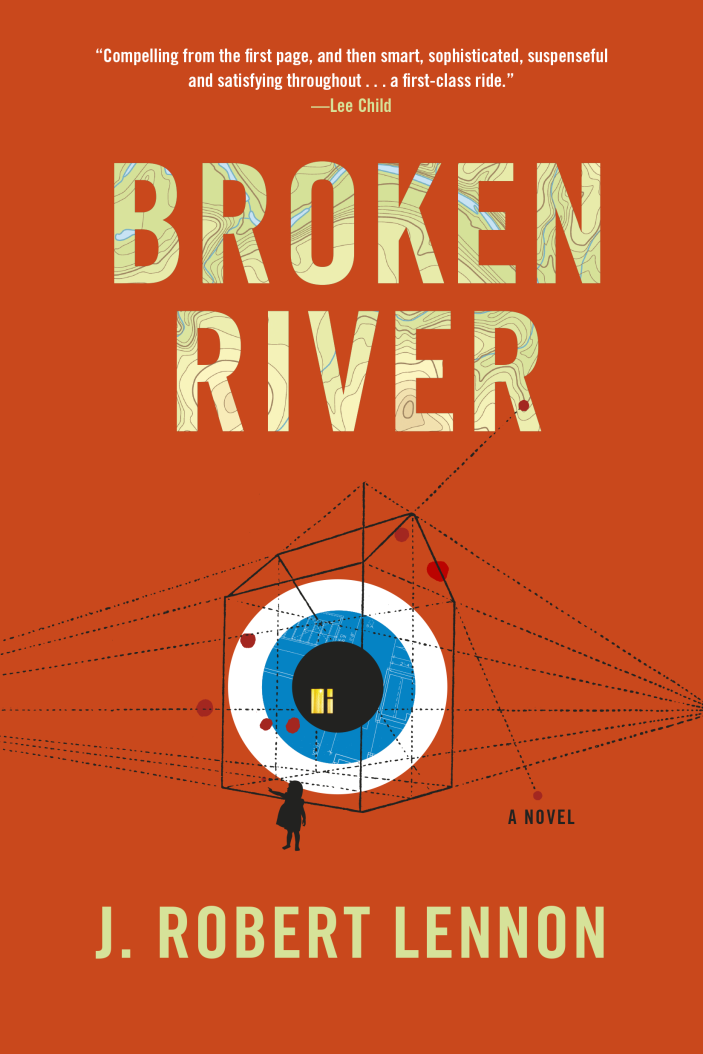
Broken River by J. Robert Lennon

My dear husband recommended I read Broken River by J. Robert Lennon because it features an inventive character called the Observer, and it’s also about a house, and what the house contains. (I’m kind of always writing about houses and what they contain, which is why Robert suggested I read this novel.) The Observer character evolves over time within and outside of several carefully constructed and smartly intersecting narratives. Overall I found the book really well made and engaging. It’s creepy in all the best ways (which is maybe evident from one glance at the cover). I recommend you read it especially if you want to see how someone can make something intricate and also smartly accessible, that isn’t shaped like most traditional narratives.

Here are some bits I particularly love—as is the case often in my posts, these passages are torn from context but maybe that doesn’t matter?—and maybe you will see why I love them. (Also, I have never seen anyone write about those weird tube men, and how brilliantly Lennon does so, below!):

p. 26: “In any case, the identity of, fate of, and story behind the previous inhabitants of the house is something Irena intends to research while she is here. If the results are interesting, maybe she can incorporate them, somehow, into her novel. Because at the moment, the novel has no real plot—it’s just descriptions of things. That’s what Irina is good at. She believes that she inherited this deficiency from her father, who is a visual artist and does not require narrative to make something of value. But if that’s her cross to bear, she will do it stoically.”

p. 118: “The observer lets her go. It is time to turn its attention to the family many miles to the north, though the Observer is increasingly aware that it needn’t choose one time, one place, on group of human being to attend to. Indeed, it is quite capable of observing anything, all things. But it has begun to recognize that its purpose, as opposed to its ability, is limited: or, more precisely, its purpose is to be limited. It is unconcerned with, bored in fact by, the enormity of its power. It is interested only in the strategic—the aesthetic—winnowing of that power.”

p. 119: “Of course the humans die. Quite possibly all of them. Perhaps the Observer will die as well; it doesn’t know, and it can’t imagine what it would do differently if eventual death were a certainty. But the humans, it suspects, know. This is likely why, years ago, at the beginning of the Observer’s existence, the murdered man and woman screamed, even before any damage was inflicted upon their bodies: they were justifiably fearful that their lives were about to end. If the humans know that death is coming (and, by the Observer’s standards, it would seem that it tends to come very soon), their words and actions must all be profoundly influenced by that fact. They fear making wrong choices, so they avoid making any at all. They keep very still, hoping that death might fail to take notice of them.”

p. 158: “Of course Eleanor wouldn’t have it any other way. She is not one of those parents who believes that her child must find a tribe, invest herself in society, hide her eccentricities in an effort to blend into the group—even though these are the lessons she herself was taught, and shat she has historically done, and what, despite her engagement in ostensibly solitary pursuits, she is presently doing for a living. No, what she wants for her daughter is intellectual and creative self-actualization without compromise. In other words: Don’t be like me. Be like your father.”

p. 203: “By hour three of her journey here, her lower back ached with a familiar, almost homey, pulsing intensity that bordered on nausea. She had completed the decrepit-barn-and-speedway portion of the trip and had entered the domain of inexplicable traffic lights, roadside diners, and auto dealerships outlined in colorful flags and punctuated by convulsing forced-air tube men. (She doesn’t understand the tube men. They catch the eye, yes, as only a madly flailing twenty-foot-tall monster can; but who decided such a sight could make you buy a car?) Sewn-on smile notwithstanding, the tube men appeared to her earnestly, even violently repulsive. Turn back, their frantic motions seemed to say. There’s danger here. We’re tall enough to see over the trees, and only nightmares await.”
short stories (what are they?)

I never really learned how to write a short story. Despite reading stories, at grad school I mainly focussed on writing a novel. So I tried to write stories but was never on sure footing.

Since then I’ve written a handful of stories that were published and appreciated. Good. But also kind of accidental.

There are whole discussions and dissertations on the boundaries and features of form, shape, etc. What must be in a story, what makes a story a story. I am not inside those conversations except as a reader and writer (which is to say I’m inside or adjacent to those conversations as practitioner, not scholar). This year I am taking a class with Ariel Gore which is helping me learn my way through and beyond what we have been told we can contain in any piece of writing. Good!

It’s been exhilarating to write stories within the context of hybridity of form—as I become less and less concerned with form. That is, I haven’t had time to fret or really think about whether something is a story or not—maybe being able to call a piece a story is up to me, maybe a vignette can also be a story. I believe it’s helpful to be aware of the rules (though rules can be oppressive, or have histories of oppression). Good to learn and then maybe unlearn. I don’t want or need to adhere to rules that don’t work for me. (Rules such as: a character must have a large or small epiphany, or a story must display a certain shape, narrative arc, or structure.) And so these new things I’m writing (which I call fiction) are free form, maybe free of form. I think I’m reaching back to what my mate and I sometimes discuss in our feedback, “is this a story?” “I don’t know if this is a story.” Does a story need a certain specific ingredients to it to be called fully baked? If I leave something out, or add in something that isn’t on the list, is it still possible that the product will taste good, feed a hunger? If words and imagery and music coalesce into a Something, is that enough? To make a thing that’s a Thing?

What I’m getting at is whose rules are these, and do I really need to abide by them? (The answer is not mine, and not really.) Yes, a story (any piece of writing for others) might satisfy in some (possibly ineffable) way, and might (I hope) contain vibrant imagery, etc. but who says stories can’t be more like poems? Who says a poem or a dream isn’t enough?

I’m deeply interested in this question—especially because I round out a collection of longer pieces that probably pass as stories (in a traditional way)…I’m catching these new little dream-lets, making them into things that (to me) feel like Things. I’m eager to let these new hybrid beings past the bouncer and into the party of my story collection. Why not? It’s a low stakes risk. Maybe the editor won’t like it. Maybe I’ll get a bad review. Who cares, if I feel that the collection, what I am curating, has integrity?

bookmark

Looking for a bookmark last night, I found an index card with a quote on it, from Michael Ondaatje’s In The Skin of a Lion, which is one of my favorite novels of all times.:


“The first sentence of every novel should be: ‘Trust me, this will take time but there is order here, very faint, very human.’ Meander if you want to get to town.”

Despite how elusive achieving “order” feels to me (and despite how much I prefer to just write lyrical ephemera), I want to be able to provide reassurance, order that is at least “very faint, very human” and I want the reader to trust the storyteller/narrator.

I want to learn how. I’m eager to learn how, as hard as it is and as much as (why?) it terrifies me.

At the Hour Between Dog and Wolf by Tara Ison

Cover of novel, At The Hour Between Dog and Wolf by Tara Ison

I had the great fortune to get to know Tara Ison when I was a student at the Antioch Los Angeles MFA program, where she taught. (I’ve written previously here about Tara’s work.) Tara’s classes and workshops were always compelling, as is her writing. Tara’s new novel, At The Hour Between Dog And Wolf is an incredibly nuanced and humanity-deepening book—told through the deceptively simple view of a teenaged girl, but containing the grace and texture of Virginia Wolf…for instance, page 62 begins a stunningly long passage of interiority while the protagonist is sewing, and four pages later we are gently reminded of the work (literally) in her hand with the following, “Or—this has never occurred to her before, the needle paused in the cloth—what if her mother didn’t go Underground at all? What if it was a lie?” This intrusion of the needle in the fabric exquisitely reminds us we are embodied, reading a story that is embodied…simply gorgeous. I didn’t write down a lot because I wanted to give over to the reading.

Tara’s novel contains a modern understanding of trauma and what makes a person do what (some would argue) they must, in order to survive. How trauma and necessity can shift an identity so fully that the twists of what is right and who we are ends up looking like light through a prism…anyway, here’s a passage ripped from context, but to illustrate how powerful, suspenseful, breathtaking is the text:

p. 214:

“Pray, keep the faith. God is with us. Everything will be fine.

But she still always looks out the door, first. There’s that old feeling of an end rushing at her, again, the threat of another, bigger end, the kind that drops from the sky or bursts into your room without knocking, or grabs the back of your head and twists. And though you clutch and squirm there’s nothing to hold onto, no matter how hard you pray you still feel flung through the air and to the ground somewhere else, where nothing and no one is the same, the same is what ended, is gone forever. But maybe if she looks first, she’ll see the end in time, marching up the road toward her. Maybe this time she’ll be able to take the right action, keep it from happening, shut and bolt the door closed. Maybe she’ll be able to keep it from coming in.”

What a fine treasure this book is, and a call through dark times toward understanding of what hatred can yield, and how we might better fight its harms.

Fiebre Tropical by Julián Delgado Lopera

Front cover of Fiebre Tropical by Julian Dalgado Lopera

Fiebre Tropical by Julián Delgado Lopera is amazing. You should read it. Whether you read Spanish or not, the lyric and poetry is resonant…the flow within these pages is so beautiful and real and incredible. The story, the characters, the narrator’s beautiful voice. All of it. Please read this book.

Here are some gems, completely out of context but to show you how gorgeous it is:

p. 144: “How desperate had she become? Nobody in the family wanted to dive deep into her desperation. No one wanted to remember. But if you watched Myriam close for years, you could almost peel the amnesia off her skin, like an onion, layer by layer, until you reached a yellowing coat wrapping her body like a mummy, and here’s where she had stored her gray bitten-down nails, here’s where she stored bruised knees, numb heart, deadly popsicles. She must have been frenetic, manic, sleepless. So hopeless, almost no light shone inside her.”

p. 204: “Alba crawled around the house, close to the floor, recoiling every time she saw men’s shoes, plugging into the dirt, swimming deep in the soil, deeper into the soil, watching some of the horse’s bones go by, skeletons of children, a lost shoe, emeralds gleaming cutting piece from her arms that quickly regrew, she swayed from side to side with her mouth open, eating fresh dirt, swallowing fresh dirt, bathing in its misty coolness.”

p. 252: “I needed a perfect place to smoke the cigarette in peace. I walked past the pool, chasing the disgusting ducks with red balls on their beaks. Patos desgraciados, inmundos asquerosos. What the fuck happened there, Nature?”

p. 272: “We smoked and smoked and smoked so many cigarettes that by eight p.m. I was made entirely of smoke, bones of smoke, skin of smoke, curls of smoke, if someone had blown on me I would have disappeared.”

how to make popcorn

I love popcorn. I make it often. I make really good popcorn. Some of this method I learned from my friend Kassie Maneri. She and her family are expert popcorn makers, one of the million reasons I’m grateful they are in my life.

Over the years I have made a lot of popcorn and honed my skills. Even so, it’s a practice each time to get it just right. You have to pay attention.

Here’s what I use:

  • heavy bottom pan (I use a Revereware saucepan that looks like this. Maryellen (Maneri) says it seemed important to have a loosely fitting lid to let the steam escape. Makes sense!)
  • usually organic popcorn, usually yellow, but white is great too.
  • oil (canola, grapeseed, or coconut or olive oil, if you like the flavors–but usually the popcorn turns out more crispy with grapeseed or canola or possibly coconut oil. Olive oil would be my last choice but it could work.)
  • butter (dairy or vegan), salt, pepper, nutritional yeast, etc. (see below)
  • a wee big bowl (Derry Girls reference!)

Here’s what I do:

Cover the bottom the pan with a layer of popcorn, then add oil. Until recently I used canola, but switched to grapeseed oil, which seems as good, probably better. Add enough oil so the kernels are covered and glossy but not swimming. Leave the pan uncovered, and turn on the heat—on my gas stove, I turn it to level 6 (of 10) on the dial. (Medium high, I guess.) Keeping the pan level, swirl the pan on the flame (or heat) pretty much continually (or as frequently as you can). This will allow the kernels to begin to sizzle and change color to golden. (Kassie referred to this as bronzing. That’s the best way to describe it.) The goal is that all the kernels are at the same basic stage of cooked-ness, if possible. Keep swirling! Once the first kernel or two pop, put on the lid, and turn up the heat to level 8 (high but not full blast). Let the corn pop, continuing to swirl and move the pan until the popcorn is near the lid, the carefully pour out most of the cooked popcorn to allow room to cook the rest. The idea is that you are letting some steam out, which will keep the popcorn crispier. (I’m not a food scientist but I think that’s part of the magic.) Once all the kernels are popped, empty the popcorn into the bowl. Use the same pan to melt a pat or two of butter. I sizzle the butter till it’s clear, for best flavor. Drizzle on the popcorn, then sprinkle salt, flipping or mixing the popcorn so the decorations are evenly distributed. I have recently begun adding many twists of fresh ground black pepper—till it’s visible and it takes a lot of pepper!—this makes it even better. And nutritional yeast is fine, too, if you like it, but sometimes I appreciate the simplicity of butter and salt. Adding all four items sometimes tastes slightly like cheese puffs, which is nice if you are feeling decadent. (Or just shred some cheese over the popcorn, for serious luxury.) Practice makes near-perfect.

If you try this method, please do report back and let me know how it goes. Or share your favorite recipe! My friend Tia said if you put a tablespoon of sugar into the hot oil, you will get kettle corn. I tried this and it was wild and amazing and delicious.

p.s. I immortalized the Maneri popcorn on p. 129 of my novel, The Eight Mile Suspended Carnival:

While everyone settled onto wooden benches, Suspender took the motor from its shelf, and plugged it into the air wire. He fed the reel into the praxinoscope, and flipped a switch. The machine sputtered, flickered. Then pictures. Lo-Lo brought the roll-cart, laden with pans of popped corn, and carnies grabbed handfuls into their laps. “All hail the Maneri method!”

“Oh, what glory to be entertained,” Nelda said. “And fed.”

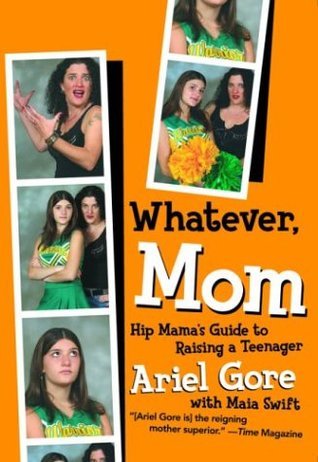
Whatever, Mom by Ariel Gore

Whatever, Mom, by Ariel Gore & Maia Swift…What a great book. I read it in 2023, and while the times have changed a lot for all of us since this book was published—it’s still extremely relevant. The love and wisdom in these pages still apply, maybe more than ever. So grateful for this book as a guide through the brambles of raising a teen. Check it out!

“a shareable heat” (Alexis Pauline Gumbs interviewed by Ariel Gore)

I’m savoring the latest from Ariel Gore: her school-in-a-book called The Wayward Writer: Summon Your Power to Take Back Your Story, Liberate Yourself from Capitalism, and Publish Like a Superstar.

I’ll post about this book and what it helps manifest at intervals. Here’s a sliver of wisdom and heat for today.

On p. 31, Ariel Gore is interviewing Audre Lorde biographer Alexis Pauline Gumbs.

Ariel Gore: “What else should aspiring lit stars know about their lit star life?”

Alexis Pauine Gumbs: “Audre Lorde wrote a poem for her children where she said: 

‘Remember our sun

is not the most noteworthy star

only nearest.’

As ‘lit stars’ it matters where we are, it matters who we impact. It is not so much about our brilliance, or being the brightest and out shining other stars. It is about being close. Close to a shareable heat. It is about whether or not our communities can utilize the solar power in our writing to grow something that nourishes them for real.”

***

(I adore this notion of shareable heat. Here’s some shareable heat in sonic form, manifested by Damon Locks/Black Monument Ensemble, which you can enjoy here.)

Harm reduction & teen drug use (with resources)

Teen drug use concerns me. I am learning more about it, with the lofty hope of de-normalizing it. I’m assuming others might feel the same, and I hope this post is helpful.

When I was a teen, I smoked pot at fairly regular intervals. I was lucky and didn’t develop problems related to drug use. But marijuana & its spinoffs are quite different than back in the 80s. It would be natural for someone like me to shrug off kids using pot (after all, We turned out fine!). So I’m grateful to learn how these substances are different now—and to focus on what we now know about the teen brain.

It seems like harm reduction is a really wise framework for this topic. A friend pointed me toward a helpful brochure called Safety First. It’s free, downloadable, and you can also order print copies. That was a great place to start.

If you want to go deeper, there’s a whole curriculum (also free) which you can find here. The curriculum is extremely informative, and has seeded important discussions in my family about harm reduction strategies, mental health, and other crucial things. Learning together has helped us consider (in a non-judgmental framework) how we choose to be in the world.

The curriculum includes helpful videos (from AsapSCIENCE) like this one, about smoking vs. vaping. What I like about these videos is that they are chock full of science & facts, and are engaging and non-judgmental.

(Did you know? In Ohio, Good Samaritan laws protect teens who call 911 for medical help when they see someone overdose. I don’t know if this is widely known. Please tell your humans about this—and let’s all look out for each other.)

Run away & join the Carnival…

cover art by Gronk

Need a getaway? Here’s where to find my novel, The Eight Mile Suspended Carnival: