Pith from Rebecca

Look closely: you will find pith here.

If your nouns and verbs can do the work, let them.  You’ll have little need for adjectives and adverbs.

(p.s. It’s a shame I can’t–or won’t–follow this advice.  I just tried that exercise where you take a page of your work and banish all adjectives and adverbs.  It wasn’t as bad as I thought, but it wasn’t as good as I’d hope.  Some things made no sense without the adjectives.  Worth trying, though, and worth keeping in mind as I write.)

Sixty thousand words (plus or minus a few)

My novel is now past 60,000 words.
Image stolen from http://www.opacity.us/ephemera/post/royal_land/

Microsoft Word is now showing my novel has 60,437 words. It has been such slow progress; I am not going to tell when I started writing this thing.  But now it feels like it’s going to be a real novel some day. I’m close to the end (of the plot) so how not to rush, how to stay slow enough that I don’t skimp on the things that this mess-in-progress deserves?   Its allure and complex grime keep calling me back to previous scenes, unanswered questions, pieces of the puzzle that now make sense, or don’t. How to twist things into the right shape, how to fortify what needs strength, how to obliterate the coy, the unnecessary, the overly precious junk?

In my distractions, I do a google search for images, “decrepit carnival,” and find this about a place called Royal Land, which was a sort of recycled carnival that did not travel.  My carnival is a non-traveling carnival, so finding this link (and image, which I love) today, I’m renewed–the serendipity cherubim at google hooked me up.  I love conducting this type of non-scholarly research.  It’s one of the great things about writing fiction, the freedom to make things up, but make things up that are also underpinned with some real things, somehow held together with real wire and string, but not so precisely tethered to the mundane.

Back to work now, as Tom Waits would say, “Hoist that rag.”

Everything’s so easy for Pauline…

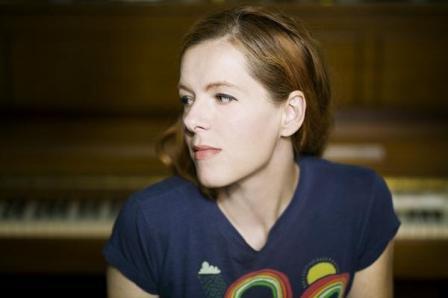
Neko Case, looking cool as usual. But I think she's still "Margaret."

This song haunts me.  Neko Case is amazing from any angle: musician, poet, strong survivor of life’s trials.  But this song sticks with me, and I can’t shake it off.  I’m sure the story is not as simple from Pauline’s point of view, but still…  This song seems as much a poem as any of Simon and Garfunkle’s poetry.  Here are the lyrics.

“Margaret vs. Pauline”

Everything’s so easy for Pauline
Ancient strings set feet a light to speed to her such mild grace
No monument of tacky gold
They smoothed her hair with cinnamon waves
And they placed an ingot in her breast to burn cool and collected
Fate holds her firm in its cradle and then rolls her for a tender pause to savor
Everything’s so easy for Pauline

Girl with the parking lot eyes
Margaret is the fragments of a name
Her bravery is mistaken for the thrashing in the lake
Of the make-believe monster whose picture was faked
Margaret is the fragments of a name
Her love pours like a fountain
Her love steams like rage
Her jaw aches from wanting and she’s sick from chlorine
But she’ll never be as clean
As the cool side of satin, Pauline

Two girls ride the blue line
Two girls walk down the same street
One left her sweater sittin’ on the train
The other lost three fingers at the cannery
Everything’s so easy for Pauline

Read any good girls lately?

My daughter is three years old, and has gotten to the point of focusing on who is a “she” and who is a “he.”  This includes people she knows, toys, and musicians playing on CDs.  It also includes characters in books.

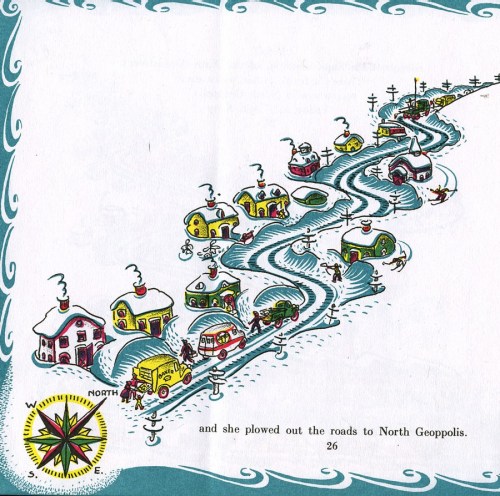
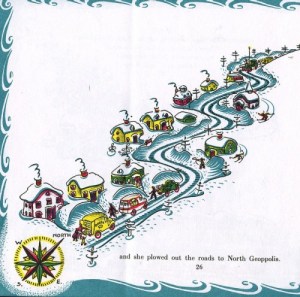
Without being obsessive, I’ve tried to ensure a balance of genders in her literary protagonists.  Fairly early, many of her favorite characters were male, among them: Else Homelund Minnarik’s Little Bear, and Peter of the Ezra Jack Keats books.  But giving her plenty of shes to think about was more challenging than it seemed.  To minimize gender stereotypes, and give her plenty of female heroes.  Her latest hero is Katy, from Virginia Lee Burton‘s book Katy and the Big Snow.  Following is from the Amazon.com review:

Katy, a red crawler tractor, “could do a lot of things,” Burton explains early on. In the summer she is a bulldozer, helping to build and repair roads in the city of Geoppolis. In the winter, she turns into a snowplow, waiting and waiting for her chance to be useful. Most of the winters, though, the snowfalls are mild and the town doesn’t need Katy. But when the big one finally hits, the town is buried in page after page of powder. The power lines are down. The doctor can’t get his patient to the hospital. The fire department can’t reach a burning house! “Everyone and everything was stopped but… KATY!” Suddenly, the entire community is dependent on one little snowplow.

I found the book in a jumbled shelf at Dark Star Books last week.  My daughter now fully identifies with Katy.  This is a snowy winter, and her Grandpa Mark drives a snow plow, so the story of Katy is not only relevant but personal.  At one point in the book, the highway department says of Katy, “Nothing can stop her.”  A couple days ago, my daughter repeated it, about herself.

I want to capitalize on this moment, so I’m looking for recommendations.  I like best the books where it feels incidental that the characters are female–not necessarily overtly political or socially aware (or please, not simply politically correct!) and I want books that have good stories, well written, and with lovely art.  I love old books that have held up over a long time.  And with strong females or girls.  Female animals are okay, but I want to make sure we have some good shes around.

Read any good girls lately?
Ode to The Unembellished

Fragment of marble statue of woman's head, Greek, ca. 350 B.C.; believed to be from a funeral stele.

Driving to Yellow Springs from my home at Sanity Creek, again I noticed the beauty in the lines of the barren trees.  Winter used to depress me, and it still does in some ways, but there was a winter, soon after I’d moved to the country, when I could not believe the beauty of the trees without their dressing.  As if I had never seen them, they appeared, a revelation.

I’ve long been fascinated by line drawings, and wire sculptures, much more than paintings and color.  Seeing artists’ sketches, their studies, before the emergence of the painting, is fascinating.  (Possibly I’m obsessed with process.)  In college art class, the blind contour drawing was one of my favorite assignments–pulling together several ideas that still resonate:  the idea of starting and continuing until a natural end, the idea of gesture, the idea of trusting “the force” as a warrior might–both Buffy and Luke closed their eyes to discover their power.   The paradox of seeing while not seeing, and the idea of simplicity.  I loved the drawings produced by this technique, the movement, the essential truth of the process.

There is something about the unembellished that I find much more inspiring than all the paint and gold leaf you can flash in front of me.  A million years ago when I first went to Europe (actually, it was 1989) I traveled quickly through so many countries, five short weeks, the blur of time makes memory fuzzy.  But I recall when I got to Greece: after regarding the gorgeous decadence of Italian art, the unembellished and sometimes broken forms of Greece allowed me to slow down, to appreciate what is underneath.

I wish I could be more minimalist in my writing.  I crave slowness, and more silence.

The antidote to “Black Swan”?

Today, I saw “Black Swan.”  It was the first theatre-movie I’ve seen in almost a year.  (Last year it was “Fantastic Mr. Fox,” a bit more uplifting.)

“Black Swan” disturbed and engrossed me, though I’d seen Pi and so I knew this film would be no lighthearted romp.  Natalie Portman (whom I’ve loved to watch, ever since “The Professional“) was impressive.  So was Mila Kunis, who was familiar and I trying to place, when the box office guy said, “She’s from ‘That 70s Show.'”  So many things to ponder about this film, and I’m still pondering.  I loved the use of black, white, and grey, with only a little pink shining through at times.  (Oh, yes, and that really important bit of red.)  Through the whole film, I held my breath a lot, only realizing how tense I was as the credits rolled.  So many things…an interesting sort of Hollywood lineage with points on the timeline: Barbara Hershey, Winona Rider, and Natalie Portman…and Barbara Hershey’s role, a study in how not to raise a daughter, despite one’s own extinguished dreams.  (Eeek.)

So tonight, as an antidote to the snakebite of “Black Swan,” I feel compelled to watch at least a little of Altman’s somewhat overlooked ballet film, “The Company.”   “The Company,” which I saw years ago at the same beloved Little Art Theatre (where I saw the movie last year and today), has held a warm spot in my heart.  I own the DVD.  Neve Campbell and James Franco are sweet, and it’s Altman, for crying out loud.  It’s just endearing.  Some friends with whom I saw it were not as impressed, essentially saying there’s not much there there, and maybe they’re right.  But I was charmed by it.  (See it, if only for Malcolm McDowell wearing yellow, babies.)

Maybe it will smooth out some of the rough jagged I’m still feeling in the wake of “Black Swan.”

Dialogue is exhausting

I got exhausted reading a book to my daughter last night, and not just due to chronic lack of sleep, but also because the story included a whole lot of dialogue.  I think it might even be physiological, but I have no proof, it’s just a theory.

This realization (that my weariness was because I was speaking characters’ words) illustrated an excellent point that Douglas Bauer makes about dialogue in The Stuff of Fiction: Advice on Craft.

His chapter on dialogue is worth reading in full, but the particular point I’m thinking of has to do with the idea of a sort of judicious (or ill-advised, liberal) use of dialogue.  His idea is that entering (reading) a story can be like going to a party: you see a couple across the room.  The reader can see them talking, one of the characters is holding a small dog, and something seems to be happening in the interaction, and so on.  (This would be the part of the story where the writer is summarizing and setting the scene.)   Asking readers to come closer, close enough to overhear (as it were) the characters speaking, can heighten drama and make the reading experience more urgent and interesting.  It’s also wholly more strenuous reading, which brings up the next point.

I see a lot of prose that has entirely too much dialogue.  Writers of fiction (and probably creative nonfiction) have a responsibility not to exhaust the reader by putting too many words between quotation marks.  I am all for demanding a lot of my reader.  But choosing to have my characters speak directly to a reader, I should be thoughtful and give the reader a break every so often.  A moment or two of pause, a look around the room, something to let the reader take a breath–even if the reader is reading silently.

At any rate, I should be careful about how I use the power of the spoken voice, reserving it for what matters most.

Bygone eras…

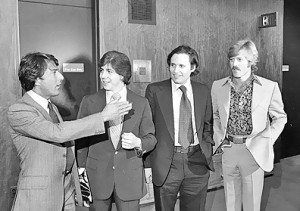
Hoffman, Bernstein, Woodward, and Redford

…in American cinema, journalism, politics…

I just watched “All The President’s Men.” Chilling.  And inspiring, to see Redford and Hoffman before they were bloated with (possibly still righteous) self importance.  And they sure don’t make movies like they did in the 1970s.  I think that was the best era of American film.  Ben Bradlee says it best (from the film):

“You know the results of the latest Gallup Poll? Half the country never even heard of the word Watergate. Nobody gives a shit. You guys are probably pretty tired, right? Well, you should be. Go on home, get a nice hot bath. Rest up… 15 minutes. Then get your asses back in gear. We’re under a lot of pressure, you know, and you put us there. Nothing’s riding on this except the, uh, first amendment to the Constitution, freedom of the press, and maybe the future of the country. Not that any of that matters, but if you guys fuck up again, I’m going to get mad. Goodnight.”

The Year of the Tiny Frog

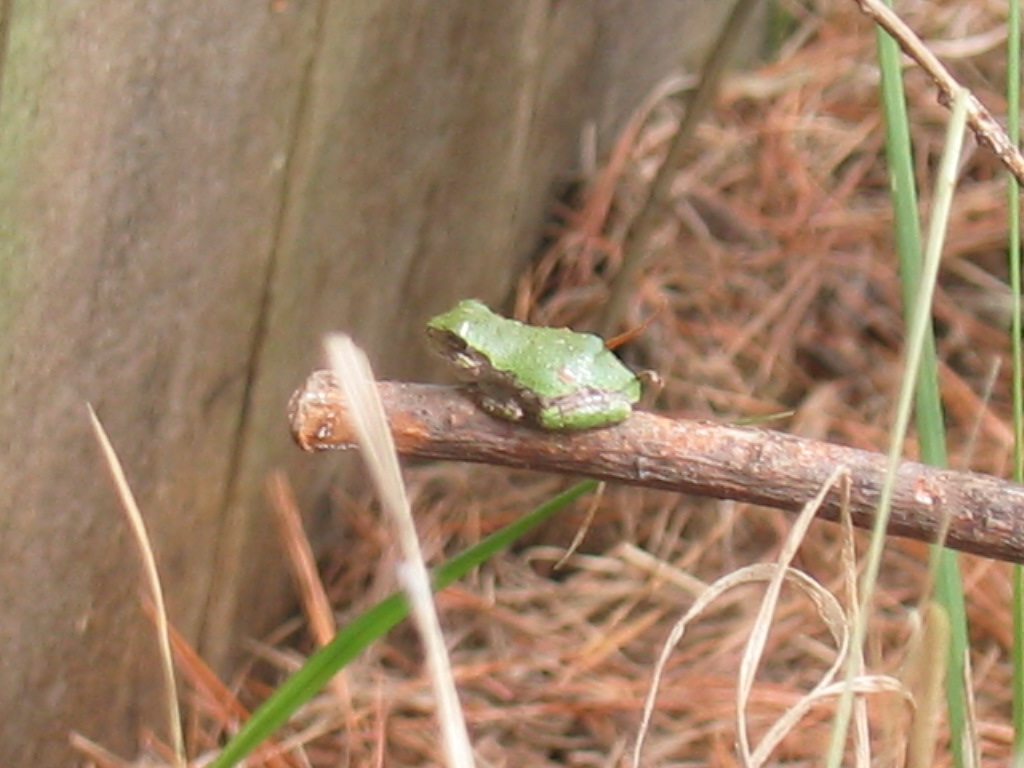
I took this photo (years ago) near Sanity Creek.

I am proclaiming 2011 The Year of the Tiny Frog.   In honor of the Tiny Frog, I intend to:

1) Read more of more interesting books;

2) Write more;

3) Sleep more;

4) Enjoy more of the real stuff and banish the fake stuff from my home, and life;

5) Spend more time with people, books, art, and music that give (rather than sap) energy.

The Tiny Frog would have it so.