Lovely review of Wexler’s The Painting and The City

There’s a very nice review of my husband’s novel at OF Blog of the Fallen.  The reviewer, Larry, really seems to get at what I observed when I watched Robert work on the novel, when he says,

“Wexler’s novel felt as though it were a briskly-paced story that had been stripped of any extraneous fat, leaving the reader with a story that moves at a falsely languid pace until s/he realizes just how quickly things have developed and how engrossed s/he is with what has transpired.”

Gratifying!

Control

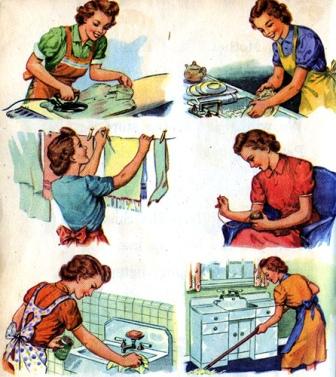
I really like to have a clean house.  This is challenging because I live with a toddler.  I never knew how much of a control freak I was until I involved my two and a half year old daughter in cleaning the bathroom.

Working with a toddler, my first lesson is that getting things clean becomes less important than keeping the walls dry.  Trying to keep her (and me) from slipping on the wet marble, visions of us both cracking our skulls haunt me.  But while she happily scrubs the walls with a terribly soppy sponge, she’s having fun while I freak out.  I try to keep it to myself, though.  I smile and encourage as much as I can.  Because: I want her to learn that we clean the house sometimes.  I want her to see that it’s not just a chore, that it’s fun.  And she wants to help.  I know that some day she will lose interest, so I try to savor the mess we’re making under the pretense of cleaning.

When I was in graduate school and working full time, I got used to watching my standards drop.  It was not comfortable at first, but then a simple equation developed: The floor didn’t always need to be clean AND I definitely needed to read, write, etc.  I’d clean when the semester was over.

Now, I have to decide how we live, I have to model things.  To show my daughter how we should take care of our home.  When I have the energy, I try to make tidying up the million pieces of Lego and the salad of doll clothing strewn on the floor (for the third time today) a game.  I announce that she is not allowed to put away the red pieces, but only the yellow ones.  (She stops what she’s doing and comes over.  “Can I put green ones away?” she asks.  “Well, I guess so,” I say, binning another piece, marveling that for one moment I am actually ahead of how her little mind works.)

Cleaning with a toddler is at least twice the work of cleaning alone.  For a long time I would only clean when she was sleeping or out of the house.  But, if I want her to learn that this stuff is important (at least while she’s not in graduate school) I’m learning the truth inside the cliche: the process is more important than the outcome.

And if it takes twice as long, at least the walls will be clean.

Imagination proves life is worth living

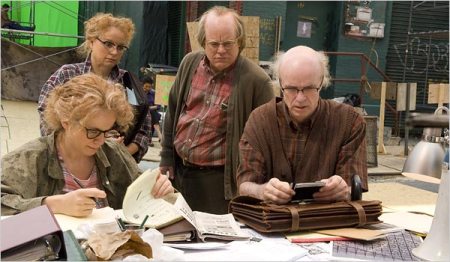
A couple of weeks ago, I watched “Synecdoche, New York” with the brilliant Phillip Seymour Hoffman leading a delectable cast of independent actor types.  I say “types” because the layers of fiction and nonfiction within the film (and the roles reversed and layered and reversed again) were so head-spinny that it made my head spin like a terrible cliché.

But.

The film was incredible.  Incredible that what started out as a dire look at what appeared to be the real world cracked open so deliciously and before me stood actors, cardboard cutouts, people, all echoing each other so brilliantly.  In a way, it reminded me of the intricate and mostly successful novel called The Way Through Doors by Jesse Ball.

So the film opens with this depressive, apparently hypochondriac theatre director (Hoffman looking really terrible) whose best creative days are behind him.  His painter wife (played by the fabulous Ms. Catherine Kinnear) and child soon leave for a show in Berlin without him.  From that point on, things (like time, space, etc.) start to crack open.  Layers of paint and facade peel off.  Hoffman’s character gets involved with a woman who buys a house that is literally on fire.  Etc.

Grindingly depressing, maybe.

But.

Phillip Seymour Hoffman holds the work together, like glue for layers of peeling wallpaper that wants to step off the wall and live a life that has nothing to do with two dimensions, thank you.

If you have the time and patience to sit through some grim, horrid, sad “what is the meaning of art?” types of questions, please watch this movie.

The fact of making a movie like this, and the human spirit embodied in a piece of work that sustains the crazy fantasy magical mess that unfolds (and folds back upon itself, several times), to me, proves the point that life is worth living.  It is such an incredible work of imagination.  This fact: that the filmmaker (Charlie Kaufman) made his film to the end, taking the magic of the world he created seriously is a feat of genius and love.   This type of real commitment to something (anything!) magical seems sadly rare in these cynical days.

The mere fact of the film undercuts the miserable character’s quest for meaning, and in a strange way, I found it completely uplifting.

The importance of manuscript formatting/I admit to being a nerd!

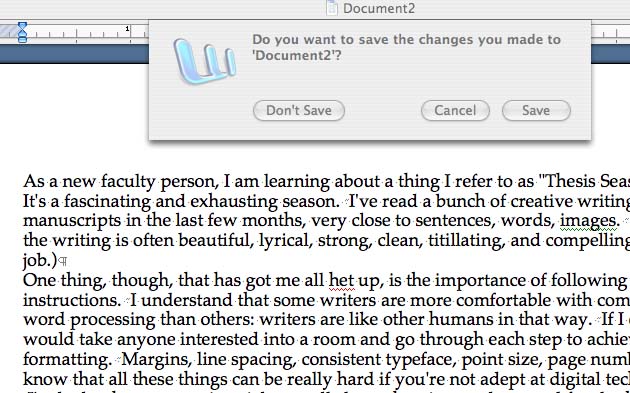
As a new faculty person, I am learning about a thing I refer to as “Thesis Season.”

It’s fascinating and exhausting.  I’ve read a bunch of creative writing manuscripts in the last few months, sitting right next to to sentences, words, and images.  (Luckily, the writing is often beautiful, lyrical, strong, clean, titillating, and compelling.  I do love my job.)

One thing, though, that has got me all het up, is the importance of following instructions.  Some writers are more comfortable with computers and word processing than others: writers are like other humans in that way.  If I could, I would take all these writers into a room and together, we’d go through each step to achieve proper formatting.  Margins, line spacing, consistent typeface, point size, page numbering.  I know that these details can be really hard to face if you’re not adept at digital technology.  I’m lucky that my previous job was all about showing students and faculty how to navigate the word processing jungle.  I’m a nerd about this stuff.  According to Microsoft, I am a “Word Expert.”  (This always amuses me, especially when I’m writing, because the last thing I feel like is a word expert!)  For this reason, however, I harp on formatting.  My students might be tired of hearing it, but I am trying to help them as they approach the larger world where their work will be judged by someone who doesn’t care about them nearly as much as I do.

As writers, it’s in our absolute best interest to follow guidelines EXACTLY.  If a publisher desires certain formatting, we better pay attention.  If the goal is to impress the reader with our lovely words, sentences, images, then having the manuscript itself not distract from that seems essential.

Teachers, but more importantly, future editors, are easily distracted by a writer’s inattention to these details.  They are looking for a reason not to read our work.  Let’s not give them the one that is, in some ways, easiest to avoid.

If a writer wants to be taken seriously, is in her best interest to gain control over the “physical” aspects of manuscripts.

The Word Expert has spoken.
Stark Folk Interview (via Laconic Writer)

This is an interview that my husband, Robert Freeman Wexler, did with Brady Burkett of Stark Folk. Check out the interview; check out the band!

Stark Folk Interview It’s time for another installment in the Laconic Writer Central (LWC) sporadic interview series, this time with Brady Burkett of the Stark Folk Band. Stark Folk’s second album Well Oiled came out this month, following the self-title debut from 2008.  Both are available on cd and vinyl from Old3C Records and digitally on iTunes. The band is a collaboration between Burkett and Ryan Shaffer, plus other musicians to fill out the sound. LWC: Let’s sta … Read More

via Laconic Writer

Travail

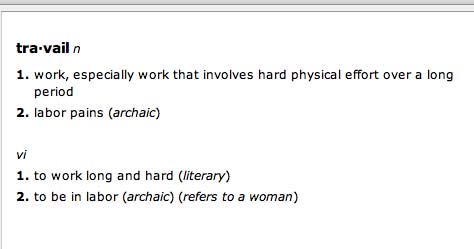
A word I like, that I first learned in high school French, “to work.”  Interesting that it has both these ideas in it, working over a sustained period, and giving birth.

Seems about right.

Innocent hubris

There is a trajectory of mental states from the beginning writer toward the seasoned, thick(er)-skinned writer.  I think that development along that trajectory includes getting beyond the innocent hubris of “My writing is great! People have always said so!” and moving toward the knowledge that all good writing takes work and generally benefits from a variety of voices giving constructive feedback.

Like the child who is always praised and never challenged, we do no service to ourselves by glossing over things we need to work on.  I ought to know.  I used to be one of those innocent hubris writers.  I hope I’ve moved beyond it.

I sure have a few calluses.

My characters are slackers.

The outline of my novel-in-progress is now fully scrawled in 24 notebook pages.  The next job is to type it up, massage it into a sort of stage manager’s “bible” which was a technique I used with The Watery Girl. This process seemed to help.  Character motivations, scene breakdown, major “props” or icons that I needed to follow through the novel, for continuity.  But now what?  I still have to figure out how this story ends.

Writers often talk about how their characters take over, dictate, and decide what happens next.

So where are my people?  Asleep, at the bar?  It’s sunny out, did they call in sick today?

Slackers.

Jason Dryden of Sleepybird

Jason Dryden died too soon.  Too soon because I needed to see him play more music.

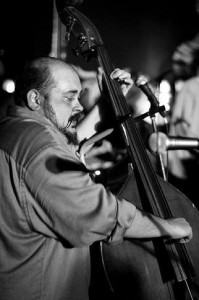
I didn’t know Jason well, but saw him perform often as part of the band Sleepybird. I am lucky to have seen them play as many times as I have.  But I am greedy.  I want more.  Jason on bass and theremin was something brilliant. The alchemy of Sleepybird I have written about before.  Jason was a huge presence, a performer among performers, down to his moustache.  When I first saw Sleepybird (in a friend’s living room) the musicians plucked and plunked and blew and soon, strains of their song, “Butter her up” warmed the air.  I was hooked.

I was lucky enough to see Sleepybird et al in “The Fruit for the Egg” at Stivers in February.  It was amazing.  My husband bid on and won a ceramic piece Jason made, a round white vessel with crackly grey fault lines, and a lid with a primitive white bird as handle.  It’s beautiful and delicate and ancient-looking.

In ways that are so close to my being that they are hard for me to articulate, Sleepybird (performing live, especially) gives me license to write fiction.  The inspiration that comes through them to me, to my inner creator, is tangible every time I hear them.  Something about the substance that they form with their individual selves and instruments, and all encompassed in the music, flows directly into the bloodstream of my creativity.  The inventiveness that I can sometimes muster in my fiction is buoyed by the phenomenon that is Sleepybird.  In particular, that potent energy has been embodied in the way Jason Dryden played the theremin… in the magic of watching his hand dance, ever so slightly, a delicate feather of motion, through the air, and the sounds that motion created.

Although I didn’t know him well enough to glorify him, or demonize him, Jason’s death is really affecting me.  People I know and love were very close to him.  Listening this week to the Sleepybird song, “Already Gone,” I was reminded of the impermanence of everything.  But if anything is important, then everything is important.

Send love to someone.  Do it with words, or clay, or music.  The person who receives your love may not know you, and you may not know them, but do it anyway.  You might do it unwittingly, as perhaps Jason did for me.  The magnitude, though, like the sadness, will last forever.  And even so, is worth it.