A metaphor for line editing

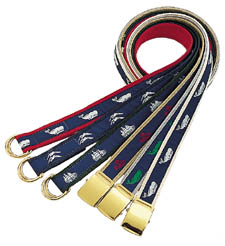
Lately, I’ve been reading other writers’ unpublished work, and also editing my new novel. As I whittle sentences down to a size and rhythm that’s tighter and more manageable, I keep thinking of this process as a sort of good corseting. I wish I could show my dear readers what I mean by demonstrating, but it’s as if I’m cutting excess stuff, and yanking the corset tighter. Again and again, in different ways and different places. Cut, yank, cut, yank, and so on. I’m recalling those preppy camp belts people used to wear with chinos in the 1980s, with webbing and metal buckles that you fold down, like seat belts. But with those belts, there was much more pulling involved.

Something like this.

preppy belts
So everything looks better, and feels better, as long as one is not a sentence.

Reading on August 14 in Yellow Springs

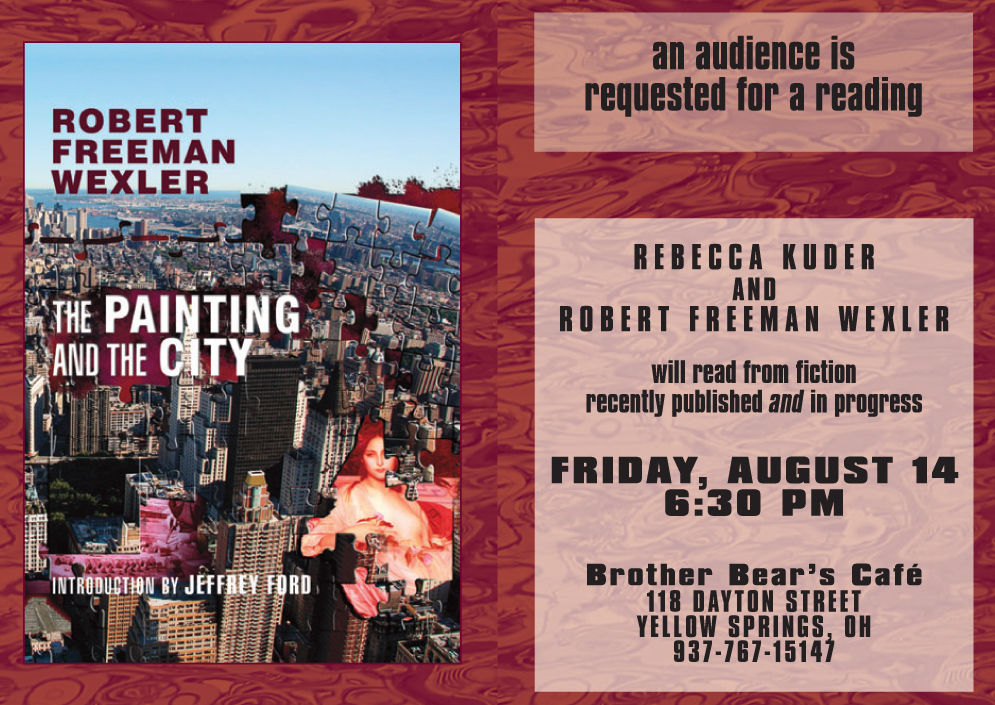
At Brother Bear’s Café (118 Dayton Street, Yellow Springs Ohio) on Friday, August 14 at 6:30 pm, I will be reading with my husband, Robert Freeman Wexler (www.robertfreemanwexler.com). We will read from fictions newly-published and in-progress.

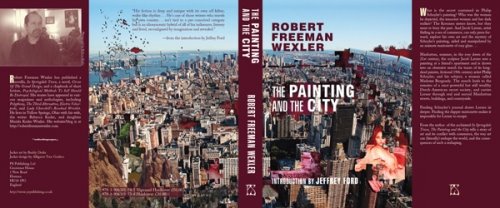
Appended from the press release Robert wrote: We live outside Yellow Springs, on Sanity Creek, where we craft our strange and marvel-filled tales. Copies of Wexler’s new novel, The Painting and the City, will be available for purchase.

Spread the word. Hope to see you there!Bro-bear's Reading Postcard

Cicada

I have been fascinated with cicadas since I was a kid.

In my novel, The Watery Girl, cicadas are kind of important, maybe emblematic.

I just found this on Wikipedia and couldn’t keep it to myself. I wish I could shed my shell like that sometime. Or at least once.

Write what you know…but not everything you know…

There was a lot of discussion at the Antioch Writers’ Workshop (AWW) about the chestnut, “write what you know.” Zakes Mda gave a lovely keynote speech, and talked about the idea of writing what you don’t know, or maybe more accurately, writing what you want to know.

I think that the idea of writing what you know is too often taken too literally. People write fiction which is autobiography, veiled by the sheerest curtain: so that setting, plot, characters, dialogue, and just about everything else is (to borrow a phrase from the ubiquitous Law and Order TV shows) “ripped from the headlines” of their lives. When I talk to other writers about this, the more savvy people agree that yes, it behooves a writer to write from a basis of emotional or psychological truth. The idea of authenticity is everywhere these days, and the word is overused, but it fits here, I think. However, having some core of authenticity does not necessarily mean transposing your real life to fiction. No matter how interesting the “headlines” of someone’s life might be, the world and the world of words would be better if people would use more imagination.

So I’ve been thinking about various angles on this problem, both in fiction and nonfiction.

I attended a memoir workshop last week at the AWW. I submitted a piece of nonfiction, more of a personal essay than memoir. In the piece, there is a person whose name I did not use; let’s call this person the villain of my story. Part of the reason I chose not to use the villain’s name had to do with protecting myself. But the story I told is mine, and the reason I decided to tell it has mainly to do with not hiding secrets.

As I understand it, here are my options:

1. Put the essay or whatever it is aside, congratulate myself for the courage and catharsis of writing it, and get back to work on my novel.
2. Change names and call it nonfiction.
3. Change names and call it fiction. (This has zero appeal. See above about not hiding secrets.)
4. Name the person and open myself to unknown and unpleasant reactions.

I get mad thinking about how, in order to tell my story, to be free enough to write it and safe enough to publish it, I have to not tell it all. Or more accurately, I get mad that I can’t name a real villain.

So whose story is this? If I experienced it, do I own it? Is it mine? If it’s mine, why can’t I tell everything? Who do these facts belong to, if not me?

Who owns the truth?
Isn’t there a better word?

I don’t particularly like the term “networking” unless you’re talking about computer cables and fiber optics. When talking about meeting, working with, and being real with other real humans, “networking” sounds mechanical and shallow. But whatever we call it, connecting with others who care about the written word makes me feel like I’ve just woken from a great night’s sleep, brain rested, abundant sunshine in the forecast.

I spent last week at the Antioch Writers Workshop, among writers, editors, teachers, and readers who care about the nerdy things I care about, like near-perfect metaphors, mining memory, and squashing clichés. Midweek, that thing happened when time feels like it’s accelerating, and I realized the workshop would be over soon. I got really sad, because I want to spend more time among people who concern themselves with words, sentences, images.

I’ve known, worked with, and adored various writers for a while now, many of whom prop me up when I’m drooping. Many are my beloved people. And last week, I met and mingled with others who, I hope, will expand this constellation.

I am trying to convince myself that sending thank you notes is not on a continuum with stalking, and that if I received a handmade card from another writer, I would be glad.

Time wears on a collection of pens

The banner for this blog is from a photo I took in October, 2004. It’s a little recipe box from my grandmother’s things, and seemed like a perfect place to keep my collection of fountain pens. Yes, I know, a collection of fountain pens, but I’ve always loved them (I used to write with those leaky clear plastic-barreled Shaffer Scripto fountain pens in college–writer Howard Waldrop blogs about them here) and I actually use all my pens now, so I stand behind living the cliche. (And if it mitigates, I aim to write as few cliches as possible with those pens, and when I discover one slipped by, I scratch it out.) When I was first using this box to keep them, I would sometimes sort the pens alphabetically by maker. The little backdiving woman is from a cake top a dear friend (and host of my writing group) made for me (and put on top of a scrumptious cake) when I was about to get married.

I no longer own two of the six pens in the photo. One was a hand-me-down from my ex, and it needed to go. The other, a gift from my husband, I broke the nib, and it wasn’t fixable. (DANG!) But I’ve got some newer beautiful additions to the collection. Perhaps I will post photos some day when I get some spare time.

And while I’m coming out…more on Buffy

I think that Buffy the Vampire Slayer was/is one of the best and most worthy fictions ever created. For a million reasons, not the least of which, from the final episode:

“From now on, every girl in the world who might be a Slayer, will be a Slayer. Every girl who could have the power, will have the power. Who can stand up, will stand up. Every one of you, and girls we’ve never known, and generations to come…they will have strength they never dreamed of, and more than that, they will have each other. Slayers. Every one of us. Make your choice. Are you ready to be strong?”

This kind of thing has long been my mission statement as a writer. I realized that back in the late 80s, after college, when I was figuring out what my life was all about. What I “figured out” then has evolved dramatically since, but even back in my clueless early 20s, I knew that my mission had, among other things, something to do with helping women and children stand up.

I have a cardboard cutout of Buffy in my new faculty office. I stared in her eyes while taking thirty quick breaths to pump me up before I went in to meet with a really cool small press, literary warrior-editor to pitch my novel yesterday. It helped, I think.