The best lilac ever

Last spring, my husband and I fell in love with a small house on the edge of a state park. The house is tiny, but very charming, and located on about an acre of green velvet…the land slopes down to an ancient rock wall, and a creek that feeds into a splendid gorge. We weren’t really looking for a house, but this place was too wonderful to ignore. So we sold our house in town and moved out to the country.

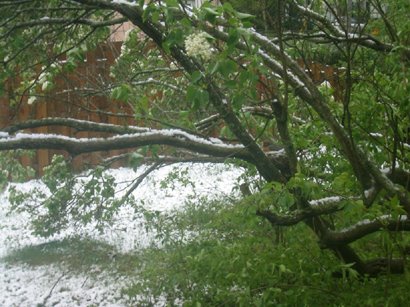
Our former house had few trees in the yard, but it did have one venerable white lilac. Someone told me it could be more than 50 years old. Sprawling and wide, the white lilac slouched unassuming in the back yard, visible from the dining room window. The white lilac, like me, had good and bad years while I lived in that house. But for the lilac, good years meant mounds of white popcorn-ish blooms, which I’d scramble to cut before they faded. Overflowing the kitchen table or my office desk, it was easy for me to be generous, give away blowsy bouquets, and save armfuls of fragrance from rotting on the tree. On our first wedding anniversary, a crazy April snowstorm fell on the white lilac blooms, and a mother robin, nursing a nest of eggs in the crook of the tree, looked quite unamused.

Before we turned over the old house, we dug up a spindle from the white lilac, a shoot that had snuck up near its base. My husband planted this lilac sprout at the new house, so we could remember a piece of our past. And thankfully, I have a lot of photos of the old white lilac.

So I’ve struggled with words to describe how I felt when I passed the old house recently and saw that the new owners had Cut. Down. The. White. Lilac. Tree. Words like angry, sad, sick to my stomach weren’t strong enough—I needed words like RAGEFUL, DEVASTATED, and I needed to capitalize them. I felt like throwing up, like purging all my insides. I couldn’t blog about it right way; I needed to calm down. I needed a cooler heart.

Because of various unpleasant details, routine in closing any real estate deal, I’d been fighting my urge to dislike the people who bought our house. What now seem like little things annoyed me, and I thought I’d gotten past it, no reason to hold onto anger, after all, I love our new house and life is good. I rarely feel like committing physical violence, but when I saw the lilac lying in loggish pieces on the lawn, the fireball in my gut urged me to reconsider my pacifism. As I think of it now, I still have to fight back a deep and visceral disgust.

Until now, I thought I was only a metaphorical tree-hugger. But this was the best lilac tree ever. How could someone kill it? Did they do it from ignorance; did they know what kind of tree it was? Or did they do it on purpose, in which case, how evil! I’ve thought up all kinds of clichés about it, the tree was too good for this world, the new owners don’t deserve that tree anyway, on and on. I don’t want to carry venom toward these people, but how can I ever forgive them?

I saw something today in this spindly baby lilac, this offspring. As I sift through the myriad feelings this felled tree brought up, I am beyond relieved that we took a piece of the august white lilac. That the spindle survived! It won’t bloom this year, but maybe next, or the year after…. Is what I see in this baby lilac something like hope?

White noise

White noise lulled me as I slept in New York City, and when I woke and looked out the window, its source surprised me.

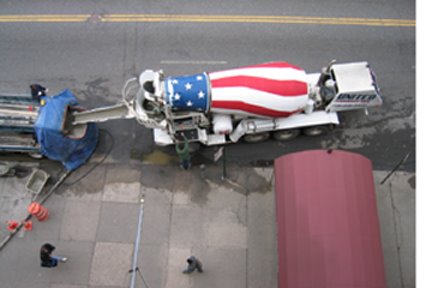
A cement mixer, directly in front of the hotel. Though cylindrical, (and therefore not an officially sanctioned shape, according to my very patriotic high school American history teacher) it bore an American flag on its torso. The mixer extruded cement into some sieve or strainer, and it was unclear where the cement was actually going. Did it matter? Like a cigarette butt, isn’t it just better if it’s out of my car? Who cares if, after I toss it from my car, it turns up in the park, sodden in the grass, perhaps never to biodegrade? (Where is their patriotism? Don’t our parks matter? When I see people do this, I want to call the cops. Or better, Homeland Security.)

If America (in the form of this working vehicle) squeezes out the cement and it goes somewhere, anywhere, so it can fortify, build a better America, or at least a newer one, reinforcing the lack of grass everywhere, increasing the possibility of flooding elsewhere, it will be a stronger America, reinforced by this substance, stimulating some abstract notion of economy, employing some underpaid humans.

I saw something today in this patriotic cement mixer. The white noise helped me sleep in, comfortable in my vacation bed, as the mixer turned, moving, changing, extruding something for some concrete reason, I’m sure, and I slept, wondering whether I was being bitten by bed bugs (there’s an epidemic in the city, I’ve read, and my skin believed it was under attack, even though it wasn’t, because one never knows, they could be terrorist vermin!) All this on 23rd Street, in the city that, when wounded, inspired the rest of the to country slap a little patriotism on our own vehicles in the form of the ubiquitous magnetic American flags. Someone is making a fortune off those. (I got a magnetic yellow ribbon a while ago, to demonstrate that we liberals care about the soldiers too, but it fell off. It’s probably languishing in the park with the cigarette butts.)

Melting

How much stuff does a person need?

I come from generations of consummate packrats. So the myriad cardboard boxes that followed me when I moved across the US to Seattle had historical context. When I moved back to Ohio, my boxes traipsed back too, cardboard tails between cardboard legs. Many of the same boxes. Those boxes haunted me for years. In quiet moments, they tugged at me; I should really sort those out, I’d think, organize them by topic, label, categorize, get some swankier boxes, see if I really want to keep all that…all that what? Who knew what was in those boxes; in my nightmares, the piles coalesced into a towering grey jumble of things I needed, treasures, placeholders–so I could remember every detail of the miles I’d traveled. A buffer from the terror of forgetting.

Finally, moving into a smaller house forced me to face the boxes, to peel away layers of myself, my history, things I thought I couldn’t live without. Boxes and bags of stuff were sold at yard sales, given to friends, donated to charity, left for trashpickers at the curb. (The cumulative feeling of all this letting go was heady exhilaration. What I had left were the really important things, and, dross gone, I saw those things more clearly. Like editing an overfull sentence down to a few perfect words. My only regret is a pair of well-worn cowboy boots some early bird swooped up for $10 one of the yard sales. But if I truly need cowboy boots again, I’ll find something better.)

Like frozen matter, stuff calcifies with the myth of memory, stuff collects felty dust, stuff dictates how we live. Why is it so hard to let go of stuff, even stuff that’s broken, spent, forgotten, rotten, moldy, stuff that triggers sad memories…stuff that should long ago have been given over to the cockroaches? Stuff threatens to suffocate, bury; stuff becomes an unbearable burden. When I walk through the hall, the precarious pile of my stuff, even in my phantom-limb memory, slides to the floor, slippery as dead fish.

I saw something today in this partially unfrozen waterfall near where I live. The spring melt allows the water to move, unobstructed by ice, flowing on to the next experience. New memories to remember, to move through, and let go. A good start.

Emerging

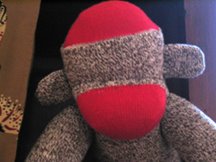
What will happen when I gather the embroidery floss and start the improvisation of face? Will the right face emerge? (Will it be a good face?)

Can I trust the process of emerging, and my memories, to sustain me as I create this monkey’s face? How can these stitches possibly hold enough love?

In the early 1990s, a friend told me the story of how her parents took away her toys too soon. She was maybe ten years old. She hadn’t been done with them. In particular, she pined for her sock monkey, floppy and enchanting, dependable…its disposal was one stretch of her stolen childhood she had never forgotten.

I decided to make her a new sock monkey.

Since then, I’ve made a lot of sock monkeys for adults. Using Red Heel socks I stitch by hand, and watch each monkey emerge. Lumpish and lovable. With each monkey, I have tried to echo something of the recipient’s aesthetic, or some piece of his or her life…each monkey means something specific.

Making monkeys for babies is more difficult. Not knowing the future person who will cling to that monkey, I can only presume the child will be, in some way, like its parents. But even if I have touched the mother’s full belly, there’s no crystalline detail to play with while creating the monkey’s face. For babies, I attempt a face that will amuse and delight: a curlicue of bliss, or humor, but most importantly, a friendly face.

I saw something today in this monkey’s blank, blind face. This monkey is for the baby of a friend I have not seen in several years. I think the child will need a lot of support and love, and I can only do that from afar. How can I convey this in cotton, thread, and stuffing? How can I pour into the small stitches all these complicated wishes?