Dear Inner Critic—Interview by Ariel Gore

sepia tone image of human, on the floor, with papers and material spread out, writing on a notecard.

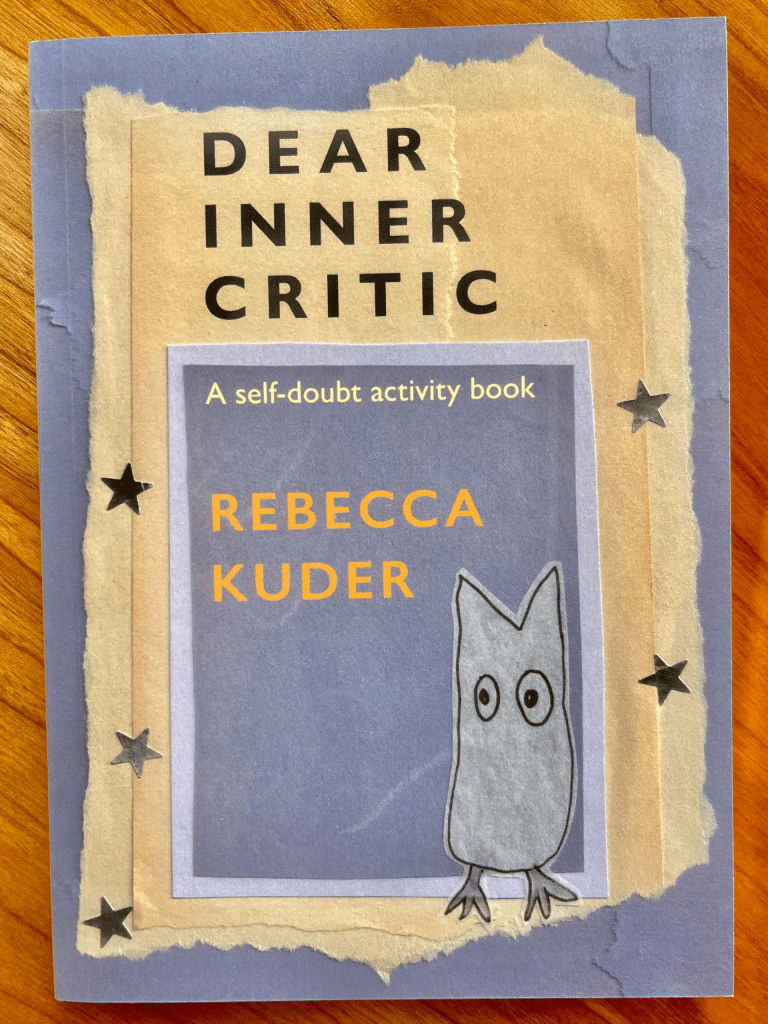
I am so grateful for Ariel Gore‘s invitation to chat about Dear Inner Critic: a self-doubt activity book and other salient things. Read our interview here. Ariel’s Literary Kitchen (aka School for Wayward Writers) is where Dear Inner Critic was born, so to share the book’s story there warms my heart.

If you are like me, you know in your bones that these times call for much inspiration and fortification! So please do whatever you can to support independent, collective, human-scale publishing, and eschew the monsters of big capitalism!

Head over to the Literary Kitchen’s Underground Book Shelter to purchase fabulous, unique, humanity-expanding books.

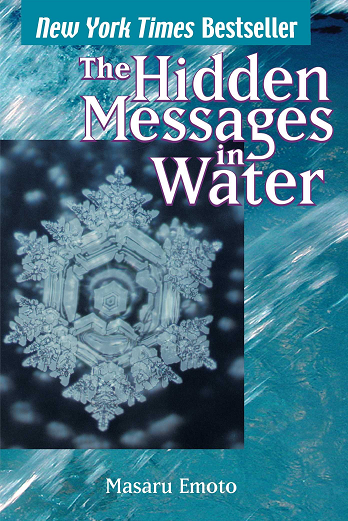
The Hidden Messages in Water by Masaru Emoto

I recently read The Hidden Messages in Water by Masaru Emoto. This book is amazing. I know its premise may be wobbly, or pseudo-science, but when I don’t ask it to prove itself and when I allow imagination and read it like a novel (or at least as a non-skeptic), I find the narrative extremely compelling and hypnotic. Like, what if?

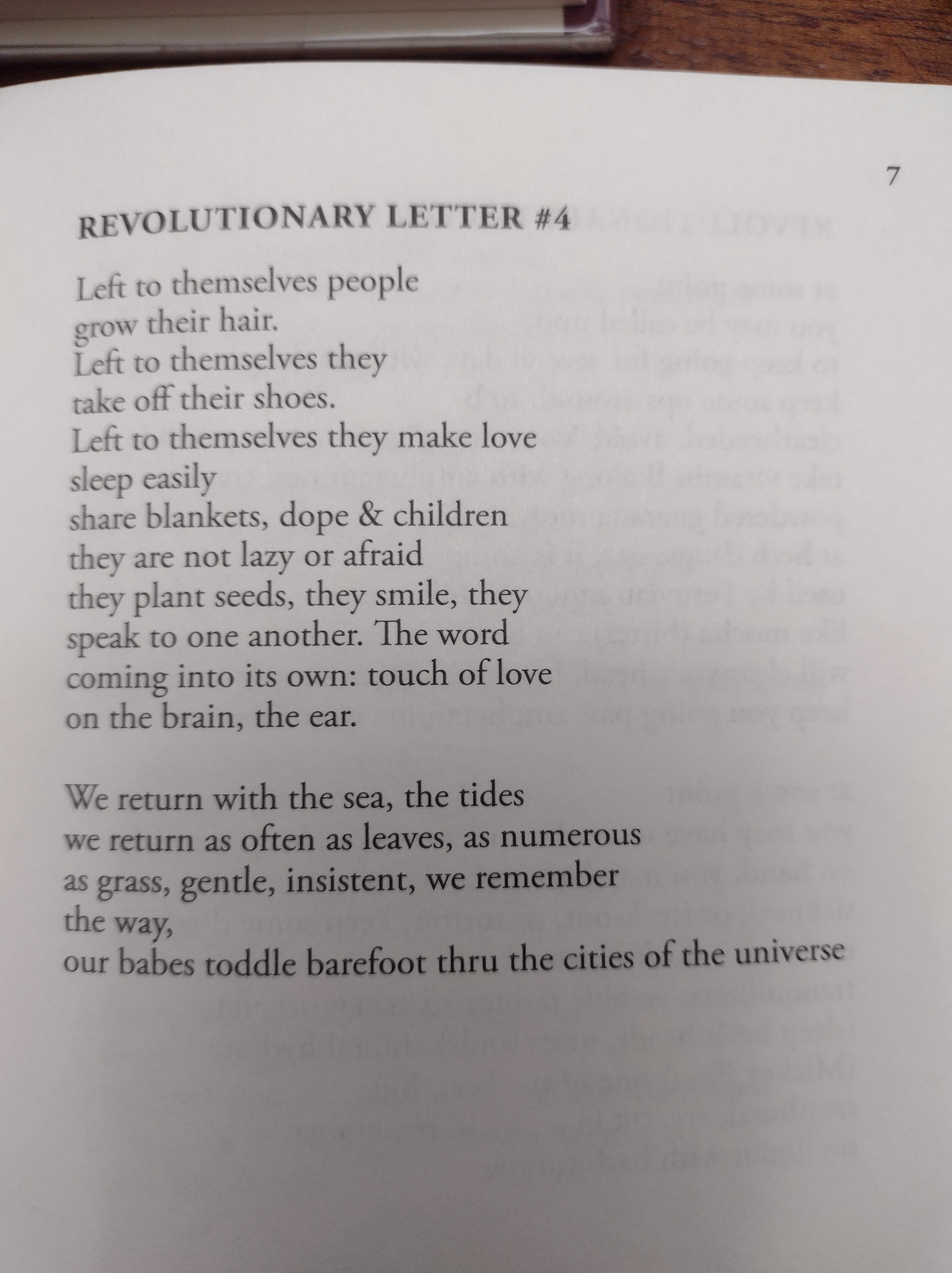
From p.151:

“We all have an important mission: To make water clean again, and to create a world that is easy and healthy to live in. In order to accomplish our mission, we must make sure that our hearts are clear and unpolluted.

Over the centuries, humankind has constantly robbed from the earth, and left it ever more polluted—the history of which is recorded by water. Now, water is beginning to speak to us. Through water crystals, it is telling us what we need to know.

Starting today, we must begin to carve out a new history. Water is carefully and quietly watching the direction we take—the direction that you take at this very moment—and watching over us all.

I only ask that you listen to and absorb what water has to say—to all of humankind, and to you.”

quiet, but things are happening

photo of cup of tea and boots overlooking pond

I’ve been quiet over here, but very busy.

In 2023, I took a fabulous year-long online writing class with Ariel Gore called Mavens of Mythmaking. Some highlights:

  • I completed a short story collection called What To Keep, for which I am seeking a publisher.
  • I finished a full revamp/revision of my novel The Watery Girl. This year, I will seek publication.
  • The memoir about my childhood home continues to emerge and evolve—in fragments and fractals—which, I am learning, is how this thing is meant to be written. Some day it will be a book.

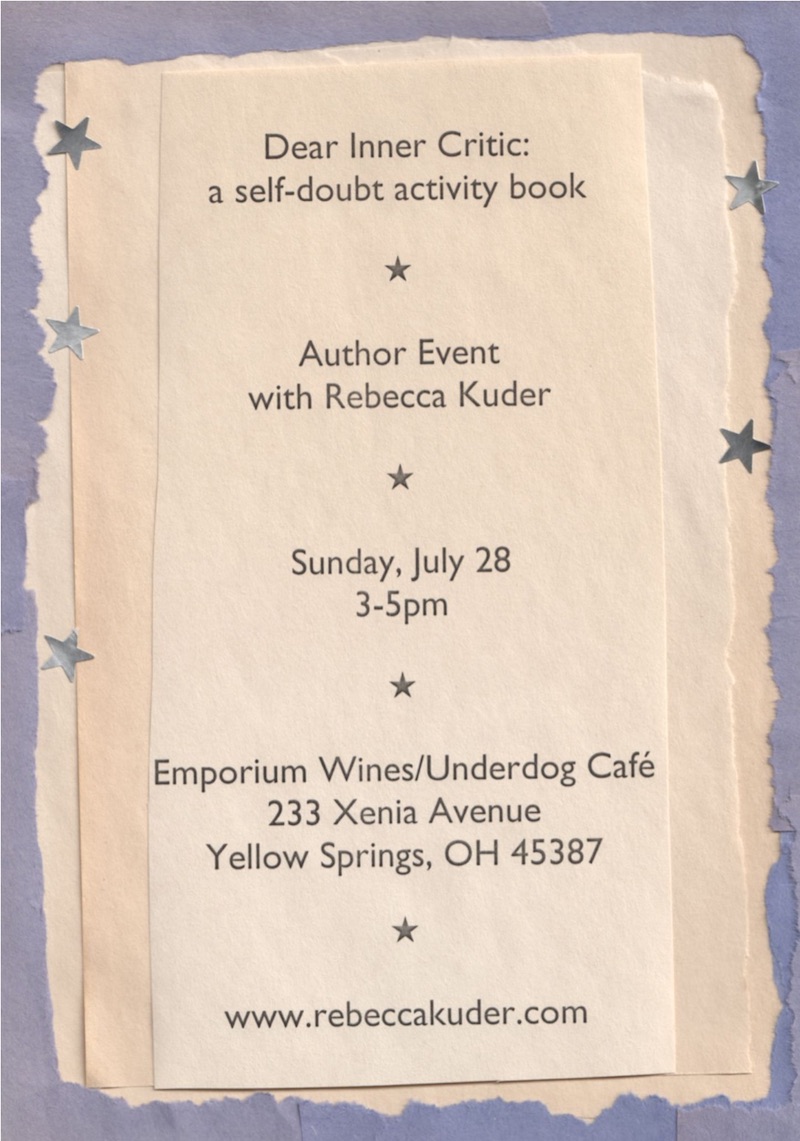
My newest book, Dear Inner Critic: a self-doubt activity book, grew from years of renegotiating my relationship with the inner critic. Many readers have attended workshops and reframed self-doubt with me. Thanks for your good company! (Who knew a handful of tricks would grow into a real book?!)

  • This book is built from L-O-V-E. My keenest hope is that it will help people free the creative urge. (If I have anything to offer humanity, this book is it.)
  • On the journey toward creative liberation, I have trodden this self-doubt path myself. The tricks in this book have changed my life.

Soon, Dear Inner Critic will be available from the Literary Kitchen (literarykitchen.org). Please subscribe to my blog or follow my instagram for more information.

Broken River by J. Robert Lennon

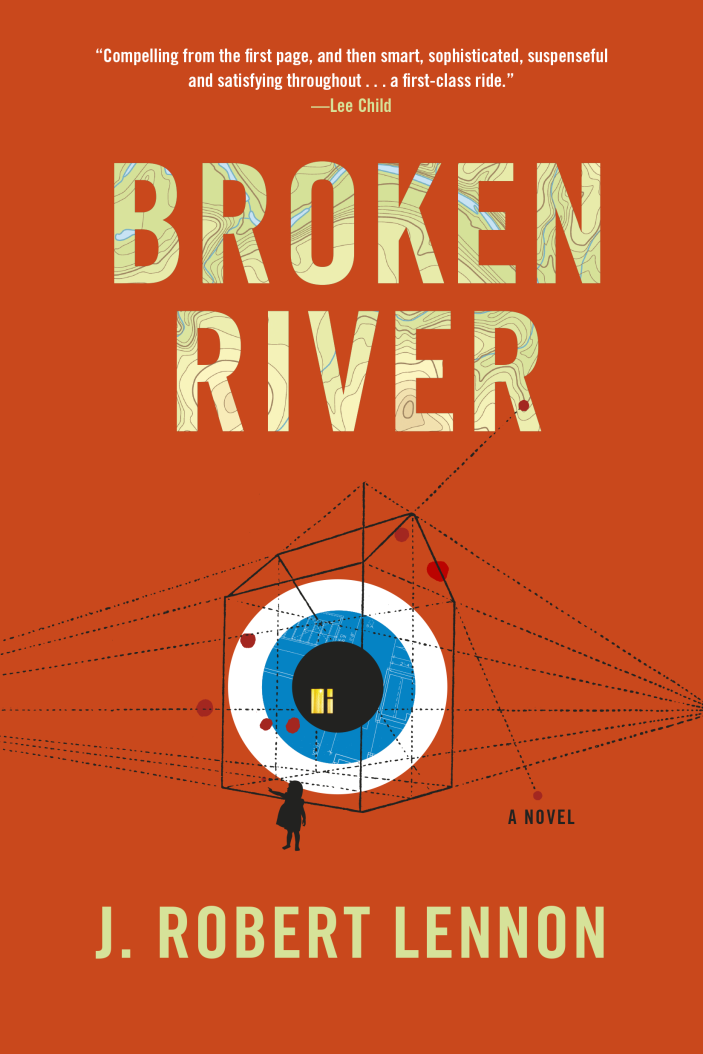
My dear husband recommended I read Broken River by J. Robert Lennon because it features an inventive character called the Observer, and it’s also about a house, and what the house contains. (I’m kind of always writing about houses and what they contain, which is why Robert suggested I read this novel.) The Observer character evolves over time within and outside of several carefully constructed and smartly intersecting narratives. Overall I found the book really well made and engaging. It’s creepy in all the best ways (which is maybe evident from one glance at the cover). I recommend you read it especially if you want to see how someone can make something intricate and also smartly accessible, that isn’t shaped like most traditional narratives.

Here are some bits I particularly love—as is the case often in my posts, these passages are torn from context but maybe that doesn’t matter?—and maybe you will see why I love them. (Also, I have never seen anyone write about those weird tube men, and how brilliantly Lennon does so, below!):

p. 26: “In any case, the identity of, fate of, and story behind the previous inhabitants of the house is something Irena intends to research while she is here. If the results are interesting, maybe she can incorporate them, somehow, into her novel. Because at the moment, the novel has no real plot—it’s just descriptions of things. That’s what Irina is good at. She believes that she inherited this deficiency from her father, who is a visual artist and does not require narrative to make something of value. But if that’s her cross to bear, she will do it stoically.”

p. 118: “The observer lets her go. It is time to turn its attention to the family many miles to the north, though the Observer is increasingly aware that it needn’t choose one time, one place, on group of human being to attend to. Indeed, it is quite capable of observing anything, all things. But it has begun to recognize that its purpose, as opposed to its ability, is limited: or, more precisely, its purpose is to be limited. It is unconcerned with, bored in fact by, the enormity of its power. It is interested only in the strategic—the aesthetic—winnowing of that power.”

p. 119: “Of course the humans die. Quite possibly all of them. Perhaps the Observer will die as well; it doesn’t know, and it can’t imagine what it would do differently if eventual death were a certainty. But the humans, it suspects, know. This is likely why, years ago, at the beginning of the Observer’s existence, the murdered man and woman screamed, even before any damage was inflicted upon their bodies: they were justifiably fearful that their lives were about to end. If the humans know that death is coming (and, by the Observer’s standards, it would seem that it tends to come very soon), their words and actions must all be profoundly influenced by that fact. They fear making wrong choices, so they avoid making any at all. They keep very still, hoping that death might fail to take notice of them.”

p. 158: “Of course Eleanor wouldn’t have it any other way. She is not one of those parents who believes that her child must find a tribe, invest herself in society, hide her eccentricities in an effort to blend into the group—even though these are the lessons she herself was taught, and shat she has historically done, and what, despite her engagement in ostensibly solitary pursuits, she is presently doing for a living. No, what she wants for her daughter is intellectual and creative self-actualization without compromise. In other words: Don’t be like me. Be like your father.”

p. 203: “By hour three of her journey here, her lower back ached with a familiar, almost homey, pulsing intensity that bordered on nausea. She had completed the decrepit-barn-and-speedway portion of the trip and had entered the domain of inexplicable traffic lights, roadside diners, and auto dealerships outlined in colorful flags and punctuated by convulsing forced-air tube men. (She doesn’t understand the tube men. They catch the eye, yes, as only a madly flailing twenty-foot-tall monster can; but who decided such a sight could make you buy a car?) Sewn-on smile notwithstanding, the tube men appeared to her earnestly, even violently repulsive. Turn back, their frantic motions seemed to say. There’s danger here. We’re tall enough to see over the trees, and only nightmares await.”

At the Hour Between Dog and Wolf by Tara Ison

Cover of novel, At The Hour Between Dog and Wolf by Tara Ison

I had the great fortune to get to know Tara Ison when I was a student at the Antioch Los Angeles MFA program, where she taught. (I’ve written previously here about Tara’s work.) Tara’s classes and workshops were always compelling, as is her writing. Tara’s new novel, At The Hour Between Dog And Wolf is an incredibly nuanced and humanity-deepening book—told through the deceptively simple view of a teenaged girl, but containing the grace and texture of Virginia Wolf…for instance, page 62 begins a stunningly long passage of interiority while the protagonist is sewing, and four pages later we are gently reminded of the work (literally) in her hand with the following, “Or—this has never occurred to her before, the needle paused in the cloth—what if her mother didn’t go Underground at all? What if it was a lie?” This intrusion of the needle in the fabric exquisitely reminds us we are embodied, reading a story that is embodied…simply gorgeous. I didn’t write down a lot because I wanted to give over to the reading.

Tara’s novel contains a modern understanding of trauma and what makes a person do what (some would argue) they must, in order to survive. How trauma and necessity can shift an identity so fully that the twists of what is right and who we are ends up looking like light through a prism…anyway, here’s a passage ripped from context, but to illustrate how powerful, suspenseful, breathtaking is the text:

p. 214:

“Pray, keep the faith. God is with us. Everything will be fine.

But she still always looks out the door, first. There’s that old feeling of an end rushing at her, again, the threat of another, bigger end, the kind that drops from the sky or bursts into your room without knocking, or grabs the back of your head and twists. And though you clutch and squirm there’s nothing to hold onto, no matter how hard you pray you still feel flung through the air and to the ground somewhere else, where nothing and no one is the same, the same is what ended, is gone forever. But maybe if she looks first, she’ll see the end in time, marching up the road toward her. Maybe this time she’ll be able to take the right action, keep it from happening, shut and bolt the door closed. Maybe she’ll be able to keep it from coming in.”

What a fine treasure this book is, and a call through dark times toward understanding of what hatred can yield, and how we might better fight its harms.