
No matter what chaos and obligation may choke me later, it feels grand to have written and refilled the pens with that so good Noodler’s ink.
No matter what chaos and obligation may choke me later, it feels grand to have written and refilled the pens with that so good Noodler’s ink.
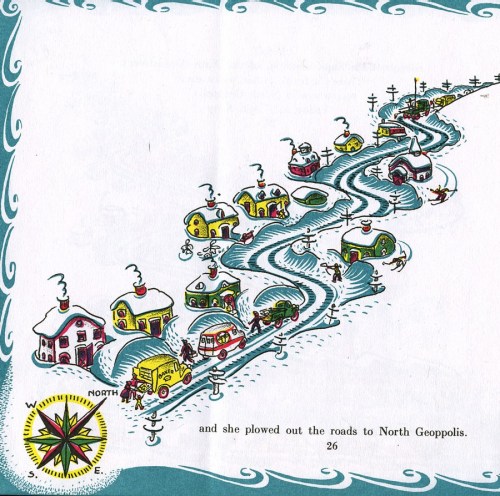 My daughter is three years old, and has gotten to the point of focusing on who is a “she” and who is a “he.” This includes people she knows, toys, and musicians playing on CDs. It also includes characters in books.
Without being obsessive, I’ve tried to ensure a balance of genders in her literary protagonists. Fairly early, many of her favorite characters were male, among them: Else Homelund Minnarik’s Little Bear, and Peter of the Ezra Jack Keats books. But giving her plenty of shes to think about was more challenging than it seemed. To minimize gender stereotypes, and give her plenty of female heroes. Her latest hero is Katy, from Virginia Lee Burton‘s book Katy and the Big Snow. Following is from the Amazon.com review:
Katy, a red crawler tractor, “could do a lot of things,” Burton explains early on. In the summer she is a bulldozer, helping to build and repair roads in the city of Geoppolis. In the winter, she turns into a snowplow, waiting and waiting for her chance to be useful. Most of the winters, though, the snowfalls are mild and the town doesn’t need Katy. But when the big one finally hits, the town is buried in page after page of powder. The power lines are down. The doctor can’t get his patient to the hospital. The fire department can’t reach a burning house! “Everyone and everything was stopped but… KATY!” Suddenly, the entire community is dependent on one little snowplow.
I found the book in a jumbled shelf at Dark Star Books last week. My daughter now fully identifies with Katy. This is a snowy winter, and her Grandpa Mark drives a snow plow, so the story of Katy is not only relevant but personal. At one point in the book, the highway department says of Katy, “Nothing can stop her.” A couple days ago, my daughter repeated it, about herself.
I want to capitalize on this moment, so I’m looking for recommendations. I like best the books where it feels incidental that the characters are female–not necessarily overtly political or socially aware (or please, not simply politically correct!) and I want books that have good stories, well written, and with lovely art. I love old books that have held up over a long time. And with strong females or girls. Female animals are okay, but I want to make sure we have some good shes around.
Read any good girls lately?
 I got exhausted reading a book to my daughter last night, and not just due to chronic lack of sleep, but also because the story included a whole lot of dialogue. I think it might even be physiological, but I have no proof, it’s just a theory.
This realization (that my weariness was because I was speaking characters’ words) illustrated an excellent point that Douglas Bauer makes about dialogue in The Stuff of Fiction: Advice on Craft.
His chapter on dialogue is worth reading in full, but the particular point I’m thinking of has to do with the idea of a sort of judicious (or ill-advised, liberal) use of dialogue. His idea is that entering (reading) a story can be like going to a party: you see a couple across the room. The reader can see them talking, one of the characters is holding a small dog, and something seems to be happening in the interaction, and so on. (This would be the part of the story where the writer is summarizing and setting the scene.) Asking readers to come closer, close enough to overhear (as it were) the characters speaking, can heighten drama and make the reading experience more urgent and interesting. It’s also wholly more strenuous reading, which brings up the next point.
I see a lot of prose that has entirely too much dialogue. Writers of fiction (and probably creative nonfiction) have a responsibility not to exhaust the reader by putting too many words between quotation marks. I am all for demanding a lot of my reader. But choosing to have my characters speak directly to a reader, I should be thoughtful and give the reader a break every so often. A moment or two of pause, a look around the room, something to let the reader take a breath–even if the reader is reading silently.
At any rate, I should be careful about how I use the power of the spoken voice, reserving it for what matters most.

Reading to my daughter tonight, as usual, she chose the books. First, she chose one called Reading Makes You Feel Good by Todd Parr. “I really like books by Todd Parr,” she said. She’d already been reading it to one of her babies when I came in. [My daughter has a lot of babies. Often, when I tell her the name of an author or illustrator, she says, “I have a baby named” (fill in the blank).]
In the rush of the day, it would be easy to just get to the meat and read the book, rather than taking a few seconds to name the author and illustrator. Some books we have (and some she picks from the library) are so ugly, cheesy, and poorly written that I don’t feel like elevating the schmucks who created them by giving them name. Meow. (Though those schmucks are probably making a living at what they do, so I should refrain from sneering, at least from that whole “making a living by writing books” angle.) But even with these stinky books, each time, when I read the title, then “written by…” and “illustrated by…” the child comes to know that there are people behind each book.
My daughter lives with two parents who are writers. As she grows up, she’ll know a lot–maybe too much–about what it means to be a writer. So many writers bemoan the current state of publishing…it’s a sad time for books, some say. But we could do a lot to improve the morale of writers if we do this simple act: when reading a book to a child, include the name of the writer and illustrator. Every time. Every book.
If we do, maybe that lucky child who doesn’t know any writers personally will come to know that someone sat and thought about the book, someone chose words and painted images to tell the story that lulls her to sleep.
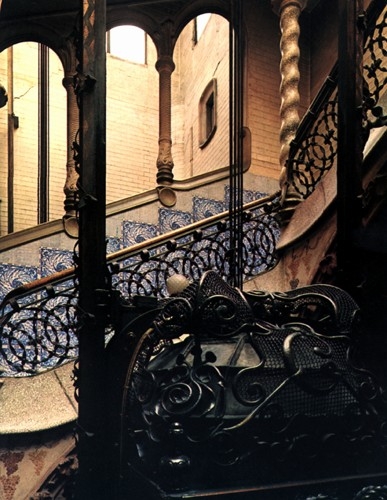 Today I needed to write about a memory from a minor character (Anton the Younger). As houses, and the image and idea of house, tend to haunt me, I decided the character used to live (or actually work) in Casa Calvet in Barcelona. I focussed on this staircase.
I love writing fiction, because there’s so often room to saturate the story in the tea of the writer’s obsessions. Whether this particular scene is going to stay or not, the process was fruitful.
Writing is good.
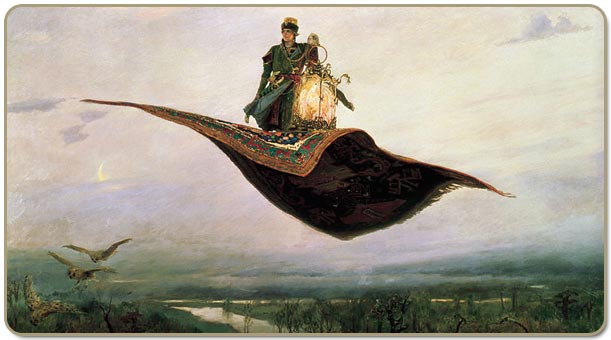 Oh, novel. I’m to page 182, near the end, surely, and sure, and not sure, how it ends. Looking into the less cloudy abyss. How not to rush, how to give it the time it needs? Stevie Wonder sings, in cafe background, “I believe (when I fall in love it will be forever)…” How many times does he repeat that line, I can’t count, but enough times until I start to believe in its incantation, and the love becomes the writing…and then…

Several weeks ago, I asked my daughter, who is almost three, if she would like to dress up for Halloween. She said yes, that she wants to be a pirate. (I think she was inspired by the Charley character in Lucy Cousins’ Maisy books, because several of the books feature him dressed as a pirate.) I don’t think we’ll go pillaging for candy anywhere, unless it’s early enough to be before her bedtime, but I do think we’ll dress up and go out walking in our small town. (Last year, she had a lovely time at pizza dinner with a dear old friend and her daughter–the daughter is a year older than mine, and was dressed as Sleeping Beauty, in gorgeous shiny regalia. My daughter’s all purple ensemble: eggplant hat, fuzzy purple coat, shirt, pants, and purple Robeeze boots were cute but as a costume, it was a little abstract. I admit to putting very little thought into it. She was two!) But this year, pirate.
How to build a pirate costume for a toddler? I’m not going to rush out and buy a bunch of junk. We’ll use stuff from home: bandana, some shirt and pants, boots, jewelry, and a stuffed parrot from the toy box. I have no idea what a pirate mama should wear, but in my last-minute urge to be creative, I recalled a dream I had earlier this week.
So indulge me writing about a dream again. (It’s my blog!)
I was at a writing convention, in a big hotel, or maybe it was a cruise liner. Someone I used to work with at a regional theatre ages ago (who is not a writer) was there, and there was some craziness about him throwing a party that he invited me to but I didn’t have time to see the invitation, being too busy taking care of a sick toddler, but then later I saw him and some other men from his hallway dressed as women. (If you knew the man I’m talking about, this would be a very amusing sight. So we have a Halloween theme begun…) Later in the dream, I was delightedly climbing, scaling really, the outside of what had now become a beautiful, very old, stone building (apparently now not a cruise liner, but still the writing convention). Climbing the stone was exhilarating and effortless. I was the opposite of afraid. It was maybe as good a feeling as dreams of flying. Someone inside the building asked what I was doing. “SWASHBUCKLING!” I yelled. It was how I imagine those parkour people feel when they are doing their amazing yet completely natural movements.
And then (just now) I remembered Peter Pan and the pirates in Neverland, Smee and Hook and the gang. I’ve long been obsessed with those characters, so took a nostalgic stroll through the images I used in grad school for a seminar on J.M. Barrie’s Peter and Wendy, where I found the image above. (Not Disney. No. No. Read Peter and Wendy. Even if you are a grownup with no kids. It’s beautiful. If you have the time or money, look at the edition with illustrations by Mabel Lucie Attwell. They are transcendent.)
So yeah, I am going to be a pirate this year.
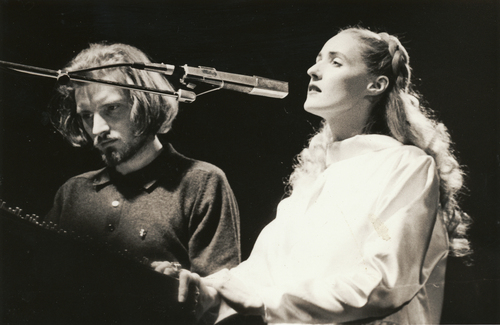 Yesterday, I listened to Dead Can Dance “Toward the Within” because, happily, it’s Dead Can Dance season again, and their music always helps me into the right moody mood for autumn. This song, “Cantara,” struck me as the proper anthem for my new year. The sort of warrior voice that echoes through this song, in Lisa Gerrard’s language, seem just what I need. I don’t usually choose battle metaphors, but this notion, the idea of preparing for battle, seems right for some reason. (Contradictory for a Libra, maybe.)
At the end of the video, Lisa Gerrard mentions her child’s pre-verbal state, and how the child sings, unfettered by the bounds of language. Maybe my war is with language, and I need to sing without words.
And I’ve been fascinated with death lately, fascinated with the full process that it is, and all that it implies. After listening to Gerrard and Brendan Perry, it seems like this song is my right anthem for now.
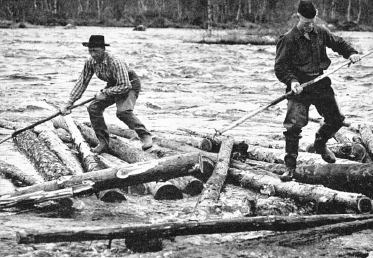 Trying to recreate words lost in the recent death of my hard drive (and overly old backup files). Writers beware: back up your data. (Or risk having to recreate. I think the following might be better than what I had, but there was too much angst in the process of loss.)
Years before, opportunity had stolen most of the trees. Bend, snap, cut went the rhythm of thieves. Wood mill. Trees sometimes fall naturally into water, storms come and leave their messes behind, but these logs were felled too fast, unnatural, and shipped down the river, money to be made. They’d grow back, some said, but forgot to plant seedlings, no thought beyond the next greed-meal. Just along the river, a few bushes remained in the thin trickle of lush.
 Someone very smart just articulated something I needed to hear. In the context of writing fiction, specifically, world-building, there’s a need to embrace the logical, but move away from the expected. For instance, if your novel is placed along a river, in a very dry climate, there would be trees there, or if not trees, an explanation of what happened to them. Logical, both in nature, and in the context of the world being created. But when a writer is deciding which of two characters named Anton (“Anton the Elder” and “Anton the Younger”) should quit a carnival due to fickle working conditions, the expected would be the younger leaving. Youth has more energy and less patience, right? But why can’t Anton the Elder leave?
So I decided he did leave. In my world, age has more wisdom and less capacity for bullsh*t.
 Rebecca Kuder