I can’t yet write deeply/fully about my experience at Lynda Barry’s WRITING THE UNTHINKABLE Omega Institute workshop last week, because it’s all still coalescing, and it’s summertime, and I just don’t have the mind space word space right now. But I wrote a message to my former students and couple colleagues, because the message does scratch the surface (cliche, I know) in telling about how it was to be in the room with LB. More, more deeply, when I can.
***
Hi, all,
I’m just back from an amazing workshop at the Omega Institute in Rhinebeck, NY, where I spent the week along with 70 others working with Lynda Barry. Some of you know her work, maybe some of you don’t…but I wanted to pass these links along in case they are of interest to you.
If you like her vibe and work, I recommend the workshop very highly. It got me moving in the creative flow, writing and drawing and working really hard, and also unlocked a lot of stuck ideas I had about making art and what it’s all about.
(Or, in shorthand: Lynda Barry rocks! And so can you!)
She’s very generous about her teaching. She considers her work open-sourced, and wants anyone and everyone to have access to it. Her book that contains the most teaching stuff in it is Syllabus, but it has as much for the maker of art as the teacher. (Okay, by now you know how I feel about Lynda Barry’s work.)
Here’s her TED talk, a good, longish introduction to her work:
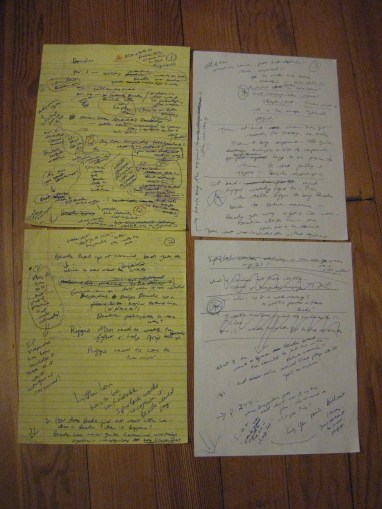
Often, new writers use extraneous stage directions and phrases that aren’t needed to show characters action. (So do I.) The reason, I think, is similar to my last post: First, the writer needs to see it all happening, in detail. Once that vision is established, however, it’s great to trust the reader to and winnow what’s possibly bloating the sentences. Here’s an example from my novel:
FIRST VERSION: (I had to figure out where the character was going, and sort of lay it all out, with too much stage business describing what’s happening.)
She stumbled through the fire pit and into the hotel, quietly as she could, and went straight toward the stairs, but was stopped by Mr. Suspenders’ voice from the direction of the kitchen, where there was a light. “Whoever you are, a little help!”
PARED DOWN: (Once I realized I could see it, I pared down.)
She stumbled into the hotel, quietly as possible, and went toward the stairs, but Mr. Suspenders called from the kitchen. “Whoever you are, a little help!”
I just had that feeling again: Final tweaks to my carnival novel, paper manuscript having been read aloud by me, inked notes having slashed many paragraphs, sentences, and words, now typing it up…
…this novel’s first of its nine lives was so overwritten, so many adjectives…I piled them on until the pile slid down into a word-hoarder’s jumble and hid the story…
…but the feeling I just had, again, slashing, slaying, comes back to TRUSTING THE READER…but also remembering that as writer, first, I had to KNOW (that the goggles were cloudy and tight, the straps were safe, there was “so much wind and motion”)…
…I had to see it & know it before I could show it…
…a very satisfying feeling, knowing now what I don’t need to say on page…
…there must be a word for that feeling…the first-knowing-then-trusting-before-being able-to-do-the-showing…
…But today I reached page 200 of a final flea-combing through my novel! I love this process: Reading aloud, carefully, slowly enough, making necessary changes, nothing is sacred…all performed within a short-ish (for me) timeframe so the arc of the thing is fresh in my mind. One day ahead of schedule! Now: Can I read 130 more pages between today and tomorrow afternoon? Hmm…
This summer, I will start looking for a publisher. (Even as a volunteer, I love my job.)
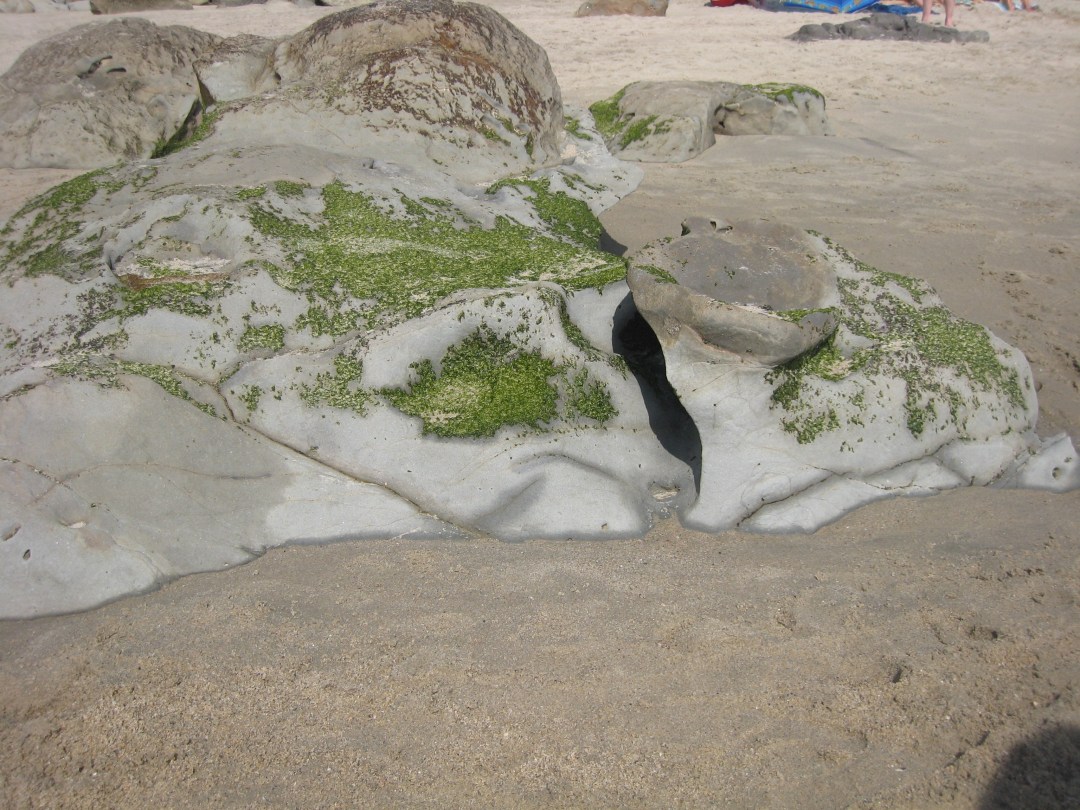
Mountain/small rock, Laguna Beach, California, 4/3/16
Considering the controversy surrounding the Antioch Review’s publication of the article “The Sacred Androgen: The Transgender Debate,” by Daniel Harris, I thought of Maggie Nelson’s genre-bending memoir,The Argonauts. (You can read an overview of the Antioch Review controversy here.) (And I blogged a tiny bit about The Argonauts here.)
In The Argonauts I find a beautiful work of humanity. Reading it helped open my thinking about gender and the lack of imagination it takes to embrace the too-limiting gender binary. (As a writer and person who celebrates the human imagination, why should we only acknowledge two poles?) (I like to believe my mind and heart were already pretty open, but as a relatively straight, cisgendered woman, with a relatively well-understood path to walk, I have some distance to travel before I can truly understand less straightforward life narratives. As stories will do, reading the story of Maggie Nelson and Harry Dodge helped open me, helped me see a wider vista.) I recommend the book. In addition to its value as a work of social justice (and theory: it is quite accessible even to me, as someone outside of Theory) its lyricism is breathtaking.
What I find in Nelson’s book is a beautiful argument in favor of focusing on the particulars of being human, that specificity. For those of us who write fiction, this is an important part of creating character. (And as we create character in fiction, we have the opportunity to open the minds and hearts of our readers, to allow them to imagine another human’s inside terrain.)
Maybe the Antioch Review could invite Maggie Nelson to write for a future issue!
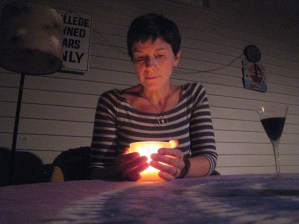
Flea market lamp; thrift store wine glass bought for our wedding; College Cars Only sign stolen from Earlham College in the mid-1980s; tablecloth brought from Africa via college friend; ship painting by folk artist Mary Paulsen acquired in 2012 in North Carolina; glass flowerpot candleholder from Mendelson’s Liquidators and used for wedding centerpiece, still useful; Writer in the midst of detritus of the Weird.
I’m grateful to editor Mark Teppo of Resurrection House for first publishing the story, and to Year’s Best Weird Fiction 3 guest editor Simon Strantzas and Michael Kelly at Undertow.
It’s a big deal (to me) that 1) Anyone is reading anything these days, that 2) Mark Teppo liked my story enough to publish it, and that 3) Simon and Michael also liked it enough to honor it in this way.
I don’t often write short stories. This story came from months and strata of excavation, which I wrote about here and elsewhere on the blog: layers of messy personal essay drafting, onion-peeling story attempts…all trying to find where the innards of that slice of my humanity would fit into Story.
Grateful that it fit somewhere, and that people in the world outside my head appreciate it. I always felt, and still feel, weird. Nice to have an upper case confirmation.
“If a person will only think about it, the first fountain pen was
undoubtedly the human body itself, with its seemingly endless
(till death do us part) supply of ink.” —p. 165, Parsifal
“A fountain pen forces no one to read its words.” —p. 224, Parsifal
As I read Jim Krusoe’s writing, which I’ve been doing for a decade and a half, I find it simultaneously familiar and strange. In his work, I hear a persistent drumming behind the prose, a call. My ears strain to grasp the sound; it’s just beyond my reach. It occurs to me that it’s similar to how the musician Bill Frisell allows his past themes to reemerge and weave into the texture of the new, Don’t I recognize that from somewhere? Familiar, strange. By these haunts, I’m both lulled and awakened. What does that memory mean this time?
In Krusoe’s work, that mystery gives me permission to dream while I’m awake. Or, perhaps, as Krusoe puts it on p. 75 of Parsifal: “Somewhere there must be a word, some technical term, for a combination of anticipation, nostalgia, and dread.”
Then there are the pens. The protagonist of his last novel, Parsifal (Tin House, 2012) repairs fountain pens. (Reminiscent of the protagonist in his first novel, Iceland, who repairs typewriters.) This persistent loyalty to archaic means of capturing story on page is a comfort in our era of disembodied ones and zeros. In the narrative weave of Parsifal, a sort of Aesthetics of The Fountain Pen emerges:
“‘In my experience,” Parsifal tells those who ask, ‘there are two kinds of people: those who enjoy complications and subtlety, and those who do not. If you are not the sort of person who enjoys complications and subtlety, then a fountain pen is not for you.’”—p. 191, Parsifal
I write first drafts on paper. The fountain pen is my primary tool. Wait! Am I “the sort of person who enjoys complications and subtlety?” Am I really? Or do I like things more tidy? Complications and subtlety are so messy! So uncomfortable! But evidently so appealing, so attractive. As a person who (apparently) enjoys complications and subtlety, the fountain pen thread was one of the primary pleasures as I read this novel. If we can trust the narrator of Parsifal:
“During the first years of fountain pens, prior to the actual Golden Age, which was roughly from 1910 to 1950—prior to the invention of the ballpoint, in other words—it is a little known fact that no fountain pen came with the small clip that holds it snugly inside a pocket of a shirt. That was invented by George Parker, of the Parker Pen Company, and ever since then it’s hard to imagine a pen without one (though some pens are still made this way, primarily for the Japanese market). So it is possible for something to come from nothing: no clip for many years, and then suddenly, a clip. And now, with the fountain pen practically extinct, the clip lives on, attached to ballpoints, and roller balls, and mechanical pencils, and laser pointers.”—p. 246
Jim Krusoe was my mentor in graduate school, and since then has continued to be a significant influence, inspiration, and support. In the classes I teach, we sometimes discuss why different writers write. I’ve never asked Jim why he writes, but I wonder if there’s a clue in Parsifal on p. 181, “Who was it that said our sole glory as humans is to leave behind a record of our crimes and desires?”
(Was it Jim Krusoe?)
His next novel, The Sleep Garden, arrived at my house yesterday. I cannot wait.
Writer with a stink bug (Antioch College Olive Kettering Library)
This week I set the goal of finishing a solid revision of my novel. Thanks to the wise and generous writers who read and gave feedback on this round (Kristin Walrod, Melissa Tinker, and Robert Wexler), and the stink bug who showed up for the final lap, I made it.
My husband Robert printed out the beginning of his novel for me to read. I printed the end of my novel for him to read. Loving this man, this work, this symmetry…

 Often, new writers use extraneous stage directions and phrases that aren’t needed to show characters action. (So do I.) The reason, I think, is similar to


 Rebecca Kuder