Here’s a great little review of In Springdale Town, by Robert Freeman Wexler (who is also my husband). The ebook “opens with an ostensible introduction from the author, purporting to tell us the origins of the tale, but he immediately raises our doubts…”
What a lovely finish for the review: “This is a fantastically idiosyncratic narrative that will stick with you long after you put it down. A must must must-read.”
Trent Walters, J’agree!
(p.s. You can read an interview with Robert here.)
I’ve had little time for writing lately. But the intention, and the work when time allows, is to return to the brain of my novel in progress. At intervals, when I approach the stack of notes, outlines, and diagrams, I find scrabbly handwritten pages, still to be typed up. Today, three such forgotten pages included intricate ramblings that I don’t remember writing. But based on the single sheets on which the words are written (not in the notebook, not on yellow legal paper) I recall now rushing to my daughter’s creative movement class, realizing I brought no work to do, and finding scrap paper. The words on the paper were extra crazy and weird, abstract and also specific, really just a spew of stuff about the textures and elements of this novel. If the last novel was water and air, this one is earth, metal, fire–so this is what the windings on those found pages contain.
“Just make some shit up,” my husband and I often say about writing fiction, part joke, part true. For now, when it’s hard to get back into the novel’s essence, I am grateful for these odd scrabbles to type up. Because I can always type. And I trust the Wexlerian principle of just putting it all in, pile it on, see what fits.
The junk yard of words is in no hurry, will wait for me.
Swimming beyond the breakers, being lifted gently, interpreting light and shadow on waves, a practice, being the human working and being carried by water and letting go of every possibility of knowing.
Feels like writing a novel.
In 2000, on my first trip to the beach with my then not-yet-husband, he and I went out swimming. I kept trying to see if I could stand, kept trying to know where I was. His advice: Don’t try to touch bottom. It will only scare you if you can’t. Just swim. I am from inland, from clear chlorine pool swimming. In that dark North Carolina water, full of who-knows-what, I learned about a certain kind of faith. The kind of faith that teaches a body to trust that it will know what to do, that it will tend to survive. Floating and swimming and rolling in those waves, I realized the novel I was beginning to write was like that. Don’t try to touch bottom. It will only scare you if you can’t. Just swim.
This seems the only way of making something when you’re trying and there might be nothing there. The cliched leap of faith, the answer to the question, “What else would I be doing with my life if not this?”
Twelve years later, still swimming, still trusting that a body will know what to do.
On the waves, writing another novel, still.
**
Or, says Tom Waits:
The ocean doesn’t want me today
But I’ll be back tomorrow to play
And the strangels will take me
Down deep in their brine
The mischievous braingels
Down into the endless blue wine
I’ll open my head and let out
All of my time
I’d love to go drowning
And to stay and to stay
But the ocean doesn’t want me today
I’ll go in up to here
It can’t possibly hurt
All they will find is my beer
And my shirt
A rip tide is raging
And the life guard is away
But the ocean doesn’t want me today
The ocean doesn’t want me today.
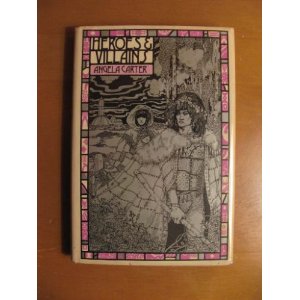
This is not my book, but there’s one like it on my desk. I wish you could see the cover up close.
There’s a book on my desk that I finished but can’t quite put away. I want to blog about it but have not had time to be thoughtful, and the tapestry of its pages is still sinking into my soul. It’s Heroes & Villains by Angela Carter. My husband recommended it–he thought it would inspire me as I work on my new novel, because it’s also about a young woman who loses (and maybe finds) herself in a world very different from the one she’s known. (In my case, the protagonist has amnesia, so she doesn’t know what she’s known.) And both lost/found young women get pregnant. Reading this novel confirmed what I knew: I need to read much more Angela Carter.
As I read, I saw that my husband’s recommendation was eerily right on. I am not comparing my work to Carter’s writing, but there are some similarities between my book and hers. How could I have known that the novel I’m working on has this kind of root source essence to dig into? I read this novel too quickly; I didn’t give it the time and attention it deserved. Now it sits prettily on my desk, wanting more of me, and me of it, but there’s no time right now.
All I can say is that it deserves more of me, and we will both have to wait. But it will be worth the time, at least for me.
Robert Edric, author of The Devil’s Beat and The Mermaids (among many others)
Robert Edric is the author of twenty-two books, most recently The Devil’s Beat. I had the pleasure of talking by phone with Mr. Edric on March 8, 2012. Our conversation centered around Edric’s novella, The Mermaids, from PS Publishing. (Special thanks to Peter Crowther from PS for arranging our interview.)
Here’s the first installment transcribed. I will post more as time allows.
REBECCA KUDER
This spring, I’m teaching a creative writing course, and looking at a examples of well-written fiction and nonfiction, approaching reading as painters look at brushstrokes, to understand how the thing was made. I’m assigning The Mermaids because I love it, because of its economy, and its unity of place and action. I think it’s a great text to focus on.
ROBERT EDRIC
With regards to the actual writing itself, it was one of those books that actually got smaller and smaller and smaller. I wrote it in a week, twelve years ago, when we’d just moved house, and I didn’t have anywhere to work. And every autumn, I get the urge to write a book again, and so I sat down, and I wrote three novellas, of which The Mermaids was one. I originally spent a fortnight, I only ever work for a few hours in the morning, and I spent a fortnight writing it, and then I typed it up, which takes a very long time for me, and I put it away. And I didn’t look at it again for three or four years, because…I don’t know what happens in America, but in England, novellas, short novels, were just a no-no for publishers, and I had another book on the stocks, and I put these three novellas to one side, thinking they would make a nice trilogy eventually. With The Mermaids, I much enjoyed writing it because as you may have guessed, that kind of language over anything much longer than that length isn’t sustainable. It’s very unreal language… it’s loquacious and it’s poetic…it hovers between language of the real world, and language of dreams. The book itself is posited on the notion of the existence of mermaids, of course, and we all know they don’t exist. So you have to take out of the equation, instantly, the reader’s suspension of disbelief. You can’t depend on your reader thinking, “Oh, I believe in mermaids, so I’ll read this,” or, “I don’t believe in them, so I won’t.” The language somehow has to reflect that lack of the concrete… the language itself isn’t concrete because the facts aren’t concrete, because the reality of the situation is that it all exists inside a girl’s head. She’s fifteen, just about to be sixteen which sort of turns her into a woman in the eyes of them all, so the language is the language of thought, and dream, and fantasy, as opposed to the language of the real world. Nowhere in the book is there a suggestion of time, and place. I know where it’s set, and the timing is about the mid 1930s. There’s a very tiny reference to a major war having been fought fifteen years earlier. And the language somehow has to be as timeless as the notion of mermaids, which is why the language is as it is, which is a consequence of the book having been revised and revised and revised downward. My manuscripts are invariably twice the size of the finished product because of the way I work. I work very organically. I know this sounds a little precious but I sit down, and I write for about two hours, and I produce 6000 or 7000 or 8000 words, usually a whole chapter, in the case of The Mermaids, five or six chapters, five or six pieces rather, and then I literally leave it a year, having written for two or three months, and then go back to see what’s there. I’m not a planner. I don’t work things out, I don’t know what happens the day after and the day after and the day after. I write and write and write until I’m exhausted, and don’t want to do it anymore, and then I go back to create some kind of order out of that particular chaos, and I create the form of the book out of what I’ve written, as opposed to worrying about what’s missing or what should be there. I see what I’ve written, and then I work out how to best structure it. And so the language, I suppose, is all there in the very beginning but you need then to create the spaces in the language. And I’m very conscious of the fact that it’s the most poetic thing that I’ve written. I’ve written crime novels where the language is completely different. But I’m also a writer who’s very aware of language. I love reading well-constructed sentences. I love finding out how meaning has come into being through language. One of the important things a lot of reviewers and critics never seem to want to know about, never want to talk about, is how something was actually created. It always concerns me that there’s a kind of belief that the thing was there, and what the writer’s done is give it some kind of meaning and structure. You scream at them and say, “No, it’s all been made up! It’s all come from my head, it’s all come from my imagination!” But it’s an intangible. It’s one of the things that they don’t know. And they don’t know about fine writing. You never see in a review, “Well, this is beautifully written,” well, they’ll say it as a throw-away, it’s like calling a meal “well-cooked.” It’s very edible. Well of course it should be! And writing should be clear and simple and straightforward. It should do what the writer wants it to do, and most importantly of all, for me, the writing should reflect the nature of the story being told. And that brings us back to the idea of this being fantasy, dream… it’s a kind of vaporous language, the language in The Mermaids. It’s very suggestive, and you can disagree with practically everything that’s written about the mermaids from the girl’s perspective. The counterpoint for that, of course, are the three men who are questioning the girl. And their language, and the writing which reflects and represents them, is very very different.
REBECCA KUDER
I’d like to pick up on several things you said, but I’d like to start with some very heartfelt praise about what you’re talking about in the language, because I’m very concerned with sentences and phrases. You have so many watery images and words and so much, I would say, hypnosis, within the sentences, that I felt the sentences and phrases were often mimicking the movement of waves on the shore. And it just thrills me when words are so beautifully steeped in the essence of the book.
ROBERT EDRIC
Thank you for that. Do you know something, one of the greatest things for me in writing is being able to do that. It somehow doesn’t matter that the reader doesn’t pick up on it–it’s always nice when it happens–but it doesn’t matter, because the ability to put things in is more important than the ability to take them out at the end. And I’m a great fan of something called euphony where words simply look right, the tone… I mean I’m one of these ridiculous writers. I think James Joyce used to do it. I read a sentence and instinctively I know if it’s right or wrong. And if it’s wrong, and I don’t know why it’s wrong, I work out the number of syllables, and it’s a ridiculous way of structuring a sentence, but sometimes it is simply the number of syllables in a sentence which is wrong. And it’s not something you pick up, it’s instinctive, like walking or running, you know how to do the thing you do well, but it goes wrong sometimes and if you were that good at doing it, why does it keep going wrong? And yes, you’re right, there’s an incredible amount of watery imagery in The Mermaids, and there’s a lot of reflection, there’s a lot of looking glass, there’s a lot of surface of water, there’s a lot of the tide rising and falling, just as the tide rises and falls through the little village. And there are a lot of people changing direction just as the tide comes and goes, and there are lots of people being believed and disbelieved in equal measure. And I live at the seaside, I walk my dog on the beach once or twice a day, and I know what a difference living by the sea makes. I don’t suspect you get that there.
REBECCA KUDER
I sure don’t! Sadly.
It’s interesting about sound–it’s such an intimate connection with words and sound and how things look and sound. I remember being at a seminar that Cathy Smith Bowers, an American poet, was giving, and she handed out this chart of vowel sounds and the feelings that we get from different vowel sounds, and I realize that I hear that and I experience it intuitively, but looking at it now, on later drafts, I can see, “Oh, I have lots of o sounds here, what’s going on with that,” and then make more of it. In The Mermaids, there is a passage on p. 41 where you have such beautiful repetition: “She herself had told no one except the photographer, and had told no one else of what she had told and shown to him–told no one that he and she had gone back to the cave together before the sea had returned and filled it again…” and the repetition of “had told” was somehow very luscious. And the vowel sounds supposedly cause, in the reader, feelings of sorrow, awe, dread, gloom, heaviness, but also of calm and soothing, so it’s an interesting and very complicated way to look at sentences but it’s a poet’s look at sentences, I guess, and I love seeing that in prose.
ROBERT EDRIC
Most writers who’ve served their proper apprenticeship–I mean, I’ve published, God knows, 20, 22 books now–and so I daresay that intuitively, you do pick up these things without being told what you’re doing. It almost seems preposterous to tell a creative writing student that there are too many i’s or too many o’s and why do you use the word “told” four times in two sentences? Well, one answer for that is it’s like a bell being tolled, and if you’re telling someone, you’re not simply whispering or speaking or saying or remarking or answering or suggesting, telling someone is a different thing entirely. I love deciding which words work best. And I think with things like The Mermaids, it is an allegory, and most allegories depend on a very very simple language… not childlike, but a language a child would easily understand. My first instinct on writing The Mermaids was to make it so a ten-year-old could read that book. And there’s not a word in it that they wouldn’t understand. I know it has a few dark shadows in the book which children wouldn’t appreciate, and I know it’s about puberty and adolescence, which a lot of people don’t want to sort of face up to, from either side of it, so to speak, but the language of the book is–I hesitate to use the word “biblical”–but biblical language is incredibly straightforward. If somebody’s saying something, it is “I said” “he said” “I said” “he said” and I think that that’s great. People worry about this; people worry in creative writing, they say, “Oh, you’ve used ‘he said/she said/he said/she said’” and I normally say to that, “Well, if we know who’s speaking, there’s no need to tell it, but by telling who said it, you’re making another point. It’s a bit like the old cliché about Raymond Carver, “Oh, God, he overdoes it,” but he doesn’t. “What’s the weather like?” he said, “It’s raining,” she said. “Is it?” he said. “Yes,” she said. It’s the “he saids” and “she saids” in that sentence that make it the desperate little conversation it is. And I don’t know how you can tell people that that’s a good thing or the right thing or the proper way to do it, but it is. Like most writers, you do intuitively know it.
REBECCA KUDER
And it becomes a metronome, sort of.
ROBERT EDRIC
It does. And part of euphony, part of words looking and sounding right is of course the rhythm. I love the rhythm of words. I love words that somehow look to be doing the job they’re doing. In a very simple way, “he said/she said” does, but then you can describe the flow of water, the flow of seaweed, the flow of air, the flow of time, the flow of a narrative, the flow of a dress, the flow of anything. You can describe words using the same one, you can describe events using the same few words. Short stories, and novels, have to have some kind of cumulative effect. The nice thing about The Mermaids, from my side, is that, with it being only eighty pages long, I can control that flow from beginning to end. I would love that book to be read in a single sitting because there will be echoes and reflections throughout it which depend upon each other. You read the first ten pages of a novel, and by the time you get to page 400, there are meant to be echoes and reflections of 400 pages ago, so you might be two or three months away from that first page, whereas with something like The Mermaids, you’re very close to the first page still. It is, in a sense, like writing a piece of music.
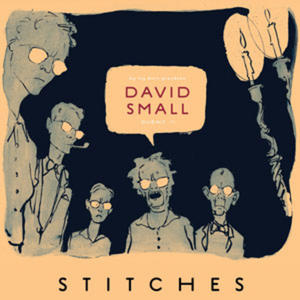
Small print: “by my durn grandson DAVID SMALL Durnit…!!”
One of my students sent me a link to the ten best graphic memoirs, according to Time. David Small’s book, Stitches, was included. I find graphic memoir (graphic “literature” in general) fascinating. (There’s that annoying question of whether anything created in the comic strip format can be considered LITERATURE, to which I say hell yes, but that’s another post.) Many have commented about how writers contain the uncontainable within the tight frames of comic, and how useful that can be–similar to using tight poetic forms as scaffolding for what is huge, frightening, or unapproachable.
I was engrossed in Stitches, for many reasons, and I look forward to reading Small’s books for children. One particular greatness of Stitches was Small’s use of eyeglasses to obscure eyes. In the book, his elders who wear glasses usually have blank space behind the lenses, so their eyes are unavailable, erased, hidden. It’s not until crucial moments in the drama, when truth is being told, or when the character is suddenly vulnerable, that eyes are depicted. This is one of the things that graphic literature can do so beautifully–adding visual layers to the storytelling that cannot be done with words alone.
Among some pieces of wisdom I’ve been given by writers and teachers (and give, now, to my students) is to take care when writing about eyes. I’ve included this advice in a handout I give to students. The following may sound overly dogmatic, and in the whole document I do discuss how rules can (and often should) be broken, if broken well and with foresight, but sometimes it’s necessary to remember:
USE CAUTION WITH EYES, FACES, AND FACIAL EXPRESSIONS
Be careful when you are describing how a point of view (POV) character looks, unless the person is looking in the mirror. However, it can be a cliché to use a character looking in a mirror just so the writer can describe the character’s appearance. Showing a POV character’s face (reddening, for instance) can sound stiff and inauthentic. If you are going to describe how a character looks, focus on more interesting details beyond the data that would be listed on a drivers’ license (hair color, eye color, height, and weight) unless those details are integral to the story. And these glimpses of characters should come naturally from the story, lest they feel pasted on to assist the reader imagine how the character looks. (Readers like to use their imaginations!)
Another note about eyes
You can get into trouble when depicting ANY character’s eyes doing things, and describing facial expressions in general. Eyes and faces, in real life, do convey nonverbal messages, but it’s difficult to translate these things into prose. Be aware of how you do this, if you choose to do this. It’s often better to let the actions and dialogue of your characters illustrate their inner states of being, rather than description from the outside. It’s always good to be careful with the actions of eyes, for instance “his eyes followed her across the room,” because such descriptions, if taken literally, can draw the reader out of the story.
Post on your blog the next 7 lines, or sentences, as they are – no cheating!
Tag 7 other authors to do the same
***
Mim stopped herself telling Cleopatra anything about Beede. She wanted to hold him inside herself, alone, to hoard him, as long as she could. If she told of him, it would water down his essence. And there was something hungry about Cleopatra that made Mim not want to share Beede with her in particular. Tonight Cleopatra smelled sharp and musty, like she had been cooking remedies, or maybe she had been outside with a man, but Mim couldn’t separate the smells to divine which man, and Cleopatra never told when or if.
“Where did you come up with alabaster?” Cleopatra asked.
“Suspenders.” Mim wanted an answer.
***
So with no intention to annoy, I’m tagging seven friends who write…
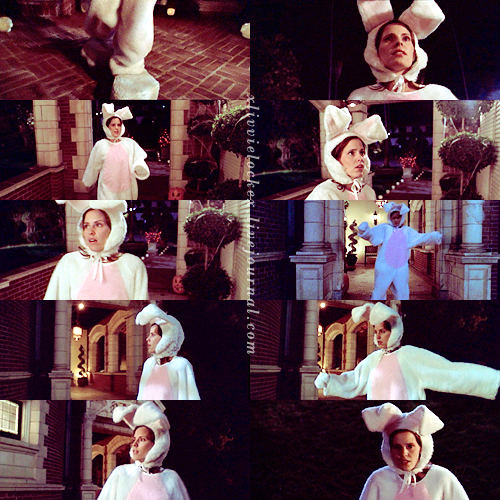
I’ve always loved that scene in the Buffy musical where Anya rocks out against bunnies. If you haven’t seen it, do. (Joss et al seem to have locked down movies I used to find on youtube, but you’ll get the idea.)
Because everyone in the land called Facebook seems to be posting something about rabbits today (why? I ask you) I’d like to share a snip from a story I’m writing called “Rabbit, Cat, Girl.” Here goes:
You want to know about the girl. I want to tell you. But I must begin with rabbits.
Here’s what I know: there have been rabbits since the start of the world, gnawing the sharp drygrass when there are no tender green spring shoots. They burrow into the bases of catalpa trees, and under bushes, hiding like vermin. Some people find rabbits endearing, benevolent like the smiling Easter Bunny, a chocolate charade, lurking beneath false rebirth of spring. Soft and so helpless, they hop like little innocents, and grow like armies, eating everything. Have you ever studied a rabbit’s teeth?
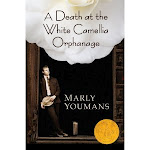
Having read the first page of A Death at the White Camellia Orphanage by Marly Youmans, I’m eager to read the rest. For me it’s a moment of “can’t wait, have to wait” because some work reading must precede this novel, but I hope time will expand so I can get to this novel sooner. I had the pleasure of participating in Marly’s decentralized interview leading up to the novel’s recent release. You can read that brief interview here.
I am reading my four-year-old daughter Charlotte’s Web, by E.B. White. I had forgotten how great the book is–easily one of the best novels I’ve ever read.
The first line: “‘Where’s Papa going with that axe?’ said Fern to her mother as they were setting the table for breakfast.” Seriously, I can’t think of a better hook. When I took it from the shelf last week, my daughter was hesitant to read what, a year or so ago, she had with odd prescience named “the bacon book.” I said, “I’m just going to read the first line.” I did.
Today, after reading her the chapter where Wilbur et al prepare to go to the Fair, my daughter acted out part of the story. She needed a spider, and I remembered my husband’s wonderful Steiff spider, now known as “Charlotte.”
My daughter (“Fern”) quickly made a tent for Wilbur and Templeton (because, she informed me, they were going to kill Templeton, too). She said that Charlotte was “one of the savers.” Fern and Charlotte were saving Wilbur and Templeton.
So another reason to love this book: from it spins the truth that it’s not only males who do the saving around the farm. Females do, too. Children who hear animals talking are taken seriously by most adults, even the medical establishment, in the form of Dr. Dorian: “Children pay better attention than grownups. If Fern says that the animals in Zuckerman’s barn talk, I’m quite ready to believe her. Perhaps if people talked less, animals would talk more. People are incessant talkers–I can give you my word on that.”
I can’t wait until bedtime, so I can remember what happens next.




 Rebecca Kuder