transportation via image

IMG_0297
(Dollhouse dollhouse, kitten, Tiger.)

A week ago, I returned from the Omega Institute where I attended Lynda Barry‘s 5-day workshop called WRITING THE UNTHINKABLE. (I know that I will be writing about the experience for a long time, so I’m not even trying to encapsulate it all here. I do know that the time I spent in that workshop will affect my work and life in ways I can’t yet imagine, and probably for the rest of my life.)

Barry’s work had us considering what is an image but here “considering” is the wrong word: instead of an intellectual brain-ing activity, we considered via specific remembered images…with the moving hand and what she calls the back of the mind, and our friendly Professor Andretti (her workshop code name) guiding, prompting, timing us. We worked like dogs! (It’s a cliche, but also an image, and a puzzling one: aside from working dogs, do dogs work?) On the drive home, almost every song I heard had a mystery in it.

Images are everywhere, and I’m almost 50 years old, and I feel like I am just now noticing this!

Doing this work was the kind of experience that opens the senses. I’m noticing so much, so much more fully, in a more embodied way. I have not yet opened my composition book where the work from the workshop is contained. I’m following Professor Andretti’s advice and waiting, so the images have time to coalesce. It’s a magic process, and I don’t want to disturb it.

But I did open a small box of stuff that’s been sitting in my office for almost a year. The box is full of items from my (long-gone) childhood dollhouse. I still have most of the contents and inhabitants (Steiff and Schuco mohair bears, mostly, and some other species). A couple years ago, I moved the things out of boxes onto a bookshelf in my office, and having it out in the open makes me so happy. But today’s box was undiscovered until my mother found it at her house last year. (When she gave it to me, I opened it and looked through quickly, but didn’t have time to really peruse it, so I put it away. Now I am wondering if I put it off not only because of busyness and inertia, but maybe also something like the composition book from the workshop: maybe in that box there was still something magic happening that needed to be undisturbed.)

Tonight when I looked through the tiny items with my daughter, among the treasures (some pictured below) I found a tiny sample bottle of Estee Lauder Youth Dew. (Lynda Barry writes and talks about how sometimes an image, a song, will transport us back to a forgotten corner of our lives. If you are a child of the 1960s and 70s and you don’t believe me, try smelling some Youth Dew!)

This is one of those times I’m glad I’m a packrat.

Here are some things I found.

IMG_0299
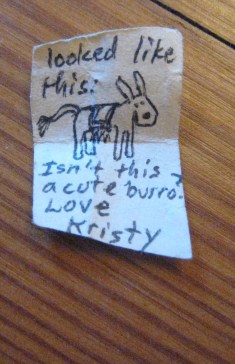
“Dear Flipper, I went to Mexico with my family last summer. I saw a burro that…:”
IMG_0300
“…looked like this: …Isn’t this a cute burro? Love Kristy”


IMG_0285
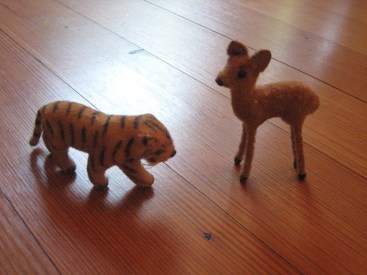
Tiger and Deer were already in my office dollhouse, but in the new box…
IMG_0291
Tiger and Deer found their letters!
IMG_0287
“Dear, Deer I love you. Please write soon. Love Tiger Baby p.s. I coming over.”
IMG_0288
“Dear Tig, You can come over. Sat + Sun”
IMG_0292
more tiny letters and cards (and pencils)
IMG_0295
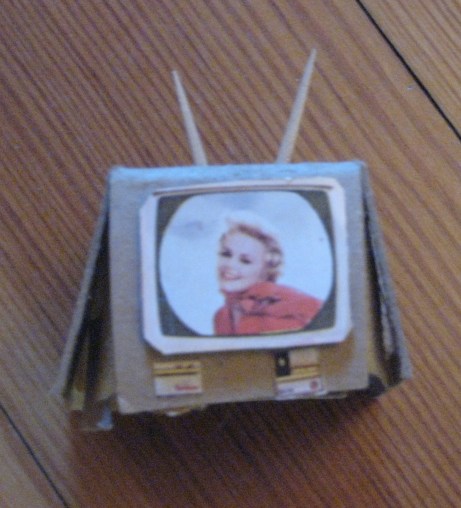
Handmade dollhouse TV. (Antenna=tootpicks)

Lynda Barry, Omega Institute workshop (scratching the surface)

IMG_0214.jpg
(words by someone else, drawing by me)

I can’t yet write deeply/fully about my experience at Lynda Barry’s WRITING THE UNTHINKABLE Omega Institute workshop last week, because it’s all still coalescing, and it’s summertime, and I just don’t have the mind space word space right now.  But I wrote a message to my former students and couple colleagues, because the message does scratch the surface (cliche, I know) in telling about how it was to be in the room with LB. More, more deeply, when I can.

***

Hi, all,

I’m just back from an amazing workshop at the Omega Institute in Rhinebeck, NY, where I spent the week along with 70 others working with Lynda Barry.  Some of you know her work, maybe some of you don’t…but I wanted to pass these links along in case they are of interest to you.
If you like her vibe and work, I recommend the workshop very highly. It got me moving in the creative flow, writing and drawing and working really hard, and also unlocked a lot of stuck ideas I had about making art and what it’s all about.

(Or, in shorthand: Lynda Barry rocks! And so can you!)

She’s very generous about her teaching.  She considers her work open-sourced, and wants anyone and everyone to have access to it.  Her book that contains the most teaching stuff in it is Syllabus, but it has as much for the maker of art as the teacher.  (Okay, by now you know how I feel about Lynda Barry’s work.)
Here’s her TED talk, a good, longish introduction to her work:
And here’s a link about her work as it pertains to ACADEMIC WRITING as well…

***

Love, Rebecca

Alice, Although (Come support the Yellow Springs Kids Playhouse)


IMG_0039

I sent this letter to the editor of the Yellow Springs News. I’m posting it here I missed the paper’s deadline.

**

To The Editor,

If you missed the Yellow Springs Kids Playhouse production of Alice, Although last weekend, you’ll have another opportunity June 30 through July 3. The ambitious show’s focus is on the scandalous and influential life of Teddy Roosevelt’s daughter, Alice.

The production features a cast of young eagles, rough riders, reporters, “It” girls, four Alices, the Roosevelt family, and a snake named Emily Spinach. Through creative staging and hard work, the play’s original script by Jill Summerville and music by James Johnston have been brought to life by the children under the guidance of Ara Beal, AnnMarie Saunders, Eilis Price, Melissa Heston, Jennifer Gilchrist, and Barbara Leeds. YSKP is known for its inventive, exuberant productions, and this summer’s offering is no exception. These children are serious about their work, and it shows.

I grew up doing theatre in Yellow Springs, at school and at Center Stage, and studied theatre at Earlham College. But even for those of us who didn’t follow an academic or professional path, the value of community theatre is deeply felt and far-reaching. At its best, creating a theatrical experience nourishes the imagination and builds generations of humans who are capable of imagining the world anew.

Although the YSKP is grateful to receive donations and grants, the organization depends on ticket sales for funding. In addition, YSKP offers scholarships so that a child can participate regardless of a family’s financial circumstances. Packing the amphitheater next weekend is one way to support this gift of building children’s’ confidence and imagination. Collaborating in the expressive arts helps humans learn about cooperation, and helps build empathy in a world where we sorely need more. In our small way, by turning up to watch the show and supporting organizations like the YSKP, we can help make the world better.

So come see the magic emerge against the cyclorama of Washington DC in rosy hues, reminiscent of a Maxfield Parrish sky. Performances continue at 7:30pm at the Antioch College Amphitheatre (moving inside the Foundry Theatre if the weather doesn’t cooperate) Thursday, June 30 through Sunday, July 3. Dinner and dessert will be offered by Sunrise Café—convenient if you have a busy schedule. (Did I mention the peach pie?)

Sincerely,

Rebecca Kuder (YSKP volunteer and parent of an “It” girl)

Experiments with raw

IMG_9149.jpg

I’m trying experiments where I don’t overthink some of the writing I release into the world. Where I don’t polish until it’s as perfect as my ego can make it (perfection is overrated and a lie, anyway.). This (below) is a raw something I wrote recently (some even tonight) and I will soon type it onto handmade paper by Sarah Strong for an exhibit called The Power Of Story, so I thought I’d also put it here.

**

I am from

1970s Osh Kosh overalls having
too much TV in the afternoon after school
Brady Bunch Courtship of Eddie’s Father, as sad a show as I have ever known.
What else in the afternoon in the house that is no longer there is the driveway even there anymore, I think not.
I am from a fire exercise a house burned down on purpose
it was my house but not really my house because we were renters.
Who did that fire serve, I hope someone, maybe it served my friend whose house burned down later because maybe the firefighters had learned something when they burned down my house.
Did they learn anything.
What did I learn.
Maybe just that stuff needs a place
but if you don’t have a place then
at least keep the stuff keep all the stuff you can from that place
from those days
(and later learn that whether or not you keep one damn thing it doesn’t matter
because stories stick to you better than the shadow to Peter Pan
and don’t need to be reattached by Wendy or anyone else.)

(On apologizing only when necessary) From The Argonauts, by Maggie Nelson

argonauts cover
A stunning and exceptional book from Graywolf Press

I’m so grateful that my dear friend Melissa Tinker gave me a copy of Maggie Nelson’s amazing and gorgeous work of humanity otherwise known as The Argonauts. I adore this book, for about a million reasons. I have so much to say about it, and will, when time and thought allow. For now, here’s what I have stolen from the book today.

Sometimes as a writing warm-up, it’s useful to type up someone else’s well-written words. Today I typed up from p. 98 of The Argonauts.  As someone who has struggled all my life with equivocating and unnecessary apologizing, this passage speaks to me.

Maggie Nelson writes:


“Afraid of assertion. Always trying to get out of ‘totalizing’ language, i.e., language that rides roughshod over specificity; realizing this is another form of paranoia. Barthes found the exit to this merry-go-round by reminding himself that ‘it is language which is assertive, not he.’ It is absurd, Barthes says, to try to flee from language’s assertive nature by ‘add[ing] to each sentence some little phrase of uncertainty, as if anything that came out of language could make language tremble.’

My writing is riddled with such tics of uncertainty. I have no excuse or solution, save to allow myself the tremblings, then go back in later an slash them out. In this way I edit myself into a boldness that is neither native nor foreign to me.

At times I grow tired of this approach, and all its gendered baggage. Over the years I’ve had to train myself to wipe the sorry off almost any work email I write; otherwise, each might begin, Sorry for the delay, Sorry for the confusion, Sorry for whatever. One only has to read interviews with outstanding women to hear them apologizing. (Monique Wittig). But I don’t intend to denigrate the power of apology: I keep in my sorry when I really mean it. And certainly there are many speakers whom I’d like to see do more trembling, more unknowing, more apologizing.”

—Maggie Nelson, The Argonauts, p. 98


Prince (& how it still seems impossible)

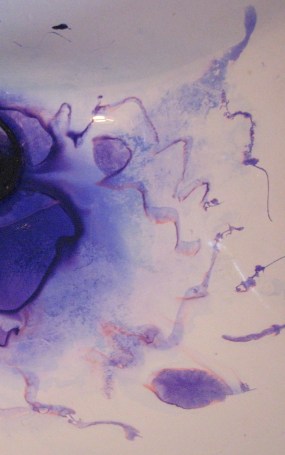
messy_ink detail
Purple prose, to be sure.

His music was the color of the sky of my coming of age. His potency and unapologetic thrust toward LIFE made room for us to do the same…and by “do,” I don’t only mean do the nasty…he named things we could only stumble through feeling, back in our half-formed days…he was able to let the quivery bits of being a vulnerable human shine through, but refused to let that vulnerability stop him…when I think of the iconic flirtation in the geometry of his mouth…he was such a beautiful gamester…I don’t want to make him into a messiah…but there’s something about a world where Prince’s style of shiny permission-giving could be part of my teenage life so casually, so almost accidentally, that makes me believe there COULD be a messiah like Prince…

My essay at The Rumpus


IMG_9230
I made this.

My essay “Hot Thing” (about menopause) was published last Sunday on The Rumpus. (You can read it here.) In the literary community, The Rumpus is a big deal, and I’ve never had anything published there. And to any woman, writing an essay about something as personal as menopause is a big deal. (Theme emerges; to me, this whole event is a big deal.)

(I’m grateful to Zoe Zolbrod and Martha Bayne, editors at The Rumpus, who asked thoughtful questions and helped me fortify the essay and say what I meant to say. May all writers have the experience of working with such helpful editors along the way!)

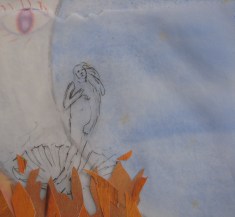
It’s also a big deal because they chose to use my original art alongside the essay. I was glad to be asked what I wanted them to use. To answer, I thought about the essay, extracted themes and images.  Flames, visibility and invisibility,  beauty, mess…The day before I sent the final revision, the image of Venus rising appeared. When I should have been working on edits, I printed the Venus image. On tracing paper with a felt pen, I sketched her lines and contours, placed the paper over various backgrounds, finally settling on a painting of the moon which I made decades ago. And from a photograph of autumn leaves torn from a discarded Glen Helen calendar, I cut flames. Pieces arranged but not glued down, I took a photo and sent it. I felt self-conscious about presenting the art (because I’m an amateur) but blazed ahead anyway. That they chose to use this image validated what I tell my students: Trust your instinct.

So that’s part of the story of this essay.

Another part is that that publication of “Hot Thing” inspired a 2:30am craft essay about writing the essay, which I am now hatching. Not sure where it will end up, but I’m holding on to the tail of the kite.

Another—maybe most important—part is of the story is that I am claiming this new phase in my life. As I put words and images into the world, I am no longer practicing the art of invisibility.

Reading Krusoe

Krusoe_sleep garden
Jim Krusoe’s newest novel from Tin House

“If a person will only think about it, the first fountain pen was
undoubtedly the human body itself, with its seemingly endless
(till death do us part) supply of ink.” —p. 165, Parsifal

“A fountain pen forces no one to read its words.” —p. 224, Parsifal

As I read Jim Krusoe’s writing, which I’ve been doing for a decade and a half, I find it simultaneously familiar and strange. In his work, I hear a persistent drumming behind the prose, a call. My ears strain to grasp the sound; it’s just beyond my reach. It occurs to me that it’s similar to how the musician Bill Frisell allows his past themes to reemerge and weave into the texture of the new, Don’t I recognize that from somewhere? Familiar, strange. By these haunts, I’m both lulled and awakened. What does that memory mean this time?

In Krusoe’s work, that mystery gives me permission to dream while I’m awake. Or, perhaps, as Krusoe puts it on p. 75 of Parsifal: “Somewhere there must be a word, some technical term, for a combination of anticipation, nostalgia, and dread.”

Then there are the pens. The protagonist of his last novel, Parsifal (Tin House, 2012) repairs fountain pens. (Reminiscent of the protagonist in his first novel, Iceland, who repairs typewriters.) This persistent loyalty to archaic means of capturing story on page is a comfort in our era of disembodied ones and zeros. In the narrative weave of Parsifal, a sort of Aesthetics of The Fountain Pen emerges:

“‘In my experience,” Parsifal tells those who ask, ‘there are two kinds of people: those who enjoy complications and subtlety, and those who do not. If you are not the sort of person who enjoys complications and subtlety, then a fountain pen is not for you.’”—p. 191, Parsifal

I write first drafts on paper. The fountain pen is my primary tool. Wait! Am I “the sort of person who enjoys complications and subtlety?” Am I really? Or do I like things more tidy? Complications and subtlety are so messy! So uncomfortable! But evidently so appealing, so attractive. As a person who (apparently) enjoys complications and subtlety, the fountain pen thread was one of the primary pleasures as I read this novel. If we can trust the narrator of Parsifal:

“During the first years of fountain pens, prior to the actual Golden Age, which was roughly from 1910 to 1950—prior to the invention of the ballpoint, in other words—it is a little known fact that no fountain pen came with the small clip that holds it snugly inside a pocket of a shirt. That was invented by George Parker, of the Parker Pen Company, and ever since then it’s hard to imagine a pen without one (though some pens are still made this way, primarily for the Japanese market). So it is possible for something to come from nothing: no clip for many years, and then suddenly, a clip. And now, with the fountain pen practically extinct, the clip lives on, attached to ballpoints, and roller balls, and mechanical pencils, and laser pointers.”—p. 246

Jim Krusoe was my mentor in graduate school, and since then has continued to be a significant influence, inspiration, and support. In the classes I teach, we sometimes discuss why different writers write. I’ve never asked Jim why he writes, but I wonder if there’s a clue in Parsifal on p. 181, “Who was it that said our sole glory as humans is to leave behind a record of our crimes and desires?”

(Was it Jim Krusoe?)

His next novel, The Sleep Garden, arrived at my house yesterday. I cannot wait.

(That this is my life…)

Who knows where it will lead.

Here’s what happens when I see my friends Deborah and Karl Colon (of Changeling) play their music: My heart, having usually been trapped inside my body (where it lives) for some number of days, weeks, or months, sneaks through the sonically-opened window (the one attached to my soul) and my heart unfolds its tired wings, and rises upward or outward, to wherever it is that beauty lives. Yes. This. The heart goes for a visit to Beauty. It’s a tactile sensation. At the first few strains of their music on Thursday night, I felt it, and realizing that this, this, watching the gamboling and frolicking of our children together, this diamond-making that my musical friends do, I thought, and could hardly believe, “This is my  life…that this is my life…”