Our children

They have their own thoughts, they have their own thoughts

Hardly an original thought, but I am starting to understand how much “our” (=all) children need nature.  Even the grownup children.  In my mind, this thought, which is so simple, connects to this song.

Lyrics by Khalil Gibran, Music by Ysaye M. Barnwell

Your children are not your children
They are the sons and daughters of life’s longing for itself
They come through you but they are not from you and though they are with you
They belong not to you
You can give them your love but not your thoughts
They have their own thoughts
You can house their bodies but not their souls
For their souls dwell in a place of tomorrow
Which you cannot visit not even in your dreams
You can strive to be like them
But you cannot make them just like you
Strive to be like them
But you cannot make them just like you

It is impossible to overstate how bittersweet it is to watch a child grow up.  The process is so slow that it becomes invisible, and then one day, the infant is walking, the toddler is speaking, the child is telling stories.  She runs and stumbles and gets up and isn’t scared and she climbs to the top of the blue jungle gym.  When she stands there, realizing where she is, she says, “Mama, help me,” and while I calmly coach her to find a place to put her feet, I am not breathing, I am “please don’t fall!”ing, and I am trying to know with my own body that she is balanced and strong and wise and that even if she falls, this is the work she needs to do on this day, at this moment.  It is exactly right.

(I can house her body but not her soul…For her soul dwells in a place of tomorrow which I cannot visit not even in my dreams, and this fact is what is so beautiful and this fact is what breaks my entire heart.)

She finds her feet, she climbs down, she smiles with exhilaration and now she has done her work of this day and I have not done it for her, I have resisted even trying, and this means that she knows she can do it herself.  She can do it herself.

And you know what?  I do not want the children to be just like us.  Please no!  I want them to find a better way to live here on this earth.  Meanwhile, let’s help them learn by stepping aside and letting them put their bare feet on the earth, letting them feel the mud and water and prickly grass, and letting them pay attention and do all those beauteous things that surround us every day, those things we forget have such significance in the constant rush of rush rush rush.
The exquisite seasons of Kazuo Iwamura

A lovely book from a series by Kazuo Iwamura.

A librarian friend sent my daughter a bunch of discarded library books last year.  (I often find the best children’s books are discarded by libraries.)  Among that batch was the The 14 Forest Mice and The Summer Laundry Day, by Kazuo Iwamura.  It’s a story of a family of mice who pack up and take their laundry to the river to wash.  The mama mouse knows why her children are rushing–they’re excited for the accompanying swim.  Along the way, gorgeous illustrations walk the reader past delicately-rendered dragonflies and foliage.  Reading it feels like a hike in the woods.

My daughter loved this book almost as much as I did.  Quickly I looked for the other books in this series: there’s one for each season.  Finding affordable copies of the 1991 English translations by MaryLee Knowlton was a slight challenge.  I eventually found all three of the others, on eBay and abebooks.com.   Today, the winter book came, completing our collection.

I love how this series shows the mice making sleds and indoor games to pass the time during a blizzard, or forging a platform to watch the harvest moon in autumn, or rice dumplings for a spring picnic.  The illustrations make me feel like I’ve been out in nature: colors rich and vibrant, drawings not just of “flowers” but true species.  The wood violets look like wood violets.  I also love how the series can give a child a sense of the year’s cycles, and a focus on the natural world.  The mice create things by using curiosity and invention, and the materials around them.

The stories are elegant and simple, and illustrate how to live in harmony with nature.  The large family (grandmother and grandfather on down to a toddler) works together to do the stuff of life, the maintaining of home.  Though somewhat hard to find, if you are seeking books that show kids something other than our consumer-based culture, it’s worth the search.  Let me know what you think of them.

Raising a Raindog

This morning, my daughter was pushing the play button over and over again to hear the beginning of a song on a mixed CD that my husband made for her.  On the CD are various of her favorite songs, but all are real “grown up” music that this child’s parents like to listen to.  (There are a few kids CDs in the house, and  some aren’t bad, but we like her to listen to music that won’t sound icky-sticky to our ears.)

The song she kept replaying was “Filipino Box Spring Hog” by Tom Waits.  She likes Tom Waits.  She’s enjoyed this song for a while, even sang it spontaneously one day awhile ago, but today, she was studying on it.  Asking me what instruments were in that musical stew.  I tried to identify each bang and clang as I could (it’s hard–you try it!).  I explained that sometimes Tom Waits just bangs on things, like cans and other things–his percussion is not only drums and the usual stuff.  And as I reveled in the idea of Tom Wait and Marc Ribot et al making that song, I realized my daughter was trying to find the guitar in the song and play along on her beat-up dulcimer, which she calls her banjo.

Later when I asked her what she was up to, she said she was trying to find out why he said, “Kathleen” (as in “Kathleen was sitting down in Little Red’s Recovery Room, in her criminal underwear bra…”)

“T’ain’t the mince meat filagree
T’ain’t the turkey neck stew
T’aint them bruleed okra seeds
though she made them especially for you…”

I’m fighting the urge to expect her to like everything I like, but I’m hoping that putting her around really interesting music will at least be good for her curiosity which will be good for her soul.

One by one

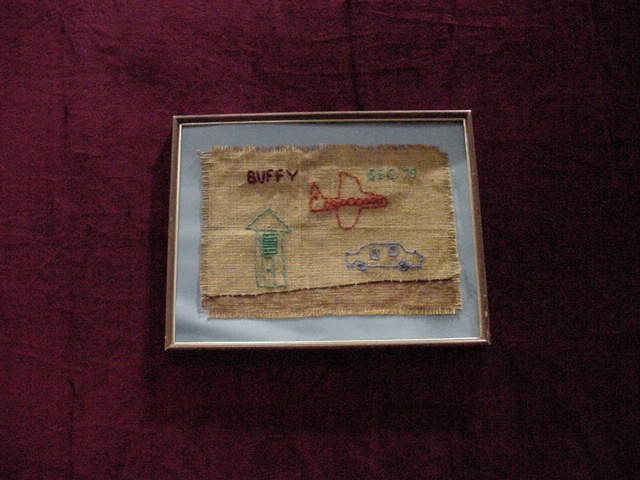
Buffy made this when she was a kid.

A few years ago, Buffy said:

So here’s the part where you make a choice. What if you could have that power, now? In every generation, one Slayer is born, because a bunch of men who died thousands of years ago made up that rule. They were powerful men. This woman is more powerful than all of them combined. So I say we change the rule. I say my power, should be *our* power. Tomorrow, Willow will use the essence of this scythe to change our destiny. From now on, every girl in the world who might be a Slayer, will be a Slayer. Every girl who could have the power, will have the power. Can stand up, will stand up. Slayers, every one of us. Make your choice. Are you ready to be strong?

“Nous Sommes Embarques”

The hands of Bruno Ganz and Peter Falk

I watched some episodes of “Columbo” as a child, but it was the Peter Falk of Wim Wenders’ breathtaking “Wings of Desire” that I recall, sad at Falk’s passing.  In the film, Peter Falk played himself, “Peter Falk,” come to Berlin to make a movie about the Holocaust.  In the clips on youtube, Falk (as “Falk”) politely puts off the media who want to interview him, complains to the costumer until he gets a decent hat, and draws a portrait of one of the extras on the fictional set.  He marvels at her face, and about the extras:

 ‎”Extras. These humans are extras. Extra humans.”

Later, “Falk” talks about drawing, the process of making a line, making art, being alive.  He says,

“Here, to smoke, have coffee. And if you do it together it’s fantastic. Or to draw: you know, you take a pencil and you make a dark line, then you make a light line and together it’s a good line. Or when your hands are cold, you rub them together, you see, that’s good, that feels good! There’s so many good things! But you’re not here – I’m here. I wish you were here. I wish you could talk to me. ‘Cause I’m a friend.”

After we realized we both loved “Wings of Desire,” a friend sent me the poem which runs through the film.  It’s beautiful, and so I am sharing it here. (Thanks, and RIP, Steve B.)

Song of Childhood

By Peter Handke

When the child was a child
It walked with its arms swinging,
wanted the brook to be a river,
the river to be a torrent,
and this puddle to be the sea.

When the child was a child,
it didn’t know that it was a child,
everything was soulful,
and all souls were one.

When the child was a child,
it had no opinion about anything,
had no habits,
it often sat cross-legged,
took off running,
had a cowlick in its hair,
and made no faces when photographed.

When the child was a child,
It was the time for these questions:
Why am I me, and why not you?
Why am I here, and why not there?
When did time begin, and where does space end?
Is life under the sun not just a dream?
Is what I see and hear and smell
not just an illusion of a world before the world?
Given the facts of evil and people.
does evil really exist?
How can it be that I, who I am,
didn’t exist before I came to be,
and that, someday, I, who I am,
will no longer be who I am?

When the child was a child,
It choked on spinach, on peas, on rice pudding,
and on steamed cauliflower, 
and eats all of those now, and not just because it has to.

When the child was a child,
it awoke once in a strange bed,
and now does so again and again.
Many people, then, seemed beautiful,
and now only a few do, by sheer luck.

It had visualized a clear image of Paradise,
and now can at most guess,
could not conceive of nothingness,
and shudders today at the thought. 

When the child was a child,
It played with enthusiasm,
and, now, has just as much excitement as then,
but only when it concerns its work.

When the child was a child,
It was enough for it to eat an apple, … bread,
And so it is even now.

When the child was a child,
Berries filled its hand as only berries do,
and do even now,
Fresh walnuts made its tongue raw,
and do even now,
it had, on every mountaintop, 
the longing for a higher mountain yet,
and in every city,
the longing for an even greater city,
and that is still so,
It reached for cherries in topmost branches of trees
with an elation it still has today,
has a shyness in front of strangers,
and has that even now.
It awaited the first snow,
And waits that way even now.

When the child was a child,
It threw a stick like a lance against a tree,
And it quivers there still today.

And so, Mr. Falk, as the elderly Storyteller of the film says, at the final moment, “Nous sommes embarques!”

A fan back here is wishing on your wings, now returned to you.

Optimist and Pessimist: A Light Operetta

Is it my imagination, or does this guy look like Tom Waits?

OPTIMIST: Sung to the tune of “Singin’ in the Rain“:

I’m mowing in the rain, just mowing in the rain, what a glorious feeling, I’m mowing again!

PESSIMIST: Sung to the tune of “Misery’s the River of the World

If there’s one thing you can say
About Mankind
There’s nothing kind about man
You can drive out nature with a Mower
But it always comes roaring back again

OPTIMIST:

Splashy and head up 

With rain in my ‘do
Why is each new task
A trifle to do?
Because I am living
A life full of dew.

(And I’ll get a blog post out of this yet!)

PESSIMIST:

Misery’s the River of the World
Everybody Mow! Everybody Mow!
(Bandana’s soaked, Bandana’s soaked)
Misery’s the River of the World
Everybody Mow! Everybody Mow!

Finding rabbits

Two Steiff woolen rabbits with photo of John Ott

As you five swell followers might know, I’ve been writing an essay about my childhood home that was burned down in a planned fire exercise when I was sixteen.  A rabbit figures in the story.  Here are a couple of excerpts.

After their pyrotechnic work was done, house gone, I returned to the remnants, stood on the ashes.  Near where the shed had been, I found one of my small wool Steiff rabbits, intact, unscathed.  A tiny symbol of the phantom limb of home–does keeping hold of stuff I had before the house disappeared stand in for a home?  When I hold that rabbit in my hand, I feel something stable and secure, but that’s too simple.

Then later in the essay:

Now I hold the Steiff rabbit that didn’t burn.  I imagine again walking across the charred land, finding the thing, the size of a cotton ball, where our garage had been.  How hadn’t I packed it?  How hadn’t it been torched?  I want to touch, smell, hear, see, consume the moment of finding that rabbit.

So telling truth, I pin that rabbit to a velvet board, and into a new ghost story I shove the cute animal, twist rabbits against type, make them sinister, keep writing.  Everything must be lit, and burn, then melt, transmogrify: everything must milk and then feed that famished ghost, memory.

At a fabulous Yellow Springs yard sale this morning, I found two Steiff rabbits, and bought the pair for a mere $7.  It was like my recurring dreams of finding pieces of my childhood Steiff collection at antique stores and having to buy them back, but in reverse: this morning they were not my rabbits, and I was awake.  Now they are on (the one clean corner of) my desk.

Just more evidence that things keep turning and turning, but won’t let us forget: carbon replaces itself, surprises us, and continues to haunt…

In The Skin of A Lion

Cover of the first edition

I’m re-reading and pondering Michael Ondaatje’s book, In The Skin of A Lion.  I love this book. For me, this is a book to read again and again, to study and learn from.  This novel is an open apprenticeship.  Any good novel might be like that: think about which novel yours might be.  This one speaks to me.

Tonight, this passage from p. 157 seems like one definition of community:

“Alice had once described a play to him in which several actresses shared the role of heroine.  After half an hour the powerful matriarch removed her large coat from which animal pelts dangled and she passed it, along with her strength, to one of the minor characters.  In this way even a silent daughter could put on the cloak and be able to break through her chrysalis into language.  Each person had their moment when they assumed the skins of wild animals, when they took responsibility for the story.”

“heirlooms / a loon”

"I can't drink this coffee til I put you in my closet..." Kirstin Hersh

Music to shed by.

Like a time machine, Kirstin Hersh’s song, “A Loon,” spins me back to the agitation and healing of the 1990s, perfect soundtrack for peeling off layers of emotional scar tissue.

Anger, barely contained within the sing-song, Hersh’s album, “Hips and Makers,” was a favorite for a certain slice of my therapy.  When her song, “Your Ghost” reappeared and began to haunt me recently, I ordered a copy of the CD, which arrived today.

Listening to these songs is like listening to the echo of a loon calling back through the years.  I love how opaque and personal some of her lyrics are; we’re invited into her head (I’m butchering the line breaks  here, adding breaks to denote pauses in the sung song in “A Loon”):

Some store

I’m not going back there any more
wandered in

don’t think I’ll do that again
no I

don’t think I’ll do that again.

I swear you

look at me cross-eyed and I

don’t know what to do
no I

don’t know what to do

crazy loon.

(Then there’s this mad catharsis in the music, then this quiet little afterthought:)

There’s a room in his pallet
there’s a pillow for his head
sees an offshoot in his bottle
when he wants to see me dead
heirlooms

a loon.
Never thought I’d see that silly grin
never thought I’d see that fool again
never thought I’d like that lunatic.

Nothing left to dance around
what a hero
what a black and blue bird
what a loon a loon
what a loon a loon.

Loons nested on the pond by Med-O-Lark, where I worked as a camp counselor back in those days.  Loons only nest on very clean water.  Surrounded by teen angst, this loon pond was where I first heard of the Indigo Girls, where “Closer to Fine” and their other anthems blazed across me and rooted into my synapses.

Indigo Girls was for the surface; others helped peel off underlayers.  Kirstin Hersh helped.  Tori Amos, in “Little Earthquakes,” provided more obvious pumice.  Still does, when needed.

House, Stuff, Fire…

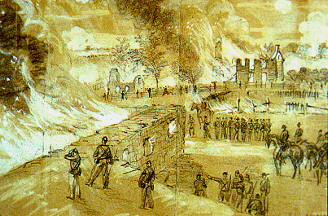
During the battle, the Confederates burnt Samuel Mumma's farmhouse, springhouse, and barn to prevent them from being used by Union Sharpshooters. This on-the-spot sketch was done by the Englishmen Alfred Waud.

Writing churns things up.  That churning is one of the most fantastic things about writing, one of the things I love, but it’s not comfortable.  Facing things, really looking at things, staring dumbly at things, that kind of minute and honest reflection, can be difficult and unpleasant.  You can also find small treasures there.  In working on an essay about stuff (literal stuff, the items that tumble from my closet, the towers of papers and important detritus spanning my surfaces) I realized I actually need to be writing about my phantom limb: my childhood house that’s no longer there.  It was burned down in a fire training exercise.  I’ve written about it in my novel, immortalized it here and there.

This time I decided to write a short story about the house, about a ghost in the house, about the fire…currently, the stuff of the story is a huge mess, but it’s been satisfying to make.  Right now I’m just generating words, ideas, the raw junk that I will attempt to shape into a story.  It’s all I want to do, but it’s so untidy, so simultaneously new and ancient.  Like my surfaces, it’s cluttered, noisy.

And sometimes a spider skitters from underneath…