What I thought inessential is essential

This is a different mess of mine, but looks similar

So I’ve been working on this terribly overwritten draft of my novel in progress.  Gone through the printed pages carefully, cutting, pruning, taking out piles of adjectives and phrases.  The typed pages are a mess now, not unlike this other mess from a previous project.  I keep thinking, “Which gremlin scribbled all over these neat pages here that I now have to type up?” though the gremlin is me.  This novel I have been writing since 2004.  Part of its problem is uneven terrain: while I was figuring out what it was, I was writing along, letting time pass in the story, and the story emerged like sourdough bread (a terrible metaphor!) that, 100 or so pages into it, actually begins to take shape.  So now as I comb through the years of words on these pages, I see where things need to be built up, and where torn down.  With this project, I pushed language and narrative beyond anything I’d ever done.  On purpose.  Because I could!  Here I gave myself license to write a really bad first draft, and use all the purple colorful clang I heard in my head.  (Knowing I would cut later.)

Too many adjectives!  Oy vey!  Too many phrases strung together that unwound from my mind and at one moment in time made sense but now hang like random junkyard decoration.  Get that egg beater out of there!  What did I just step on?  Is that stench overripe banana?  And so on.

Get it out of here!

I realize at least two things about this draft, both of which were essential to my authority in telling the story.  I needed both:

1) The self-indulgent “let everything be in there” messiness.   As author and creator of this world, I had to see how dingy and dusty and clangy and rotten the nouns were.  I had to see the layers of adjective like paint on an old carnival sign, repainted over crack and crumble.  How else would I know the patina of this place?  And;

2) The excessive phrases that are stage directions: “She put the scissors on the round table to the left of the door” and so on.  If it’s even important that she put the scissors down (question everything!) does it matter where?  She put them down.  Fine.  But the writer, again, to establish authority, must see the whole thing happening like a play, must know and track where the scissors are put down.  In case someone else needs to bob her hair!  And so on like that.

If I know this world I’m writing is dusty and clangy and I know where the scissors are, I don’t have to tell you (unless it’s important to the story).  If I am doing my job well enough, the reader will trust me.  She will thank me for sparing her unnecessary words.  Doing so will leave me more room for the things that really need to be there.  It’s like all the doing of research that doesn’t end up in the novel.  Having those things, knowing them, seeing and breathing them, is what allows me to tell the story in a way that will keep people reading.

I hope.

“Give me something to sing about” (RIP Whitney Houston)

Alas, this is not Whitney Houston.

“Give me something to sing about,” sang Buffy the Vampire Slayer, in the excellent Joss Whedon musical, “Once More, With Feeling.”  (From which the title of this post was mis-appropriated.)  Buffy had died and gone, probably, to heaven, but her friends wanted her back home.  So they re-animated her.  Buffy was kinda bummed.

I just read that Whitney Houston died.  My first thought was, “Wait, Whitney Houston DIED?”  Shit.  My second thought was a song, an earworm from my 1990s, before the term earworm, before the song became an earworm for me.

(Rewind.)

FADE TO:  Somewhere in Los Angeles, a city where I did not live.  Sometime in the early 90s.  Just before Valentine’s Day.  Visiting a man.  (I am choosing vagueness.  Some people I know will be glad.)  I was fairly smitten with this guy, despite the miles that separated us, and many other differences.  He was sweet, and fun.  His life seemed big, glamorous.  I lived in Seattle.  (Same time zone, one thing in our favor.)  We’d gone to see a movie.  Memory is funny: I went down to LA several times while we were involved, and he came to Seattle several times–and our visits start to blur, but I’ll say that we saw a movie the night before Valentine’s Day; I’ll say the movie was “The Crying Game.”  Late that night, he said something that made me feel our time together was almost over, that he didn’t want to continue a long distance relationship.  Despite my own misgivings about how long it could last, I was young and romantic and sad when I heard him say whatever it was he said.  Though these years later I know it was best to let go, back then, I wasn’t ready.  There were things I thought ours might have been.

Early the next morning, and I mean really early, something like 7am on a Sunday morning LA time, Valentine’s Day, someone in his apartment complex decided to turn up the radio really loud.  The radio was blaring a song.

You know the song.

First, in the origami that was folding in my heart (expect and hope for something, then have it change too many times until it can never be the shape you thought you wanted) the song’s refrain was an irony at my expense.  Later, every time I heard that song, it was a reminder of that salty moment, that sadness which felt like emptiness.  (I didn’t learn until years later that Dolly Parton wrote the song, a fact which now makes the song more okay, especially when it’s Dolly and not Whitney singing.  More personal origami, this just in: As research for two novels, I’m reading a book about the April 1974 tornados that scoured the middle U.S., and according to King Wikipedia, that’s the exact month when Dolly Parton released that song.)

“AND I-I-I-” (HOW LONG CAN SHE HOLD THAT “I”???) “WILL ALWAYS LOVE YOUUUUUUUU-U-U-U” Whitney Houston sang on that early Valentine’s morning, from a stereo I would never see, volume cranked past 10 to 11 by someone I would never meet, some random person living near a man I had hoped to spend a lot more time with.  (Maybe that person played the song that morning extra loud for a valentine.  Maybe that person still loves that valentine.  Maybe there is an “always” somewhere.  For: I am happily married and have a wonderful child.  The man who lived in LA is married and has children, too, and I hope he’s happy.)  At that moment, though, even Whitney sounded sad, her sadness spilled out, sad for the sad little me, lost in that anonymous LA apartment complex, so early on Valentine’s morning.

So now you, too, know what I heard, actually, when I “heard” the news tonight about Whitney Houston.

It’s awful that another talented and tortured soul died early.  I wish people going through her kind of pain could get better, could live to be happy and really old and then die of natural causes.  I have other things I could write about Whitney Houston, but this memory, this earworm, floated to the top.

(“Don’t give me songs…don’t give me songs…give me something to sing about,” Buffy said.)

The Rules

THE RULES:

1) NEVER UNDERESTIMATE EACH OTHER.

2) KEEP YOUR HANDS STRONG.

3) DON’T KEEP WHAT YOU CAN’T CARRY.

4) CLOSE YOUR EYES ONLY WHEN NECESSARY.

5) NO SPITTING.

6) NO PUGILISM.

7) A THING ISN’T YOURS UNTIL SOMEONE GIVES IT YOU.

8) MACHINES SHALL REMAIN PRISTINE.

9) DON’T BE TOO SUPERSTIOUS.

10) BE A LITTLE SUPERSTITIOUS.

11) TRUST US.

(From The Eight Mile Suspended Carnival.  Please abide by these rules if you ever have a chance to visit.)

Cornflowers and ghosts

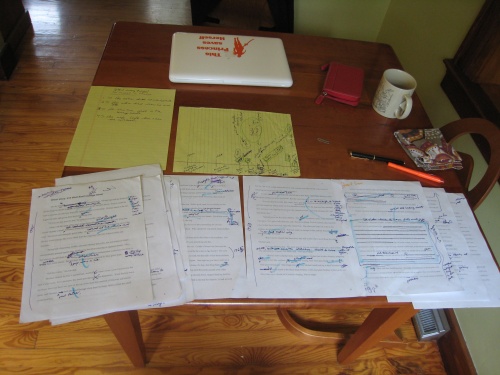
A mess that might be grow up to be a story someday.

This morning, as I did my post-child infrequent and highly interrupted version of Julia Cameron’s morning pages (more like three quarters of a page, if I’m lucky) my daughter said, “My, look at all those words!  It’s like a giant nametag!”  Aside from making me laugh, her comment reminded me of the photo I took last weekend: the mess I was making with a ghost story in progress, whose birth story can be found here.  When I talk about making a mess, this is what I mean.  This is the kind of mess that I love.  It’s all my mess (no one else has read this story, and all the scribbles, highlighting, and editing is mine!  No judgement, no other voices in my head!) and here I’m trying to make order of it.  It’s the first draft of a messy story that came from a terrible essay about one thing which grew into an essay about something else.  Like the leggy cornflowers that we let go (“Let?”  Who has time to even consider “letting” weeds grow; they just grow taller when I’m not looking) that bloom into flowers, whose color is unmatched in the rest of nature.  The flower that needed to be.

I’m not saying this mess is good, and I don’t know if it ever will be.  But what else would I rather be doing?  Maybe weeding the other flowers to give the cornflower more room.

What about you?  What would you weed today?  What would you plant?

The end of a story?

It’s weird writing something when you don’t know you’re about to write the end of the thing.  This might be the end of the ghost story I’m writing.  We’ll see.  But it seems like the end.

This photograph faded with time, as he told the story to Cricket, as he counted to one hundred, night after night as he himself drifted next to his child, wondering how on earth such a tender thing could continue to survive.

Vigor takes work

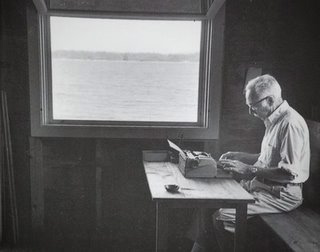
E.B. White, writing in Maine

I just reread Elements of Style, and several bits of wisdom have taken residence in my mind.  This was the first time I’ve read the fourth edition.  I found the updates to this edition helpful, in particular, some of the tidbits in the final section on style.  If you haven’t read it, do.

I’ve been working through a novel, editing, pruning, and rearranging.  Strunk and White remind me of point 22, on p. 32 of this edition: “Place the emphatic words of a sentence at the end.”  This can apply to sentences, paragraphs, lines of poetry, and even words: the beginning and end of these units carry the most power, the most weight.  The middle can be incidental, or worse, ignored.  Here’s a clever example (possibly urban legend, but interesting anyway) of how words can work with mixed up middles becoming invisible, and yet the content is still clear.  (Thanks to my friend Lara for digging this up when my human memory failed.):

“Aoccdrnig to a rscheearch at Cmabrigde Uinervtisy, it deosn’t mttaer in waht oredr the ltteers in a wrod are, the olny iprmoetnt tihng is taht the frist and lsat ltteer be at the rghit pclae. The rset can be a toatl mses and you can sitll raed it wouthit porbelm. Tihs is bcuseae the huamn mnid deos not raed ervey lteter by istlef, but the wrod as a wlohe.”

Beginnings and ends of these words are stable, are what we expect, and therefore they guide in reading through the garble.

Another thing that Elements of Style illustrates is more visual than literal.  Writers have to learn the twin arts of making a mess (making a creation, a draft) and then cleaning it up (editing, revising).  If you look at the layout of the examples in Strunk and White, you could consider the left column (before the makeover) as the making of the mess, and the right column (after the makeover) as cleaning it up.  I’m going to use this idea when I talk to students.  I think it helps to put the implicit and explicit judgment of Strunk and White into a context: all writing is a process, a walking through and then away from the muddy, toward the clear.  Start somewhere.  Edit as needed, strive to improve the mess, to communicate better.

Maybe the most important advice is point 17, on p. 23, “Omit needless words.”  An anthem for some people who write, an ideal to strive toward.  I’ve been polishing, weeding the needless, plucking extraneous words from overburdened sentences.  Sometimes it takes years to realize a word is needless.  Omit needless words is a noble mantra and practice.  With time, I could whittle this paragraph down even more than I have, but in the battle between how the blogosphere measures time and my tendency toward perfectionism, I go for speed and risk flaws.  This time, for the first time, I found (or noticed) the sub-mantra of Omit needless words on p. 19, under point 14.  “Note, in the examples above, that when a sentence if made stronger, it usually becomes shorter.  Thus, brevity is a by-product of vigor.”

It’s worth repeating: “…brevity is a by-product of vigor.”

That is such a beautiful fact, and beautifully put.  No wonder I am tired, this revision has been vigorous.  The novel is shorter.  And, I hope, stronger.

I believe

Oh, novel.  I’m to page 182, near the end, surely, and sure, and not sure, how it ends.  Looking into the less cloudy abyss. How not to rush, how to give it the time it needs? Stevie Wonder sings, in cafe background, “I believe (when I fall in love it will be forever)…” How many times does he repeat that line, I can’t count, but enough times until I start to believe in its incantation, and the love becomes the writing…and then…

My characters are slackers.

The outline of my novel-in-progress is now fully scrawled in 24 notebook pages.  The next job is to type it up, massage it into a sort of stage manager’s “bible” which was a technique I used with The Watery Girl. This process seemed to help.  Character motivations, scene breakdown, major “props” or icons that I needed to follow through the novel, for continuity.  But now what?  I still have to figure out how this story ends.

Writers often talk about how their characters take over, dictate, and decide what happens next.

So where are my people?  Asleep, at the bar?  It’s sunny out, did they call in sick today?

Slackers.

The reluctant outliner

Outlining, after having written 150 pages of mess. All this will amount to a novel some day, but now, it’s a snarl of words in my computer and notebook.

And in my head.

I sometimes write an outline when I have something to write that needs a clear, simple structure. But with my fiction, which can be (and usually is) a mess, I tend to write an outline when I’m near the end of a draft, and stuck, not sure what happens, or needs to happen next.

Today, stuck, resuming after an uncomfortably long break, my smart husband suggested I write an outline, figure out what I have, and where I need more stuff.

It sounded quite unappealing. No romance, no forward motion.

But once I got started, it was welcome, easy, comforting busy-work. “I’m doing something in aid of my novel!” I thought. It’s not the exhilarating fall of writing new stuff, but feels productive. Like something a grown up would do. Like someone who Writes Novels would do.

Here’s how I do it:
1. Make sure all the handwritten notes are typed up into the computer file. (I write new matter on paper, with a fountain pen. It’s much more fun for me. And I usually write down scenes and new stuff as they occur to me, trying to put them in an order that makes sense, but not always in a linear or chronological way.)
2. Open the computer file, and start looking at it, page by page, but from a bird’s eye view (anyone who has a better way to put this without using a cliche, please share!).
3. With paper and pen next to the computer, write an outline, scene by scene. Mostly focus on plot (what happens) but sometimes on themes or other important things to note, things to pick up on later.

It takes a long time, but in the past, I have found it very useful. Sometimes the outline ends up being like a stage manager’s “bible” with set, costume, prop notes, and actor’s motivations, etc. Often, that’s how I find big gaps, things that need to be rearranged, or just taken out. I hope this will be true this time around.

At least it feels like I’m doing something.

On making a mess


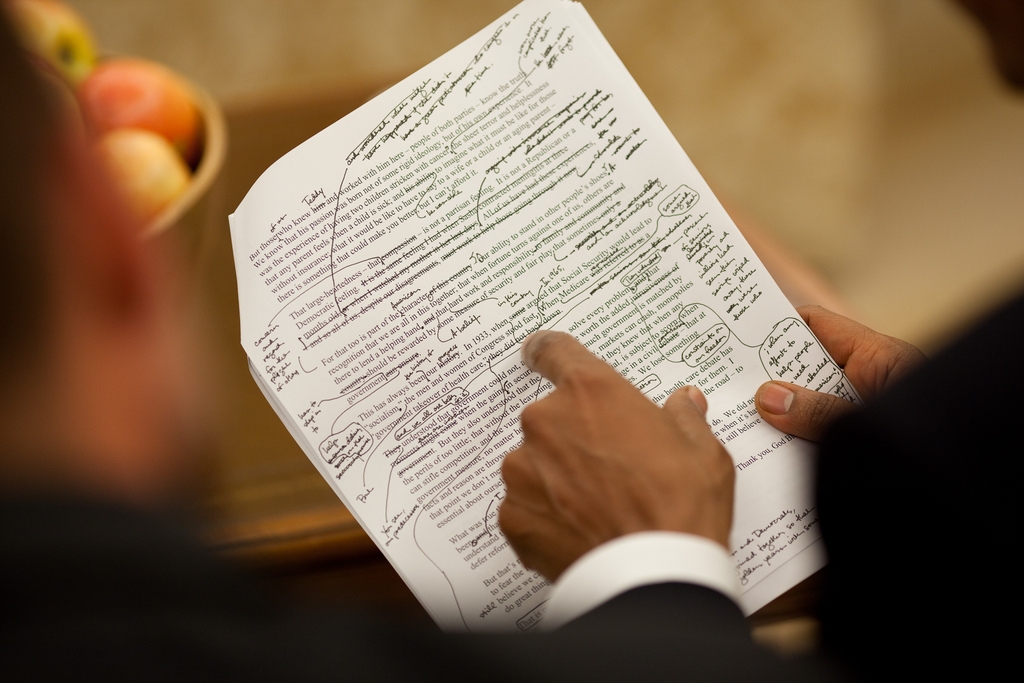
I saw this photo of Obama’s speech and was inspired.

The following is from Writing Your Dissertation in Fifteen Minutes a Day, pages 33-34:

“How does one really begin to write? William G. Perry Jr. has described the process succinctly: ‘First you have to make a mess, then you clean it up.’ If you think about the implications of this statement, you quickly realize that how you write is up for grabs: no more neat outlines with Roman numerals to follow, no elegant topic sentences for each paragraph, maybe not even any clear sense of where you’re going.”

I use that idea when I teach writing courses. I believe it applies any type of writing. Once people accept the premise, it frees the writer to do what is needed. To write something.

Clearly Obama knows this. I’m glad to know that someone still uses a pen. And that the person “running the country” cares about what he says enough to make a mess.