Hacking them out of my prose today, I am seeing a direct correlation between a writer’s use of exclamation points and how much she/he trusts the reader. Trust the reader to get what you mean. There’s no need to shout about it, assuming the rest of the sentence and the work is doing its job, I tell myself.
The writer Lee K. Abbott gave a talk at Antioch Los Angeles when I was in school there. I recall him saying that every writer is allowed ONE exclamation point per career. “And it better be a fire,” he said. Though I hope I am allowed more than one, I often recall that idea, and try to use them sparingly.
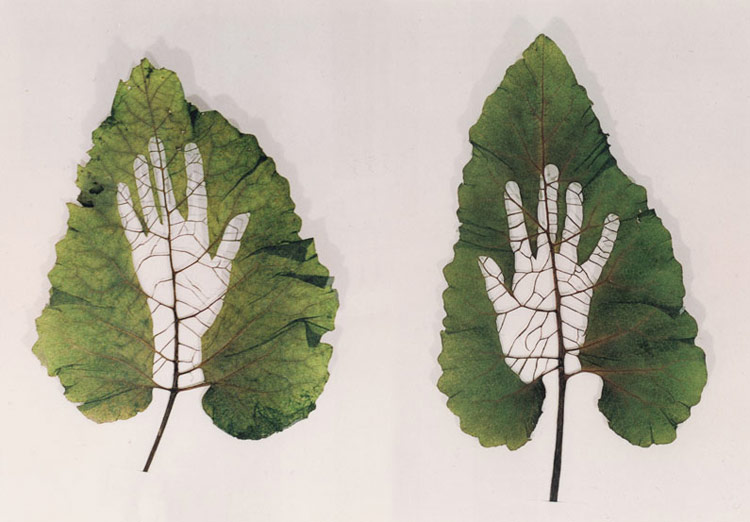
In college drawing class, I learned about negative space. If you look long enough at something, a shape forms around it: the thing where its object isn’t. So I look and look at nothing, pining for the past, wanting to yank back that day when we planted the live Christmas tree in the yard, or that other day when the circus was in the park next door, and my parents collected elephant poop to fertilize our garden. Elephants gone, dung gone too, no remnants now left. I want back so many other days. Memory provides only edges. Pinning decrepit butterflies to velvet, I smell the dust, turn around, look back, and find another disintegrating wing of the few things I can recall. I set out to order it all, by chronology, or theme; I make another list, “things that happened to my body,” such as falling down sixteen steps, such as running through the glass door. Anything that helps me contain the mess. But this story disobeys my desire for dramatic unity. It won’t sit still. Memory doesn’t fix itself close enough to truth, doesn’t allow our trust; the interior record is fuzzy, ephemeral. I call the county office to gather facts.
I’d like to know, for instance, when my house was burned down, when it began its exquisite disappearance.
A mess that might be grow up to be a story someday.
This morning, as I did my post-child infrequent and highly interrupted version of Julia Cameron’s morning pages (more like three quarters of a page, if I’m lucky) my daughter said, “My, look at all those words! It’s like a giant nametag!” Aside from making me laugh, her comment reminded me of the photo I took last weekend: the mess I was making with a ghost story in progress, whose birth story can be found here. When I talk about making a mess, this is what I mean. This is the kind of mess that I love. It’s all my mess (no one else has read this story, and all the scribbles, highlighting, and editing is mine! No judgement, no other voices in my head!) and here I’m trying to make order of it. It’s the first draft of a messy story that came from a terrible essay about one thing which grew into an essay about something else. Like the leggy cornflowers that we let go (“Let?” Who has time to even consider “letting” weeds grow; they just grow taller when I’m not looking) that bloom into flowers, whose color is unmatched in the rest of nature. The flower that needed to be.
I’m not saying this mess is good, and I don’t know if it ever will be. But what else would I rather be doing? Maybe weeding the other flowers to give the cornflower more room.
What about you? What would you weed today? What would you plant?
It’s weird writing something when you don’t know you’re about to write the end of the thing. This might be the end of the ghost story I’m writing. We’ll see. But it seems like the end.
This photograph faded with time, as he told the story to Cricket, as he counted to one hundred, night after night as he himself drifted next to his child, wondering how on earth such a tender thing could continue to survive.
“The first sentence of every novel should be: ‘Trust me, this will take time but there is order here, very faint, very human.’ Meander if you want to get to town.”
This is from Michael Ondaatje’s book, In The Skin Of A Lion, which I blogged about here. When I first read this passage, years ago, I realized this is the kind of fiction I want to write, and this proclamation provides comfort.
There’s a beautiful feeling I sometimes get when I’m reading. It’s the moment I realize I’m in the hands of a good storyteller. I’ve had that feeling sometimes reading “great” books, and sometimes reading unpublished student work. The feeling helps me relax and be along for the journey, and I crave it in everything that I read. This is not to say that I want what I read to soothe me–on the contrary. (As the fabulous Joy Williams wrote in her essay “Uncanny the Singing That Comes From Certain Husks,” “Good writing never soothes or comforts. It is no prescription, neither is it diversionary, although it can and should enchant while it explodes in the reader’s face.”) But that somewhat unnamable awareness that I’m in good hands as I read is always welcome. It has to do, maybe, with an amount of confidence (and sincerity) in the writer, because I don’t get that feeling, usually, when I read an overly clever or cynical voice–a narrative stance that, to me, usually feels insincere. I think the feeling I’m pondering can be called “trust.” As I notice it, something changes in my body; I relax a little (even if the story is unsettling, exploding in my face) because I understand an agreement the writer is making with me, and I am making with the writer: I trust that she or he will uphold whatever rules and aesthetics the story (or poem) requires, and I trust that the writer’s choices were made in earnest, and with honor behind them.
I want to give that same feeling to my readers. With my words, I want to craft a net, a web, or a hammock, to catch, or lull them into a place, a moment, a thought. Myself I want to quiet down to what’s essential, and I want the reader to witness (with me) that silver drop of water on a leaf, or that strange knocking sound that’s just too far off to identify but too close to ignore.
As you five swell followers might know, I’ve been writing an essay about my childhood home that was burned down in a planned fire exercise when I was sixteen. A rabbit figures in the story. Here are a couple of excerpts.
After their pyrotechnic work was done, house gone, I returned to the remnants, stood on the ashes. Near where the shed had been, I found one of my small wool Steiff rabbits, intact, unscathed. A tiny symbol of the phantom limb of home–does keeping hold of stuff I had before the house disappeared stand in for a home? When I hold that rabbit in my hand, I feel something stable and secure, but that’s too simple.
Then later in the essay:
Now I hold the Steiff rabbit that didn’t burn. I imagine again walking across the charred land, finding the thing, the size of a cotton ball, where our garage had been. How hadn’t I packed it? How hadn’t it been torched? I want to touch, smell, hear, see, consume the moment of finding that rabbit.
So telling truth, I pin that rabbit to a velvet board, and into a new ghost story I shove the cute animal, twist rabbits against type, make them sinister, keep writing. Everything must be lit, and burn, then melt, transmogrify: everything must milk and then feed that famished ghost, memory.
At a fabulous Yellow Springs yard sale this morning, I found two Steiff rabbits, and bought the pair for a mere $7. It was like my recurring dreams of finding pieces of my childhood Steiff collection at antique stores and having to buy them back, but in reverse: this morning they were not my rabbits, and I was awake. Now they are on (the one clean corner of) my desk.
Just more evidence that things keep turning and turning, but won’t let us forget: carbon replaces itself, surprises us, and continues to haunt…
I’m re-reading and pondering Michael Ondaatje’s book, In The Skin of A Lion. I love this book. For me, this is a book to read again and again, to study and learn from. This novel is an open apprenticeship. Any good novel might be like that: think about which novel yours might be. This one speaks to me.
Tonight, this passage from p. 157 seems like one definition of community:
“Alice had once described a play to him in which several actresses shared the role of heroine. After half an hour the powerful matriarch removed her large coat from which animal pelts dangled and she passed it, along with her strength, to one of the minor characters. In this way even a silent daughter could put on the cloak and be able to break through her chrysalis into language. Each person had their moment when they assumed the skins of wild animals, when they took responsibility for the story.”
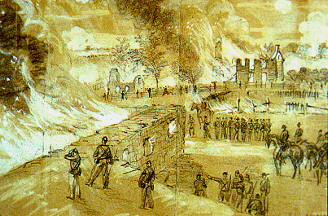
During the battle, the Confederates burnt Samuel Mumma's farmhouse, springhouse, and barn to prevent them from being used by Union Sharpshooters. This on-the-spot sketch was done by the Englishmen Alfred Waud.
Writing churns things up. That churning is one of the most fantastic things about writing, one of the things I love, but it’s not comfortable. Facing things, really looking at things, staring dumbly at things, that kind of minute and honest reflection, can be difficult and unpleasant. You can also find small treasures there. In working on an essay about stuff (literal stuff, the items that tumble from my closet, the towers of papers and important detritus spanning my surfaces) I realized I actually need to be writing about my phantom limb: my childhood house that’s no longer there. It was burned down in a fire training exercise. I’ve written about it in my novel, immortalized it here and there.
This time I decided to write a short story about the house, about a ghost in the house, about the fire…currently, the stuff of the story is a huge mess, but it’s been satisfying to make. Right now I’m just generating words, ideas, the raw junk that I will attempt to shape into a story. It’s all I want to do, but it’s so untidy, so simultaneously new and ancient. Like my surfaces, it’s cluttered, noisy.
In the car this morning, listening to my daughter’s “mixed tape” (a CD, actually) that includes Jack Hardy’s song, “Blackberry Pie,” I got sad again about Jack’s passing. Since he died, I haven’t not been sad about it, but there are moments when there’s an upwelling I can’t ignore or fake my way out of. I told my daughter that it makes me happy and sad to hear Jack’s songs. After she informed me that I should not sing the song because, “I’m Jack Hardy and I get to decide who sings my songs,” we had an interesting conversation about how he wrote those songs, and how they are his, but he also gave them to us, so they are also ours. She agreed.
Here are the lyrics:
Blackberry Pie
i stopped all day to pick wildflowers
down by the banks where the blackberry grows
all in the shadows of the late autumn hours
all in the brambles and the late blooming rose
i picked all of the white ones and picked all the blues
for those are the ones that would go with her dress
and i'll dance tonight, wear holes in my shoes
'til i am the one that she loves the best

(chorus:)
so dally down where the river runs
where the forest bathes the senses clean
dally down where the fiery sun
and the rhythm moon makes a faery dream
and you might think that my heart would lie
that many a girl had caught my eye
but my heart all along belongs to the girl
who baked me a blackberry pie

though i've stayed single all of these years
'tween the twisting rope and the wounding wind
never staying long enough to see the spring
where i had seen the harvest in
and i don't give a tinker's damn for the road
though many they say i'm bound to roam
and i just might be the last one in
though i will be coming home

(repeat chorus)

and many a glass i'll drink tonight
where the wine-red hand is from work or fight
there is no judge more fair than time
for there is no one to change his mind
each time i look in the parting glass
those years that look both ways to know
i'll sing the last song of my youth
but i'll sing it again tomorrow

(repeat chorus)
Today the line, “I’ll dance tonight, wear holes in my shoes/till I am the one that she loves the best,” made me think about writing. About what I’m willing to do, what I even want to do when I write. I am willing, I want to wear holes in my shoes so the thing (the novel, the essay, the story) is good, is good enough. To extend the metaphor, I was thinking an editor might be the “she” in that phrase, but more than that, the “she” is also me. So I’m the dancer, and I’m also the “she” who the dancer wants to impress, from whom the dancer want to earn love. Crazy geometry. An illustration of how Jack’s songs are about so many more things than what appears on the surface. And how they belong to him, but they also belong to us.
And the sadness comes from my pushing against this: I know that no one lives forever, but I always thought he would “sing it again tomorrow.”
In hopes of assessing how many one sentence paragraphs I had in my novel, I changed the magnification on my word processor window, which made the text appear much smaller than usual. This allowed me to see most of a page on one screen. As I scrolled through the pages, stopping whenever I saw a one sentence paragraph, I joined what I could with longer paragraphs, and omitted some. This was prompted by a piece of advice in Francine Prose’s Reading Like A Writer, namely not to overuse the one sentence paragraph. As I combed through the text, some unexpected things happened:
1) I realized that sometimes one sentence paragraphs are necessary, the best choice. I want to trust the reader, and not lean too heavily on the structural signal of a one sentence paragraph as alert: “Hey you reader! Look here! This line is so important I set it up on its own! Read carefully!” And yet sometimes a one sentence paragraph just feels right. (It was good to interrogate each occurence, however, to be sure.)
2) The decision about where to break paragraphs has its own intuition, and the writer should take time to quiet down enough and follow it.
3) I was doing a lot of changing and then changing back, doing and undoing. A lot of tinkering, but maybe the act of tinkering confirmed that I’d gotten some bits “right” before questioning, if such a thing as “right” is possible in a thing so subjective as fiction.
4) Another nuance I hadn’t considered, in defense of keeping some one sentence paragraphs in this novel: my protagonist is seven years old. The child’s close lens on her world and the visual smallness of a one sentence paragraph seem connected. I don’t think this is overly precious, in this case.
5) The exercise was a great lesson, and proved the point that Prose includes in her book. On p. 68-9, she quotes Rex Stout’s novel, Plot It Yourself, in which “Nero Wolfe is called upon to determine if three manuscripts that figure into a case involving accusations of plagiarism could have been written by the same person.”:
“A clever man might successfully disguise every element of his style but one–the paragraphing. Diction and syntax may be determined and controlled by rational processes in full consciousness, but paragraphing–the decision whether to take short hops or long ones, and whether to hop in the middle of a thought or action or finish it first–that comes from instinct, from the depths of personality. I will concede the possibility that the verbal similarities, and even the punctuation, could be coincidence, though it is highly improbable; but not the paragraphing. These three stories were paragraphed by the same person.”
So is the paragraph like a fingerprint, individual to each writer? Maybe.
Another thing happened as I worked through the manuscript, not related to paragraphs, but worth noting. As the text looked so much smaller to my writing eye, it performed a visual trick on me. I’ve done this bird’s-eye thing before, but this time I was pulled into some scenes despite (or maybe because of) how hard it was to read the words. The clusters of words formed different shapes in my brain, pulling me in. Like those little sugar Easter eggs that you peer into, I had to look closely and see the world that was hiding there. And thus I did a whole lot of unexpected line editing than I planned to do. Good.






 Rebecca Kuder