If your nouns and verbs can do the work, let them. You’ll have little need for adjectives and adverbs.
(p.s. It’s a shame I can’t–or won’t–follow this advice. I just tried that exercise where you take a page of your work and banish all adjectives and adverbs. It wasn’t as bad as I thought, but it wasn’t as good as I’d hope. Some things made no sense without the adjectives. Worth trying, though, and worth keeping in mind as I write.)
Microsoft Word is now showing my novel has 60,437 words. It has been such slow progress; I am not going to tell when I started writing this thing. But now it feels like it’s going to be a real novel some day. I’m close to the end (of the plot) so how not to rush, how to stay slow enough that I don’t skimp on the things that this mess-in-progress deserves? Its allure and complex grime keep calling me back to previous scenes, unanswered questions, pieces of the puzzle that now make sense, or don’t. How to twist things into the right shape, how to fortify what needs strength, how to obliterate the coy, the unnecessary, the overly precious junk?
In my distractions, I do a google search for images, “decrepit carnival,” and find this about a place called Royal Land, which was a sort of recycled carnival that did not travel. My carnival is a non-traveling carnival, so finding this link (and image, which I love) today, I’m renewed–the serendipity cherubim at google hooked me up. I love conducting this type of non-scholarly research. It’s one of the great things about writing fiction, the freedom to make things up, but make things up that are also underpinned with some real things, somehow held together with real wire and string, but not so precisely tethered to the mundane.
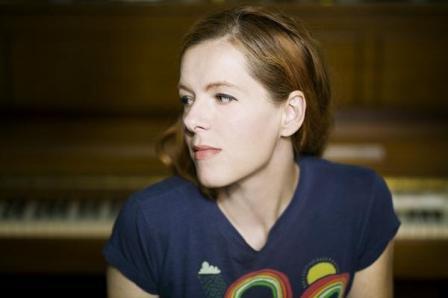
Neko Case, looking cool as usual. But I think she's still "Margaret."
This song haunts me. Neko Case is amazing from any angle: musician, poet, strong survivor of life’s trials. But this song sticks with me, and I can’t shake it off. I’m sure the story is not as simple from Pauline’s point of view, but still… This song seems as much a poem as any of Simon and Garfunkle’s poetry. Here are the lyrics.
“Margaret vs. Pauline”
Everything’s so easy for Pauline
Everything’s so easy for Pauline
Ancient strings set feet a light to speed to her such mild grace
No monument of tacky gold
They smoothed her hair with cinnamon waves
And they placed an ingot in her breast to burn cool and collected
Fate holds her firm in its cradle and then rolls her for a tender pause to savor
Everything’s so easy for Pauline
Girl with the parking lot eyes
Margaret is the fragments of a name
Her bravery is mistaken for the thrashing in the lake
Of the make-believe monster whose picture was faked
Margaret is the fragments of a name
Her love pours like a fountain
Her love steams like rage
Her jaw aches from wanting and she’s sick from chlorine
But she’ll never be as clean
As the cool side of satin, Pauline
Two girls ride the blue line
Two girls walk down the same street
One left her sweater sittin’ on the train
The other lost three fingers at the cannery
Everything’s so easy for Pauline
I got exhausted reading a book to my daughter last night, and not just due to chronic lack of sleep, but also because the story included a whole lot of dialogue. I think it might even be physiological, but I have no proof, it’s just a theory.
This realization (that my weariness was because I was speaking characters’ words) illustrated an excellent point that Douglas Bauer makes about dialogue in The Stuff of Fiction: Advice on Craft.
His chapter on dialogue is worth reading in full, but the particular point I’m thinking of has to do with the idea of a sort of judicious (or ill-advised, liberal) use of dialogue. His idea is that entering (reading) a story can be like going to a party: you see a couple across the room. The reader can see them talking, one of the characters is holding a small dog, and something seems to be happening in the interaction, and so on. (This would be the part of the story where the writer is summarizing and setting the scene.) Asking readers to come closer, close enough to overhear (as it were) the characters speaking, can heighten drama and make the reading experience more urgent and interesting. It’s also wholly more strenuous reading, which brings up the next point.
I see a lot of prose that has entirely too much dialogue. Writers of fiction (and probably creative nonfiction) have a responsibility not to exhaust the reader by putting too many words between quotation marks. I am all for demanding a lot of my reader. But choosing to have my characters speak directly to a reader, I should be thoughtful and give the reader a break every so often. A moment or two of pause, a look around the room, something to let the reader take a breath–even if the reader is reading silently.
At any rate, I should be careful about how I use the power of the spoken voice, reserving it for what matters most.
Image stolen from pearlblossomhighway.blogspot.com
Reading to my daughter tonight, as usual, she chose the books. First, she chose one called Reading Makes You Feel Goodby Todd Parr. “I really like books by Todd Parr,” she said. She’d already been reading it to one of her babies when I came in. [My daughter has a lot of babies. Often, when I tell her the name of an author or illustrator, she says, “I have a baby named” (fill in the blank).]
In the rush of the day, it would be easy to just get to the meat and read the book, rather than taking a few seconds to name the author and illustrator. Some books we have (and some she picks from the library) are so ugly, cheesy, and poorly written that I don’t feel like elevating the schmucks who created them by giving them name. Meow. (Though those schmucks are probably making a living at what they do, so I should refrain from sneering, at least from that whole “making a living by writing books” angle.) But even with these stinky books, each time, when I read the title, then “written by…” and “illustrated by…” the child comes to know that there are people behind each book.
My daughter lives with two parents who are writers. As she grows up, she’ll know a lot–maybe too much–about what it means to be a writer. So many writers bemoan the current state of publishing…it’s a sad time for books, some say. But we could do a lot to improve the morale of writers if we do this simple act: when reading a book to a child, include the name of the writer and illustrator. Every time. Every book.
If we do, maybe that lucky child who doesn’t know any writers personally will come to know that someone sat and thought about the book, someone chose words and painted images to tell the story that lulls her to sleep.
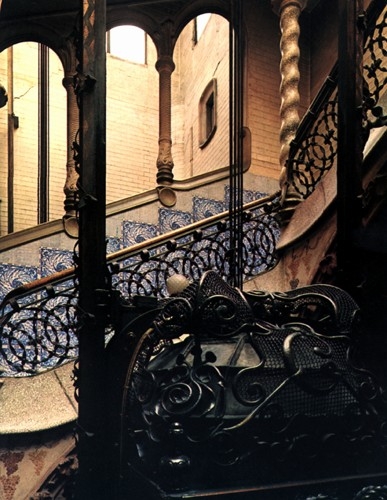
Today I needed to write about a memory from a minor character (Anton the Younger). As houses, and the image and idea of house, tend to haunt me, I decided the character used to live (or actually work) in Casa Calvet in Barcelona. I focussed on this staircase.
I love writing fiction, because there’s so often room to saturate the story in the tea of the writer’s obsessions. Whether this particular scene is going to stay or not, the process was fruitful.
My, oh my, I saw Gogol Bordello last night. Excellent Brazilian expatriates Forro in the Dark opened. Though I didn’t say for the whole GB show (being a tired parent, too far from home for a late night drive), all that I saw and felt was incendiary. See them if you can.
There is something about being with people who are doing their thing. Clearly, these folks were at it. I remember a boy in high school who threw discus for the track team. There was a photograph of him with discus in the yearbook: elemental, he was doing his thing. My high school boyfriend had the same look when he was playing his guitar.
My husband looks that way when he reads his fiction aloud. It’s hypnotic.
My daughter is part of a Montessori toddler preschool. They sing a song that goes through all the kids by turns, “Go on Merida, do your thing, do your thing, do your thing, go on Merida, do your thing, do your thing and stop.” At home, she sings through all the children’s names. They take turns.
Last night was Gogol Bordello’s turn.
The planet needs more people out, doing their thing. It will make us all happier. We can take turns.
I’m going to go back to doing my thing and write this novel now.






 Rebecca Kuder