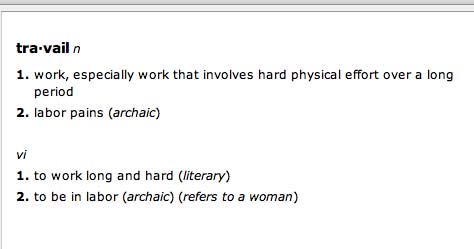
 A word I like, that I first learned in high school French, “to work.” Interesting that it has both these ideas in it, working over a sustained period, and giving birth.
Seems about right.
A word I like, that I first learned in high school French, “to work.” Interesting that it has both these ideas in it, working over a sustained period, and giving birth.
Seems about right.
 There is a trajectory of mental states from the beginning writer toward the seasoned, thick(er)-skinned writer. I think that development along that trajectory includes getting beyond the innocent hubris of “My writing is great! People have always said so!” and moving toward the knowledge that all good writing takes work and generally benefits from a variety of voices giving constructive feedback.
Like the child who is always praised and never challenged, we do no service to ourselves by glossing over things we need to work on. I ought to know. I used to be one of those innocent hubris writers. I hope I’ve moved beyond it.
I sure have a few calluses.
 The outline of my novel-in-progress is now fully scrawled in 24 notebook pages. The next job is to type it up, massage it into a sort of stage manager’s “bible” which was a technique I used with The Watery Girl. This process seemed to help. Character motivations, scene breakdown, major “props” or icons that I needed to follow through the novel, for continuity. But now what? I still have to figure out how this story ends.
Writers often talk about how their characters take over, dictate, and decide what happens next.
So where are my people? Asleep, at the bar? It’s sunny out, did they call in sick today?
Slackers.
When I was studying theatre, good directors always talked about being exquisitely specific in our choices as actors. The character had to be known in the body of the actor, imagined in clear view. Knowing what the character had for breakfast, down to the amount of milk they poured on their overcooked (or undercooked) oatmeal. How much honey, or brown sugar. Bananas, raisins, or something exotic like candied ginger? Or did they had nothing for breakfast? And then, more importantly: how did the breakfast feel in the belly? Inhabiting characters.
In this same way, I think characters in fiction (and probably some creative nonfiction, too) have to be built, drawn, and very specific. Let the audience, the reader, really see (and more importantly, feel) the life of the character.
And I am not talking about eye color.
I was once in a creative writing workshop with a very unskilled writer. (I make this judgment based upon the truly terrible work she had submitted for the workshop.) Her comments on the other writers’ work boiled down to saying she wanted to see more of what the characters looked like. “Like, how tall is he? What color is his hair? His eyes?” She didn’t have much else to say. Until just this moment, I scoffed at how unsophisticated her comments were, and how unimportant those details are in a good story. I still feel that if a writer mentions those pedestrian details, they better be important to the story. But it just occurred to me that this unskilled writer might have been talking about eye color, but meaning something more salient, that is: perhaps she wanted the writers to draw specific characters. Maybe the other writers (myself included) had made fuzzy or unconsidered choices with our characters. We probably needed to go much further, all the way down the alimentary canal.
I have been thinking in a very gestural and unscientific way about how poems, short stories, and novels are similar and different, both for reader and writer.
Something comes to mind about pacing, tempo, and where to break things.
When working on a novel, finding the right chapter break is crucial. It’s also important to think about where to end paragraphs. Is the question of where to end paragraphs even more important in writing short stories? And decisions about line breaks, even in the very occasional poems I’m working on, seem similarly intuitive and challenging.
I am not claiming that sentences, or words, are not crucial in novels. But there does seem to be a point of comparison among the forms, with the question of chapters, paragraphs, and lines, and where to break them.
Now the question is: how to end this post?
Outlining, after having written 150 pages of mess. All this will amount to a novel some day, but now, it’s a snarl of words in my computer and notebook.
And in my head.
I sometimes write an outline when I have something to write that needs a clear, simple structure. But with my fiction, which can be (and usually is) a mess, I tend to write an outline when I’m near the end of a draft, and stuck, not sure what happens, or needs to happen next.
Today, stuck, resuming after an uncomfortably long break, my smart husband suggested I write an outline, figure out what I have, and where I need more stuff.
It sounded quite unappealing. No romance, no forward motion.
But once I got started, it was welcome, easy, comforting busy-work. “I’m doing something in aid of my novel!” I thought. It’s not the exhilarating fall of writing new stuff, but feels productive. Like something a grown up would do. Like someone who Writes Novels would do.
Here’s how I do it:
1. Make sure all the handwritten notes are typed up into the computer file. (I write new matter on paper, with a fountain pen. It’s much more fun for me. And I usually write down scenes and new stuff as they occur to me, trying to put them in an order that makes sense, but not always in a linear or chronological way.)
2. Open the computer file, and start looking at it, page by page, but from a bird’s eye view (anyone who has a better way to put this without using a cliche, please share!).
3. With paper and pen next to the computer, write an outline, scene by scene. Mostly focus on plot (what happens) but sometimes on themes or other important things to note, things to pick up on later.
It takes a long time, but in the past, I have found it very useful. Sometimes the outline ends up being like a stage manager’s “bible” with set, costume, prop notes, and actor’s motivations, etc. Often, that’s how I find big gaps, things that need to be rearranged, or just taken out. I hope this will be true this time around.
At least it feels like I’m doing something.
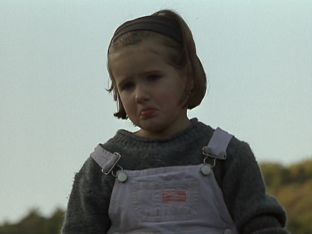 Why do I write about waifs and orphans? I am neither, but they stir me. Why?
Recently I realized that the characters in my novel-in-progress are all, in some manner, orphaned. I’m still uncovering, discovering, or making up the extent to which this manifests itself (and matters) in the mess. But I know that’s an emerging, and somehow important, current through this work, and much of my other work.
In my novel, The Watery Girl, Claire and the watery girl are both alone.
I am an only child, and the mother of an only child. But I don’t think my obsession with waifdom and orphandom is that simple. It could be the notion that we are all alone in some deep sense. I’m still figuring it out.
Community and family are really important to me, and day-to-day, I don’t feel alone. Honestly, I would like to have more actual time alone. But I don’t want to feel alone inside. There’s something scary about that feeling. And yet I also understand that independence is important, dependence can be tricky and dangerous, and I am okay with the occasional loneliness of being alone.
But the waif. The orphan. Something about their vulnerability (which is, perhaps, in all of us, in some deep, hidden place) attaches itself to what I am doing, or trying to do, in my fiction. Do these waifs and orphans need me to tell their stories? Does this render me less alone?

I have been ruminating about Lynnell Edwards’ question on the Red Hen Press blog, and wanted to post my thoughts here.
I don’t have a policy on vampires. I have read beautiful, strong, amazing prose in a variety of genres, including “literary realism.” I haven’t read Twilight or Harry Potter, but I have read Lord of the Rings. And though I don’t want to compare a television show to a novel, I do love “Buffy,” because the writing is excellent, the characters rich and complicated, and the issues they deal with (ethical, moral, metaphysical) are important and paradoxically what I would consider “real.” These are some of the same characteristics I would look for in a good novel or story.
Different genres have different sets of expectations from the readers, and publishers. It can be hard to run a workshop or a class with a mix of genres–if only because other writers, leaders or teachers aren’t necessarily familiar with all genres. That can make things tricky, especially when students are just learning how to operate within a workshop setting.
One problem is that writing students (and readers in general) may be reacting to having been fed more visual media or media tie-in books than original books within the fantasy and science fiction genres. But as small children, most of us read plenty of fantastical things. Dr. Seuss, Harold and the Purple Crayon are a couple things that come to mind. It makes me sad that so many adult readers lose access to what is magical in literature by way of shedding childhood and heading into the “real world.”
Ursula LeGuin has some interesting things to say about the genre silos, and the “literary” biases against fantasy. If this problem interests you, check out her essay collection, Cheek By Jowl. I find a lot of bias in academe against work that is other than literary realism. Magical realism is acceptable, usually, and a few other lucky or pushy writers who have slipped with their novels into the list of acceptable, despite the fact that they write science fiction. I am thinking of Margaret Atwood. She has protested long and loudly enough to have convinced many readers (who might disdain other works of “science fiction”) that she’s not writing it. If something can be translated or packaged as allegorical, it “transcends” the genre. (Even the word “transcend” bothers me here.)
Overall, I don’t care where my students aim to publish their work. If it’s good, it’s good. I strive to help students learn about what I think makes fiction work, what makes it strong, what might make it transcend whichever box it ends up being placed in by a publisher.
Or, to quote Shakespeare’s Juliet:
“What’s in a name? that which we call a rose/By any other name would smell as sweet…”
And: There’s a Library of America collection of Philip K. Dick’s novels. So I guess he is another who slipped through the cracks.
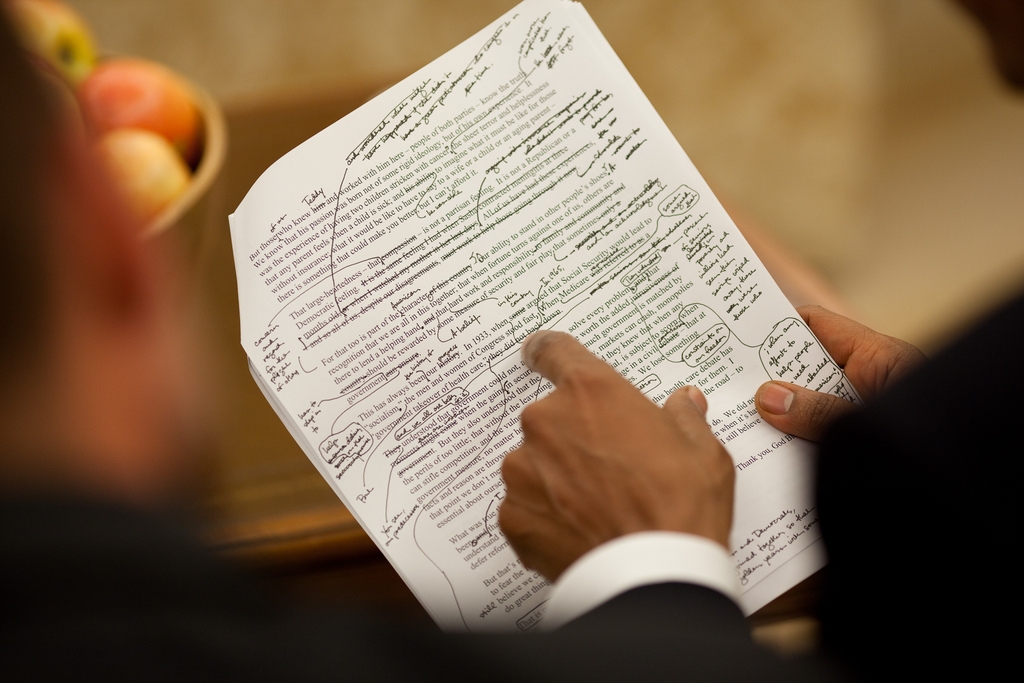
I saw this photo of Obama’s speech and was inspired.
The following is from Writing Your Dissertation in Fifteen Minutes a Day, pages 33-34:
“How does one really begin to write? William G. Perry Jr. has described the process succinctly: ‘First you have to make a mess, then you clean it up.’ If you think about the implications of this statement, you quickly realize that how you write is up for grabs: no more neat outlines with Roman numerals to follow, no elegant topic sentences for each paragraph, maybe not even any clear sense of where you’re going.”
I use that idea when I teach writing courses. I believe it applies any type of writing. Once people accept the premise, it frees the writer to do what is needed. To write something.
Clearly Obama knows this. I’m glad to know that someone still uses a pen. And that the person “running the country” cares about what he says enough to make a mess.
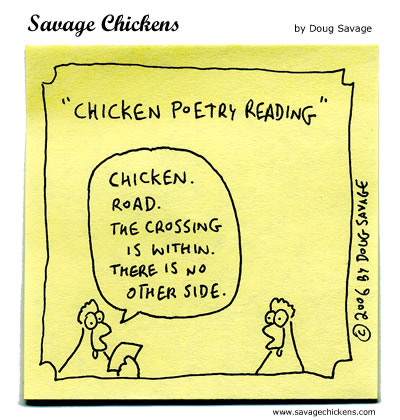 Writers of all forms say they feel not simply drawn, but called to write. But when I was in grad school, I noticed something about the poets. Many seemed more mystically attached to what they did than the writers of prose. Those poets were not pretentious, but watching them, I got the feeling there was something purer, maybe gnostic, about the practice of poetry. Could poetry be a more athletic practice than prose, if only in the necessary distillation and economy of words? (I don’t mean to make too many generalizations about forms and writers: there are certain novelists who are or might as well be poets, or whose prose feels like poetry. I love reading a novel that feels like it was written by a poet.)
I’ve written poetry most of my life, but I always feel timid taking my poetry seriously. When it comes to poetry, I know I am a hobbyist. Not a real poet, but someone who visits the land of poetry on vacations, wearing garish clothing and the wrong shoes, talking too loud, and taking snapshots of the pretty sites. With a straight face, I can call myself a writer, but not a poet.
I need to work some light into that dark corner. I need to read and write more poetry.
 Rebecca Kuder