“I’m going to write down who I am,” said two-year-old Merida, paper and pen in hand, one recent morning. When I recounted this to her papa, she looked at it from another angle and said, “I’m a girl and I know how to write myself down.”
The Lorax, revisited
 What do we think of Dr. Seuss’ The Lorax these days?
I recall the book from my past, though I don’t exactly remember it from my childhood. I’m not sure if I read it back then. Being someone who cares about the environment and loves Dr. Seuss on what feels like a cellular level, I bought a copy (printed on recycled paper) for my two-year-old daughter.
She discovered it last week.
Discovering a book, for her, usually means that she wants her parents or any other literate person who happens to be around to read the book several times per day. But the Lorax is long, and we didn’t make it to the end of the story for the first few days of its discovery.
But my husband and I both want to hide the book, and dread it being handed to us by the little waif who lives in our house. I think there are two reasons for this.
1) It’s really, really too long. I think it could be cut down by half, and would be a much stronger book. The number of clunky sentences in this book is astonishing, considering who wrote it. And I think this is because:
2) The genius of Dr. Seuss seems to be squelched, choked, or otherwise obscured by HAVING AN IMPORTANT MESSAGE. Sure, there are messages in plenty of his books, and even though I agree with most of the message in this one (rampant, irresponsible industry=bad, trees=pretty) his message seems to have bent the tree of his narrative over too far, so that in a way it resembles a dying version of one of the book’s skewed, leaning, tufted trees.
As a writer, this is a really good lesson to learn (over and over again, each time my little cherub brings me the dreaded book). If you have AN IMPORTANT MESSAGE (which is fine, and has its place) please make sure that the message doesn’t wilt the narrative.
And cut everything down by half. But not the trees.
French editions by Robert Freeman Wexler
Very exciting news in our house:
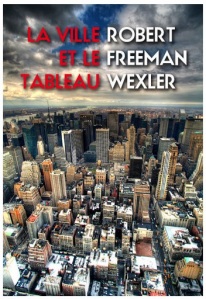
Robert Freeman Wexler’s novel and story collection will be coming out in French from Zanzibar Editions.
I hope this means a trip to Paris!
Woody Guthrie was right
“I hate a song that makes you think that you are not any good.
I hate a song that makes you think that you are just born to lose. Bound to lose. No good to nobody. No good for nothing. Because you are too old or too young or too fat or too slim too ugly or too this or too that. Songs that run you down or poke fun at you on account of your bad luck or hard traveling.
I am out to fight those songs to my very last breath of air and my last drop of blood. I am out to sing songs that will prove to you that this is your world and that if it has hit you pretty hard and knocked you for a dozen loops, no matter what color, what size you are, how you are built, I am out to sing the songs that make you take pride in yourself and in your work.
And the songs that I sing are made up for the most part by all sorts of folks just about like you.”–Woody Guthrie
Jim Krusoe’s novel “Erased”
A couple weeks ago, I finished reading Jim Krusoe’s novel, Erased. I wanted to read the whole thing again right after finishing the last line.
Reading this book, or really any of Krusoe’s fiction, is like taking a trip to the inner layer of the mind, which has somehow been turned inside out and exposed to the sun, and then finding some unknown organ that you need to survive but never knew was there. In his novels, dreams and reality at first seem to (but then don’t quite) fit each other…like a box of mismatched lids for old canning jars.
Here’s a bit from later in the novel, which I don’t think will spoil anything.
“Time, that old fooler, expanded and compressed itself, rolled over and played dead, only to spring back to life again when I least expected it. How long I walked, I couldn’t tell. It could have been hours. It might have been minutes. I heard the high squeals of bats and the sharp cries of night birds. I heard my own breath grow heavy as I trudged up a smallish hill, then I heard it ease on the way down. The wild dogs, or a completely different set of wild dogs, were back.”
In Erased, Krusoe’s protagonist is looking for his mother, who is supposedly dead, but keeps sending him postcards. This quest takes him to Cleveland, an idealized Cleveland that is laughable to anyone who has been to the real Cleveland. In Krusoe’s vision, the city is brimming with artists, carrying their work (often classical sculpture busts) with them to cafes like real-life celebrities carry small dogs in handbags. I love how the writer boldly steals the city from “our” reality.
Speaking of theft, I stole this photo from an interview with Jim Krusoe at Bookworm on KCRW.
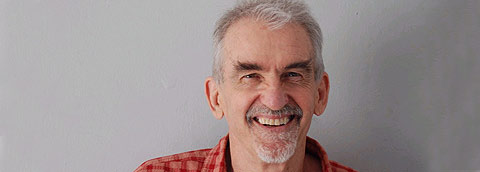
Jim Krusoe was my mentor in graduate school at Antioch Los Angeles. I still consider him my mentor. Jim is a wonderful teacher. By asking a seemingly a simple question, “What are you interested in writing?” and telling me to write seven pages, Jim fostered my novel The Watery Girl into being. His manner is so good-natured and encouraging that, when he tells you the first few pages of a story need to go, you cut them without pain. I have learned so much from Jim over the years, I can’t imagine where I’d be as a writer without him.
I think Erased is his strongest work yet. And I can’t wait to read more, and read again.
The three layers
 I am new to writing nonfiction. In working on my birth essay, I have really struggled about what should stay in, and what should not. As I mentioned here, it’s one of the hardest things I have ever written, maybe the hardest. I think I understand part of the reason why.
There seem to be at least three layers to the story:
1) The first layer is what happened. The truth. Or maybe The Truth. The Facts. The situation. The lived-experience.
2) The second layer is “Our story.” Like the details about the interpersonal relationships that were created and sustained on that day, during that prolonged moment.
3) The third, final, and possibly publishable layer: What I choose to construct so that it fits in the (hopeful) market and will be interesting to readers.
Readers might not care about the little inside jokes between my husband, my doula and me. They don’t necessarily care what the sky looked like as we drove to the hospital, and so many other textures and details that just don’t fit in the 2500 word limit.
It’s disorienting and difficult to construct something tidy from the messy, complicated, ineffable nine months, and then 36 bolded hours of my life.
Where, oh where is The Nearsighted Monkey?
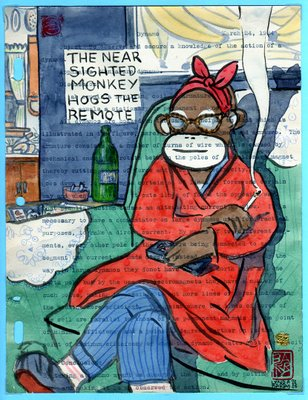
I’ve been waiting for months.
I keep trying to pre-order it, but it keeps being delayed. As a fan of Lynda Barry, and monkeys, and well, not cigarettes, but you get the idea: I am eager.
WHERE IS IT? And now I read THIS and get confused. I thought it was supposed to be out in fall 2009. If you have any scoop, post here!
I adore Lynda Barry. I will wait as long as I have to, but I just got another message from the online retailer where I ordered it, informing me of a delay. This is getting really tantalizing.
Okay, of course the delay is not all about me, and I’m sure others are affected. And I suppose it would behoove me to get used to the delayed gratification of publishing…but more on that angle in another post. STAY TUNED.
On “the fantastika”
I just read an interview with Serbian writer, Zoran Zivkovic posted on SF Signal. In particular, I love the distinction he makes between genre fiction and “the fantastika” the which is excerpted here:
SF SIGNAL: “I read in an interview that you consider yourself a writer “without any prefixes.” Why do you think some readers, critics, and other writers have biases against fiction that are typically labeled as genre or might include elements of the fantastika?”
ZIVKOVIC: “These are two very different things. The fantastika is a noble and ancient art. (A much broader term, by the way, than “fantasy.”) According to some studies in literary history, about 70 percent of everything that has ever been written in the last 5,000 years, ever since literacy came about, belongs to one of many forms of the fantastika. Some readers might not like it, that’s quite legitimate, but I don’t see how any serious critic could have biases against it. This would mean denying that the vast majority of the world literary heritage has any value. As for genre fiction, it refers to products of the contemporary publishing industry. Since any industry is primarily about making a profit, it’s no wonder that their products don’t have much art; art by its very nature does not go along with popularity. And only popularity, mass readership, paves the way to profit. Alas, the more popular usually means the more trivial, less artistic.”
There’s so much importance placed on the boxes where writing is published…and so much distain for the genre ghettos, that it’s refreshing to be reminded of the long traditions that existed before Barnes and Nobel needed simple shelving instructions.
Interdisciplinary Aesthetics

“Interdisciplinary Aesthetics”
I thought I came up with this term the other day, but alas, a quick google reveals I cannot claim it.
Interdisciplinary Aesthetics. I thought, “This should be an academic field!” In my dream department, the teachers would be people like Joy Williams, Joss Whedon, Lynda Barry, Dave Chappelle, Tom Waits, the guys from Sleepybird, the creators of “Mad Men” and “Nip/Tuck” and “Deadwood” and whoever thought up that “Think Different” campaign for Apple computer. And lots of other people who seem to get that the disciplines of 2-D and 3-D art and literature and theatre and music seep into each other and can and should collaborate on a cellular level. (6/15/12: I’m adding Jon Langford and anyone else he wants to bring to the guest list.)
We could have some scientists and other thinkers, too. I’m sure there are plenty of others who should apply when we open the department.
In those halls, you would find painters and writers and quiltmakers and dancers and drum-bangers and all kinds of rowdy, quiet, thoughtful, brilliant people. And maybe even some people who use (gasp!) computers as the primary medium.
Maybe we should pool our resources and everybody move to Denmark.
Discuss…
Writing really bad stuff
If you want to write, you have to write some really bad stuff first. You have to sit down, get out paper or computer and put one word in front of the other, like walking, and if you’re lucky, it can be as unthinking, un-thought about, as walking…for stepping is something most adults who can walk rarely examine.
Gets you from one place to another.
While you’re getting from one place to another, the awful part is to be thinking, “This is all crap; I can’t believe how bad this is,” but that’s part of how to make things.
The stuff has to exist in its crap-like state before you can make it better.
I read once that Joy Williams rarely revises her work; it just comes out brilliantly. Lucky her! The rest of us just have to write lots of crap. I guess it’s good to be writing at all, even if it’s crap.
You have to keep knocking on that dark door…
 Rebecca Kuder