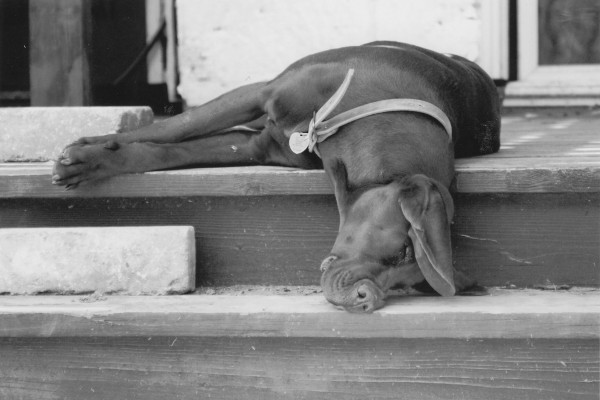
The novel I’m revising is like a dear old hound dog. Waits for me on the porch, with an occasional, “woof” when the wind blows, until I remember to come over and give that dog something to chew on.
The novel I’m revising is like a dear old hound dog. Waits for me on the porch, with an occasional, “woof” when the wind blows, until I remember to come over and give that dog something to chew on.
Here’s a statement I wrote last week for a grant application. I’m new-ish to personal essay, so it feels weird to proclaim anything about it (because I keep learning what it is!) but this piece describes some of my process and reasons for writing personal essay, so I thought it was worth posting here. It’s slightly edited toward blogginess. Cheers!
***
My essays grow from lived experiences (transitions and grief), but I wait to write them until I find a way to transcend my life and connect to something larger, something that might resonate for readers. Writing stories about life can be very therapeutic, but must stretch beyond the writer’s singular experience and have meaning to others.
In my experience, the process of writing personal essay is murky and chaotic. Sometimes I use the metaphor of an onion, as layer after layer I peel away to reveal what I really mean, to move toward something that feels true. (Some layers are just rotten, bound for the compost heap.) From there, I discover a shape, rendering that central image or idea in the stuff of lyrical essay. As I craft each essay, draft after draft, I interrogate myself repeatedly about what is relevant. When a story involves others, I ask myself which parts are mine to tell. I am careful in what I include, and what I protect. Writing personal essay means navigating these boundaries. Writing from life demands constant vigilance and integrity, lest the exercise and the writing itself collapse into mere therapy, or worse, narcissism.
With these essays, I intend to connect to others. Beyond that, I am interested in language, how to refine until even the vowel sounds help the reader feel what I mean to impart. It is life affirming when a reader tells me that something I wrote moved them, and it is satisfying as a creator when someone compliments the way I tell a story. It is these twin aims (reaching others, and artful storytelling) that keep me writing personal essay.
Specifically, in “The Bit Jar,” I wasn’t sure I was going to write about this topic for the public, but I felt called to encourage others who might be going through trauma. When the opening scene presented itself, I realized it could be the right frame to approach the material.
Sometimes finding a tight container is the way in.
In a similar way, “Love Letter (an avalanche)” arose when I sat and listened to a poetry reading. First I thought, “I have to write my ex a letter.” As the event continued, I thought, “Maybe this is a blog post.” Then finally I thought, “Maybe this is an essay.” The work-in-progress (“Hot Thing”) emerged because I wanted to capture in prose what it felt like to have a hot flash. The first draft began as a list, and eventually I kept the list form, steeping the essay in rumination about the tension between the facts and how it felt to me.

In her essay, “On Keeping a Notebook,” Joan Didion writes:
“…perhaps it never did snow that August in Vermont…maybe no one else felt the ground hardening and summer already dead even as we pretended to bask in it, but that was how it felt to me, and it might as well have snowed, could have snowed, did snow.”
I’m writing a piece in which I wanted so badly to use these words, but I used another part of Didion’s essay, had to let go of this treasure for the sake of the whole fabric I’m making…but I love this passage. I love its cadence, I love the self-doubt and rumination. This progression from Fact toward How It Felt To Me is an important and rich one, and we dismiss it at our humanity’s peril. This has been on my mind a lot, sparked anew last night when I read David Ulin’s piece about redefining creative nonfiction, in which Ulin writes, “all art is a kind of hybrid, reality reconstructed, redefined.”
Yes.
We get up each morning. Unless we are nudists, we put on layers, veils, makeup, clothing to disguise or hide or redefine something about ourselves. “Reality” is manufactured somewhere inside each human brain. (I am not a brain scientist; I don’t remember which part, but I have read about this, and I think this is true.) Things happen, there are facts, and facts are arguably “real” or “true”, but it seems to me the realm of literature, or art, is built upon everything else. The murk. How It Felt To Me. Even when I’m writing fiction, How It Felt To Me matters much in the making. Even if I am creating a world and pretending it doesn’t actually exist, even if I am telling Lies, How It Felt To Me can’t help but steer the making. (I could lie to myself now and say it doesn’t, but lying takes too much breath, breath I could instead be using to write, breath I could be using to stay alive.)
The fun is grappling around in the mess of these parts.
The fun is shaping stuff from the parts.
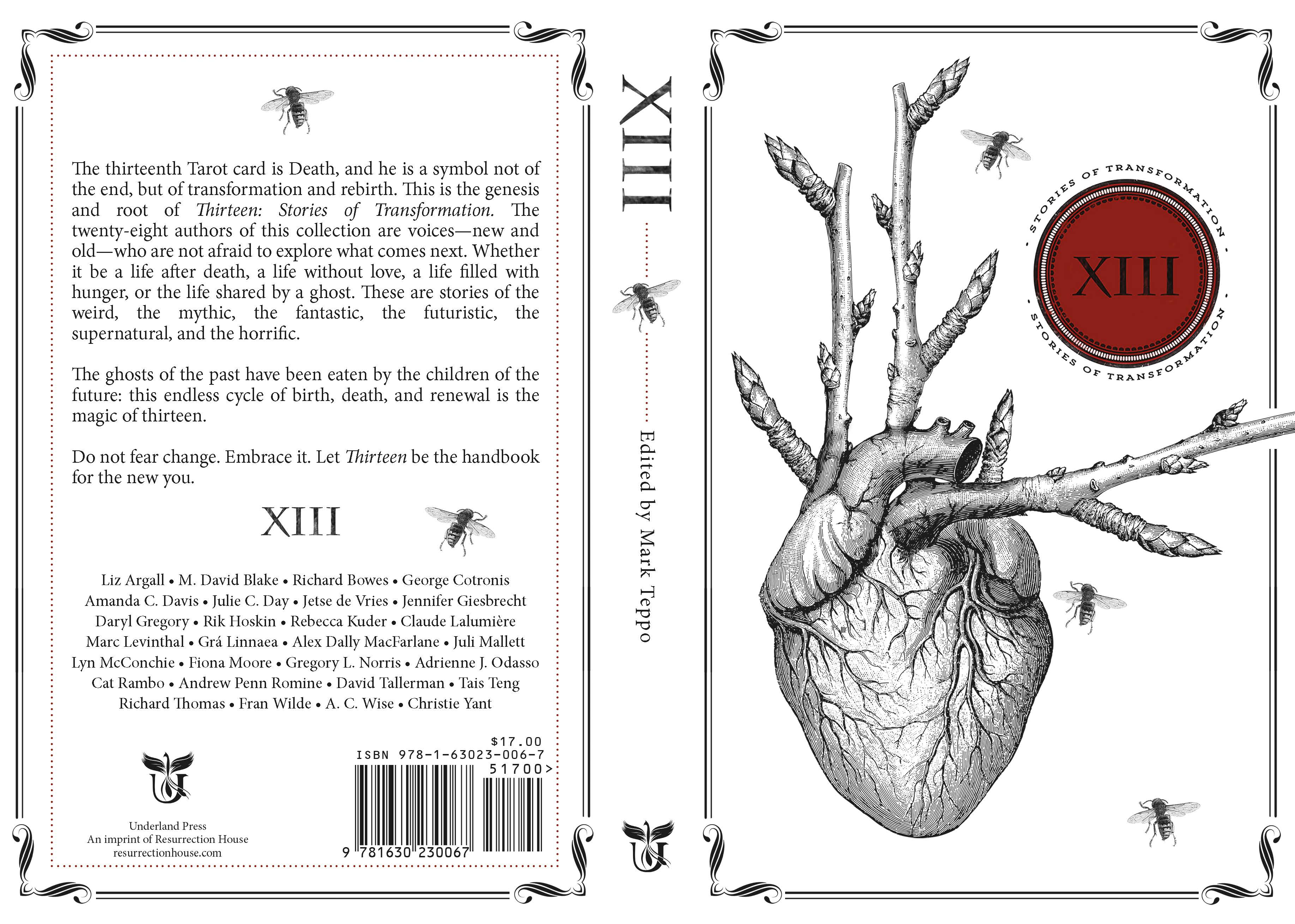
The cycle of living and dying continues…thankfully, so do words, and stories…and so I’m belatedly announcing the birth of Resurrection House XIII, an anthology of which editor Mark Teppo writes, “The ghosts of the past have been eaten by the children of the future: this endless cycle of birth, death, and renewal is the magic of thirteen.” Between the covers of XIII you will find my story, “Rabbit, Cat, Girl,” which I hope you will enjoy. (I’ve written about the process of writing this story here and elsewhere on the blog.)
More information about the anthology can be found at http://www.resurrectionhouse.com/up/thirteen/.
I’ve been relatively quiet on the blog lately. During the silence, I finished a reasonably far-along draft of my novel, The Eight Mile Suspended Carnival. And now my hands (and the rest of me) work on final-ish revisions of The Watery Girl.
My intention is that 2015 will be an interesting writing year. Please stay tuned.
It seems I’ve been spending a lot of time lately in the unknown. Or maybe I’ve been here all along, and I’m just now realizing (or accepting) the way my feet feel on that cold, clammy ground.
Anyway, a couple of things I’ve read lately got me thinking that it would be okay to impose this idea on the students in my advanced creative writing class at Antioch College. (As with most of my teaching, I always feel like I’m learning more than my students, and certainly I risked imposing my shit onto my students in this case.) Last night, we tried this prompt, and I thought it would be fun to likewise impose my shit onto anyone reading this blog post. (If you try it, please post here about how or whether it works for you!) Here it is:
Writing prompt: Step into the Unknown
(inspired by Nick Flynn and Lynda Barry, February 2015)
Lynda Barry writes about the two questions that plague her: “Is this good?” and “Does this suck?” “To be able to stand not knowing long enough to let something alive take shape! Without the two questions so much is possible. To all the kids who quit drawing…Come back!” –Lynda Barry, What It Is, Drawn and Quarterly, 2008, p. 135
Nick Flynn, in his memoir The Reenactments, writes, “It was easier, when high, to take photographs than to write—photography requires focused attention, and I could focus when high, my world in fact was nothing but focused, reduced to a pinpoint, to a chunk of hash impaled on a pin. But writing requires both clarity and a willingness to step into the unknown, and there was nothing clear about my days, not then. Getting fucked up every day is about maintaining the status quo‑it has nothing to do with change, or the unknown.” (Nick Flynn, The Reenactments, p. 77)
If these ideas resonate, then writers must “step into the unknown,” and “stand not knowing long enough to let something alive take shape.”
Let’s try.
Start with a situation that you have in mind, one that is unknown to you. It might be something you are facing, a new phase of life. Or start with the phrase, “I don’t know” and do a freewrite.
This is the time of year when winter feels claustrophobic and oppressive, and although my brain knows, as Poor Will reassures us, that we have gained an hour of daylight since December 26, my psyche has trouble believing it. It’s when I start to yearn for spring, for the new life narrative that returns each year as things begin to soften and melt.
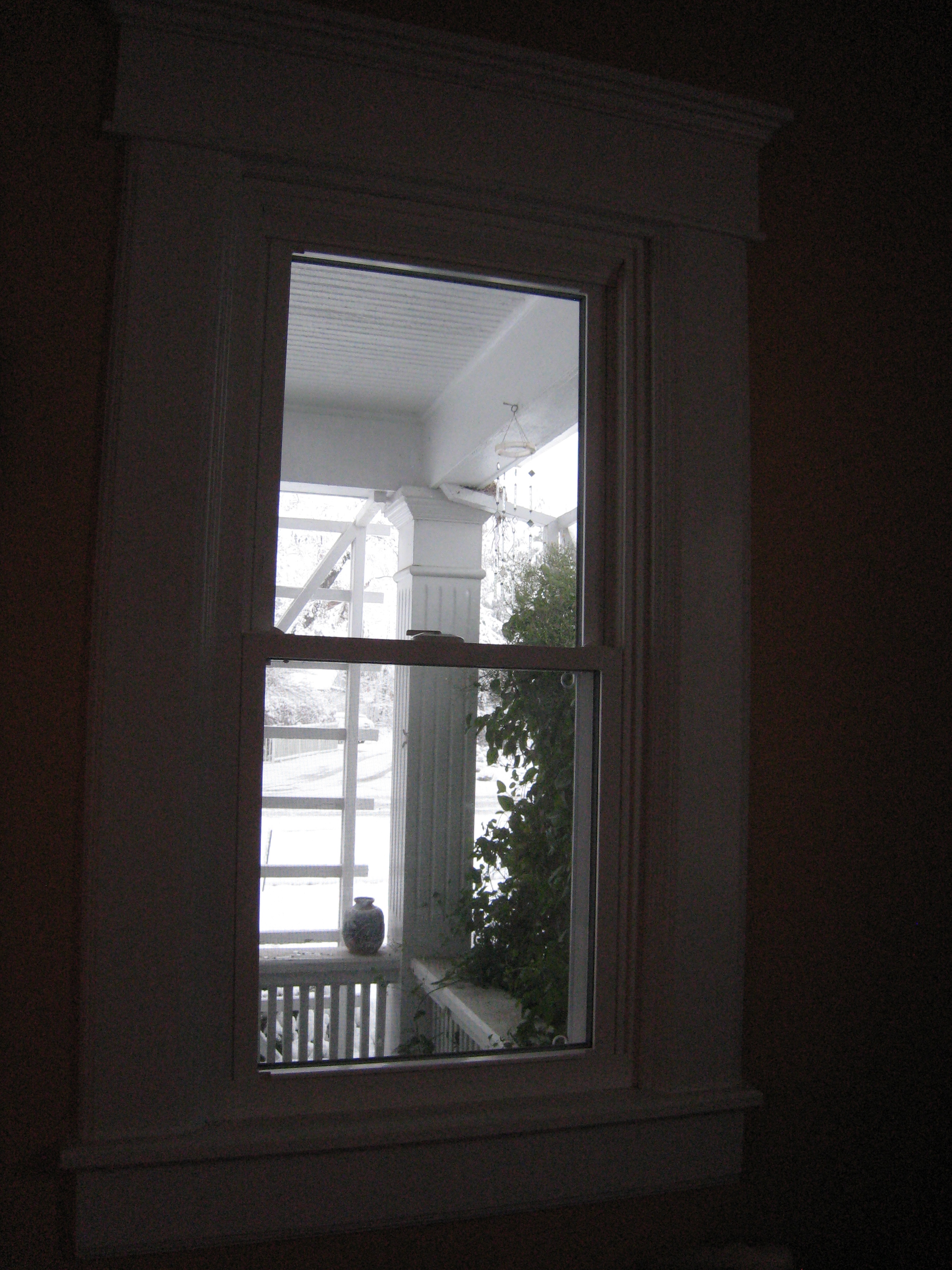
My daughter and I saw a robin in the redbud tree the other day; can it be counted as this year’s first? So early? I attach story to that robin, wonder how it could have landed, ruffled and fat, apparently unperturbed so close by the window that my daughter can’t help opening to say hello. The equinox can’t be far off.
This year, in addition to newness and hope, the equinox will bring Resurrection House XIII, an anthology of which editor Mark Teppo writes, ““Thirteen” is the first month of a new yearly cycle, wherein the old skins have been shed and the newborns are still learning to walk.” A short story of mine will be included, and I’m excited to see what else it holds, rising from the ground, between those pages.
(Any reviewers out there? I understand there may still be review copies available at Edelweiss.)
In July, I had a dream that I went to a book talk at some generic chain bookstore. E.B. White was there to talk about Charlotte’s Web. It was a small audience—maybe twelve people. I had the book with me, and lots of questions (details lost, when I woke up). In the dream I asked my number of questions, and he sat, kind and patient, as I unwound the things I wanted to know. At some point, he asked the audience whether they had a favorite part of the book. I said that my favorite parts could be traced to the parts where, as we listen to him reading the book, I recite lines along with him. (“What are you gonna do with it?” Templeton asks, about the rotten goose egg, and so on.) I mentioned to the audience that I had first found the audio book read by someone else, but discovered Mr. White had recorded it, and that it’s easily the best audio book I’ve ever heard. The author reads and you can hear so much more about his wondrous story from his intonation, from the lilting good humor in his voice, from his accent even. Listening, the textures of the place come alive. There is the benevolent curmudgeon in his reading, too, in his voice, which complicates the earnest story, and from the page, the words take wing. (In waking life, I know that not every writer is the best reader of her own work. In the case of White reading Charlotte’s Web, the reading performance elevates the already flawless novel to a new level, makes of the masterpiece something altogether new.)
I was somewhat shocked, in the dream, that Mr. White was still alive. And shocked that there weren’t hundreds of people in the audience. (Even E.B. White has trouble filling the room for a literary event?) He was gracious and warm. I think I asked him what he though about the book. I think he said he liked it. I think he said he liked the place of it, the world of it. He liked that it’s a humble canvas to explore big ideas like life and death and justice and friendship.
I was beginning to wake up by then, with such gladness at having been there.
(I wrote the following in response to a prompt about describing your inner critic, from Bonni Goldberg’s book, Room To Write.)
I would like to say that my inner critic is a hellhound with five heads, full of bile and venom, but I am not so sure. I think, instead, she’s a better version of me. She’s taller, more lanky; I’m not lanky at all, I have no lank. But I wish I did. In this way, she taunts me. She’s nearly perfect; I’m sure there’s something about her that isn’t, and certainly she would be able to spot the flaw. She’s good at spotting flaws. But she’s the Barbie-me, she’s the one with the glamorous life, she’s the one I was supposed to want to be, and still do, because of all the lies we’re fed about how we are not enough. (This soapbox, did she build it?) I think I can see her off in the corner, she’s smirking, she looks much more LA than I do (whatever that means!). Stick with it, stay, look at her. In a self-defense class I took in Seattle, the teacher talked about maximizing resources: If you are walking down the street at night and hear footsteps behind you, don’t simply speed up. Instead, turn around and look at who it is, see the person, make sure the person sees you seeing them, knowledge is a resource, “Who’s following me?” It’s good to know these things. That self-defense class was put on by an organization called Alternatives To Fear. A great organization. I still recall so much of what I learned there, but I haven’t been practicing my kicks and punches, I haven’t used my body that way in a long time. In class, we were encouraged to keep practicing even after the class was finished, so we wouldn’t get rusty. I am rusty at kicking ass. I am rusty at kicking the ass of inner critics. I don’t know if I could take her, that lanky critic. She probably took the same class, but was better at it.
What does she look like, my critic? She has no ink stains on her hands, she never needs to fill a pen. What she does is cleaner, and she needs no tools. When I get out my pen and start writing, I kick her penless ass with my rusty self-defense, my alternatives to fear. I maximize my resources. I do the work.
I feel ten feet tall, and sometimes I am.
 That moment when the new novel (new romance, how sweet, anything might happen!) unfolds in its wild way (organic, no map, messy and raw) and I must dig into worlds I know nothing about, must fortify the quivering green shoot of story that comes to me with facts about parts of the world and times in history I have not experienced…tether it down, tether it down…I’m so, so lost.
And this, apparently, is the process. Apparently this is the way.

I’ve been invited to read from my novels and shorter work at the Antioch College Local Writer Series. The reading will be on Wednesday, November 12, at 7pm at the Coretta Scott King Center at Antioch College (Livermore Street, across the street from the main Antioch towers). The event is free and open to the public, and I hear there will be snacks (and maybe a little glitter!).
 Rebecca Kuder