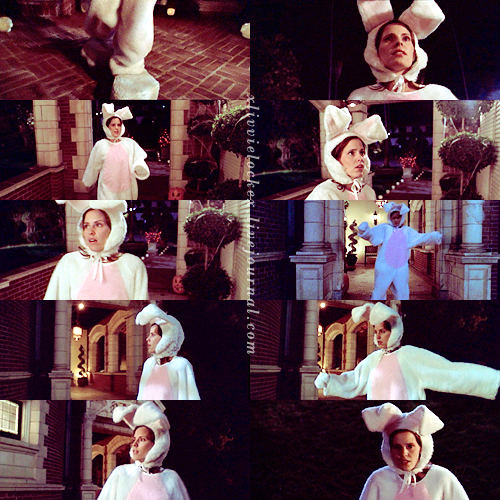
I’ve always loved that scene in the Buffy musical where Anya rocks out against bunnies. If you haven’t seen it, do. (Joss et al seem to have locked down movies I used to find on youtube, but you’ll get the idea.)
Because everyone in the land called Facebook seems to be posting something about rabbits today (why? I ask you) I’d like to share a snip from a story I’m writing called “Rabbit, Cat, Girl.” Here goes:
You want to know about the girl. I want to tell you. But I must begin with rabbits.
Here’s what I know: there have been rabbits since the start of the world, gnawing the sharp drygrass when there are no tender green spring shoots. They burrow into the bases of catalpa trees, and under bushes, hiding like vermin. Some people find rabbits endearing, benevolent like the smiling Easter Bunny, a chocolate charade, lurking beneath false rebirth of spring. Soft and so helpless, they hop like little innocents, and grow like armies, eating everything. Have you ever studied a rabbit’s teeth?
I am reading my four-year-old daughter Charlotte’s Web, by E.B. White. I had forgotten how great the book is–easily one of the best novels I’ve ever read.
The first line: “‘Where’s Papa going with that axe?’ said Fern to her mother as they were setting the table for breakfast.” Seriously, I can’t think of a better hook. When I took it from the shelf last week, my daughter was hesitant to read what, a year or so ago, she had with odd prescience named “the bacon book.” I said, “I’m just going to read the first line.” I did.
Today, after reading her the chapter where Wilbur et al prepare to go to the Fair, my daughter acted out part of the story. She needed a spider, and I remembered my husband’s wonderful Steiff spider, now known as “Charlotte.”
My daughter (“Fern”) quickly made a tent for Wilbur and Templeton (because, she informed me, they were going to kill Templeton, too). She said that Charlotte was “one of the savers.” Fern and Charlotte were saving Wilbur and Templeton.
So another reason to love this book: from it spins the truth that it’s not only males who do the saving around the farm. Females do, too. Children who hear animals talking are taken seriously by most adults, even the medical establishment, in the form of Dr. Dorian: “Children pay better attention than grownups. If Fern says that the animals in Zuckerman’s barn talk, I’m quite ready to believe her. Perhaps if people talked less, animals would talk more. People are incessant talkers–I can give you my word on that.”
I can’t wait until bedtime, so I can remember what happens next.
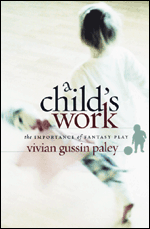
One of many fantastic books by Vivian Gussin Paley
And yes, I grant myself that exclamation point!
Here’s an interesting piece by Annie Murphy Paul about the neroscience of reading fiction. It validates things that many know intuitively: among other things, reading fiction makes more empathetic humans. (And it slashes through those conversations–conversations which, frankly, piss me off–about how nonfiction is somehow more important than fiction in helping people deal with “the real world.” I love that the study corrects for things like whether people who are more naturally empathetic read more fiction. Take that!)
Described in the piece is how we register sensations as we read descriptive language: how the evocative qualities of words like “cinnamon” work our sense of smell. This aligns with something I heard the poet Cathy Smith Bowers discuss: when we read a word aloud, its sound affects us emotionally, but even when we read a word silently on the page, our bodies experience similar sensations. As a writer of fiction, all this helps me understand why I care about what I do. Why it’s important to make stories. As a reader, it all sounds very true.
Last night, I finished reading Vivian Paley’s book, A Child’s Work. Its emphasis is on the importance of fantasy play and stories in developing a young child’s ways of processing and coping with the world. All the books by MacArthur Fellowship recipient Paley that I’ve read have moved me–she is a gifted writer, and her subject is so vital. In her work, in addition to her observations as a wise teacher, she records and shares dialogue from real children in real classrooms, making sense of their real worlds and lives through fantasy and imagination. In this book, Paley rightfully despairs at the push to bring academics to children too soon, leaving less and less time for preschool children to dream and do their natural thing. Among many passages in this book that move me and are so true, Paley writes, on p. 102:
“Every day brought me new evidence of the preeminence of fantasy in children’s thinking. It has reinforced my certainty that we perform a grave error when we remove fantasy play as the foundation of early childhood education.
We are going too far in the opposite direction. Some school people feel that because young children engage in magical thinking we must pull them on to another track as early as possible; having added extra years of schooling to their lives, we are emboldened to counteract fantasy play with ‘reality-based’ activities.
Is this not the adult version of magical thinking? To imagine that the purpose of early childhood education is to reorder the stages of human development is like the story of the prince who was turned into a frog. In attempting to turn children into creatures that are unchildlike, we ignore all the messages young children give us as they play. The frog turns back into a prince when the princess recognizes his need to be treated with kindness and respect. In the case of our children, this would include the kindness of acknowledging that their perceptions and premises are not the same as older children’s or as our own.”
This idea of how we think we can reorder the natural stages of a child’s development haunts me. Paley’s work speaks to me in particular now as the mother of a young child. And pausing to read it has helped me slow down enough to more fully engage in the play my daughter is about. So many of her sentences start with “Pretend that…” and I’m paying closer attention, and doing more active pretending with her. (It’s good for adults, too!) But anyone who is interested in stories and storytelling and their central importance to our humanity ought to read Paley’s books. The Boy On The Beach is a really good one, too, and gets at why storytelling is important to building communities.
A poem from a couple years ago, inspired by the novel I’m working on, working title of which is The Eight Mile Suspended Carvinal. This is the character Beede talking. I can’t do line breaks right in html, so I think the word “vast” was originally on the line above where it appears, but below it’s an orphan, which makes sense in the story of the novel at least.
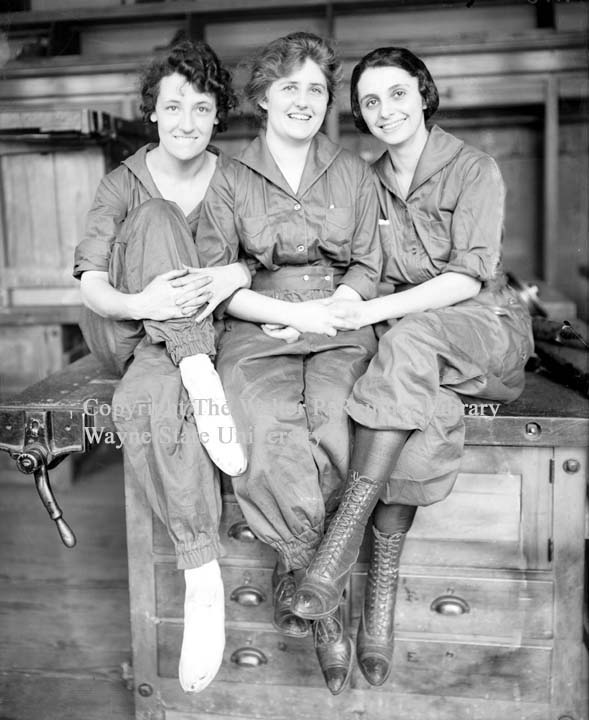
Who lost track past midnight at the Spurlock Munitions Factory, near-river, 1917?
Oh yes Oh yes Oh yes
What you’re to see, boys, you dark, dirty skells, you
seen plenty spark here, what else, you’re thinking
you constitute yourselves of solids, you’re commanding
gentlemen, can take some things, maybe you’ve traveled, say
Illinois, Illinoise, farther, it does not take ambitious nature
to see the world, just a slick hand and some loose pocket. Rust is everywhere–
Davey knows my language. So you did time, who hasn’t, all we got is time in this vast
bum’s end of things, I’ve spit up wet gobs of coal, we’re all the same
just don’t get caught. Once saw a man dangling from a shagbark hickory, by the neck, all of it, tree bark and scales fallen from those eyes, all I can say is use the brain-pan,
don’t get caught
and you won’t end up with any fallen scales, don’t laugh back there, it wasn’t all
that amusing seeing that man up there, the weight of himself dead
meat. He didn’t have much luck.
But you’ve stepped up around here, all of you,
waiting on that kiss which makes us all breathe in, every crusted morning, for the long years we’ve got, a kiss humid and lovely like that mind-reader at the carnival,
she’s got curves, wait another day and maybe you’ll find that luck somewhere. Factory life got you groaning, you’re thinking anew, ready for this
fire? Let me take off my shirt now. The way I do it, you won’t even see the spark,
just watch. Lucien B. Dunavant will show you the light.
You count your breaths; I’ll count mine. That old sack granddaddy Spurlock
has not one thing on me.
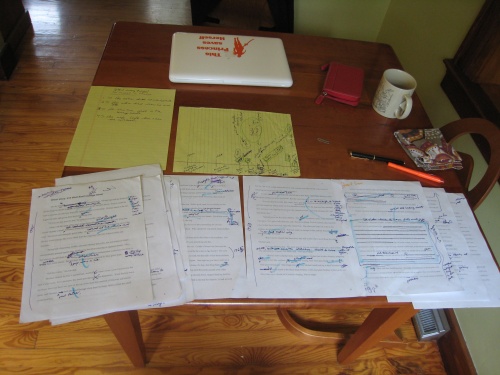
So I’ve been working on this terribly overwritten draft of my novel in progress. Gone through the printed pages carefully, cutting, pruning, taking out piles of adjectives and phrases. The typed pages are a mess now, not unlike this other mess from a previous project. I keep thinking, “Which gremlin scribbled all over these neat pages here that I now have to type up?” though the gremlin is me. This novel I have been writing since 2004. Part of its problem is uneven terrain: while I was figuring out what it was, I was writing along, letting time pass in the story, and the story emerged like sourdough bread (a terrible metaphor!) that, 100 or so pages into it, actually begins to take shape. So now as I comb through the years of words on these pages, I see where things need to be built up, and where torn down. With this project, I pushed language and narrative beyond anything I’d ever done. On purpose. Because I could! Here I gave myself license to write a really bad first draft, and use all the purple colorful clang I heard in my head. (Knowing I would cut later.)
Too many adjectives! Oy vey! Too many phrases strung together that unwound from my mind and at one moment in time made sense but now hang like random junkyard decoration. Get that egg beater out of there! What did I just step on? Is that stench overripe banana? And so on.
Get it out of here!
I realize at least two things about this draft, both of which were essential to my authority in telling the story. I needed both:
1) The self-indulgent “let everything be in there” messiness. As author and creator of this world, I had to see how dingy and dusty and clangy and rotten the nouns were. I had to see the layers of adjective like paint on an old carnival sign, repainted over crack and crumble. How else would I know the patina of this place? And;
2) The excessive phrases that are stage directions: “She put the scissors on the round table to the left of the door” and so on. If it’s even important that she put the scissors down (question everything!) does it matter where? She put them down. Fine. But the writer, again, to establish authority, must see the whole thing happening like a play, must know and track where the scissors are put down. In case someone else needs to bob her hair! And so on like that.
If I know this world I’m writing is dusty and clangy and I know where the scissors are, I don’t have to tell you (unless it’s important to the story). If I am doing my job well enough, the reader will trust me. She will thank me for sparing her unnecessary words. Doing so will leave me more room for the things that really need to be there. It’s like all the doing of research that doesn’t end up in the novel. Having those things, knowing them, seeing and breathing them, is what allows me to tell the story in a way that will keep people reading.
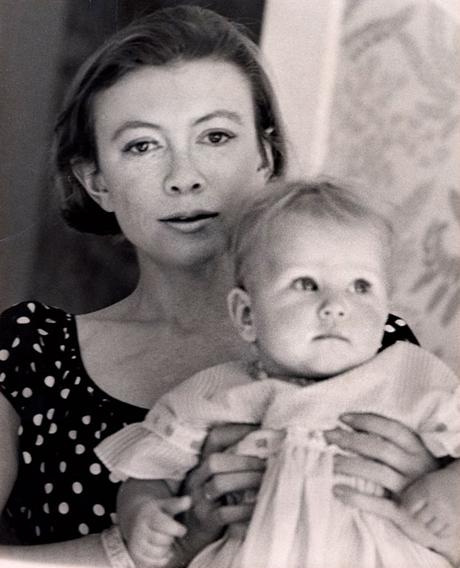
As I read Blue Nights, Joan Didion’s repetition of images and phrases hypnotized me, as did her peeled and still-peeling layers of story. As with The Year of Magical Thinking, here I felt Didion recounting memories in the way we actually experience them. As if she set out to articulate against the linear necessity of language: one letter, one word, one thought at a time, arranged tidy in a row, which is one way we make sense. The intentional fragmentation of narrative was accessible and didn’t fall off the page (or render me lost in the land of “what the fuck?”) because of Didion’s clarity. Because of her sentences. And perhaps because of the fact of what she was doing: the narrative act of slowing down, examining, opening drawers and closets brimming with iconic possessions. As Didion names these ghosts on p. 45: “The objects for which there is no satisfactory resolution.” The detritus of the lives of the people she loves best, and lost. As she opens each drawer and tells the stories of what she finds, she assumes the role of docent in the Joan Didion Museum of Loss.
(In the essay “Slouching Towards Bethlehem,” Didion writes: “Someone works out the numerology of my name and the name of the photographer I’m with. The photographer’s is all white and the sea (‘If I were to make you some beads, see, I’d do it mainly in white,’ he is told), but mine has a double death symbol.” I read that passage again after I’d read The Year of Magical Thinking, and could not avoid thinking of her life story’s foreshadowing in that moment, the double death that awaited her.)
In addition to the quandary about what to do with all that stuff (and my own eventual stuff, should I live long enough, outlive someone I love) I felt the writer’s grief and discomfort at the ache of questions she turns over and over, things upon which she shines a light, unable to avoid the vast shadows of murk.
Shadows which, despite the fact that some people, including me, happen to believe Didion walks on water, do not flatter her.
There’s something about that peeling, that sad onion, those haunts, her willingness to shine light despite what might crawl out, which makes me feel more human.
Flann O'Brien, of whose prose I could not get enough last month
Like tucking into a vat of potatoes after long without food, during winter break, I read in rapid (rabid?) succession Flann O’Brien’sThe Poor Mouth and The Hard Life. Truly when I finished reading The Poor Mouth, I was still hungry and needed more. Good thing I stocked up on both books!
Anything I say about Flann O’Brien will clunk like a can down malnourished and decrepit steps into the void of my own unworthiness, but my evangelical urge I can no longer ignore. So.
If you’re into the show “Lost” perhaps you’ve heard of or even read O’Brien’s The Third Policeman. I didn’t watch many episodes of that show, so I’m blind to the connection, but I’m glad more people heard about (and possibly read) O’Brien’s novel. (The which I need to re-read, and soon. I first read it as part of a seminar in grad school with Rod Val Moore. The book was suggested in preparation for a field trip to the Museum of Jurassic Technology.)
Reading The Poor Mouth (published in 1941) is like diving into a pool of hilarity and squalor (yes) and eating it all with a spoon. Yum, hyperbole! My favorite! Among other things I hope to grasp as soon as I re-read The Poor Mouth, O’Brien becomes a sort of cantor, invoking lyrical phrases of misery, a tapestry of moments in which, for instance, we hear, “…generally no sound except the roar of the water falling outside from gloomy skies, just as if those on high were emptying buckets of that vile wetness on the world.” A tattered weariness in which scenes begin with openings like: “One afternoon I was reclining on the rushes in the end of the house considering the ill-luck and evil that had befallen the Gaels (and would always abide with them) when…” Reveling in this luxurious squalor and over-the-topness, I laughed loud and often as I read along, even more than while reading Wodehouse. To rip a phrase from O’Brien and twist it terribly, each chapter is like a thesis, proving without doubt that the plight of O’Brien’s Gaels is a bad life “whose like will ever be there again.” (Just read the book. It’s short. If you hate it, I’ll give your money back.) I also need to read it again to see how it lines up with another hyperbolic novel on the topic of poverty, though not nearly as hilarious, George Orwell’s Down and Out in Paris and London.
Literary belly still grumbling, I took up The Hard Life. Published in 1962, the story was more shaped and plotty than The Poor Mouth. At intervals, two characters tussle in flappy rants about the shadowy political power of Jesuits within the Catholic church. Their dialogue was so well written that I didn’t struggle, despite my lack of knowledge about the issues they debated. To press these two characters into a modern context, their arguments could have been mouth-offs between two old school rappers, one-upping each other (mostly) good-naturedly, but with no self-censor. They were funny. And the mountingly bizarre plot twists were delectable. (See, I’m still on this stuff as if it’s food! And really, it is.) The end was unexpected and brilliant. I’ll say no more, so as not to spoil a good meal.
“Only the very young and the very old may recount their dreams at breakfast, dwell upon self, interrupt with memories of beach picnics and favorite Liberty lawn dresses and the rainbow trout in a creek near Colorado Springs. The rest of us are expected, rightly, to affect absorption in other people’s favorite dresses, other people’s trout. And so we do. But our notebooks give us away, for however dutifully we record what we see around us, the common denominator of all we see is always, transparently, shamelessly, the implacable ‘I.’ We are not talking here about the kind of notebook that is patently for public consumption, a structural conceit for binding together a series of graceful pensees; we are talking about something private, about bits of the mind’s string too short to use, an indiscriminate and erratic assemblage with meaning only for its maker.”
–Joan Didion, “On Keeping a Notebook,” Slouching Towards Bethlehem, p. 136.
I just began reading Blue Nights. The passage above from Didion’s much older essay has been with me as I approach a still-too-tender writing project. It’s stuff I will write about some day, though more time must first elapse. I need perspective, and this is too messy and raw. Meanwhile I put bits into a jar (or notebook) to save, to turn over, to approach for the quilt when it’s time.
Meanwhile, merely typing Didion’s words (and reading her new memoir) is a comfort and a privilege.
I used the word “decimated” in an essay today, and decided to make sure it was the right word, so looked it up, lazily, on the web. I’m using it somewhat hyperbolically in my essay, but this is among what I found:
1 : to select by lot and kill every tenth man of
2 : to exact a tax of 10 percent from <poor as a decimatedCavalier — John Dryden>
3 a: to reduce drastically especially in number <choleradecimated the population>
Just right. When the word came to me, I hadn’t consciously remembered the ten in “dec” but it is perfect. So “decimate” is like the anti-tithe, kinda.



 Rebecca Kuder