A few months ago, I had the pleasure of sitting down with Jahzerah Brooks to talk about my novel, The Eight Mile Suspended Carnival. We talked for hours. Jahzerah asked fabulous, insightful questions. She understood and articulated things about my novel that I hadn’t seen. She helped me understand what I had done (consciously and unconsciously) among those pages. Our conversation opened new vistas for me. Jahzerah is a brilliant, thoughtful reader and writer, and it was my great fortune to spend time with her.
And today when I read what she made of our conversation, I got teary. (The hybrid interview—part essay and part Q&A—was published at Craft Literary.) Writing this novel took me a long time, and so much of the work was done without any notice or attention. Sometimes I felt like a feral weed, reaching into one little shard of light in order to keep writing. It’s hard for me to put into words the gift Jahzerah has given me with her time, care, and gorgeous writing. I am so grateful.
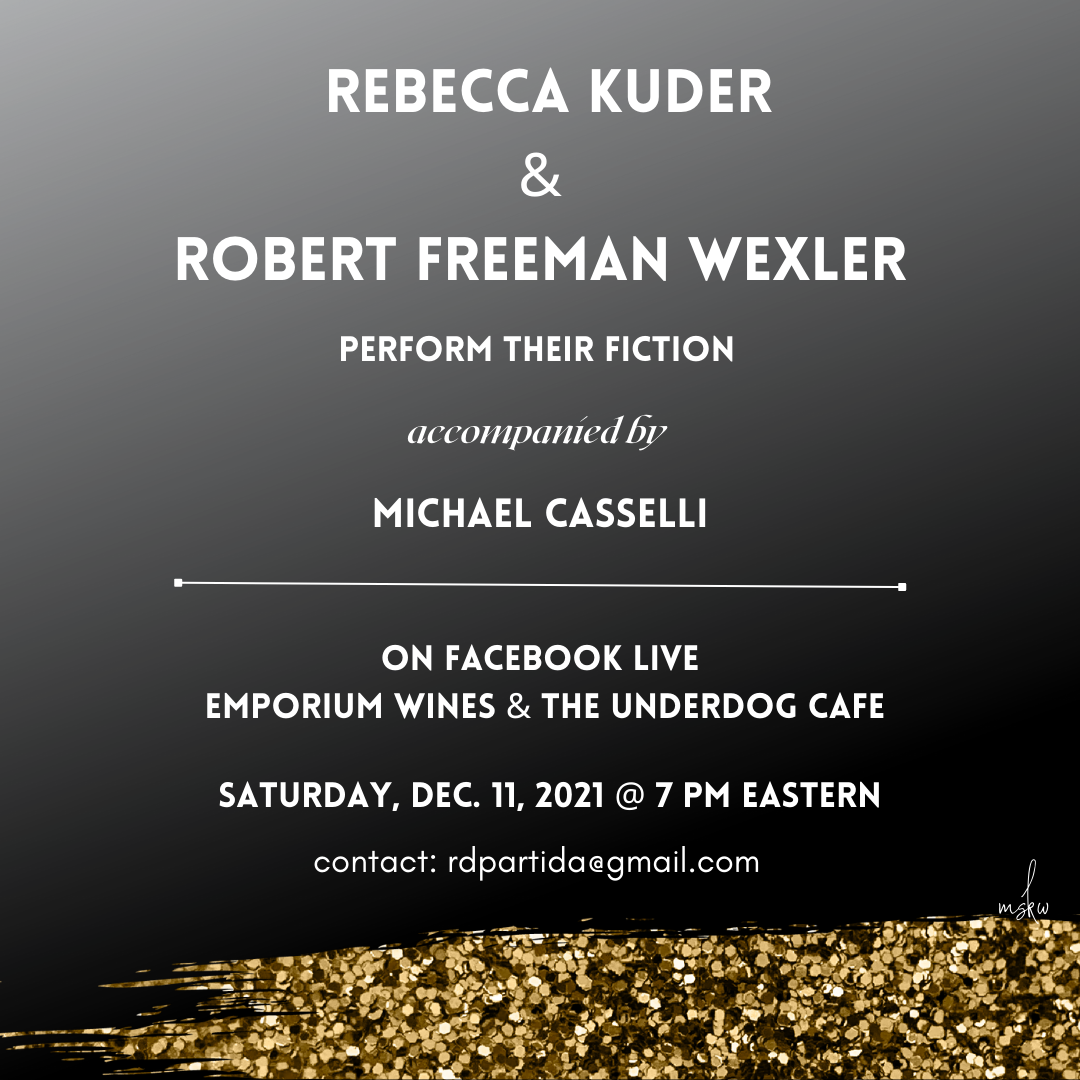
On Dec. 11, 2021, Robert Freeman Wexler and I performed fiction at Emporium Wines/Underdog Cafe in Yellow Springs, Ohio. We were accompanied by interdisciplinary/sound artist Michael Casselli. (Thanks, Robert! Thanks, Michael!)
We had hoped to share the event live via Facebook, but technology did not save us.
Fortunately, we filmed the event, and it’s now available to watch.
The video was filmed & edited by Cameron Henderson. (Thanks, Cameron!)
Catching up on some book notes, I’m thrilled to spend a moment recommending that you hurry up and read Chris Tebbetts‘ fabulous & fun novel, Me Myself & Him.
I read this novel in 2019, but because the author is a beloved friend from early days, I was “only” able to absorb and enjoy. (There is nothing wrong with reading for pleasure! Please, let’s read for as much pleasure as we can! We need all the pleasure we can get—these days, any days.) In 2019, I was happily distracted by familiar details and voices, and I let myself get swept away in the experience. But recently, I re-read the novel with a blog post in mind.
Even if Chris Tebbetts were not my friend, I would still call this a friendly book. There’s an amiable generosity in the self-deprecating humor of the narrator—the voice—and I can imagine being a friend to the fictional Chris. Fiction or non, I love reading books like this, where the narrator seems honest, earnest, and trustworthy, fully human. In the case of Me Myself & Him, some of this trustworthiness comes from the narrator’s willingness to show his imperfection, his mistakes. I found that aspect of this novel extremely life-affirming. We make choices, we make mistakes, we fuck up. We keep going, despite injury and heartache. We endure shame. Sometimes people grow, and sometimes, people forgive each other.
This novel is a beautiful artifact of connection and friendship. (Very necessary in these times of isolation.) It centers friendship as an openhearted pursuit, through many twists of fate, or plot—and speaking of plot, this novel is so appealing in its puzzle-parts, its twin lines of possibility, in being a rumination on what might happen if.
One of the most compelling textures is the narrator’s storytelling voice. Readers glimpse the interior of the character as he grapples with a complicated relationship with his father. Such as:
p. 13: In a conversation with his father about college:
“Birch had been my first choice, and against all odds, not to mention my own expectations, I’d gotten in, as a film and English double major. I had no idea what I wanted to do yet (as in, when I grew up), but I knew exactly where I wanted to be for the next four years—at Birch. And, just as important, anywhere but Green River, Ohio.
I couldn’t not go to Birch, and Dad knew that, didn’t he?
‘I know you feel forced right now,’ he said. ‘I’d feel the same way. But this is all about choices you’ve made. You do understand that, don’t you?’
This is what I’m talking about with him. It’s like falling down a hole and there’s nothing to grab onto because it’s all lined with that stainless steel logic of his.
Then on p. 28:
Then he did this one thing that he and my mother share. They’ll smile in this patronizing way when I’m acting stupider than I actually am. It’s a harder habit to break than you might think—for me, I mean.
He took a sip of coffee, to let my stupidity sink in. Then he said, ‘Actually, I want two things. I want you to speak with a counselor, and I want you to come work at the lab this summer.’ Felicia moved her head, like maybe an eight of an inch. ‘Assuming you’re still planning on Birch in the fall,’ Dad added.
Ladies and gentlemen, welcome to the bottom of the hole. Please remain seated until we’ve come to a full stop at the terminal and the captain has turned off the HOW DID I NOT SEE THIS COMING? sign.”
And later, on p. 217 in the alternate narrative strand, re: his father’s second wedding:
“I kept forgetting—or losing track of the idea—that everyone else who was coming to the wedding thought of it as this champagne-soaked, all-good thing, and entirely worth celebrating. Mark and Felicia, together forever, whatever.
At the same time, there was a little bit of What the hell is wrong with me? mixed in there. Seriously, why couldn’t I just be neutral about it, or even, god forbid, happy for them? Why did everything always have to be so considered and examined and dissected? By the time you finish dissecting anything, it’s a disgusting mess. So what did I expect? That I was going to chew on all this wedding stuff, spit it out, and like what I saw?
Please.
Honestly, what I really wanted—what I’d always wanted with regard to Dad—was to not think about it. But that never seemed like an option. He had this sway over me; this way of invading my thoughts that only got worse when I was around him. Whether that was about my own weak-mindedness, or his strength, or something else, I don’t know, but I resented it as much as anything.
It was going to be a long three days.”
Although I recoil a bit at implying that authors have a responsibility to make characters “relatable” (no pressure, writers! and I just don’t like that word), I do find the gently neurotic flavor of the narration…familiar. :) Appealing. Reassuring? (Proving that maybe neurosis/over-anxiety is not only in my head.) Maybe because the neurotic bits are so artfully balanced by a round, complicated character. Interior rumination is used judiciously here, by a writer who knows well how to handle texture and pacing—so the rumination is, to me, one of the most delicious parts of this novel.
You can learn more about Chris and his work at the website above, and on Instagram here.
Oh, and p.s., thank you, Chris, for giving young people (and old people) such a beautifully engaging novel as Me Myself & Him that feature LQBTQ+ protagonists! What the world needs!
Photo courtesy of Lauren Shows/Yellow Springs News
On February 2, Robert Freeman Wexler and I will emerge from hibernation to read from our recent “genre-defying books.” Maybe we will see our shadows, maybe not.
We had hoped to read in person, but considering the state of things, the Yellow Springs branch of the Greene County Public Library has graciously moved the event online. This means you can attend from anywhere! Please join us.
Details & registration information below.
Yellow Springs Library Local Author Visit (ONLINE): Kuder and Wexler
Local authors Rebecca Kuder and Robert Wexler will visit (online) to read excerpts from their recently published, genre-defying fiction, including a brief Q&A.
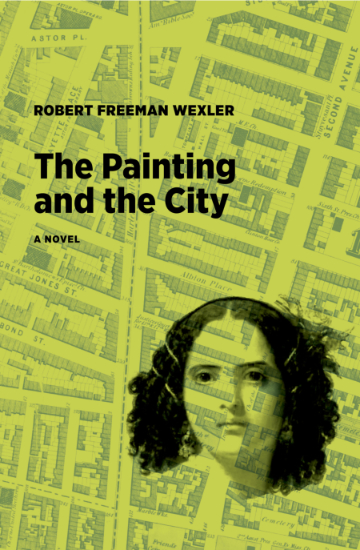
Robert Freeman Wexler and I will read (in person!) from our recently published books on Sat., Dec. 18, at 7pm Eastern at the Yellow Springs Senior Center—227 Xenia Avenue, Yellow Springs, Ohio 45387. This reading is hosted by the Epic Book Shop. I will read from The Eight Mile Suspended Carnival, and Robert will read from The Painting And The City.
If you are in the area, please join us! (Masks will required.)
Mark Andresen at the Pan Review (“a bi-monthly look at the arts and literary scene”) graciously invited me to answer some wonderful questions for the Pan Review Of The Arts No. XIII. I’m very grateful to Mark for this opportunity, and grateful there are such fascinating corners of the internet, where we can ponder the inner workings and explore inspiring esoterica.
And if you like the book, feel free to review it wherever (Goodreads, etc). And ask your local librarian to buy a copy, because libraries are where it’s at.
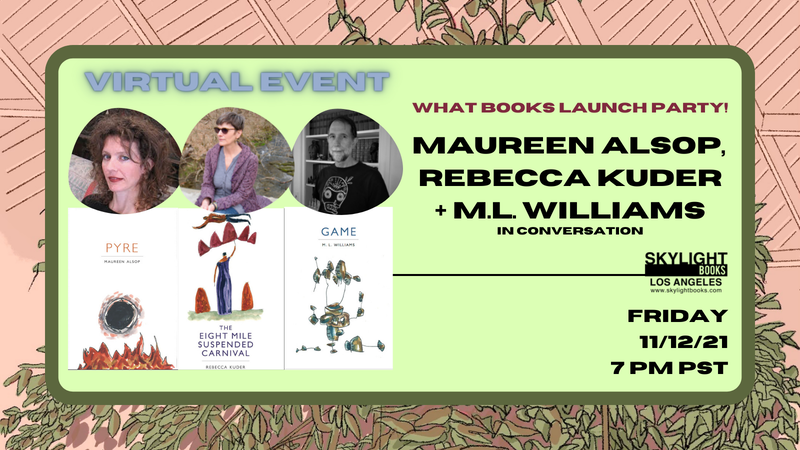
Please join me for the online What Books Press Launch party, hosted by Skylight Books! I will read from my debut novel, The Eight Mile Suspended Carnival, alongside poets Maureen Alsop and M. L. Williams. For more information, or to register, please visit the event page. (Please note the event will be held at 7pm Pacific/10pm Eastern.)





 Rebecca Kuder