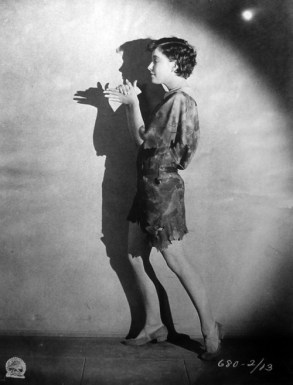
I made the thing; tiny green sock-scrap leaves sewn on tiny beige sock-scrap shirt, a messy torrent, surpassingly cute. And then I reminded her that Peter Pan is often played by a woman. That anyone could wear the costume. It was silent for a moment, as it often is when she’s thinking, and then she said, actually, her girl doll A. will probably wear the shirt every day, because of her dolls, she’s the most adventurous and flexible…
And this is how we raise them, how they lift off despite gravity, and perhaps even fly…
Undertow Publications has announced the table of contents for the Year’s Best Weird Fiction Vol. 3. I’m thrilled my story “Rabbit, Cat, Girl” will be among those chosen, including stories by Robert Aickman, Ramsey Campbell, and Reggie Oliver. (I blogged about the story of my story here and elsewhere.)
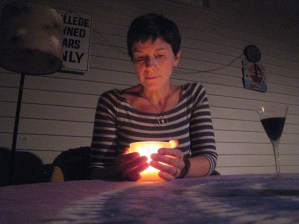
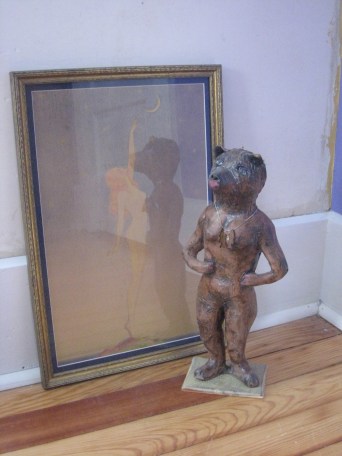
Flea market lamp; thrift store wine glass bought for our wedding; College Cars Only sign stolen from Earlham College in the mid-1980s; tablecloth brought from Africa via college friend; ship painting by folk artist Mary Paulsen acquired in 2012 in North Carolina; glass flowerpot candleholder from Mendelson’s Liquidators and used for wedding centerpiece, still useful; Writer in the midst of detritus of the Weird.
I’m grateful to editor Mark Teppo of Resurrection House for first publishing the story, and to Year’s Best Weird Fiction 3 guest editor Simon Strantzas and Michael Kelly at Undertow.
It’s a big deal (to me) that 1) Anyone is reading anything these days, that 2) Mark Teppo liked my story enough to publish it, and that 3) Simon and Michael also liked it enough to honor it in this way.
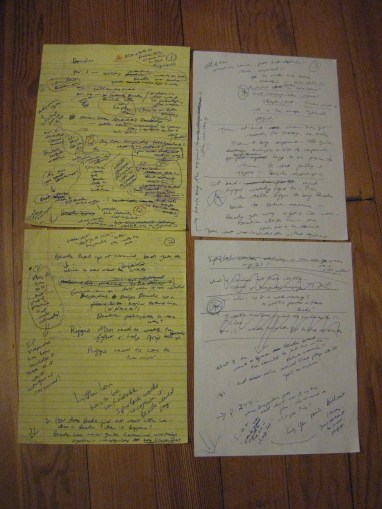
I don’t often write short stories. This story came from months and strata of excavation, which I wrote about here and elsewhere on the blog: layers of messy personal essay drafting, onion-peeling story attempts…all trying to find where the innards of that slice of my humanity would fit into Story.
Grateful that it fit somewhere, and that people in the world outside my head appreciate it. I always felt, and still feel, weird. Nice to have an upper case confirmation.
“If a person will only think about it, the first fountain pen was
undoubtedly the human body itself, with its seemingly endless
(till death do us part) supply of ink.” —p. 165, Parsifal
“A fountain pen forces no one to read its words.” —p. 224, Parsifal
As I read Jim Krusoe’s writing, which I’ve been doing for a decade and a half, I find it simultaneously familiar and strange. In his work, I hear a persistent drumming behind the prose, a call. My ears strain to grasp the sound; it’s just beyond my reach. It occurs to me that it’s similar to how the musician Bill Frisell allows his past themes to reemerge and weave into the texture of the new, Don’t I recognize that from somewhere? Familiar, strange. By these haunts, I’m both lulled and awakened. What does that memory mean this time?
In Krusoe’s work, that mystery gives me permission to dream while I’m awake. Or, perhaps, as Krusoe puts it on p. 75 of Parsifal: “Somewhere there must be a word, some technical term, for a combination of anticipation, nostalgia, and dread.”
Then there are the pens. The protagonist of his last novel, Parsifal (Tin House, 2012) repairs fountain pens. (Reminiscent of the protagonist in his first novel, Iceland, who repairs typewriters.) This persistent loyalty to archaic means of capturing story on page is a comfort in our era of disembodied ones and zeros. In the narrative weave of Parsifal, a sort of Aesthetics of The Fountain Pen emerges:
“‘In my experience,” Parsifal tells those who ask, ‘there are two kinds of people: those who enjoy complications and subtlety, and those who do not. If you are not the sort of person who enjoys complications and subtlety, then a fountain pen is not for you.’”—p. 191, Parsifal
I write first drafts on paper. The fountain pen is my primary tool. Wait! Am I “the sort of person who enjoys complications and subtlety?” Am I really? Or do I like things more tidy? Complications and subtlety are so messy! So uncomfortable! But evidently so appealing, so attractive. As a person who (apparently) enjoys complications and subtlety, the fountain pen thread was one of the primary pleasures as I read this novel. If we can trust the narrator of Parsifal:
“During the first years of fountain pens, prior to the actual Golden Age, which was roughly from 1910 to 1950—prior to the invention of the ballpoint, in other words—it is a little known fact that no fountain pen came with the small clip that holds it snugly inside a pocket of a shirt. That was invented by George Parker, of the Parker Pen Company, and ever since then it’s hard to imagine a pen without one (though some pens are still made this way, primarily for the Japanese market). So it is possible for something to come from nothing: no clip for many years, and then suddenly, a clip. And now, with the fountain pen practically extinct, the clip lives on, attached to ballpoints, and roller balls, and mechanical pencils, and laser pointers.”—p. 246
Jim Krusoe was my mentor in graduate school, and since then has continued to be a significant influence, inspiration, and support. In the classes I teach, we sometimes discuss why different writers write. I’ve never asked Jim why he writes, but I wonder if there’s a clue in Parsifal on p. 181, “Who was it that said our sole glory as humans is to leave behind a record of our crimes and desires?”
(Was it Jim Krusoe?)
His next novel, The Sleep Garden, arrived at my house yesterday. I cannot wait.
I recall (or dreamed?) reading a passage in Clarissa Pinkola Estes’ book, Women Who Run With The Wolvesthat seemed to be saying: The universe is contained in the body.
All I could find were these lines from Chapter 7 (Joyous Body: The Wild Flesh):
“The body is like an earth. It is a land unto itself. It is as vulnerable to overbuilding, being carved into parcels, cut off, overmined, and shorn of its power as any landscape. The wilder woman will not be easily swayed by redevelopment schemes. For her, the questions are not how to form but how to feel.”
Maybe it doesn’t matter whether I literally read that the universe is contained in the body. Maybe the brain doesn’t need to find it.
Maybe it doesn’t matter because the idea is there anyway, somewhere, in my body.
Writer with a stink bug (Antioch College Olive Kettering Library)
This week I set the goal of finishing a solid revision of my novel. Thanks to the wise and generous writers who read and gave feedback on this round (Kristin Walrod, Melissa Tinker, and Robert Wexler), and the stink bug who showed up for the final lap, I made it.
My husband Robert printed out the beginning of his novel for me to read. I printed the end of my novel for him to read. Loving this man, this work, this symmetry…
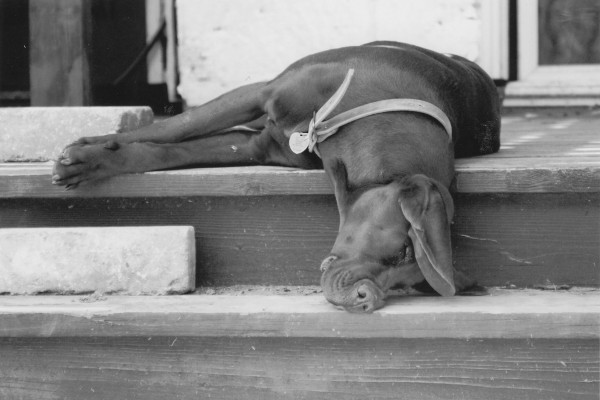
The novel I’m revising is like a dear old hound dog. Waits for me on the porch, with an occasional, “woof” when the wind blows, until I remember to come over and give that dog something to chew on.
I asked the students in my creative writing class at Antioch College to try this. Because it was a good exercise for me as a writer to type up the sentences of these writers, I am posting it here.
**
Read Colson Whitehead’s “The Port Authority” and/or the fragment from Joan Didion’s “The White Album” (section 12, pp 44-45) again. Find a spot from which you want to take inspiration, and write for 10 minutes (or longer). This is a rather open-ended option.
OR, for a tighter frame:
Use one of these fragments below—You might even choose one sentence, or one image. Read it aloud, and then write for 10 minutes (or longer).
*
“It is the biggest hiding place in the world. The inevitable runaways. The abandoned, only recently reading between the lines. After the beauty contest this is the natural next step. All the big agencies are there. He saved his tips all summer and to see them disappear into a ticket quickened his heart. Not the first in the family to make the attempt. The suitcase is the same one his father used decades before. This time it will be different. The highway twists. She will be witty and stylish there. With any luck he will be at the same address and won’t it be quite a shock when he opens the door but after all he said if you’re in town. Hope and wish. In the light of the bonfire she realized the madness of that place and was packed by morning. They will send back money when they get settled, whatever they can. A percentage. Reliving each good-bye. Practicing the erasure of her accent, she watches her jaw’s reflection in the window. Wily vowels escape. No one will know the nickname that makes him mad. This is the right decision, they tell themselves. And then there is you.”
—Colson Whitehead, from “The Port Authority”
“During the years when I found it necessary to revise the circuitry of my mind I discovered that I was not longer interested in whether the woman on the ledge outside the window on the sixteenth floor jumped or did not jump, or in why. I was interested only in the picture of her in my mind: her hair incandescent in the floodlights, her bare toes curled inward on the stone ledge.”
—Joan Didion, from “The White Album”
*
“I believe this to be an authentically senseless chain of correspondences, but in the jingle-jangle morning of that summer it made as much sense as anything else did.”
—Joan Didion, from “The White Album”
*
“There is a crack in everything. That’s how the light gets in.”





 Rebecca Kuder