Overheard, Yellow Springs, Ohio, on a single day in my grateful life: People singing show tunes around the piano at Emporium Wines & The Underdog Cafe this morning; Antioch College students singing together in the Olive Kettering Library; Grace itself in the form of the World House Choir singing, this evening, singing to the Mother of us all, the earth.
The world feels full of beauty and love, at the moment. I’ll cling to this notion, make it my lifeline, for the rainy, dark days that are surely ahead.
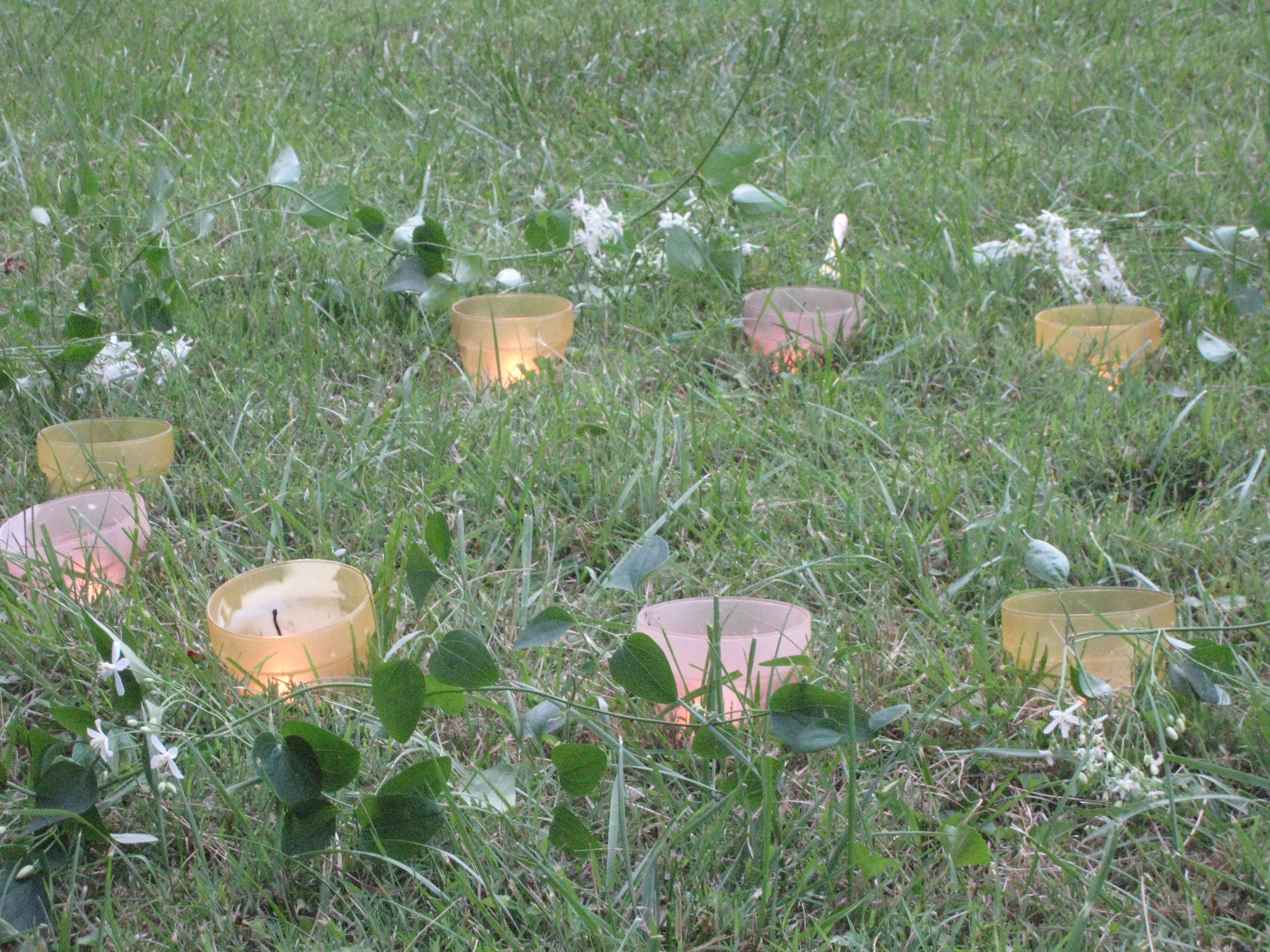
Leftover candleholders from my wedding, and weeds.
Here’s a statement I wrote last week for a grant application. I’m new-ish to personal essay, so it feels weird to proclaim anything about it (because I keep learning what it is!) but this piece describes some of my process and reasons for writing personal essay, so I thought it was worth posting here. It’s slightly edited toward blogginess. Cheers!
***
My essays grow from lived experiences (transitions and grief), but I wait to write them until I find a way to transcend my life and connect to something larger, something that might resonate for readers. Writing stories about life can be very therapeutic, but must stretch beyond the writer’s singular experience and have meaning to others.
In my experience, the process of writing personal essay is murky and chaotic. Sometimes I use the metaphor of an onion, as layer after layer I peel away to reveal what I really mean, to move toward something that feels true. (Some layers are just rotten, bound for the compost heap.) From there, I discover a shape, rendering that central image or idea in the stuff of lyrical essay. As I craft each essay, draft after draft, I interrogate myself repeatedly about what is relevant. When a story involves others, I ask myself which parts are mine to tell. I am careful in what I include, and what I protect. Writing personal essay means navigating these boundaries. Writing from life demands constant vigilance and integrity, lest the exercise and the writing itself collapse into mere therapy, or worse, narcissism.
With these essays, I intend to connect to others. Beyond that, I am interested in language, how to refine until even the vowel sounds help the reader feel what I mean to impart. It is life affirming when a reader tells me that something I wrote moved them, and it is satisfying as a creator when someone compliments the way I tell a story. It is these twin aims (reaching others, and artful storytelling) that keep me writing personal essay.
Specifically, in “The Bit Jar,” I wasn’t sure I was going to write about this topic for the public, but I felt called to encourage others who might be going through trauma. When the opening scene presented itself, I realized it could be the right frame to approach the material.
Sometimes finding a tight container is the way in.
In a similar way, “Love Letter (an avalanche)” arose when I sat and listened to a poetry reading. First I thought, “I have to write my ex a letter.” As the event continued, I thought, “Maybe this is a blog post.” Then finally I thought, “Maybe this is an essay.” The work-in-progress (“Hot Thing”) emerged because I wanted to capture in prose what it felt like to have a hot flash. The first draft began as a list, and eventually I kept the list form, steeping the essay in rumination about the tension between the facts and how it felt to me.
Doesn’t it feel like some books are too sacred to write upon? I go back and forth, and have various procedures. I’m embarrassed to say that for my favorite books (some of the ones I use for class) I have two copies on the shelf–one desk copy in which I’ve written, and one pristine. I always want the visually uncluttered reading experience, when possible…or at least I fantasize that somehow I can go back to the time of that first reading, and experience it again.
Now it strikes me that it’s like a specific cone of melon gelato I had in Italy last month. The melon gelato was so good, I immediately wanted to experience that cone again. I sit at my desk in Ohio and regret not going back for another, but it would not have been the same.
(I think the gelato was here: http://www.gelateriamillevoglie.it/ilgelato.html)
Glen Helen’s Cascades, not the Yellow Spring (but still).
Glen
From a prompt by Jyotsna Sreenivasan in the morning fiction class, AWW 2015
7/15/15
Wanting water and green, I walk down the rock steps, down and down and down and down. Whenever I count them, I get a different number, they defy me to quantify. (And what defines one step, and what separates one from the next?) The rocks are damp today, I think about whether I’ll slip and fall, the treachery I might endure for reaching outside myself. On my way down, I mark smooth friendly jewel-weed, wonder if it’s true that poison ivy always grows nearby.
Down and down, always this quest for metallic water, this iron, this water, these rocks not yellow but orange, as every observant child informs every distracted adult. My quest, my prolonged drought when I moved across the country, and back, needing the water of home. I can never get enough of that water, that water becomes food, and feeds me, pours itself down the orange-painted rock and into its loving vessel, its child, me. The metal in that water is never bitter to me, but sweet, and worth the vertigo.
In her essay, “On Keeping a Notebook,” Joan Didion writes:
“…perhaps it never did snow that August in Vermont…maybe no one else felt the ground hardening and summer already dead even as we pretended to bask in it, but that was how it felt to me, and it might as well have snowed, could have snowed, did snow.”
I’m writing a piece in which I wanted so badly to use these words, but I used another part of Didion’s essay, had to let go of this treasure for the sake of the whole fabric I’m making…but I love this passage. I love its cadence, I love the self-doubt and rumination. This progression from Fact toward How It Felt To Me is an important and rich one, and we dismiss it at our humanity’s peril. This has been on my mind a lot, sparked anew last night when I read David Ulin’s piece about redefining creative nonfiction, in which Ulin writes, “all art is a kind of hybrid, reality reconstructed, redefined.”
Yes.
We get up each morning. Unless we are nudists, we put on layers, veils, makeup, clothing to disguise or hide or redefine something about ourselves. “Reality” is manufactured somewhere inside each human brain. (I am not a brain scientist; I don’t remember which part, but I have read about this, and I think this is true.) Things happen, there are facts, and facts are arguably “real” or “true”, but it seems to me the realm of literature, or art, is built upon everything else. The murk. How It Felt To Me. Even when I’m writing fiction, How It Felt To Me matters much in the making. Even if I am creating a world and pretending it doesn’t actually exist, even if I am telling Lies, How It Felt To Me can’t help but steer the making. (I could lie to myself now and say it doesn’t, but lying takes too much breath, breath I could instead be using to write, breath I could be using to stay alive.)
The fun is grappling around in the mess of these parts.
The cycle of living and dying continues…thankfully, so do words, and stories…and so I’m belatedly announcing the birth of Resurrection HouseXIII, an anthology of which editor Mark Teppo writes, “The ghosts of the past have been eaten by the children of the future: this endless cycle of birth, death, and renewal is the magic of thirteen.” Between the covers of XIII you will find my story, “Rabbit, Cat, Girl,” which I hope you will enjoy. (I’ve written about the process of writing this story here and elsewhere on the blog.)
I’ve been relatively quiet on the blog lately. During the silence, I finished a reasonably far-along draft of my novel, The Eight Mile Suspended Carnival. And now my hands (and the rest of me) work on final-ish revisions of The Watery Girl.
My intention is that 2015 will be an interesting writing year. Please stay tuned.
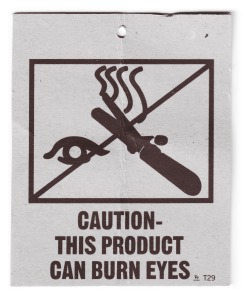
Actually, this is a helpful caution, but not for the reason you might think.
When I was thirteen, I burned my cornea with a curling iron. (No, I wasn’t trying to curl my eyelashes.) I was attempting that 70s flip thing, always striving toward Farrah or whoever created that look (and thereby dominated our dawning awareness of having to look a certain way). I curled the hair near my face, and then opened the hot flipper thingy (controlled by what is apparently called something like a “curl release button”). My eyes open, waiting for Farrah to magically emerge, the hot flipper thingy touched my cornea. I went to school, and my eye began to throb, so I guess someone called my mom, and we went to the eye doctor, who put some ointment in my eye. I remember it was winter, and how the sunshine reflected from the snow, that blinding brightness. (My cornea healed; my vision was soon fine, etc.)
The funny thing (to me) was that when I saw this caution note in the curling iron I bought last week to trick myself out for a 70s-themed adult prom, I thought, “hmm…how many people seeing this notice have actually burned their eyes with curling irons?”
I’m not sure how to end this blog post; I have nothing profound to say except maybe that vanity can be dangerous. And the human body can heal.
I got an email from my daughter’s teacher last night. My daughter is in first grade at the Antioch School, which, according to the school’s website, “is the oldest democratic school in the country.” Her teacher, Christine Lipari-Althaus, often sends emails with reminders and information about school happenings. In this message, she was reminding parents that today children would cross the field next to the school to go for the weekly swim at Antioch College. Christine reminded us to make sure our children had extra clothing, because,
“Children often find a way of locating the only mud puddle in Yellow Springs on our walk to the pool.”
Beautiful. Later in the message, she described an all-school meeting where the children worked out together the rules for jumping off the front of the tunnel that was built last year. Christine described the plan:
“We will jump one at a time, making certain that the ground is clear (no children emerging from the tunnel or cycling on the cycle path). It was also agreed that “no stunts” were permitted and that it is safest, and expected that everyone lands on their feet.”
What I love about these particulars: they describe a childhood that’s too rare today. I often think about the importance of protecting childhood. But by this I don’t mean keeping the child away from the mud puddle, or not allowing the child to jump in a place where they might get hurt. Just the opposite. By having extra clothes when they find the one mud puddle in town, and collaborating on how to jump safely in community, children are given resources that will serve them well forever.
But in reflecting on some of the work of my students, I wrote this in a narrative evaluation about gaining a deeper understanding of what it is to write and be a writer. I thought it was worth posting here:
It’s crucial to realize that if a piece of writing doesn’t come out perfect (and rarely does it come out perfect), it can always be improved. Knowing this (and living it) is much more important than any sort of inherent talent or inspiration. Doing the work is really the only thing a writer can control.
Last weekend, I was in a roomful of people remembering George Romansic. (If you don’t know who George was, you can read something about his work here and elsewhere on the internet.) Some of his people spoke that night, some played music, some just smiled, hugged, and wept. If I had spoken, here’s what I might have said.
I last visited George, who was my favorite DJ, in early January 2015. He would live a few more weeks; by then he was badly affected by the glioblastoma that killed him, but when I got there on New Year’s Eve, his George-ness was still quite evident. We hung out. As usual, in his living room, the music playing was vast and diverse and wonderful. George wasn’t up to DJing, so his son John Lewis was doing the work. George smiled when he told me John Lewis had been taking requests, finding just what his dad needed to hear from the freakishly-extensive music library. The music was good, no, not just good but delicious, like the best cafe latte (not Italian, not Starbucks, but a real Seattle coffee, like you’d find at Caffe Fiore or Cafe Lladro, anytime, but if you’re really lucky, when you were hanging out with George). At some point during the visit, John Lewis played some of his own music from his laptop, delicious too; it sounded really really really good. The child is of his father, and of his mother, but also of himself. The light in George’s face when he said his son was DJing was one of the truest things I have ever seen, that love. I see, anyone nearby who’s looking can see how George lives on in his children, John Lewis and Maddie, can see how the glorious light in these beloved grown children keeps the source of their father alive. I am grateful for this.
Now, I recall the room at George’s wake, brimming with creative people who knew and loved George. I want Maddie and John Lewis to remember that room too, and to know how many people (in the room, and elsewhere, everywhere) have their backs. (Maddie and John Lewis, we’ve got your backs. Joanie, yours, too.)
The other thing I might have said then or want to say now is that a couple months before I visited George, when I heard how really serious things were turning with his health, I happened to be reading Lynda Barry’s incomparable One! Hundred! Demons! (which I wrote about here.) I got to the part where she writes:
The groove is so mysterious. We’re born with it and we lose it and the world seems to split apart before our eyes into stupid and cool. When we get it back, the world unifies around us, and both stupid and cool fall away. I am grateful to those who are keepers of the groove. The babies and the grandmas who hang on to it and help us remember when we forget that any kind of dancing is better than no dancing at all. —Lynda Barry, One! Hundred! Demons!
And I realized that if I know one person who is a keeper of the groove, along with the babies and grandmas, it is George. Literally, in his many musical breathings in this life, in the boxes of CDs he knew so well, and in a more magical and ineffable way. George kept the groove in his pocket, in the way he would always pick us up at the airport, in the light behind his glasses, in the beat of his kind and gargantuan heart.

 Rebecca Kuder