But in reflecting on some of the work of my students, I wrote this in a narrative evaluation about gaining a deeper understanding of what it is to write and be a writer. I thought it was worth posting here:
It’s crucial to realize that if a piece of writing doesn’t come out perfect (and rarely does it come out perfect), it can always be improved. Knowing this (and living it) is much more important than any sort of inherent talent or inspiration. Doing the work is really the only thing a writer can control.
Last weekend, I was in a roomful of people remembering George Romansic. (If you don’t know who George was, you can read something about his work here and elsewhere on the internet.) Some of his people spoke that night, some played music, some just smiled, hugged, and wept. If I had spoken, here’s what I might have said.
I last visited George, who was my favorite DJ, in early January 2015. He would live a few more weeks; by then he was badly affected by the glioblastoma that killed him, but when I got there on New Year’s Eve, his George-ness was still quite evident. We hung out. As usual, in his living room, the music playing was vast and diverse and wonderful. George wasn’t up to DJing, so his son John Lewis was doing the work. George smiled when he told me John Lewis had been taking requests, finding just what his dad needed to hear from the freakishly-extensive music library. The music was good, no, not just good but delicious, like the best cafe latte (not Italian, not Starbucks, but a real Seattle coffee, like you’d find at Caffe Fiore or Cafe Lladro, anytime, but if you’re really lucky, when you were hanging out with George). At some point during the visit, John Lewis played some of his own music from his laptop, delicious too; it sounded really really really good. The child is of his father, and of his mother, but also of himself. The light in George’s face when he said his son was DJing was one of the truest things I have ever seen, that love. I see, anyone nearby who’s looking can see how George lives on in his children, John Lewis and Maddie, can see how the glorious light in these beloved grown children keeps the source of their father alive. I am grateful for this.
Now, I recall the room at George’s wake, brimming with creative people who knew and loved George. I want Maddie and John Lewis to remember that room too, and to know how many people (in the room, and elsewhere, everywhere) have their backs. (Maddie and John Lewis, we’ve got your backs. Joanie, yours, too.)
The other thing I might have said then or want to say now is that a couple months before I visited George, when I heard how really serious things were turning with his health, I happened to be reading Lynda Barry’s incomparable One! Hundred! Demons! (which I wrote about here.) I got to the part where she writes:
The groove is so mysterious. We’re born with it and we lose it and the world seems to split apart before our eyes into stupid and cool. When we get it back, the world unifies around us, and both stupid and cool fall away. I am grateful to those who are keepers of the groove. The babies and the grandmas who hang on to it and help us remember when we forget that any kind of dancing is better than no dancing at all. —Lynda Barry, One! Hundred! Demons!
And I realized that if I know one person who is a keeper of the groove, along with the babies and grandmas, it is George. Literally, in his many musical breathings in this life, in the boxes of CDs he knew so well, and in a more magical and ineffable way. George kept the groove in his pocket, in the way he would always pick us up at the airport, in the light behind his glasses, in the beat of his kind and gargantuan heart.
Like many writers who will converge on Minneapolis in April for the annual Association of Writers and Writing Programs (AWP) Conference, I’ve been perusing the immense schedule and planning my trip. (Last year, a friend suggested that before sitting down at the computer to select from the 20+ events in each time slot, I should pour a glass of wine and fortify myself against FoMO (fear of missing out), realizing that I can’t be in more than one place at a time, and I must pace myself during the potentially overwhelming weekend conference. This was wonderful and necessary advice.)
So many choices to make! One thing is sure: I’ll bring along the reusable water bottle that I bought before last year’s conference.
A couple months ago, I wrote this email to the AWP:
Dear AWP,I brought a collapsible refillable plastic water bottle to last year’s conference. I am curious whether AWP would take a lead in decreasing plastic waste by encouraging this year’s attendees to do the same. Maybe this is already a plan, but I thought it would be great if the organization would make an overt recommendation to save on some plastic waste. Thinking of the many thousands of water bottles it might save, it seems worth considering. Maybe you could even offer BPA-free AWP bottles for sale! Here’s the one I have:
I didn’t get a reply from AWP, but I imagine that 1) this one query would easily lost in a sea of emails as they plan this colossal event—I think there were an estimated 12,000-15,000 people at the Seattle Convention Center last year; and 2) AWP might not be willing to endorse this notion, because it would lead to site vendors making less money, selling fewer bottles. Financial relationships can be complicated, and compromising.
I don’t want to think about how many plastic bottles went into trash and recycling bins at the Seattle conference. (Here’s a helpful post about the problem with plastic bottles.) Recycling is good, but eliminating the waste in the first place by reusing is much sexier and more gorgeous for our earth, and for all living and sentient beings. (Let me be clear: I am not accusing AWP of ignoring how we are trashing the planet. And I understand they would need more than three months to arrange for reusable AWP-swag bottles.)
Meanwhile, let’s go guerilla-style. Let’s make this idea go viral. As I see it, if you are human, and thirsty, and will be attending AWP (or going anywhere that’s not near a source of potable water), you have these options:
Avoid drinking any water. (Some writers might want to perpetuate the stereotype that all we do is sit around and drink coffee, or booze!)
Drink water only from fountains. (Caution: You might get thirsty walking around looking for water.)
Buy a plastic bottle at the airport or convention center, and refill it at a water fountain.
Buy a reusable bottle and use it. (The Vapur bottle I have is really useful. True, it’s plastic, but it’s lightweight, BPA-free, and collapsible. It’s easy to pack it empty, pass through airport security, and then fill it at a water fountain. It even folds up into a cute little package. Random benefit: Last year, my friends and I, so eager to catch up at AWP that we were talking all over each other, used the water bottle as a talking stick at the dinner table!)
Wouldn’t it be cool if AWP were to sell BPA-free water bottles in LA in 2016? Meanwhile, in Minneapolis, let’s party like it’s 1999 and celebrate the purple Prince, but not forget to be green!
Setting up my dining table command center for a morning of work, I look at the CDs to find the day’s soundtrack. Something not too demanding, lyrics are okay for the work I have to do today. I find Iron & Wine, Our Endless Numbered Days. I put it on, but it’s not as simple as I remembered. It propels me back to the early days of Merida, the vague panic I felt when my sleep-deprived mate Robert abandoned me each morning to go off to work. I sat in the rocking chair, nursing the baby to her morning nap, listening to Iron & Wine’s breath, quiet and trapped until she would wake. Sometimes it was an hour, sometimes longer, my infant, my living heart that stepped into the world safe in slumber on the Boppy pillow. Sometimes I waited for my friend Colette and her baby Sabine to come over, so we could strap babies to our bodies and go for a hike, or simply share the overwhelm, the “quite an adjustment” to becoming parents. Or sometimes I read a book, or more likely a magazine, often something about mothering, how to make things perfect, or just how to survive these early, stretchy hours and days. They felt they would last forever. They didn’t. Now it’s now, now she’s off being seven at school with her friends, now I have only a few grains of baby left in the hourglass, which is fine, which is good, which is what I want, which is heartbreaking.
Now, at night, she worries about all the people around us who are ill, or have died, recently. We name them, talk about how. I remind her that there are also babies being born, babies we know or will know. “I was just thinking about that!” she says, sounding happy. We name the babies, too. But still, the ghosts. She writes elaborate notes to the ghosts that are haunting our house, folds and paperclips them into tiny swaddled bundles, and tosses them out the window into the snow, where I will leave them until they decompose. She knows that it’s worth writing the notes, that maybe it will help.
Which is fine, good, what I want, and heartbreaking.
That some day she will read my words. That some day she will understand how complicated it all is, this leading, this being a parent to a person, to an eventual woman. That some day she might also have music that will tunnel her back, how music will do, to a time that seemed it would never end. That everything ends.
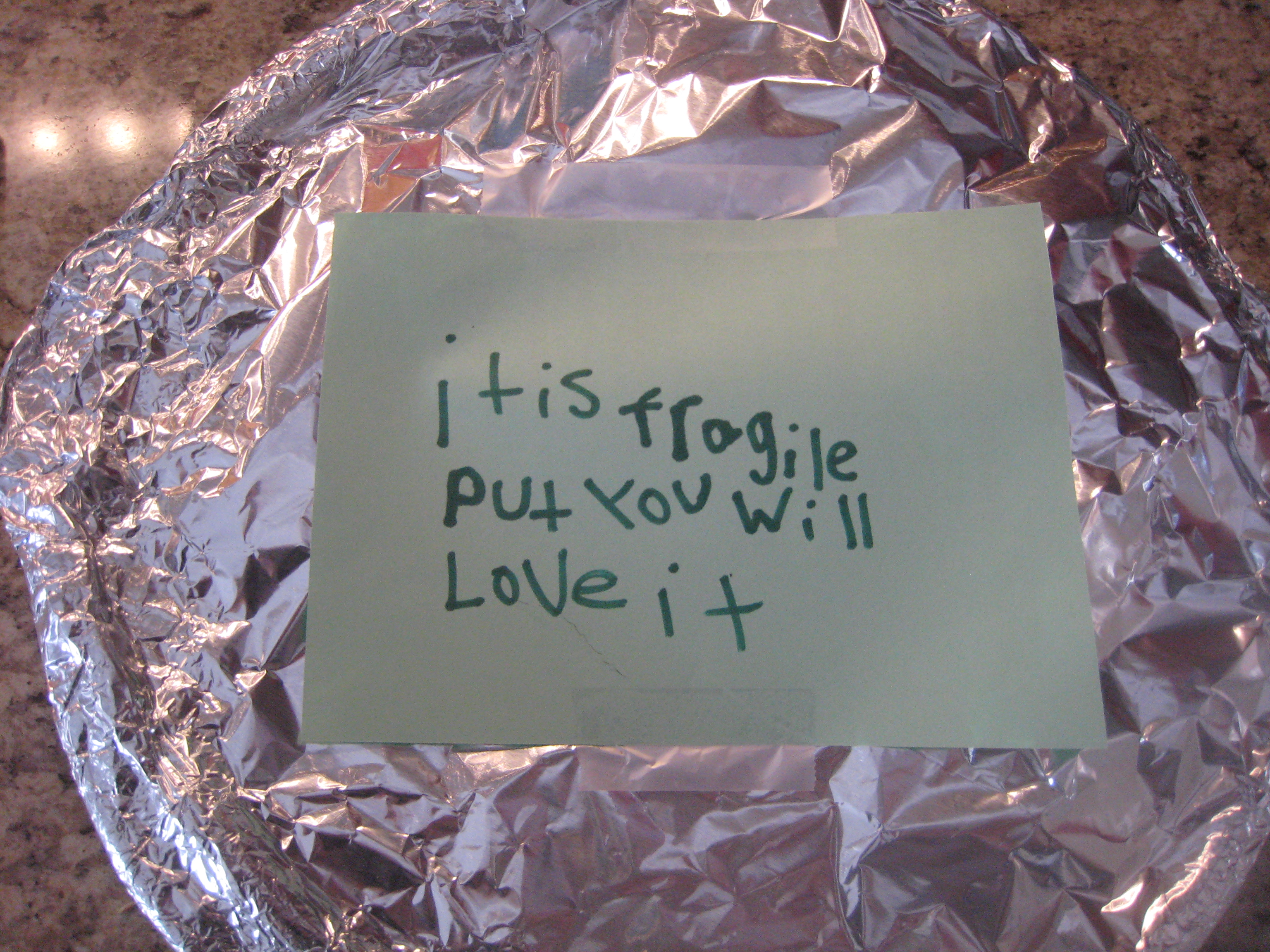
(Answer: A note and some foil that hid a banana cream pie.)
It seems I’ve been spending a lot of time lately in the unknown. Or maybe I’ve been here all along, and I’m just now realizing (or accepting) the way my feet feel on that cold, clammy ground.
Anyway, a couple of things I’ve read lately got me thinking that it would be okay to impose this idea on the students in my advanced creative writing class at Antioch College. (As with most of my teaching, I always feel like I’m learning more than my students, and certainly I risked imposing my shit onto my students in this case.) Last night, we tried this prompt, and I thought it would be fun to likewise impose my shit onto anyone reading this blog post. (If you try it, please post here about how or whether it works for you!) Here it is:
Writing prompt: Step into the Unknown
(inspired by Nick Flynn and Lynda Barry, February 2015)
Lynda Barry writes about the two questions that plague her: “Is this good?” and “Does this suck?” “To be able to stand not knowing long enough to let something alive take shape! Without the two questions so much is possible. To all the kids who quit drawing…Come back!” –Lynda Barry, What It Is,Drawn and Quarterly, 2008, p. 135
Nick Flynn, in his memoir The Reenactments, writes, “It was easier, when high, to take photographs than to write—photography requires focused attention, and I could focus when high, my world in fact was nothing but focused, reduced to a pinpoint, to a chunk of hash impaled on a pin. But writing requires both clarity and a willingness to step into the unknown, and there was nothing clear about my days, not then. Getting fucked up every day is about maintaining the status quo‑it has nothing to do with change, or the unknown.” (Nick Flynn, The Reenactments, p. 77)
If these ideas resonate, then writers must “step into the unknown,” and “stand not knowing long enough to let something alive take shape.”
Let’s try.
Start with a situation that you have in mind, one that is unknown to you. It might be something you are facing, a new phase of life. Or start with the phrase, “I don’t know” and do a freewrite.
This is the time of year when winter feels claustrophobic and oppressive, and although my brain knows, as Poor Will reassures us, that we have gained an hour of daylight since December 26, my psyche has trouble believing it. It’s when I start to yearn for spring, for the new life narrative that returns each year as things begin to soften and melt.
My daughter and I saw a robin in the redbud tree the other day; can it be counted as this year’s first? So early? I attach story to that robin, wonder how it could have landed, ruffled and fat, apparently unperturbed so close by the window that my daughter can’t help opening to say hello. The equinox can’t be far off.
This year, in addition to newness and hope, the equinox will bring Resurrection House XIII, an anthology of which editor Mark Teppo writes, ““Thirteen” is the first month of a new yearly cycle, wherein the old skins have been shed and the newborns are still learning to walk.” A short story of mine will be included, and I’m excited to see what else it holds, rising from the ground, between those pages.
(Any reviewers out there? I understand there may still be review copies available at Edelweiss.)
(Some of my best friends used to be cheerleaders.)
I’m at least ten years late to the party, but today I went to my first Zumba class. I love dancing, and I rarely do it; dance parties don’t abound these days. (That needs to change!) The Zumba class was hard, and I was often getting down in the wrong direction, but who cares! The dusty cheerleader inside me was reawakened today. Back in high school, way before MC Hammer ripped off Rick James’ riff, our squad did a pompom routine to Superfreak, before we even really understood the nuances (nuances?) of that song. Today, that superfreaky girl shook the hell out of her behind. At forty-eight, grin on my sweaty face, I am just grateful I still have a behind to shake.
Cleaning up my computer desktop, I found this fragment, written in autumn 2012. I am leaving it unfinished because time has passed, and I no longer have that authentic fire to finish it (=my daughter has moved on), but it still seems relevant.
Why I hate Hello Kitty
She has no mouth. (A friend pointed this out to me. My friend was disturbed because her daughter was interested in Hello Kitty, but Hello Kitty was physically incapable to speak, eat, laugh, or sing. The idea came up to draw a mouth on Hello Kitty, but the challenge becomes how to reach every Hello Kitty in the world? It turns out that someone has written a poem about Hello Kitty’s lack of mouth. http://www.queeg.com/hellokitty/)
Hello Kitty causes an otherwise pleasant four and three-quarters-year-old daughter of mine to whine, yell, and sob when I don’t cave in and buy an emblazoned purse at Target because she had already chosen her “impulse buy” (a pink scraper with a pig head on the handle!) at Bed Bath & Beyond. (And this from a child who can usually be re-directed away from whining for plastic crap.)
It’s impossible to avoid the Hello Kitty aisle at Target: THAT CAT IS EVERYWHERE!
Here’s what happens when I see my friends Deborah and Karl Colon (of Changeling) play their music: My heart, having usually been trapped inside my body (where it lives) for some number of days, weeks, or months, sneaks through the sonically-opened window (the one attached to my soul) and my heart unfolds its tired wings, and rises upward or outward, to wherever it is that beauty lives. Yes. This. The heart goes for a visit to Beauty. It’s a tactile sensation. At the first few strains of their music on Thursday night, I felt it, and realizing that this, this, watching the gamboling and frolicking of our children together, this diamond-making that my musical friends do, I thought, and could hardly believe, “This is my life…that this is my life…”