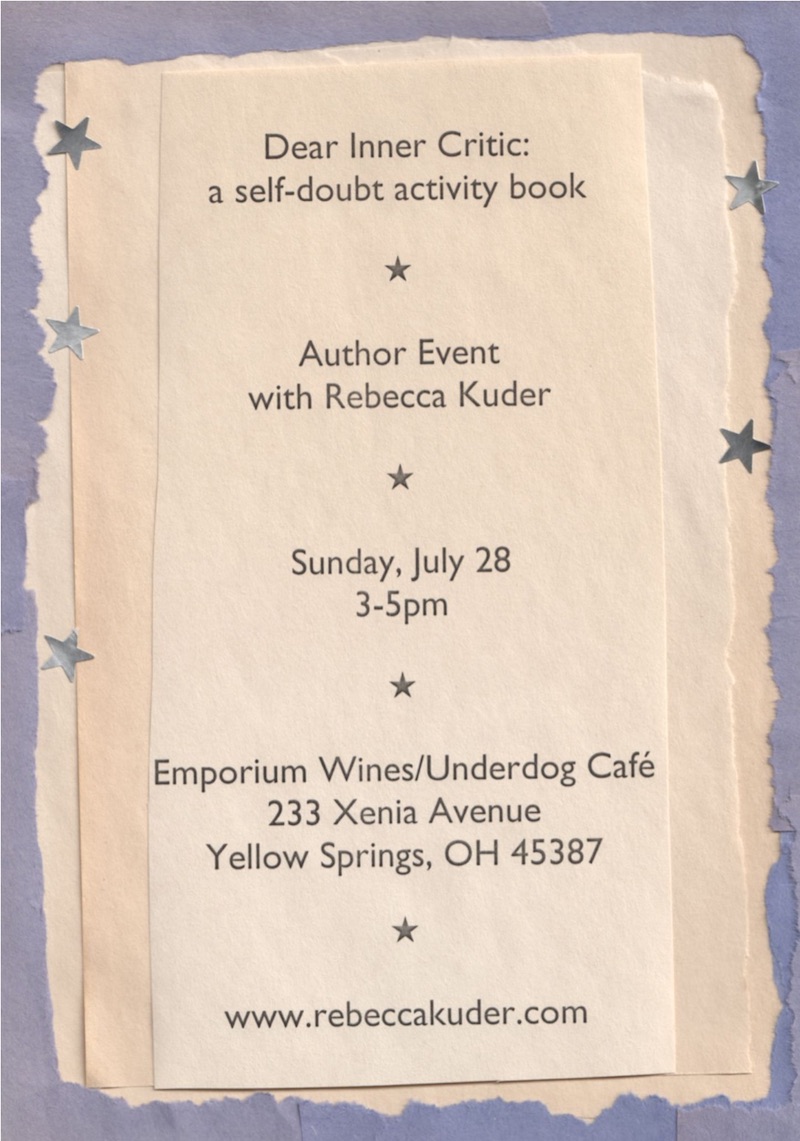
WANT TO HAVE SOME FUN? Please join me on Sunday, July 28, from 3-5pm, at the Emporium! I will read new stories and then lead an (optional) activity or two from Dear Inner Critic: a self-doubt activity book. Books will be available for purchase.
My latest essay, “You Never Know: On Memory and Memoir and Packing Light,” is now online at Reading and Traveling. This piece is among the fabulous Dispatches from Utopia that we Wayward Writers wrote at (or after) camp in the Catskills in April 2024.
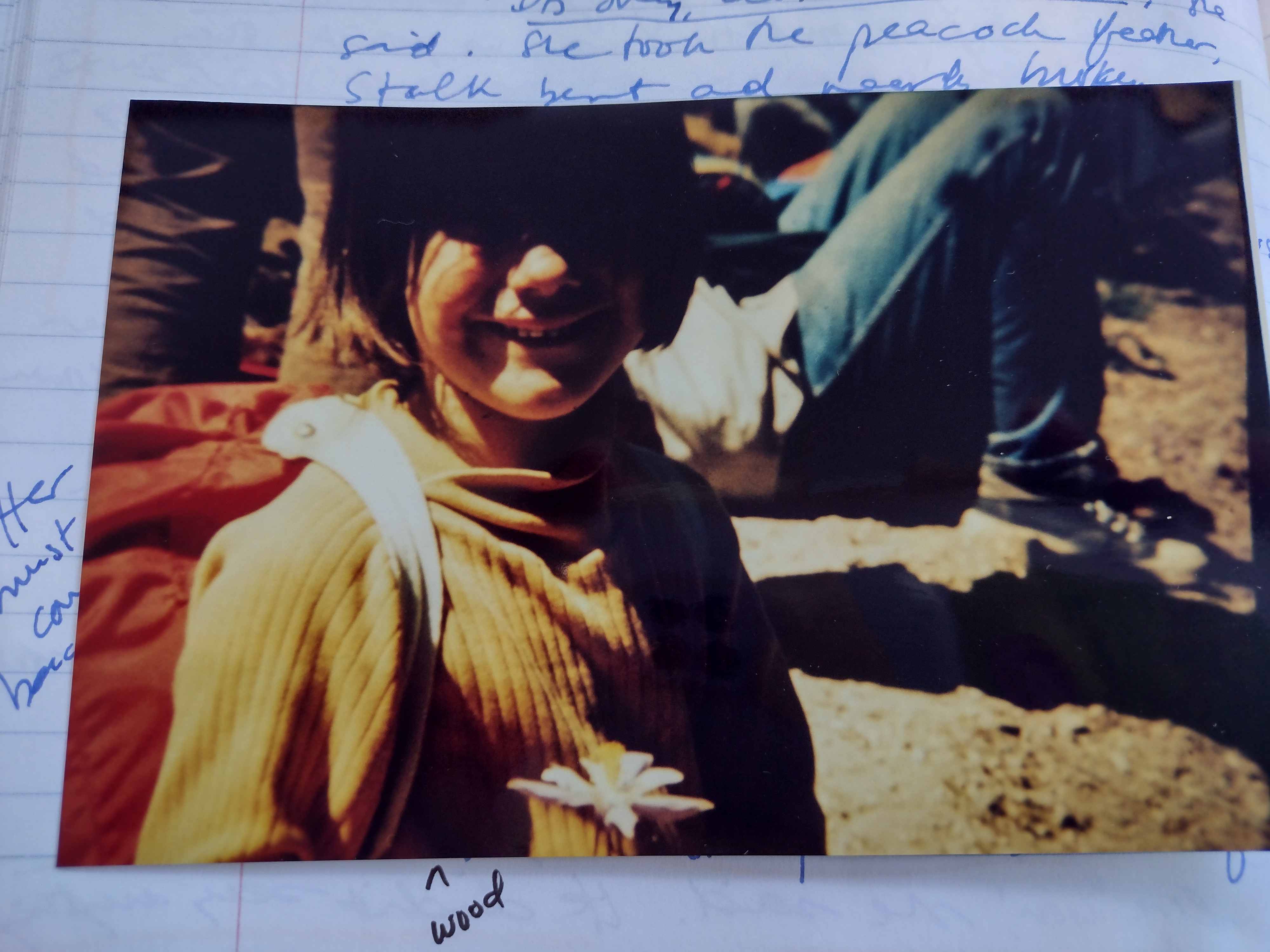
My piece centers on the gap-filled memories of the 1972 inaugural Rainbow Family Gathering, which I attended when I was five, with my young parents.
I am grateful to have had the opportunity and space (at the Mutual Aid Society in the Catskills, a new utopia forged by Adrian Shirk and others) to unearth & investigate these bits of light, and grateful to Ariel Gore and the amazing, badass campers for their curiosity, hearts, and willingness to play.
Dear Everbody, Great news! Dear Inner Critic: a self-doubt activity book is now available! Read more about why you will want this book. Learn how to buy online at Literary Kitchen, or visit the independent stores mentioned below. Love, Rebecca
You’re invited to play! Devote 30 days to creative freedom; unlock the long con of confidence; and dissolve self-doubt.
Even if you’ve been living with insecurity all your life, today can be different. This book offers a flashlight to guide you through the wilds of self-doubt. Between these covers you’ll find fun and creative strategies to quiet your negative self-talk.
You’ll write, draw, imagine, demystify—and maybe even befriend—the inner critic. You’ll set boundaries and gain room for creativity and joy. Using ingenuity and self-care, these activities let you play your way toward creative liberation.
**
Praise for DEAR INNER CRITIC: a self-doubt activity book: “Rebecca Kuder writes magical fiction and memoir with a voice so confident and agile, you’d never imagine she struggled with an inner critic. When I heard that she was not only well acquainted with self-doubt but had found ways to befriend it and play with it to the benefit of her art and happiness, I knew I wanted in on the secrets. This guide is a gift. Let Rebecca Kuder’s genius guide you to ignite your own.”
—Ariel Gore, author of The Wayward Writer (Summon Your Power to Take Back Your Story, Liberate Yourself from Capitalism, and Publish Like A Superstar)
In 2023, I took a fabulous year-long online writing class with Ariel Gore called Mavens of Mythmaking. Some highlights:
I completed a short story collection called What To Keep, for which I am seeking a publisher.
I finished a full revamp/revision of my novel The Watery Girl. This year, I will seek publication.
The memoir about my childhood home continues to emerge and evolve—in fragments and fractals—which, I am learning, is how this thing is meant to be written. Some day it will be a book.
My newest book,Dear Inner Critic: a self-doubt activity book, grew from years of renegotiating my relationship with the inner critic. Many readers have attended workshops and reframed self-doubt with me. Thanks for your good company! (Who knew a handful of tricks would grow into a real book?!)
This book is built from L-O-V-E. My keenest hope is that it will help people free the creative urge. (If I have anything to offer humanity, this book is it.)
On the journey toward creative liberation, I have trodden this self-doubt path myself. The tricks in this book have changed my life.
Soon, Dear Inner Critic will be available from the Literary Kitchen (literarykitchen.org). Please subscribe to my blog or follow my instagram for more information.
I am so grateful to have known and worked with Sears Eldredge, who I learned this week has recently died. Sears was wonderful, kind, and imaginative. He was my teacher, director, and mentor at Earlham College, and has always been a source of inspiration in the creative quest.
A couple years ago I read his wonderful book Mask Improvisation, and I could hear his musical voice in the sentences. Not only about mask performance/study, this book would be a pleasure for anyone who is interested in character and the psyche, and shows an early awareness of what we now call somatics. A beautiful and rich resource.
(RIP, dear Sears. A true artist engaged in the world. You can read his obituary here.)
When I was nine years old, I was molested by an adult. I wrote about the abuse in an essay here. (And I’ve written about it on my blog.)
I am grateful to all the love surrounding me and other survivors who are healed and healing, so that we can survive, so we can be healed and be healing. Beyond Sinéad O’Connor’s music itself (which is a potent container for my brokenness and rage more generally), being a survivor is one reason I am feeling the impact of the death of Sinéad O’Connor.
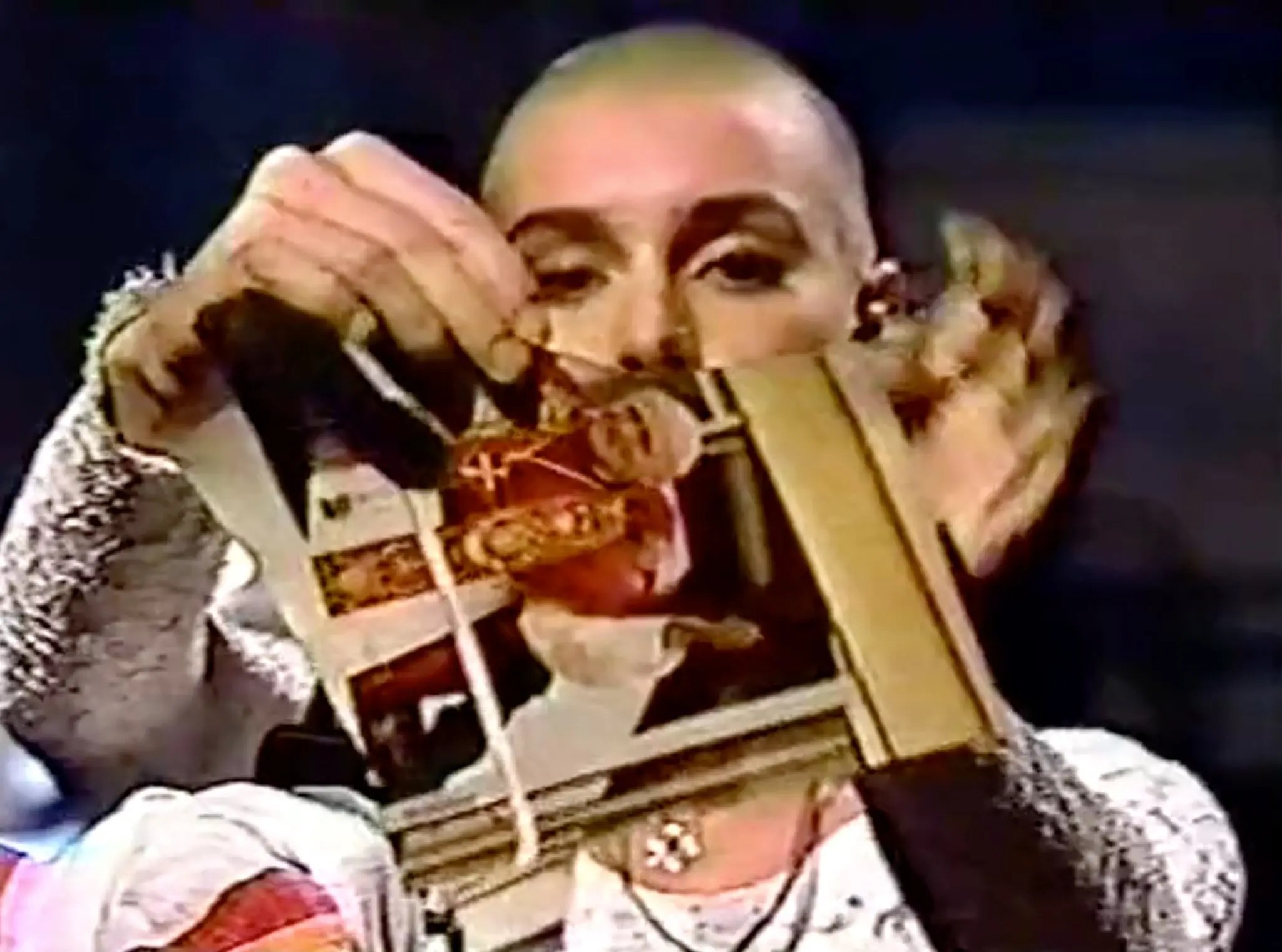
I remember watching Saturday Night Live on October 3, 1992, when she sang “War” by Bob Marley (which she had adapted to include indictment of child sexual abuse). And then tore apart her mother’s photo of Pope John Paul II. Her invocation, her voice, her conscious action. How she was standing up for children. I remember seeing it happen live on SNL, and how I felt then, how courageous and powerful she was, when I was only beginning to comprehend how my abuse history had impacted my life and my living. I believe that my abuse was passed on to me (via another human’s un-metabolized trauma) due to abuse which had happened within the context of the Catholic Church. I remember how, back then, even though survivors were beginning to emerge from the shadow of shame, still, how hard it was for me to speak about what happened to me. But I did. Later I confronted my abuser. That confrontation was an important part of my healing. Over many years, I have been able to move through and metabolize the trauma. I have been very fortunate in this journey.
I remember how I felt back then, and I celebrate how I feel now.
Sinead O’Connor spoke and stood for many of us who are survivors. I am grateful to have existed when this human and artist also existed. If you don’t understand why people are feeling her death, here is one reason: https://www.youtube.com/watch?v=ZSLyEPeWjNk
(This post was repurposed & woven into my essay, “Everywhere is War,” which you can read on Nuts and Bolts from Sonya, Sonya Huber’s e-newsletter.)
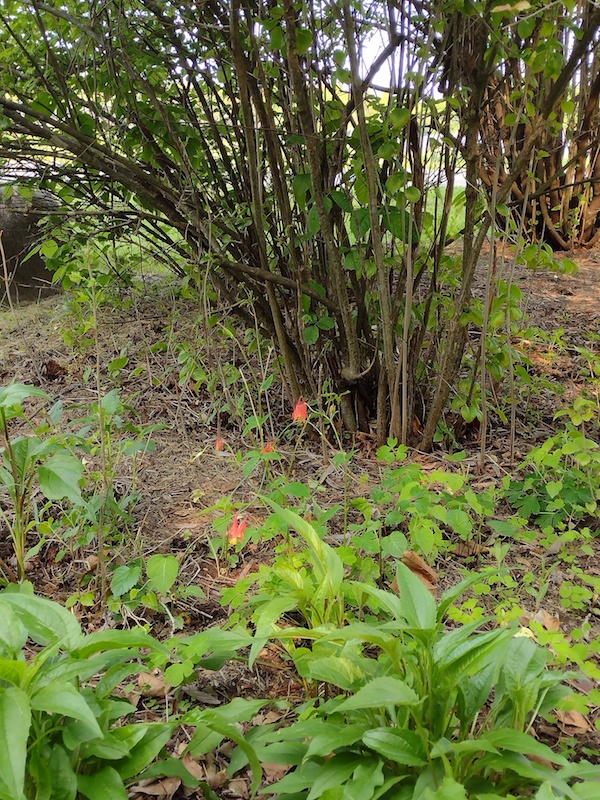
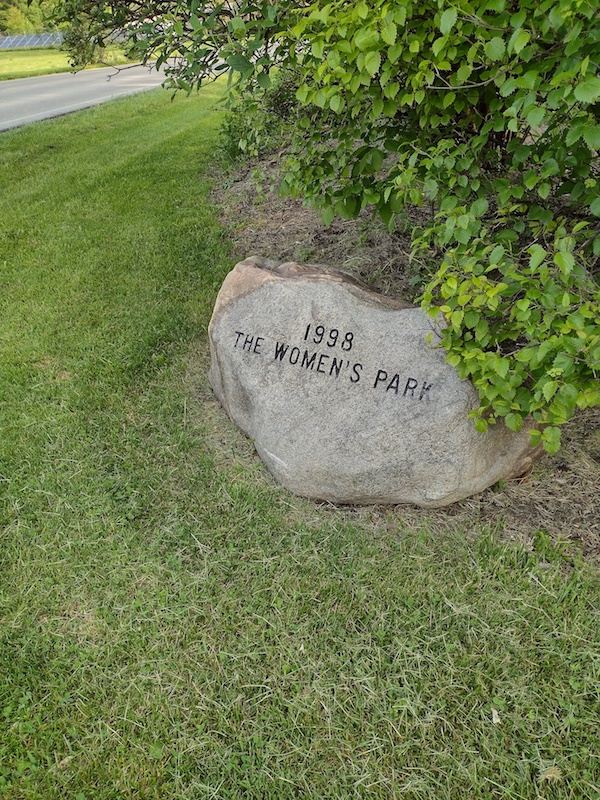
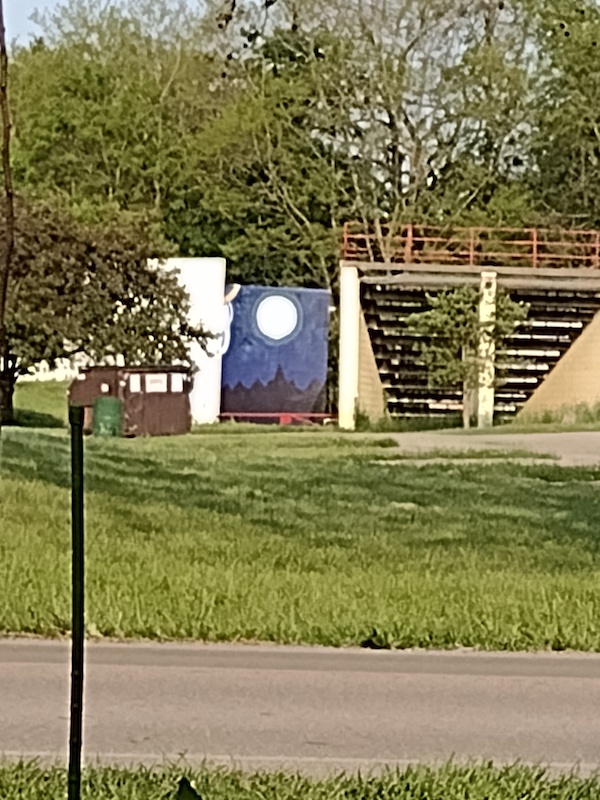
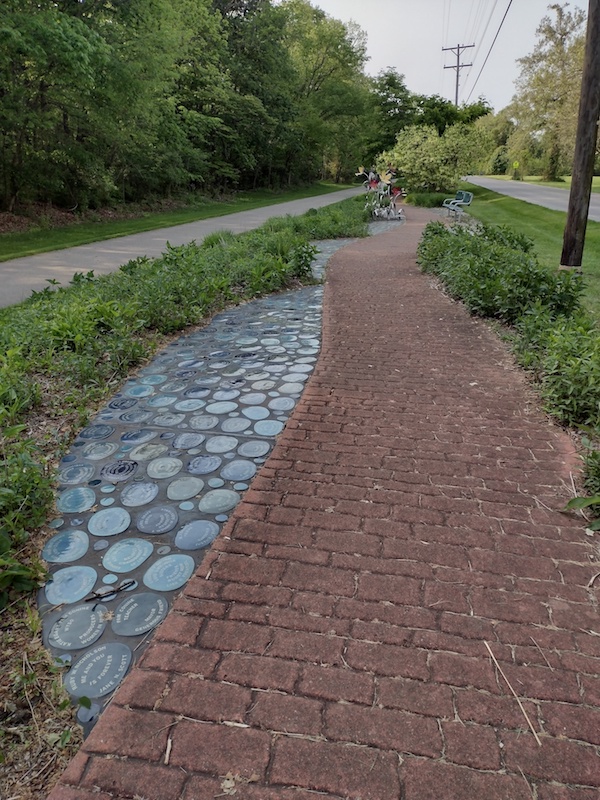
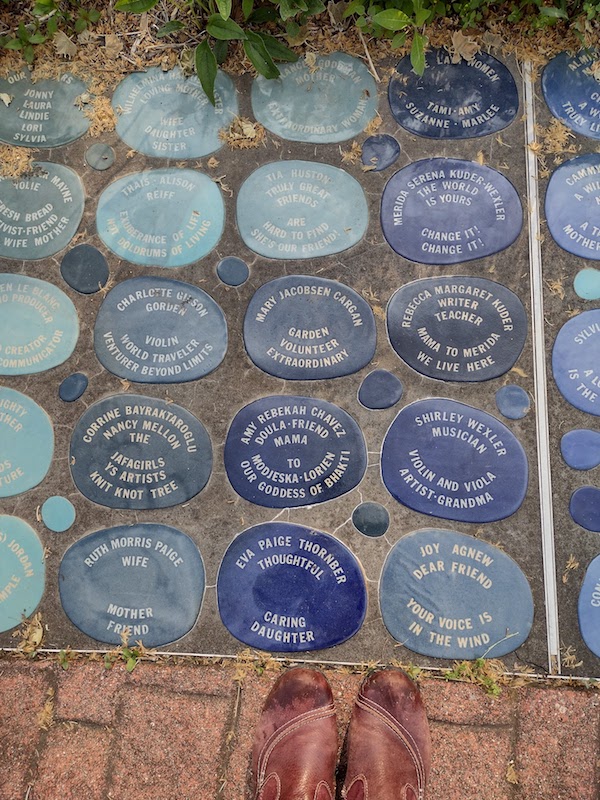
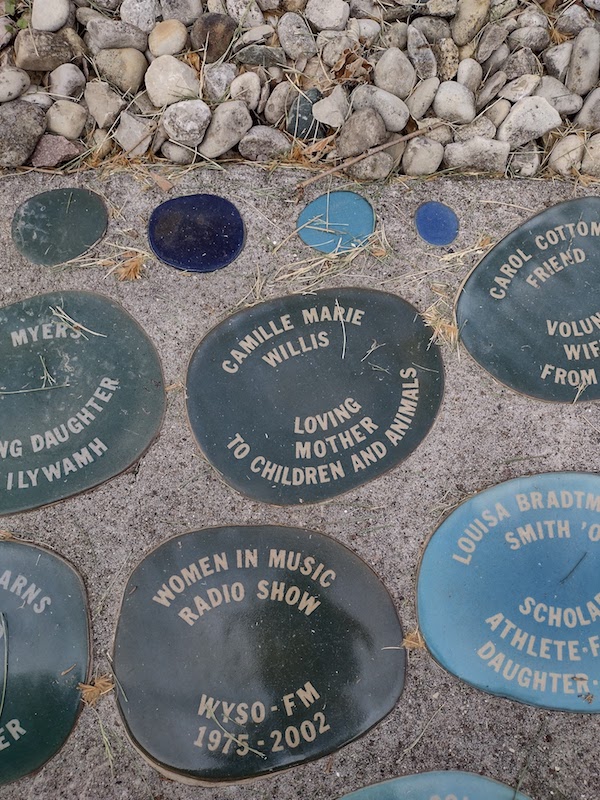
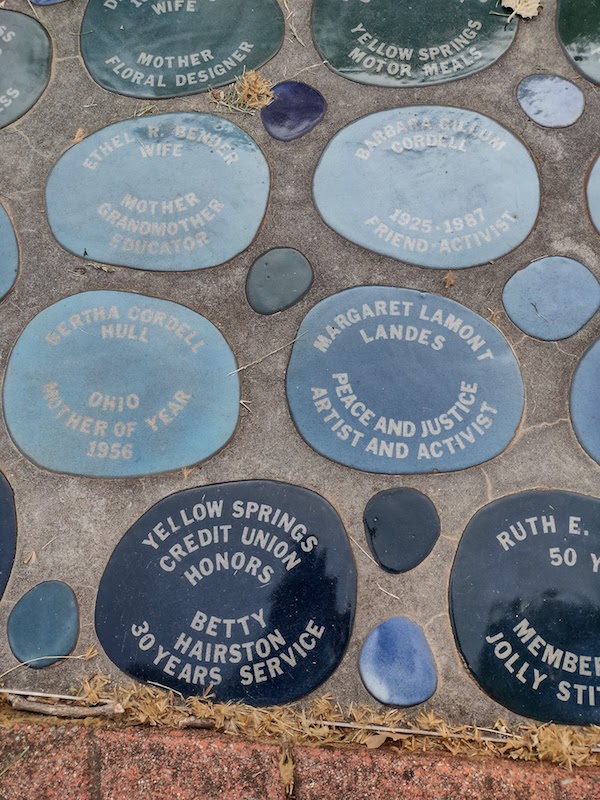
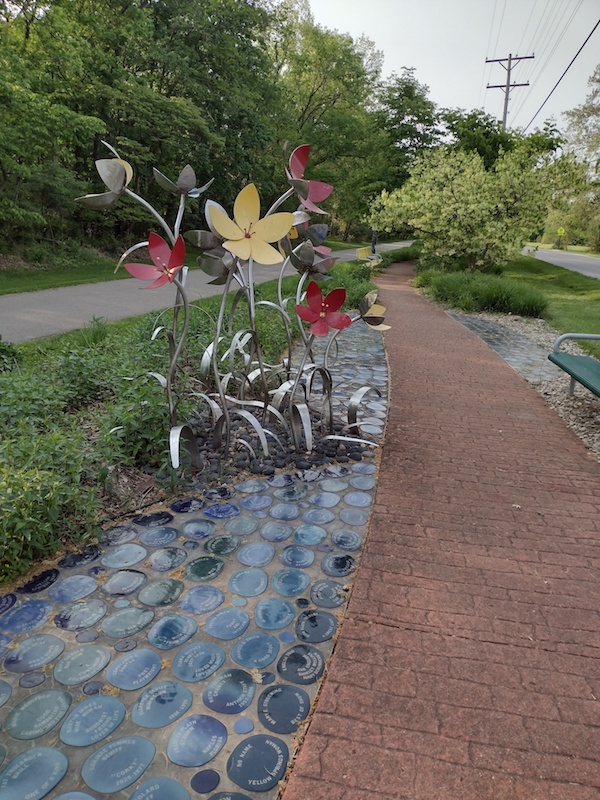
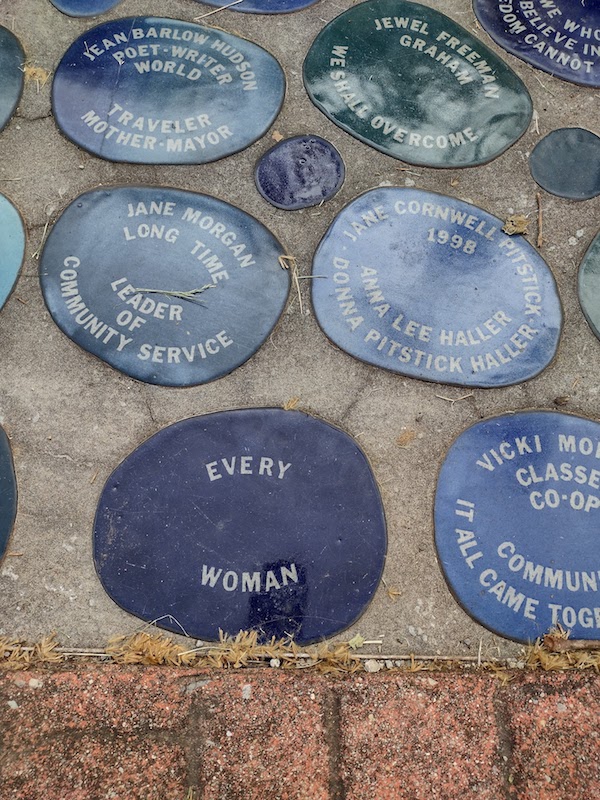
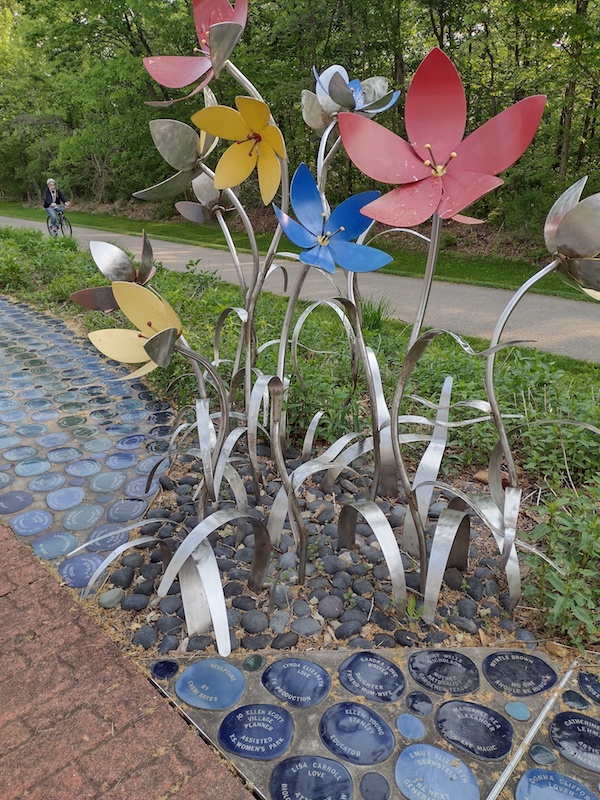
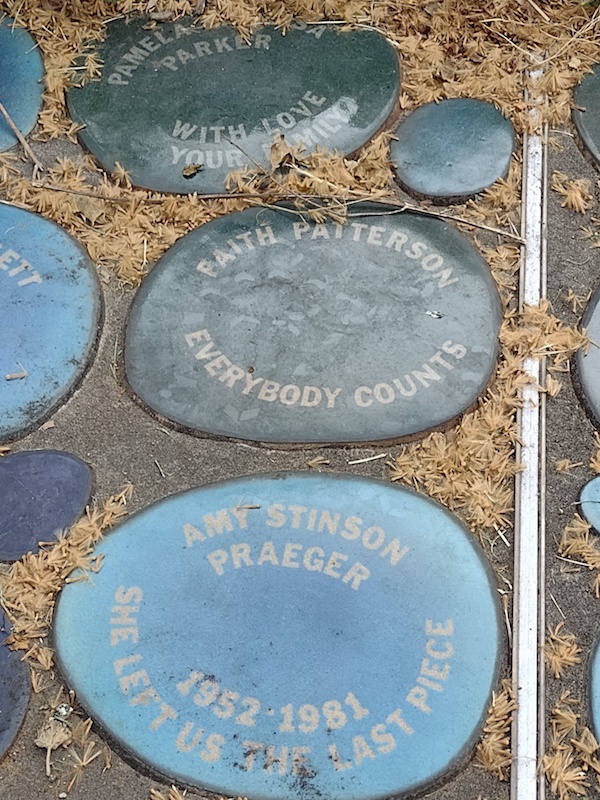
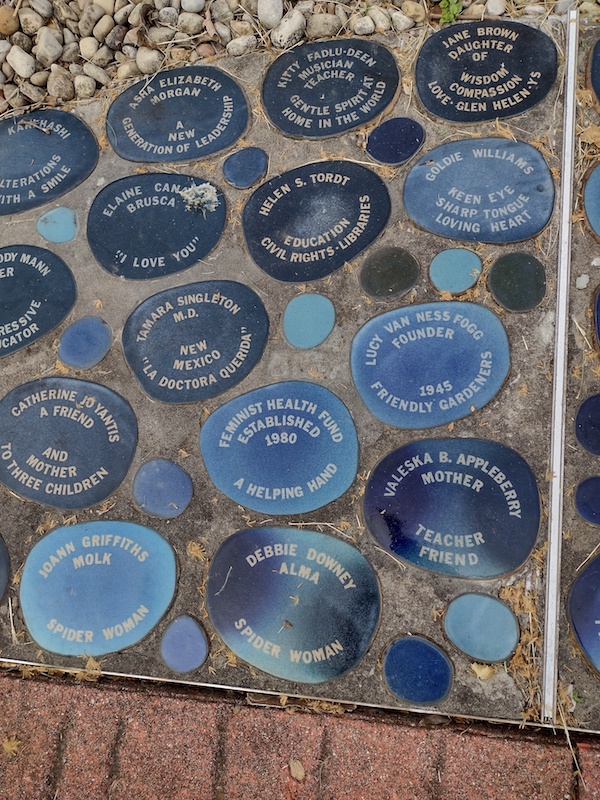
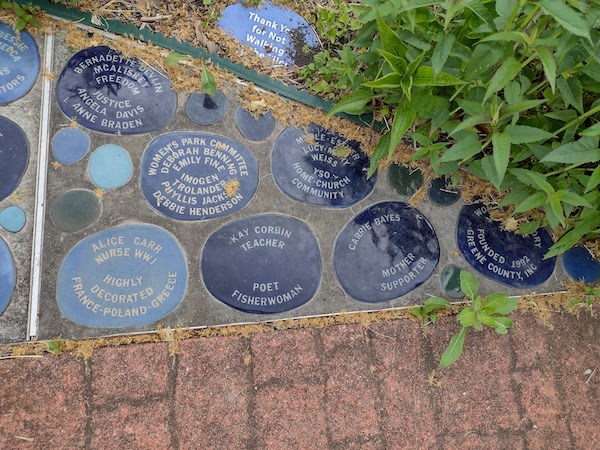
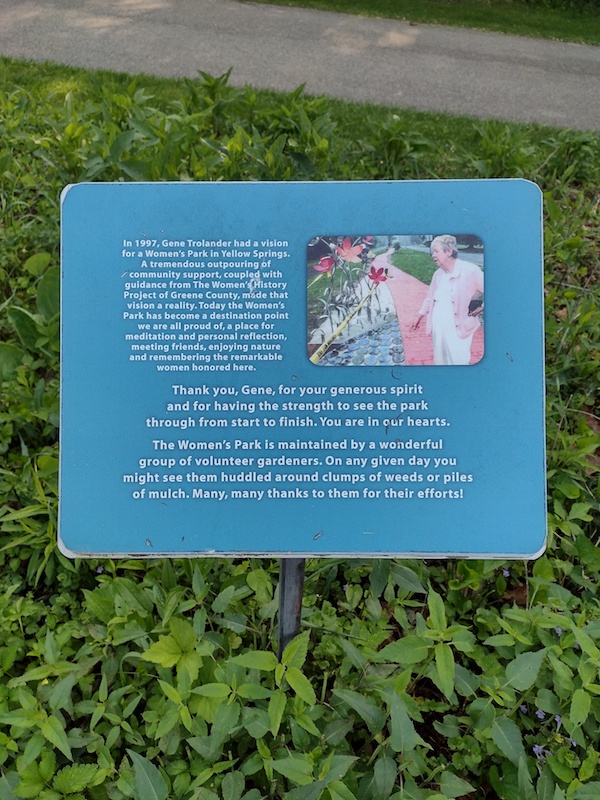
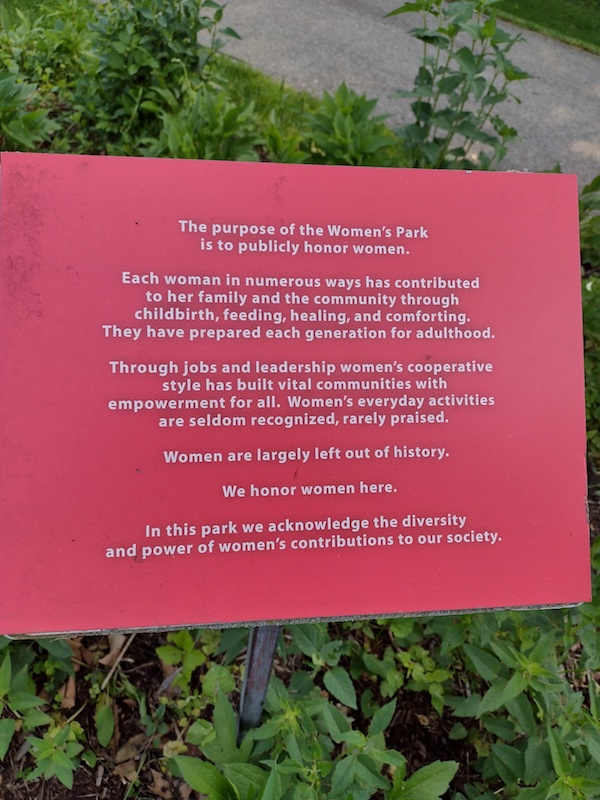
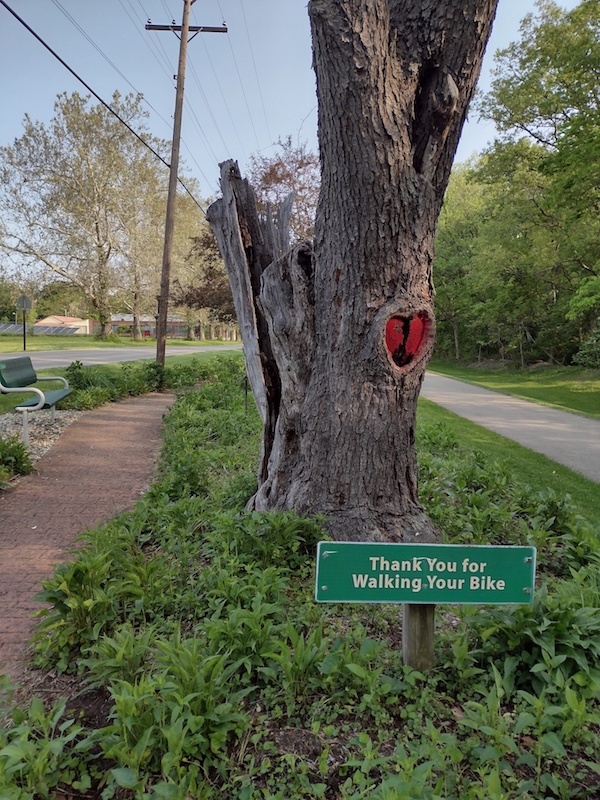
The Women’s Park in Yellow Springs is a skinny snake of land situated across the street from Antioch College and beside a bike path that leads through Ohio. A little strip of land curated for the purpose of honoring women. A margin, a digression, in a way. (Note how we fit in wherever we can.) It’s a curving path, nestled inside pockets of native plants (primarily pollinators). It was established in 1998 by Gene Trolander and others. Then, and a few times since, people have been invited to purchase tiles with the names of women and groups. Living and gone. I got a tile to honor my mother and later, one for my mother-in-law, my daughter, my friend and birth doula, and myself. I walk along the bike path regularly, and through the women’s park, but this week I slowed down enough to consider the space. It’s meant to be experienced in order, in that it’s essentially a bedazzled path, curved but linear, and you walk this way or that. There are benches where you can sit and rest. One bench honors my art teacher from the Antioch School (Margaret Landes) and another honors America writer Virginia Hamilton, who lived in Yellow Springs (one of my foundational inspirations). There’s a sculpture of huge metal flowers designed (and repainted every other year) by Deb Henderson. There’s a post with brochures about the park and foliage—the post is covered by mosaic ceramic bees and butterflies and flowers, made by Beth Holyoke and Kaethi Seidl who have done other public collaborations together. This place has so many connections for me, even before I start reading tiles.
How often I walk down the path and don’t slow down.
On the tiles I see so many of our community leaders, teachers, nurturers, healers…[I say “our” and “we” a lot when I talk about my home because there’s a long tradition of centering community (even though we often do community in unskilled ways, the attempt is real). I am an only child but I do have the “we” of Yellow Springs. I don’t often step far enough from my self to consider that I often unconsciously think in terms of relationship and community. It’s embedded and it’s interesting to notice that fact, as I type these words now.] Perusing the tiles reminds me that my experience of our town was built and shaped by women. I take it for granted. Of course I was raised by a circle of women. Of course (as a mother myself now) I have a new moon circle where I learn to be a stronger woman and mother and human (because of my doula friend Amy Rebekah Chavez).
Of course I was taught by these many quiet and unquiet, unvarnished badasses.
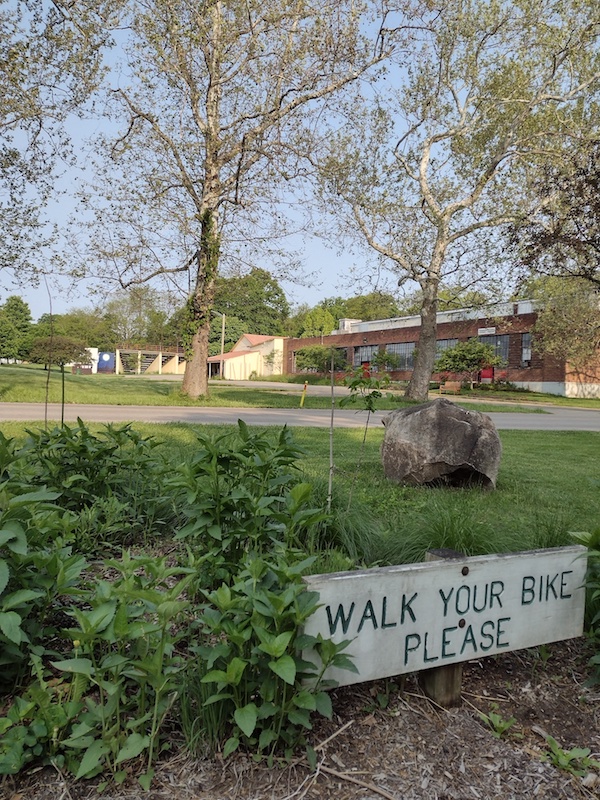
The Women’s Park is such a lovely and protected place, even alongside the racing bikes that speed past. “WALK YOUR BIKE PLEASE” a sign reads. The park is a sanctuary.
And the park is shaped like the action of so many women: We fit ourselves into what spaces we can. A strip of land transformed into a gem, a space where we can remember, celebrate, contemplate. It’s both fixed and shimmering…on the tiles, we pin down our intentions and memories and gifts to the ancestors, we give thanks to what we are still building, through the children who are all growing up…this place really does what it sets out to do—that’s how it feels to me. Even in the 30 minutes I spent there this week, I feel that. The curves of the path support me slowing the fuck down. The tiles (taken all together) are visually gorgeous, and when I pause and focus on them individually, I learn or remember about my history as one learns from a poem, from associations and connections, an image, a color, a role, some wish painted on each tile of baked earth… I pause and feel our shared lives in this place, our interconnections…this space of decentralization and celebrations, of each woman or group taking up space, but none bigger than another, all valued and important to someone, at some point in time, important together to the collective “us.” Like the stars in the sky. There are tiles for groups, and one for “Every Woman.” Everyone has space here. Everyone belongs.
Addendum: Thinking about it now, the YS Women’s Park reminds me of a carefully sources and written lyric essay. Something made from many parts and layers of story (layers of life, as in generations and people and ancestors) and breathed to life with pure intention. A shape that is subtly digressive, somewhat curvy, but clearly meant to move from one point to another. Clearly meant to transport us somewhere, via its architecture and imagery.
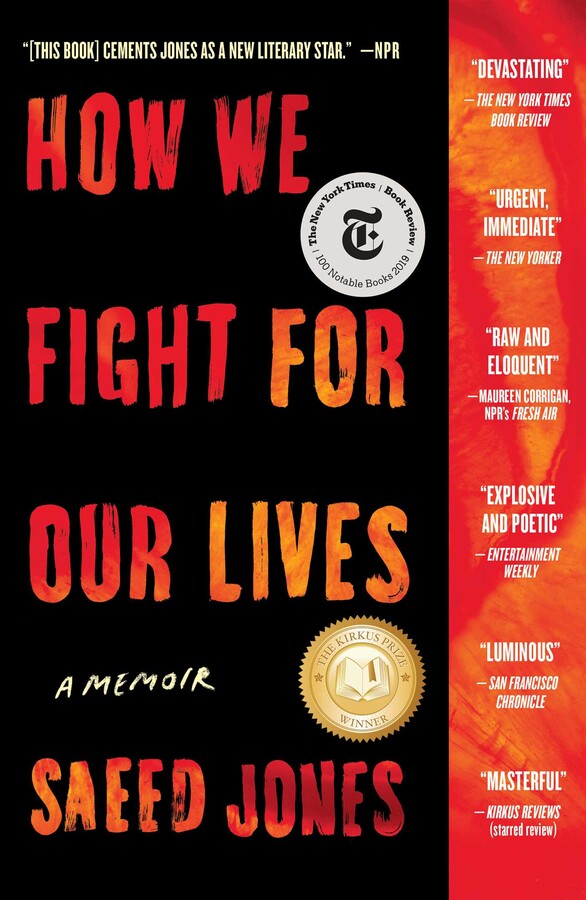
I recently read the memoir, How We Fight For Our Lives, by Saeed Jones. This is an intense and wonderfully distilled book. I love reading memoir by poets, and this is no exception. I recommend you check it out. (Assuming you are okay with the book’s at times brutal but necessary-to-tell contents. We need more stories like this.)
Ther’re so much power and beauty in this book. This passage really got me, because I’m obsessed with dust (as metaphor and noun):
p. 110: “Moving out of your longtime home means quite literally unsettling the dust of your past. Dust shimmers in the air, coloring rays of sunshine as they cut through the windows. Dust marks the outlines of where your childhood bed used to be. Dust collects in your hair. Your body unwittingly inhales your past and rejects it.”
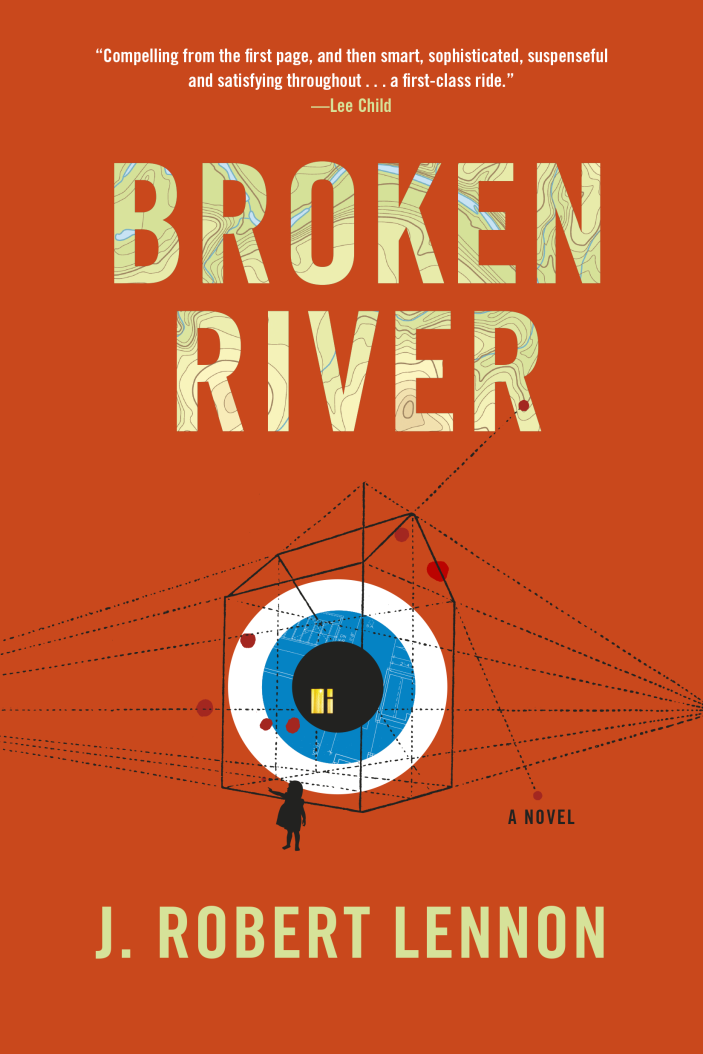
My dear husband recommended I read Broken River by J. Robert Lennon because it features an inventive character called the Observer, and it’s also about a house, and what the house contains. (I’m kind of always writing about houses and what they contain, which is why Robert suggested I read this novel.) The Observer character evolves over time within and outside of several carefully constructed and smartly intersecting narratives. Overall I found the book really well made and engaging. It’s creepy in all the best ways (which is maybe evident from one glance at the cover). I recommend you read it especially if you want to see how someone can make something intricate and also smartly accessible, that isn’t shaped like most traditional narratives.
Here are some bits I particularly love—as is the case often in my posts, these passages are torn from context but maybe that doesn’t matter?—and maybe you will see why I love them. (Also, I have never seen anyone write about those weird tube men, and how brilliantly Lennon does so, below!):
p. 26: “In any case, the identity of, fate of, and story behind the previous inhabitants of the house is something Irena intends to research while she is here. If the results are interesting, maybe she can incorporate them, somehow, into her novel. Because at the moment, the novel has no real plot—it’s just descriptions of things. That’s what Irina is good at. She believes that she inherited this deficiency from her father, who is a visual artist and does not require narrative to make something of value. But if that’s her cross to bear, she will do it stoically.”
p. 118: “The observer lets her go. It is time to turn its attention to the family many miles to the north, though the Observer is increasingly aware that it needn’t choose one time, one place, on group of human being to attend to. Indeed, it is quite capable of observing anything, all things. But it has begun to recognize that its purpose, as opposed to its ability, is limited: or, more precisely, its purpose is to be limited. It is unconcerned with, bored in fact by, the enormity of its power. It is interested only in the strategic—the aesthetic—winnowing of that power.”
p. 119: “Of course the humans die. Quite possibly all of them. Perhaps the Observer will die as well; it doesn’t know, and it can’t imagine what it would do differently if eventual death were a certainty. But the humans, it suspects, know. This is likely why, years ago, at the beginning of the Observer’s existence, the murdered man and woman screamed, even before any damage was inflicted upon their bodies: they were justifiably fearful that their lives were about to end. If the humans know that death is coming (and, by the Observer’s standards, it would seem that it tends to come very soon), their words and actions must all be profoundly influenced by that fact. They fear making wrong choices, so they avoid making any at all. They keep very still, hoping that death might fail to take notice of them.”
p. 158: “Of course Eleanor wouldn’t have it any other way. She is not one of those parents who believes that her child must find a tribe, invest herself in society, hide her eccentricities in an effort to blend into the group—even though these are the lessons she herself was taught, and shat she has historically done, and what, despite her engagement in ostensibly solitary pursuits, she is presently doing for a living. No, what she wants for her daughter is intellectual and creative self-actualization without compromise. In other words: Don’t be like me. Be like your father.”
p. 203: “By hour three of her journey here, her lower back ached with a familiar, almost homey, pulsing intensity that bordered on nausea. She had completed the decrepit-barn-and-speedway portion of the trip and had entered the domain of inexplicable traffic lights, roadside diners, and auto dealerships outlined in colorful flags and punctuated by convulsing forced-air tube men. (She doesn’t understand the tube men. They catch the eye, yes, as only a madly flailing twenty-foot-tall monster can; but who decided such a sight could make you buy a car?) Sewn-on smile notwithstanding, the tube men appeared to her earnestly, even violently repulsive. Turn back, their frantic motions seemed to say. There’s danger here. We’re tall enough to see over the trees, and only nightmares await.”










 Rebecca Kuder