What I thought inessential is essential

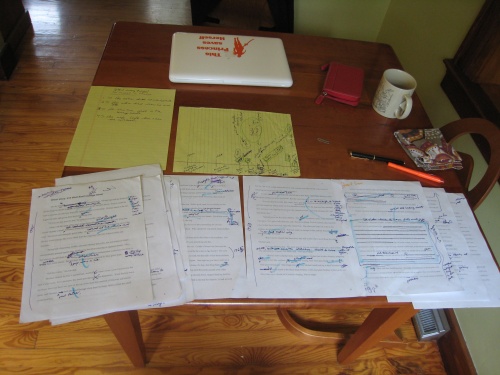
This is a different mess of mine, but looks similar

So I’ve been working on this terribly overwritten draft of my novel in progress.  Gone through the printed pages carefully, cutting, pruning, taking out piles of adjectives and phrases.  The typed pages are a mess now, not unlike this other mess from a previous project.  I keep thinking, “Which gremlin scribbled all over these neat pages here that I now have to type up?” though the gremlin is me.  This novel I have been writing since 2004.  Part of its problem is uneven terrain: while I was figuring out what it was, I was writing along, letting time pass in the story, and the story emerged like sourdough bread (a terrible metaphor!) that, 100 or so pages into it, actually begins to take shape.  So now as I comb through the years of words on these pages, I see where things need to be built up, and where torn down.  With this project, I pushed language and narrative beyond anything I’d ever done.  On purpose.  Because I could!  Here I gave myself license to write a really bad first draft, and use all the purple colorful clang I heard in my head.  (Knowing I would cut later.)

Too many adjectives!  Oy vey!  Too many phrases strung together that unwound from my mind and at one moment in time made sense but now hang like random junkyard decoration.  Get that egg beater out of there!  What did I just step on?  Is that stench overripe banana?  And so on.

Get it out of here!

I realize at least two things about this draft, both of which were essential to my authority in telling the story.  I needed both:

1) The self-indulgent “let everything be in there” messiness.   As author and creator of this world, I had to see how dingy and dusty and clangy and rotten the nouns were.  I had to see the layers of adjective like paint on an old carnival sign, repainted over crack and crumble.  How else would I know the patina of this place?  And;

2) The excessive phrases that are stage directions: “She put the scissors on the round table to the left of the door” and so on.  If it’s even important that she put the scissors down (question everything!) does it matter where?  She put them down.  Fine.  But the writer, again, to establish authority, must see the whole thing happening like a play, must know and track where the scissors are put down.  In case someone else needs to bob her hair!  And so on like that.

If I know this world I’m writing is dusty and clangy and I know where the scissors are, I don’t have to tell you (unless it’s important to the story).  If I am doing my job well enough, the reader will trust me.  She will thank me for sparing her unnecessary words.  Doing so will leave me more room for the things that really need to be there.  It’s like all the doing of research that doesn’t end up in the novel.  Having those things, knowing them, seeing and breathing them, is what allows me to tell the story in a way that will keep people reading.

I hope.

“Give me something to sing about” (RIP Whitney Houston)

Alas, this is not Whitney Houston.

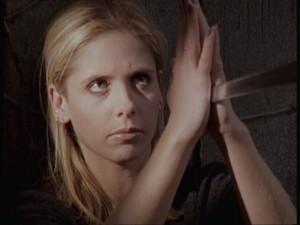
“Give me something to sing about,” sang Buffy the Vampire Slayer, in the excellent Joss Whedon musical, “Once More, With Feeling.”  (From which the title of this post was mis-appropriated.)  Buffy had died and gone, probably, to heaven, but her friends wanted her back home.  So they re-animated her.  Buffy was kinda bummed.

I just read that Whitney Houston died.  My first thought was, “Wait, Whitney Houston DIED?”  Shit.  My second thought was a song, an earworm from my 1990s, before the term earworm, before the song became an earworm for me.

(Rewind.)

FADE TO:  Somewhere in Los Angeles, a city where I did not live.  Sometime in the early 90s.  Just before Valentine’s Day.  Visiting a man.  (I am choosing vagueness.  Some people I know will be glad.)  I was fairly smitten with this guy, despite the miles that separated us, and many other differences.  He was sweet, and fun.  His life seemed big, glamorous.  I lived in Seattle.  (Same time zone, one thing in our favor.)  We’d gone to see a movie.  Memory is funny: I went down to LA several times while we were involved, and he came to Seattle several times–and our visits start to blur, but I’ll say that we saw a movie the night before Valentine’s Day; I’ll say the movie was “The Crying Game.”  Late that night, he said something that made me feel our time together was almost over, that he didn’t want to continue a long distance relationship.  Despite my own misgivings about how long it could last, I was young and romantic and sad when I heard him say whatever it was he said.  Though these years later I know it was best to let go, back then, I wasn’t ready.  There were things I thought ours might have been.

Early the next morning, and I mean really early, something like 7am on a Sunday morning LA time, Valentine’s Day, someone in his apartment complex decided to turn up the radio really loud.  The radio was blaring a song.

You know the song.

First, in the origami that was folding in my heart (expect and hope for something, then have it change too many times until it can never be the shape you thought you wanted) the song’s refrain was an irony at my expense.  Later, every time I heard that song, it was a reminder of that salty moment, that sadness which felt like emptiness.  (I didn’t learn until years later that Dolly Parton wrote the song, a fact which now makes the song more okay, especially when it’s Dolly and not Whitney singing.  More personal origami, this just in: As research for two novels, I’m reading a book about the April 1974 tornados that scoured the middle U.S., and according to King Wikipedia, that’s the exact month when Dolly Parton released that song.)

“AND I-I-I-” (HOW LONG CAN SHE HOLD THAT “I”???) “WILL ALWAYS LOVE YOUUUUUUUU-U-U-U” Whitney Houston sang on that early Valentine’s morning, from a stereo I would never see, volume cranked past 10 to 11 by someone I would never meet, some random person living near a man I had hoped to spend a lot more time with.  (Maybe that person played the song that morning extra loud for a valentine.  Maybe that person still loves that valentine.  Maybe there is an “always” somewhere.  For: I am happily married and have a wonderful child.  The man who lived in LA is married and has children, too, and I hope he’s happy.)  At that moment, though, even Whitney sounded sad, her sadness spilled out, sad for the sad little me, lost in that anonymous LA apartment complex, so early on Valentine’s morning.

So now you, too, know what I heard, actually, when I “heard” the news tonight about Whitney Houston.

It’s awful that another talented and tortured soul died early.  I wish people going through her kind of pain could get better, could live to be happy and really old and then die of natural causes.  I have other things I could write about Whitney Houston, but this memory, this earworm, floated to the top.

(“Don’t give me songs…don’t give me songs…give me something to sing about,” Buffy said.)

Into her drawers and shadows (Joan Didion’s Blue Nights)

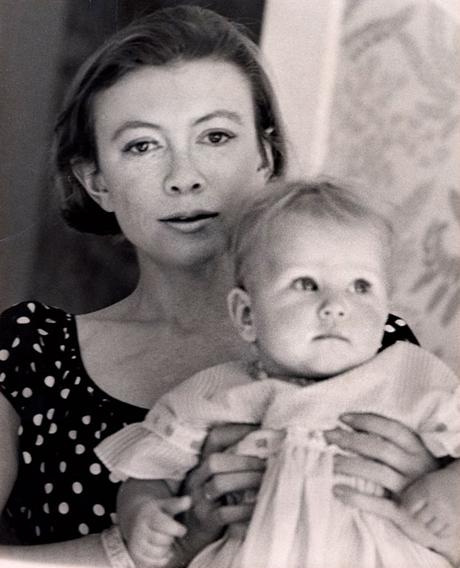
Haunted Didion

As I read Blue Nights, Joan Didion’s repetition of images and phrases hypnotized me, as did her peeled and still-peeling layers of story.  As with The Year of Magical Thinking, here I felt Didion recounting memories in the way we actually experience them.  As if she set out to articulate against the linear necessity of language: one letter, one word, one thought at a time, arranged tidy in a row, which is one way we make sense.  The intentional fragmentation of narrative was accessible and didn’t fall off the page (or render me lost in the land of “what the fuck?”) because of Didion’s clarity.  Because of her sentences.  And perhaps because of the fact of what she was doing: the narrative act of slowing down, examining, opening drawers and closets brimming with iconic possessions.  As Didion names these ghosts on p. 45: “The objects for which there is no satisfactory resolution.”  The detritus of the lives of the people she loves best, and lost.  As she opens each drawer and tells the stories of what she finds, she assumes the role of docent in the Joan Didion Museum of Loss.

(In the essay “Slouching Towards Bethlehem,” Didion writes: “Someone works out the numerology of my name and the name of the photographer I’m with.  The photographer’s is all white and the sea (‘If I were to make you some beads, see, I’d do it mainly in white,’ he is told), but mine has a double death symbol.”  I read that passage again after I’d read The Year of Magical Thinking, and could not avoid thinking of her life story’s foreshadowing in that moment, the double death that awaited her.)

In addition to the quandary about what to do with all that stuff (and my own eventual stuff, should I live long enough, outlive someone I love) I felt the writer’s grief and discomfort at the ache of questions she turns over and over, things upon which she shines a light, unable to avoid the vast shadows of murk.

Shadows which, despite the fact that some people, including me, happen to believe Didion walks on water, do not flatter her.

There’s something about that peeling, that sad onion, those haunts, her willingness to shine light despite what might crawl out, which makes me feel more human.

Eating potatoes, greedily

Flann O'Brien, of whose prose I could not get enough last month

Like tucking into a vat of potatoes after long without food, during winter break, I read in rapid (rabid?) succession Flann O’Brien’s The Poor Mouth and The Hard Life. Truly when I finished reading The Poor Mouth, I was still hungry and needed more.  Good thing I stocked up on both books!

Anything I say about Flann O’Brien will clunk like a can down malnourished and decrepit steps into the void of my own unworthiness, but my evangelical urge I can no longer ignore.  So.

If you’re into the show “Lost” perhaps you’ve heard of or even read O’Brien’s The Third Policeman.  I didn’t watch many episodes of that show, so I’m blind to the connection, but I’m glad more people heard about (and possibly read) O’Brien’s novel.  (The which I need to re-read, and soon.  I first read it as part of a seminar in grad school with Rod Val Moore.  The book was suggested in preparation for a field trip to the Museum of Jurassic Technology.)

Reading The Poor Mouth (published in 1941) is like diving into a pool of hilarity and squalor (yes) and eating it all with a spoon.  Yum, hyperbole!  My favorite!  Among other things I hope to grasp as soon as I re-read The Poor Mouth, O’Brien becomes a sort of cantor, invoking lyrical phrases of misery, a tapestry of moments in which, for instance, we hear, “…generally no sound except the roar of the water falling outside from gloomy skies, just as if those on high were emptying buckets of that vile wetness on the world.”  A tattered weariness in which scenes begin with openings like: “One afternoon I was reclining on the rushes in the end of the house considering the ill-luck and evil that had befallen the Gaels (and would always abide with them) when…”  Reveling in this luxurious squalor and over-the-topness, I laughed loud and often as I read along, even more than while reading Wodehouse.  To rip a phrase from O’Brien and twist it terribly, each chapter is like a thesis, proving without doubt that the plight of O’Brien’s Gaels is a bad life “whose like will ever be there again.”  (Just read the book.  It’s short.  If you hate it, I’ll give your money back.)  I also need to read it again to see how it lines up with another hyperbolic novel on the topic of poverty, though not nearly as hilarious, George Orwell’s Down and Out in Paris and London.

Literary belly still grumbling, I took up The Hard Life.  Published in 1962, the story was more shaped and plotty than The Poor Mouth.  At intervals, two characters tussle in flappy rants about the shadowy political power of Jesuits within the Catholic church.  Their dialogue was so well written that I didn’t struggle, despite my lack of knowledge about the issues they debated.  To press these two characters into a modern context, their arguments could have been mouth-offs between two old school rappers, one-upping each other (mostly) good-naturedly, but with no self-censor.  They were funny.  And the mountingly bizarre plot twists were delectable.  (See, I’m still on this stuff as if it’s food!  And really, it is.)  The end was unexpected and brilliant.  I’ll say no more, so as not to spoil a good meal.

Bon appetit!

Joan Didion and her bits

Joan Didion and Quintana Roo

“Only the very young and the very old may recount their dreams at breakfast, dwell upon self, interrupt with memories of beach picnics and favorite Liberty lawn dresses and the rainbow trout in a creek near Colorado Springs.  The rest of us are expected, rightly, to affect absorption in other people’s favorite dresses, other people’s trout.  And so we do.  But our notebooks give us away, for however dutifully we record what we see around us, the common denominator of all we see is always, transparently, shamelessly, the implacable ‘I.’  We are not talking here about the kind of notebook that is patently for public consumption, a structural conceit for binding together a series of graceful pensees; we are talking about something private, about bits of the mind’s string too short to use, an indiscriminate and erratic assemblage with meaning only for its maker.”

–Joan Didion, “On Keeping a Notebook,” Slouching Towards Bethlehem, p. 136.

I just began reading Blue Nights.  The passage above from Didion’s much older essay has been with me as I approach a still-too-tender writing project.  It’s stuff I will write about some day, though more time must first elapse.  I need perspective, and this is too messy and raw.  Meanwhile I put bits into a jar (or notebook) to save, to turn over, to approach for the quilt when it’s time.

Meanwhile, merely typing Didion’s words (and reading her new memoir) is a comfort and a privilege.

Wes Anderson & the Buckaroo Banzai Principle

I wrote a post here nearly two years ago (at my yearly movie outing, so sad!) about Wes Anderson.  Today, I watched “The Life Aquatic” again on DVD and though I adore it, it was as if I had never seen it before.  Turns out I barely remembered the movie, though it’s my favorite of Anderson’s.  I noticed things this time I either saw and forgot or never saw.  I watched the background this time, allowed myself to look away from the principal humans and around the room, as it were, and linger in my tour of the Belafonte.

The film’s similarities to “Buckaroo Banzai” (another favorite film) were more beautifully apparent this time.  One Banzai moment with Team Zissou was the curtain call, which some loving film geek posted here in mashup.  (There’s also the Jeff Goldblum connection linking the two films.  And as my husband said, TZ would have mirrored BB and the Honk Kong Cavaliers more fully had they brought back Ned for the curtain call, as  W. D. Richter did with Rawhide.  But not bringing Ned back does a more authentic job of continuing and closing the film’s narrative rather than opening it up, so maybe in the lineage of collective filmmaker evolution, this omission makes some sense.)

But in addition to the visual homages that Anderson paid Banzai et al, much more fundamentally, he followed the Buckaroo Banzai Principle as outlined here.  It’s, briefly:

When a work of fiction is so confident in itself that the reader just enters the world and goes with it.

Applies equally to a written or cinematic world, but as I thought about it today, I realized how I’m not quite doing that with my new novel, and thought of one little way that I can follow the BBP more closely.  For which I owe Mr. Anderson a card of thanks.  If only I had some Kinglsey (Ned) Zissou corrsepondance stock.

(Dear Mr. Anderson, if you are reading this:  Thank you.  Thank you for caring enough about your audience to make something so fully realized.  Thank you for following your own obsessions and idiosyncrasies with such commitment and grace.  Thank you for Seu Gorge reinterpreting Bowie.  Thank you for your hard work, which looks effortless as breathing in and breathing out.)

Cinderella, what big, sharp teeth you have!

Because of my recent rants about princess stuff, a friend recommended Cinderella Ate My Daughter by Peggy Orenstein.  I finally read it.  It was great.

It was great even through the lens of Orenstein’s preaching to the cliched choir (me).  It was great despite how depressing it was to read what inspired the Disney Princess phenomenon–in 2000, a new executive at Disney went to see Disney on Ice, and noticed, to his horror, that the girls wore HOMEMADE princess dresses.  In the small gowns, rather than creativity at the hearth, he saw a missed merchandising opportunity.  Thus the Disney Princess brand was born.  (And now we have girls clad in shiny, generic, made-in-China garb, rather than homespun results of someone’s invention.)

I live in Yellow Springs, Ohio, a bubble like Orenstein’s city of Berkeley, both places relatively more immune to over-the-top materialistic madness than much of the U.S.  This book was great because it was reassuring to read someone thinking about how to revolt against the default definition of femininity as only and always about what girls look like rather than what they do.  And not only is Orenstein thinking about how to revolt, she’s done her research.  She backs up her arguments.  As a journalist, she seems responsible in her work.  Her credibility as a person in the narrative is crucial to how therapeutic this book was to read.  Throughout, she’s grappling in plain view with the same questions other parents are.

It’s overwhelming to consider how to fight the subtle and unsubtle corporate power of entities like Disney.  My four-year-old daughter saw the Disney Princess undies at Target, and it’s all she wanted.  She could not be easily dissuaded.  (I bought them.)  The other day at Goodwill, I steered her away from the shelf of half-clad Barbies in the toy section.  I lured her to the books, figuring that was safe and we could get out without her wanting to buy yet another “baby.”  (She has always loved her “babies” and it’s often a struggle to convince her she has plenty of plastic mouths to feed.)  In the book section, she found a shiny pink Barbie book called Little Sisters Keep Out.  She does not know what Barbie is, though she’d seen them on the shelf.  She saw the book’s cover and said, “It’s a princess book!”  Ironically, I had just finished reading Orenstein’s book the night before.   I stood there, holding my own literary find–a gorgeous illustrated Aesop’s Fables–and reminded myself I had grown up with Barbies, and I turned out okay.  (Yet, like Orenstein, my self esteem was not helped by Barbie, nor by Seventeen Magazine, nor that iconic, tarted-up teen, Brooke Shields.)  Like the “I grew up watching too much TV and I turned out okay” argument, my Barbie excuse thins when I think too hard about it.  I bought both books, though I refused to read the Barbie book to her.  I told her that I didn’t like the kind of story inside it.  She said, “I love it.”  I told her those kinds of stories say girls can only do certain things, like brush their hair, not run and jump and climb and do fun things like that.  “But they go to the playground,” she said.  (One picture shows the dolls sitting on swings.  She decided she would read the book to her babies.  She makes up stories about the plastic dolls in the photos, and we have a compromise.)

Now that we grownups realize what TV does to a young person, or what all-pink-all-the-time (not to mention the focus on how a girl-to-woman looks rather than how she feels) does to the feminine psyche, we have the power (the responsibility!) to make better choices.

Let’s!  Let’s.

For me, all roads lead back to Buffy.  A slayer, a killer of demons.  Always fashionable, sometimes wearing implausible slaying footwear (but hey, she’s the slayer!) she takes care of herself and by “takes care of herself” I do not mean a pedicure.  In a dark alley, Buffy is the one kicking ass.  The final paradigm shift of the end of the TV series still makes me cry, every time I think of it:

“From now on, every girl in the world who might be a Slayer, will be a Slayer. Every girl who could have the power, will have the power. Who can stand up, will stand up. Every one of you, and girls we’ve never known, and generations to come…they will have strength they never dreamed of, and more than that, they will have each other. Slayers.  Every one of us. Make your choice.  Are you ready to be strong?”

Buffy wasn’t taken seriously at first.  She grew from a blonde teen cheerleader to a strong woman who changed the (fictional) world.  She spawned a small academic field called Buffy studies.  (And yet I found a Buffy dress-up game, where you can change Buffy’s clothing as if she were a paperdoll on the screen.  Sigh.)  The size of the problem of raising a strong, confident female person amidst well-funded and deeply entrenched corporate sinisterness makes me tired.  I have no answers.  But Orenstein’s book gave me hope.  Maybe parents will read it and meet together, talk about alternatives to the madness.  Maybe this kid’s parents read the book.  Maybe this kid can help start the revolution.

Maybe we will start making our own costumes again.

The Rules

THE RULES:

1) NEVER UNDERESTIMATE EACH OTHER.

2) KEEP YOUR HANDS STRONG.

3) DON’T KEEP WHAT YOU CAN’T CARRY.

4) CLOSE YOUR EYES ONLY WHEN NECESSARY.

5) NO SPITTING.

6) NO PUGILISM.

7) A THING ISN’T YOURS UNTIL SOMEONE GIVES IT YOU.

8) MACHINES SHALL REMAIN PRISTINE.

9) DON’T BE TOO SUPERSTIOUS.

10) BE A LITTLE SUPERSTITIOUS.

11) TRUST US.

(From The Eight Mile Suspended Carnival.  Please abide by these rules if you ever have a chance to visit.)

The kid-think of Room (novel by Emma Donaghue)

Many Moons Passed with the Wolf at My Door, by Angela Treat Lyon

The first book I read after fall quarter had dusted down was Emma Donaghue’s novel, Room.  I can’t avoid “reading as a writer,” and thinking about how the writer does and makes her thing, but wanted to immerse myself, so I refused the urge to take notes.

The narrative procedures used in this book are inseparable from the sensational story, which is, to quote the Wikipedia entry, “told from the perspective of a five-year-boy, Jack, who is being held captive in a small room along with his mother.”  The book is a page-turner, sure, but what kept me riveted was the grace with which Donaghue sustained the narrative told, first-person, in a young child’s words.  It’s of particular interest to me because I know it’s so damn hard to do.  (My novel, The Watery Girl, is told from the point of view of a seven-year-old, but I didn’t want to limit myself to her language.  So I used a close third person, still intimate, often imbued with thoughts and words directly mined from the protagonist Claire, but third person allows space to wiggle language.  First person really locks you in.  All writing is artifice, but if you want to convince a reader like this one, you better stick close to what a child would actually say.  And more than that, Donaghue’s Jack breathes the breath of childhood, lives out its logic.  I’m convinced her sentences are true kid-think.)

As I read Room, I kept holding my breath (not only because of the story) to see if Donaghue could sustain that thing with the kid.  She did.  There was not one moment when I disbelieved I was reading Jack’s true five-year-old thoughts.  Yes, Jack is precocious and smart, but the writer explained his particular intelligence so effortlessly when needed, and made clear that Jack’s mother worked hard to engage her son in his (albeit tiny) world.  Reading about their life in Room, I was enrapt and also exhausted, imagining how hard it would be to live in a single room with a child, non-stop, for five years.  (Putting aside the whole ordeal–the sheer exertion of the character’s work as a parent was amazing.  And yet believable.  I bought, without question, that Jack was her redemption.)

When I opened the book, I didn’t know the plot, just the premise.  As I read, I wondered how Donaghue would sustain the claustrophobia of one room for an entire novel.  When I realized their situation was about to change, the novel became “about” something very different from what I expected.  I was glad.  Thinking, as I have been this year, about brain plasticity and pinning many hopes to that idea, it fascinated me to read and consider about how Jack might (or might not) adapt to life outside Room.  And like many who have read the book probably have done, I wondered whether we each have a Room of some sort of other that’s shaped what we expect and want from the world.

I want to read more of Donaghue’s writing, soon, because anyone who can do what she did in Room is worth the time.

Foody alert: easy faux fondue toast

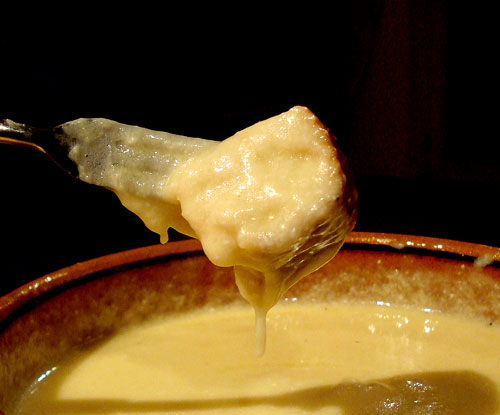
Don't have a fondue pot?  No worries.A year after I graduated from college, I backpacked by train through Europe with a girlfriend.  It was a five-week whirlwind: we visited Frankfurt, Florence, Venice, Corfu, Athens, Salzburg, Amsterdam, Interlaken, Switzerland, and a charming town in France whose name I’m forgetting, staying mainly in youth hostels.  I turned 23 at the Pink Palace on Corfu: no togas that I recall, but many shots of ouzo, and many subsequent plates smashed over my head.  At the time, I was a developing (vs. full-on) foody, but tonight I was yanked back decades and miles by an accidental flavor.

My friend K. and I stayed at a cozy, relaxing hostel in Interlaken with a modest dining room.  Interlaken, after the previous slew of cities, was like a mental rest, and we decided to stay most of a week.  Now, aside from the exhalation and the beautiful hikes and views, I remember most fondly the fondue.  It was such a casual thing there, not a production, simply part of the daily eating process, available downstairs in our momentary home.  I’ve tried to make fondue a few times since, and it’s been okay, but tonight I stumbled upon a great and easy way to fake it. Let’s call it an homage to fondue.

Here’s what to do:

1.  Get some cave-aged gruyere.  I don’t know why being aged in a cave is important, but you don’t have to go to a cave to get it–it’s everywhere these days, and it worked in this case.  (I used Trader Joe’s gruyere, but I’m sure any decent gruyere will do.)

2. Peel a clove of garlic.  (You might need more than one clove, depending on how much toast you are making.)

3.  Toast some slices of bread.  I used a good multigrain, bought from Emporium in Yellow Springs.  (Note: I often slice and freeze bread, then toast it unwrapped, or heat it, wrapped in foil, to good effect.  But for this project, you need to toast the bread fairly crispy.)  It might be good with white bread, but make sure it’s something with body.  Wimpy or mediocre bread would wilt under the next steps.

4. Rub the garlic clove on the bread, effectively worrying the garlic down to a nub–sort of a way of grating and distributing the garlic on the bread.  The garlic clove should disappear onto the bread.  (You’ll find if the bread is not toasty enough, it won’t have a rough enough surface to do the magic of grating the garlic onto the surface.  Experiment.)

5. Shred a generous amount of gruyere onto each piece of garlicked toast, and broil it–in oven or toaster-oven–until it’s melty and bubbly but not overly browned.

6. Eat it.  I bet it’s even more reminiscent of fondue if accompanied by a glass of wine, but it works fine on its own with a bowl of soup.

(For another wonderful (vegan) treat, you could stop after rubbing the garlic on toast, drizzle olive oil, salt and pepper to taste.)

Mmm, cheese…