The Lorax, revisited

What do we think of Dr. Seuss’ The Lorax these days?

I recall the book from my past, though I don’t exactly remember it from my childhood.  I’m not sure if I read it back then.  Being someone who cares about the environment and loves Dr. Seuss on what feels like a cellular level, I bought a copy (printed on recycled paper) for my two-year-old daughter.

She discovered it last week.

Discovering a book, for her, usually means that she wants her parents or any other literate person who happens to be around to read the book several times per day.  But the Lorax is long, and we didn’t make it to the end of the story for the first few days of its discovery.

But my husband and I both want to hide the book, and dread it being handed to us by the little waif who lives in our house.  I think there are two reasons for this.

1) It’s really, really too long.  I think it could be cut down by half, and would be a much stronger book.  The number of clunky sentences in this book is astonishing, considering who wrote it.  And I think this is because:

2) The genius of Dr. Seuss seems to be squelched, choked, or otherwise obscured by HAVING AN IMPORTANT MESSAGE.  Sure, there are messages in plenty of his books, and even though I agree with most of the message in this one (rampant, irresponsible industry=bad, trees=pretty) his message seems to have bent the tree of his narrative over too far, so that in a way it resembles a dying version of one of the book’s skewed, leaning, tufted trees.

As a writer, this is a really good lesson to learn (over and over again, each time my little cherub brings me the dreaded book).  If you have AN IMPORTANT MESSAGE (which is fine, and has its place) please make sure that the message doesn’t wilt the narrative.

And cut everything down by half.  But not the trees.

On writing a manifesto

I wrote my manifesto.

(Warning, hyperbole ahead.)

It was something I’d been thinking about for a long time, this writing a manifesto. Artists have artist statements, and musicians have anthems. Corporations and organizations have mission statements. They are everywhere. Plenty people, practicing living mindfully, talk about “intention.” I do, too. But without being too precious or writerly (please, please!) I wanted to proclaim my place in the world of words. Why I think it matters, what I do, what writers do. A manifesto seemed the thing to do.

It took a long time to write, because I kept thinking it would need to be perfect: like something that I would engrave on a plaque and hang on my wall. Fixed and permanent. But I finally realized that a manifesto will probably change, and probably should change, as I continue to learn about writing and what it means, to me, to be a writer. And you know what? That’s okay. It’s mine. I can change it. As many writers know and believe, any piece of writing is never really finished, you just stop working on it.

Still, it feels very strange to have written it (and now to be writing a blog post about it). The process was sort of like sitting in the passenger seat of a car going pretty fast on the highway, or maybe not that fast, maybe ambling on a more interesting road, maybe in the country, with trees that have lost their leaves, that stand like thin, silhouetted people, but at any rate, going fast enough in the car for there to be some wind when you open the window. And then the feeling of that burst of air–maybe you had to open the window because you were feeling carsick, or just too hot, or claustrophobic on a long road trip, canned in that weird car air, like you’ve been rolled into a can of sardines, without the oil and fishy smell.

Writing the manifesto was kind of like that. Posting this now is kind of like that. The exposure, which also sets you free.

MAKE ART NOT WAR

Eco*Mental (formerly known as Living Green) an environmental equipment shop in downtown Yellow Springs, has one of these groovy Shepard Fairey posters hanging on the board near their door.  I walked by several times thinking, “I have to get one of those.”  The image and message make brings back childhood in all the good, rose-colored, overly nostalgic ways.  I went in recently to buy toothbrushes, and saw that they had the design on greeting cards, so I got one.  I put it on my desk…the desk of my atelier.

About a day later, I got an email from someone working on a proposal for artifying a medical center. She wondered if I could do a diorama and story with some of my Sanity Creek Sock Monkeys.  I said, “Sure!”

I’ve only ever made monkeys to be handled, and these three guys will be encased in plexiglass, to be regarded on the wall, 3-D but really 2-D.  I am going to write a combined poem/story for them (I think) and I need to come up with a sketch and BIG PLAN in very short order, which means I need to put writing aside for a short time and do this.

But it’s cool.

Make art.  Not war.

I will keep you posted.

Susan Boyle…finally.

I kept hearing about the phenomenon named Susan Boyle. I read articles about her, but only today watched the video of her singing on “Britain’s Got Talent.”

Caveat: Fantine’s song from “Les Miserables” works on me the way that Judy Garland singing “Somewhere Over the Rainbow,” and Tom Waits singing “Somewhere” from “West Side Story” does. That is, just a few notes into the song, nearly every time, I am crying.

So watching Susan Boyle’s rendition was no exception. Something in those songs about the bitterness of still having dreams, despite living in the real-ness of the world. Knowing that dreams are sometimes impossible to achieve, and yet still having hope that some day, some how, somewhere…there’s a place for us.

Watching Simon Cowell watch Susan Boyle sing was almost as interesting as her performance. (I haven’t seen him on TV that I can recall, but I know the snark of reality TV precludes judges from gushing. Still, the look on his face as he watched her sing was sweet.) I have no idea if it was true surprise–I don’t know (and don’t really care) whether he feigned his reaction, and had already seen the contestants perform before broadcast.

Okay, so now I understand all the  frenzy about Susan Boyle. She has a beautiful voice, pouring from an unglamorous body.  I hope she can enjoy her life after all this hoopla.   And I hope that people stop judging others like books, by their clichéd covers.

Woody Guthrie was right

“I hate a song that makes you think that you are not any good.

I hate a song that makes you think that you are just born to lose. Bound to lose. No good to nobody. No good for nothing. Because you are too old or too young or too fat or too slim too ugly or too this or too that. Songs that run you down or poke fun at you on account of your bad luck or hard traveling.

I am out to fight those songs to my very last breath of air and my last drop of blood. I am out to sing songs that will prove to you that this is your world and that if it has hit you pretty hard and knocked you for a dozen loops, no matter what color, what size you are, how you are built, I am out to sing the songs that make you take pride in yourself and in your work.

And the songs that I sing are made up for the most part by all sorts of folks just about like you.”–Woody Guthrie

Is purple the new red?

Maybe I missed the memo, but from where I sat, December 2009 was the holiday season of less red and more purple.  Everywhere I would have expected to see jolly people wearing red sweaters, they wore purple.  Okay, not everywhere, but lots of places, even in Columbus, Ohio.

Purple makes me happy.  I have nothing against red; I like red a lot.  But there’s something intrinsically better about purple.  It’s more moody, more saturated, more winey.  Bacchus would probably agree, and who am I to disagree with Bacchus?

Yes, I am of Prince’s “Purple Rain” generation, so there’s that, too.

Burl Ives and Wes Anderson

I saw “Fantastic Mr. Fox” and loved it.  Though many people consider Tennenbaums the holy grail of Wes Anderson-dom, before seeing Fox, I was most fond of “The Life Aquatic.”  (It’s still my favorite.  Too many wonderful moments and quotable lines to be displaced, and Seu Jorge doing David Bowie is unparalleled in the world of adaptations.  And Klaus!  I want to watch it again right now.)

Early in “Fantastic Mr. Fox,” I recognized some music that I hear often these days: Burl Ives singing “Fooba Wooba John.”  What a funny treat!

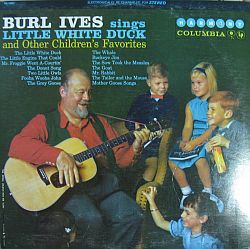
Although the adults at our house recoil at the sound of most music intended for kids, one beloved album is from my husband’s childhood–Burl Ives Sings Little White Duck and Other Children’s Favorites.  It might seem unlikely, but this morning I was actually craving that album.  Ives’ rendition of “The Little Engine That Could” made me a little misty-eyed over breakfast.  I don’t know why.  Maybe the wonder and hope of the two year old next to me, calling it the “sink I can song” or maybe just that I still believe that positive thinking is important.  (“I knew I could I knew I could I knew I could…”)

As usual, Wes Anderson chose perfect music for his latest movie.  There’s an earnest, post-cynical lens in that I love.  I see it in the Zissou saga, as I did in “Fantastic Mr. Fox” and so now I find myself tapping a foot, humming “Buckeye Jim” around the house, and now, in addition to the warmth of Burl Ives’ voice, that tune delivers me Anderson’s glorious sunset orange hues, and lovable, heroic foxes.  And I smile a silly, true smile.

Jim Krusoe’s novel “Erased”

A couple weeks ago, I finished reading Jim Krusoe’s novel, Erased. I wanted to read the whole thing again right after finishing the last line.

Reading this book, or really any of Krusoe’s fiction, is like taking a trip to the inner layer of the mind, which has somehow been turned inside out and exposed to the sun, and then finding some unknown organ that you need to survive but never knew was there. In his novels, dreams and reality at first seem to (but then don’t quite) fit each other…like a box of mismatched lids for old canning jars.

Here’s a bit from later in the novel, which I don’t think will spoil anything.

“Time, that old fooler, expanded and compressed itself, rolled over and played dead, only to spring back to life again when I least expected it. How long I walked, I couldn’t tell. It could have been hours. It might have been minutes. I heard the high squeals of bats and the sharp cries of night birds. I heard my own breath grow heavy as I trudged up a smallish hill, then I heard it ease on the way down. The wild dogs, or a completely different set of wild dogs, were back.”

In Erased, Krusoe’s protagonist is looking for his mother, who is supposedly dead, but keeps sending him postcards. This quest takes him to Cleveland, an idealized Cleveland that is laughable to anyone who has been to the real Cleveland. In Krusoe’s vision, the city is brimming with artists, carrying their work (often classical sculpture busts) with them to cafes like real-life celebrities carry small dogs in handbags. I love how the writer boldly steals the city from “our” reality.

Speaking of theft, I stole this photo from an interview with Jim Krusoe at Bookworm on KCRW.

Jim Krusoe was my mentor in graduate school at Antioch Los Angeles. I still consider him my mentor. Jim is a wonderful teacher. By asking a seemingly a simple question, “What are you interested in writing?” and telling me to write seven pages, Jim fostered my novel The Watery Girl into being. His manner is so good-natured and encouraging that, when he tells you the first few pages of a story need to go, you cut them without pain. I have learned so much from Jim over the years, I can’t imagine where I’d be as a writer without him.

I think Erased is his strongest work yet. And I can’t wait to read more, and read again.