Coming out


So until now, this blog has been about a very tightly defined (by me) literary exercise: writing brief essays based on getting inside a photo or image that inspires me or opens up my thinking in some way.

Doing this exercise has meant that I have posted only when I have some semi-polished Thing to Say or other. (My definition and determination of “semi-polished” varies by the day, as you can see by reading my pretty sparse archives.) I wanted no blabby blog, full of overshares, because those types of blogs annoy the expletives out of me. I wanted instead a venue for practicing writing nonfiction. A showcase for the handful of people who might be reading.

But the self-imposed form has become too precious (which went against the whole point of having a blog, and the THEME or IDEA of this blog) and so I’m breaking it open. OBJECTS IN MIRROR ARE STILL CLOSER THAN THEY APPEAR but they are blurrier and maybe you will see more of them. Coming atcha. You betcha. Coming out, maybe, in a way…

This week I have been attending the Antioch Writers Workshop, and my ideas about writing (creative) nonfiction have been cracked open. I’m heady with all the various shapes that creative nonfiction writing does and might take. Joyce Dyer‘s morning class has been great for that, as well as a memoir workshop with Nahid Rachlin.

I usually write fiction. I have written several novels, and some short stories. I’ve written a couple essays, and some of my short work has been published. But overall I would not consider myself a writer of nonfiction, except… I write nonfiction. I wrote what is essentially a personal essay (about something very personal, not for the blog) for the memoir workshop. It’s not memoir-y enough, I guess, but it is a start. And it turns out to be fun, and doesn’t have to be narcissistic. (I knew that from reading some great creative nonfiction, but it’s great to see and experience it firsthand.) For me, this kind of personal writing is excavation that I didn’t really think I would want to do, as:If I have the time, why don’t I work on my novel, except that as I grow older and (I hope) wiser, I realize again and again, in a deeper and deeper way, how connected all these things are. Words are words, they tell the truth, or they don’t, in various ways. There is truth in fiction and fiction in truth. Life informs fiction, fiction informs life, life informs life, etc. that is if a person (a writer or reader) is really awake.

So I’m putting my last name on the blog. I am owning this space. THIS IS MY SPACE. The little liberal, post-hippie town where I live used to have a “WE LIVE HERE!” parade, to tell the world that it wasn’t just a quaint little town to visit, or something… the freaks letting their freak flags fly, mummers, unicyclists, war protestors, etc. united to parade through town, so now, in the same spirit, this is my I WRITE HERE parade.

Having a little coming out party, for the five of you who are out there reading this.

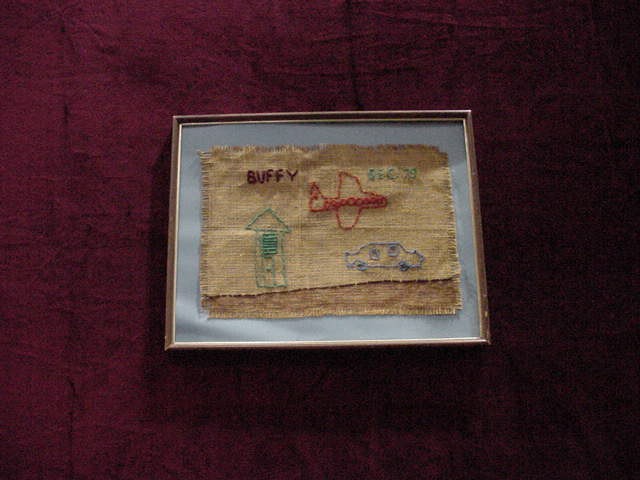
p.s. The image at the top of this post is from an auction of “Buffy the Vampire Slayer” props on eBay after the series was over. I assume it was needlepoint that Buffy was supposed to have created as a kid. Moments like these make me glad I’m a (virtual and concrete) packrat. I wish I’d been able to win the item, but I stole the image, which is almost like being there.
Safety

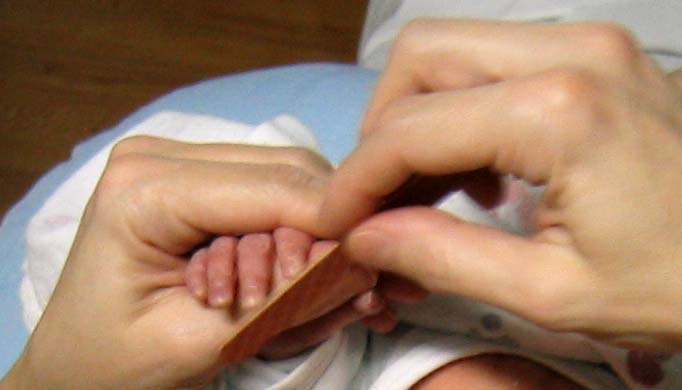
Where do babies get such little old lady hands?

How can babies be born with fingernails long and sharp enough to scratch themselves? Shouldn’t their bodies automatically be safer than that?

The hospital nurse said it’s best to file these tiny nails, rather than use baby clippers. So to protect my daughter, one of the first things I did to her body was to file her nails. She was relaxed, the nails were very soft, it was not difficult, just very very strange. It seemed out of place at the hospital: she and I should instead be 15 years into the future, at some day spa, but here she was just one day old, and the filing of the nails had more to do with her not marring her tiny, fragile face (because she doesn’t yet know how to use her hands, and they flail around, hurting herself without really knowing it) than an attractive manicure.

I saw something in this photo of my daughter’s hand. She needs me; she is almost one hundred percent need. And here we are, and we have to take care of her, keep her safe. Maybe the little old lady hands will help teach me.

(Happy one month, Merida!)

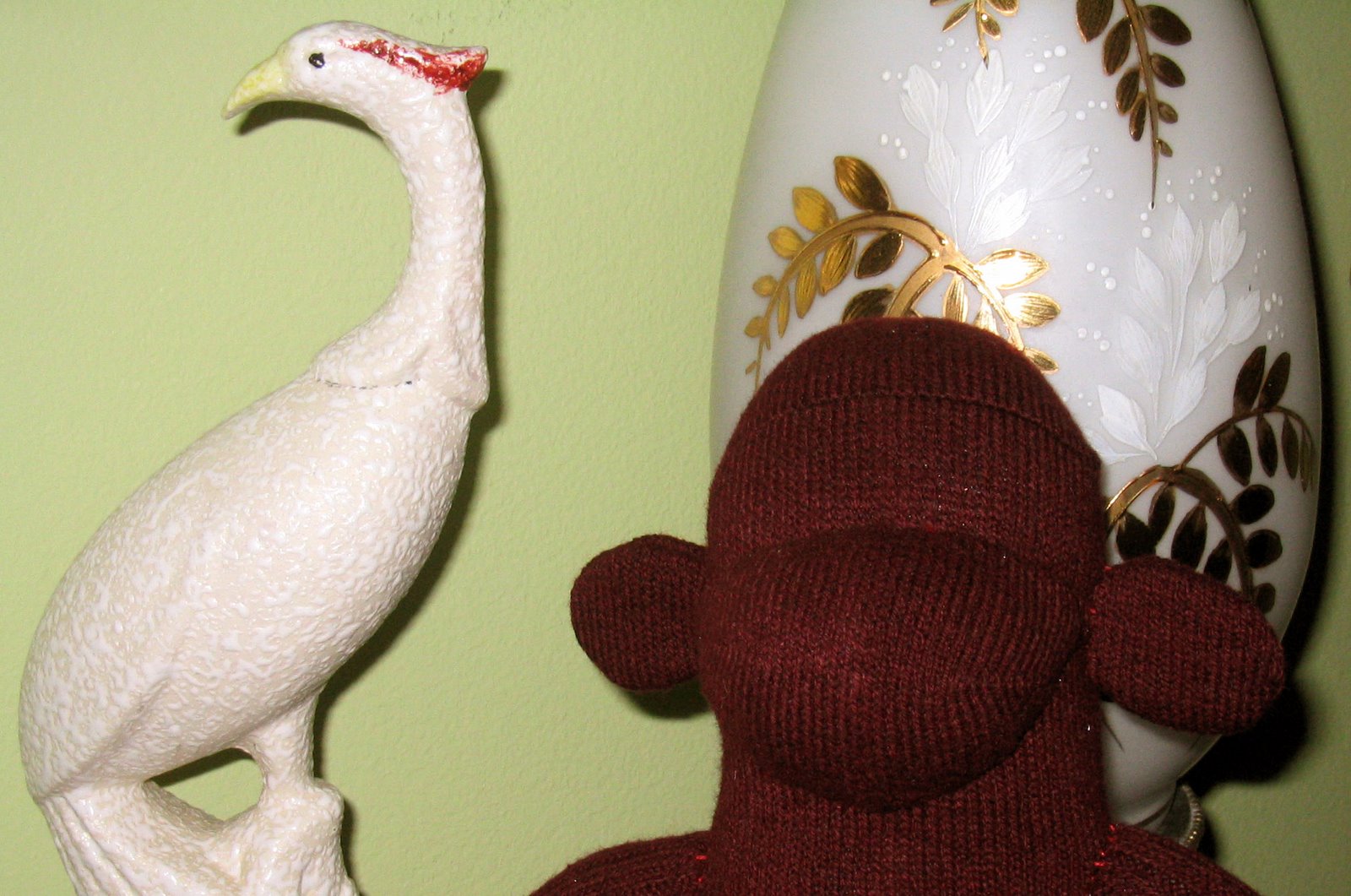
Our Monkey


I made a sock monkey for our baby, who is due today.

For the past months, November 24 has blazed across the sky of my mind, some strange icon, glowing, symbol of a question…who will this baby be?

Months ago, when I penciled a heart around the baby’s due date in my calendar, I noticed that November 24 was also a full moon. Will the full moon increase the likelihood that the baby will be born on November 24? I wondered. How many babies are born on their actual due dates, anyway? (Some quick googling–which, by the way, I recommend you avoid if you’re pregnant–reveals that the answer is around five percent, or fewer.)

Of course I had to make a monkey for our baby. It took me a long time to find the right socks, but I finally found a nice silky blend, thick enough to hold the stuffing in without showing through, but soft enough as well. I love making sock monkeys. But sock monkey faces are the hardest part. For me, the eyes are the feature most difficult to get right. I’ve often embroidered a face, only to tear out whichever feature didn’t look just right, or didn’t harmonize with its friends…too wide a mouth, or too small and stiff, eyes not friendly enough, the features combine to make an impression, and what if it isn’t just right?

In preparation to make the face on this monkey, I perused baby pictures of me, of my husband. But those photos hold faces impossible for me to objectify, to analyze. Even with the experience of redoing monkey faces, the entire unmarred surface of this monkey’s face has me completely still. Our doula suggested that maybe I need to wait to see our baby before I can do the face. Perhaps she’s right.

I saw something in this monkey’s face today. The world. More than the world, all possibilities, all that can hoped for but can’t be known, all dreams and wishes and love and fear and whispers, and night-tremblings, and skinned-knee realities to come, sullied ideals, in all their brazen realness.

Houdini the cat: 7/14/90-8/8/07


My husband and I had our dear seventeen-year-old cat, Houdini, put to sleep on the evening of August 8, 2007.

For several years, she struggled valiantly with chronic renal failure. When she was fifteen, she came through a pretty scary crisis, when she was getting sick everywhere and ended up very dehydrated, flat on the floor. She wouldn’t purr when I petted her. (This became a litmus test for me–when she seemed under the weather, as long as she was purring, it wasn’t a true crisis.) I was in denial back then about losing her, but it made me realize that all the extra time we had with her was bonus. I believe her strong personality and crankiness were key to her long survival.

She deigned to let me take care of her since 1990. I met her at the Seattle Animal Shelter where I went to choose a kitten. She was three months old, and when I picked her up, she clung to my shoulder, needling her baby claws into my vintage suede jacket. I fell in love with her. Because it was mid-October, and she was three months old, I decided to celebrate her birthday on Bastille Day, a day I could remember. (Later I noticed she always got dreamy when she heard Edith Piaf songs.)

While I said goodbye to her, scenes from her life flooded my memory…when she was spayed, because she was still so tiny, the plastic collar the vet had given her was too big, and protected her stitches but turned her into an unwitting physical comedy act. Instead I made a “sweater” by cutting arm and leg holes from a sock so that she’d leave her stitches alone. Every night she’d wriggle out of that sweater and in the morning I’d find her curled up, the sweater/sock a limp yin to Houdini’s yang. I recalled during her mid-years, trying to toilet train her–which sounded good in theory, but traumatized her pretty fully. All my apologizing paled next to how loudly she purred when I finally gave up and she saw I had set out a new litter box. (I could hear her purring from across my apartment.) I apologized again about the toilet training era before the vet put her to sleep.

We buried her body in the backyard, under the shelter of the young redbud that close friends gave us for our wedding. I read T.S. Eliot’s poem “The Old Gumbie Cat” which has always seemed a perfect tribute to Houdini’s cantankerous and judgmental yet immaculate nature:

****

The Old Gumbie Cat by T.S. Eliot

I have a Gumbie Cat in mind, her name is Jennyanydots;
Her coat is of the tabby kind, with tiger stripes and leopard spots.
All day she sits upon the stair or on the steps or on the mat:
She sits and sits and sits and sits – and that’s what makes a Gumbie Cat!

But when the day’s hustle and bustle is done,
Then the Gumbie Cat’s work is but hardly begun.
And when all the family’s in bed and asleep,
She slips down the stairs to the basement to creep.
She is deeply concerned with the ways of the mice –
Their behaviour’s not good and their manners not nice;
So when she has got them lined up on the matting,
She teaches them music, crocheting and tatting.

I have a Gumbie Cat in mind, her name is Jennyanydots;
Her equal would be hard to find, she likes the warm and sunny spots.
All day she sits beside the hearth or in the sun or on my hat:
She sits and sits and sits and sits – and that’s what makes a Gumbie Cat!

But when the day’s hustle and bustle is done,
Then the Gumbie Cat’s work is but hardly begun.
As she finds that the mice will not ever keep quiet,
She is sure it’s is due to irregular diet
And believing that nothing is done without trying,
She sets straight to work with her baking and frying.
She makes them a mouse-cake of bread and dried peas,
And a beautiful fry of lean bacon and cheese.

I have a Gumbie Cat in mind, her name is Jennyanydots;
The curtain-cord she likes to wind, and tie it into sailor-knots.
She sits upon the window-sill, or anything that’s smooth and flat:
She sits and sits and sits and sits – and that’s what makes a Gumbie Cat!

But when the day’s hustle and bustle is done,
Then the Gumbie Cat’s work is but hardly begun.
She thinks that the cockroaches just need employment,
So she’s formed, from that lot of disorderly louts,
A troop of well-disciplined helpful boy-scouts,
With a purpose in life and a good deed to do –
And she’s even created a Beetles’ Tattoo.

So for Old Gumbie Cats let us now give three cheers –
On whom well-ordered households depend, it appears.

****

She had an opinion on and a solution for everything, usually involving salmon. After the burial, our neighbor’s dog Joe came down the hill, appropriately dressed in his black and white tuxedo-style fur coat, to pay his respects.

Houdini Gatallini Bambini Baby-ini (her full name) aka “Noodle”, aka “Munchkin”, is survived by her loving human parents and her supersized 10 year old adoptive brother, Dante, aka “Big Tiny”. Dante’s eyes have been wider than usual since we showed him the body. The night after she died, he slept in the spot where she had slept the night before.

I think he’s still looking for her.

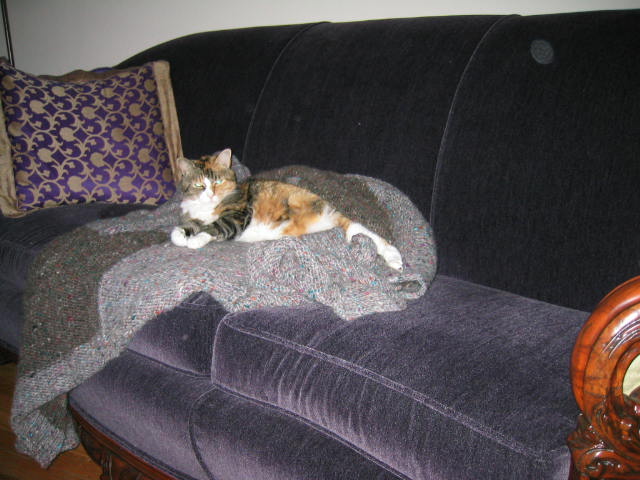
I saw something today in this photo of Houdini, taken several months before her death. The light and dark of loving and grieving, the complicated contrast between sadness and relief, the guilt I feel in letting her go. Her posture, defiant, beautiful, a true Gumbie cat with standards so high that I wonder if we ever met them. Sometimes, I think we came close.

So friends, if you visit our house and it’s a bit more chaotic than usual, do not be shocked. It’s just that scrawny, cat-shaped void.

We miss you, Houdini.

Forgiveness #1

The idea of forgiveness has been part of a class that I’m taking this year. Whether and how to forgive, the impact of forgiving (or not forgiving) on others, on oneself. I’m still learning about forgiveness…still deciding how and when to use it.

But I heard something today in a beautiful interview with Guillermo del Toro on Fresh Air. I think I was wrong about him! He really does believe Ofelia. So many things he said in the interview resonated, from the genesis of his inventiveness to the way he sees psychology, dreams, iconography in fiction…still so connected to his child imagination, he clearly values the world an artist creates…he even credits Arthur Rackham as having influenced his imagery. (Rackham illustrated J.M. Barrie’s 1906 Peter Pan in Kensington Gardens. Barrie and Peter Pan are hugely important to me.)

I will watch the movie again, with new insight from this interview. Thanks for all those who commented on my last entry–you have helped me think about this problem in a different way.

And Guillermo del Toro, if you’re reading this, or even if you’re not, I forgive you.

Dream-bursting

I’m going to be a purist. I recently saw Guillermo del Toro’s “El Laberinto del Fauno” (translated badly in English “Pan’s Labyrinth”–badly because there is only one Pan, but this movie concerned one of many “fauns.” And don’t get me started on Peter Pan.) I expected a lot, not only due to the hype surrounding the film. I’ve written a novel that concerns a young girl like Ofelia: absent parents, a child who sees a ghost. Like Ofelia, she is caught in a realm that, to an outsider, might seem imaginary. As I wrote the novel, I grappled with the question of what was real. Out of respect for my protagonist, I always fell on her side–that is, I take what she sees and experiences as real. I decided that if readers needed to see her as lost in her imagination, if they needed a scrap of the rational to hang onto, fine, but as storyteller and creator, I trusted her perception.

Guillermo del Toro’s film is stunning. His inventiveness and the way he realized the piece was a treat for the senses. But I was disappointed when rationality crept in at the end…bursting the “dream” of the story, to show us what “really” happened. To me, he betrayed the beauty he’d created.

I’m always bothered when adults disparage imagination, when they dismiss anything other than kitchen sink-realism as escapism–as the adults in the film essentially did the same to Ofelia. I admit I sometimes feel haughty when talking to people who have dismissed fancy–quietly I cheer the fact that I still allow myself the freedom to believe in story. I want a creator to let the dream be the dream that it is; I love when a creator lets the story be “real.” And by this I don’t mean realism. This letting the dream be real can make something transcendent, much more than escapism. In fact, things seem more like escapism when a creator shoves your nose in the “real world,” as a contrast to the imaginary world. This usually comes at the end, thereby reigning in imagination, shoving its messy boundaries back into its proper box: childhood, or perhaps the asylum.

I took a creative writing class in high school. Our teacher had one rule: no story could end with, “and then I woke up.” “And then I woke up” is what makes something imagined turn into escapism, the acknowledgement of the serious, the real, the rational life we busy adults must get back to, come now you foolish thing!

But isn’t it better, in this nasty, brutish, and short life, isn’t it better to leave the imagination alone, let it be what it is? To let it thrive? How many inventions and dreams would not have been realized if we always have to wake up from the dream before the story is over? If we need creators to remind us that life is mundane, to pull us back from that dangerous abyss of invention.

It used to make me mad when I encountered one of those “and then I woke up” moments in film or fiction, when the cold slap of reality hit my cheek. But this time, imagining that del Toro must have felt he had to let that ugly lump, rationality, back in, I just felt sad. I felt pity for him, and sad for me.

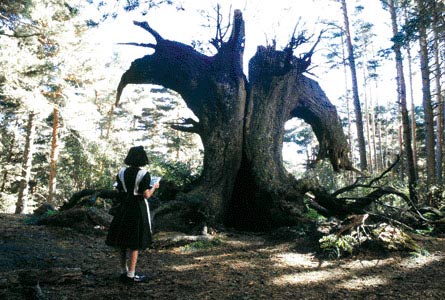
I saw something today in this photo of a creator, peering through the window. The furrows in his brow could mean anything, but I like to think he regrets that he didn’t let Ofelia (and, by extension, his audience) feel the full extent of her mud-smeared, harrowing dream.

Firefly ghosts

I saw something today in this old photo of the house where I grew up.

Which memories are ours? Which flow from stories we have been told, family legend and myth, year after year until we can recite them by heart?

My home is a ghost.

Like a phantom limb, I recall my home, sometimes dream of it, haunted by the memory, the textures. It itches and burns that I can’t recall it fully; I wish I could remember how the house smelled, the specific color of the light that filtered through the dust on its windows. When I lived there, the windows wouldn’t have been immaculate. It was the 1960s and ‘70s, and my family wasn’t concerned with Martha Stewart cleanliness. An old farmhouse, I don’t know when it was built, or whether the windows I looked through were its first windows.

My house was sacrificed to expand the park next door. What was our driveway now leads to a soccer field. I remember being glad–if my house disappeared, at least no one else would get to live in it. My house was burned as a fire exercise (how routine and usual that word made it sound, almost boring!), and as an adult I can appreciate that: the death of my house helped firefighters learn how to save other homes. But in a more perfect world, I wish I could have stayed in that house, returned to it from college, and after. Perhaps I am clinging to childhood, grabbing hold of something that never was. We were renters, so we couldn’t affect the fate of that house. Only, at my mother’s request, before the orchestrated arson, the village relocated one year’s live Christmas tree to the east edge of the lot. Today, that evergreen is the only living thing left of my home. (The tree was probably 5 feet tall when it was our Christmas tree. Seeing it now, thirty feet tall, taller, always amazes me.) A marker, an homage to our house.

And that house marked me. The one time I had to have stitches as a kid was when I ran from the landing upstairs down sixteen steps (was it sixteen? Did I ever actually count?) and through the kitchen, dining, and living rooms, arms extended in front of me, to push open the glass storm door, which shattered around my body. Somehow, the only damage was a cut in my right underarm, only five stitches needed (but oh, how I recall screaming at the light in my face in the doctor’s office!). Perhaps because it involved fear and physical pain, that was my own glass-shard memory, not pulled from the family epics. I still have a scar under my arm, which I unconsciously touch sometimes, run fingers over the ghost-wound’s raised tissue, proving that the house really existed.

In many ways, maybe in every way, the childhood home of my generation is gone too. No one I knew locked their doors. We kids spent days at the pool in the park next door, only going home for meals, and rode the new bike path along West South College Street downtown for Steiff little bears or beaded necklaces, no helmets, no pads, bare feet against rubber pedals; once I caught my toe in the spokes and it bled like water. But, after my foot was bandaged up and had healed enough, I got back on my bike, maybe still barefoot, and went onward, breezing through the streets tourists now call quaint. Those streets, our streets, are quaint. For our quaintness, we are praised and objectified. For our quaintness, we sometimes stagnate in a utopian memory that we’re not sure ever existed. But quaint is too tiny to describe the potholes, the puddles I tromped through, quaint won’t sanitize the mud from our superficially idyllic town, full of unsavory shadows, quaint won’t scour those memories, those apparitions.

Everyone has visceral memories of childhood. But here, in my narrow, sentimental view of our little Whoville, those ghostly memories were captured like fireflies in a glass Deaf Smith peanut butter jar, holes can-opener punched in the lid, and somehow, for me, in the morning, those fireflies weren’t dead carcasses. Sleeping? Maybe.

So I moved back.

I recall the moment I decided to return to my home town. Visiting from Seattle, where I lived for seven years, I was sitting at the counter at the a local cafe, looking out at people passing on the sidewalk with my then boyfriend. Unprompted, he said, “I could live here.” For some reason, when he said that, I began to cry. At the time I thought they were happy tears, but now I know they were bittersweet–moving back home would be a complex, beautiful salve for me (are those the fireflies I see, and are they waking?) but a very painful compromise for him, a home that wouldn’t last. I remember thinking at the time, though, looking through the old glass of the cafe storefront, how exciting, how right it would be to honor my childhood, reconnect with home.

Now, a new, adult view of town pleases me. Now I sip wine and write novels at that cafe, which some good friends bought last year. Many things provide fuel, inspiration for creative work, for life, for renewal. And slowly I’ve come to understand that just because my actual house isn’t here anymore, my home merely expanded. The womb of home is larger, and includes all of my hometown. Not only the town itself, but its satisfying, imperfect myth. The firefly memory.

* * *
Last year, when my new husband and I bought a house three miles from town, I was thrilled to keep our telephone prefix, to still have a hometown mailing address. I love our new home. And I mean no disrespect, but when people ask me how’s the next town over, I’m quick to clarify that technically, we still live in my hometown.

Real estate. Real estate. Growing up, my family rented, so we had to vacate when the village expanded the park. Maybe that’s why, even with the allure of Seattle seducing me, I felt such a pull to come home. For decades now, I have periodically dreamed of that house at 318 West South College Street. (Don’t look for it, it isn’t there.) I have immortalized it in a novel.

Dreams about 318 West South College Street are as welcome to me as dreams of flying.

In my most recent dream, the house was still there. Untouched since my family moved out over 20 years ago, it was for sale. My husband and I went to look, we would buy it, clean it up, renovate. Reclaim. But if it were still there, could we actually afford to buy it now? Would it have been restored by someone else, some stranger, and sold at a crazy-high market value? And what is the market value of a ghost?

Everybody row


About a month ago, I got an email. Early in the morning. I read and re-read the subject. Was I dreaming? Did it really say:

“Tom Waits Announces Tour Dates!”

For a long time, I’ve had a recurring dream. This is my dream: Tom Waits is playing the small college town where I live, or sometimes it’s the town where I went to college. He wants to hang out with me and my friends, just sitting around talking in the alley, or a friend’s house. Sometimes, when everyone else in the dream is in college, and I’m almost 40, he notices me across the room as the mature one, a woman among college-aged girls, and he and I hang out. Sometimes he and I fall for each other.

I recall reading Tom Waits loves his record label because they don’t mind if he wants to go play a 300-seat auditorium in Lisbon.

I looked at the email. A couple years ago, I had signed up for an email list announcing Tom Waits tours, in case he were ever to play anywhere I could actually get to. When I subscribed to the mail list, I got a weird error message, so I assumed the list was defunct. Resigned to checking his record label website periodically to see if he was going anywhere besides Frankfurt, or Budapest, I dreamt of flying across the world to see him. I have often thought that cliché, but it’s true: if there’s one person I’d want to see perform before he expires, or I expire, it’s Tom Waits.

But…I read the email. Not only is he touring, he’s playing two dates within a 3 hours’ drive from my home. A choice of venues. In my mind, the Orphans tour is for us orphans out here in the “flyover” states. I’ve been struggling with writing my new novel, which is partially inspired by the clang und dram of Tom Waits’ syncopation, his bangs and textures. Metal and earth. Grit and rust. Sometimes a Tom Waits song feels like the only thing that gets me, slogging, through the day…misery’s the river of the world, everybody row…

I saw something today in this poster of Tom Waits, which a fan posted on The Eyeball Kid. Tom’s looking out at the orphans, maybe he’s weary, who can tell, he always looks like his odometer has turned over at least once, yeah, he’s racked up plenty of miles, but, notoriously unkeen of touring, he’s coming here anyway. For us. In my crazy rabid fan-tasy, he’s coming here to inspire me, to remind me I still got an oar, I still can row…