The exquisite seasons of Kazuo Iwamura

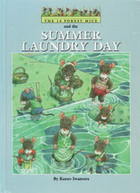
A lovely book from a series by Kazuo Iwamura.

A librarian friend sent my daughter a bunch of discarded library books last year.  (I often find the best children’s books are discarded by libraries.)  Among that batch was the The 14 Forest Mice and The Summer Laundry Day, by Kazuo Iwamura.  It’s a story of a family of mice who pack up and take their laundry to the river to wash.  The mama mouse knows why her children are rushing–they’re excited for the accompanying swim.  Along the way, gorgeous illustrations walk the reader past delicately-rendered dragonflies and foliage.  Reading it feels like a hike in the woods.

My daughter loved this book almost as much as I did.  Quickly I looked for the other books in this series: there’s one for each season.  Finding affordable copies of the 1991 English translations by MaryLee Knowlton was a slight challenge.  I eventually found all three of the others, on eBay and abebooks.com.   Today, the winter book came, completing our collection.

I love how this series shows the mice making sleds and indoor games to pass the time during a blizzard, or forging a platform to watch the harvest moon in autumn, or rice dumplings for a spring picnic.  The illustrations make me feel like I’ve been out in nature: colors rich and vibrant, drawings not just of “flowers” but true species.  The wood violets look like wood violets.  I also love how the series can give a child a sense of the year’s cycles, and a focus on the natural world.  The mice create things by using curiosity and invention, and the materials around them.

The stories are elegant and simple, and illustrate how to live in harmony with nature.  The large family (grandmother and grandfather on down to a toddler) works together to do the stuff of life, the maintaining of home.  Though somewhat hard to find, if you are seeking books that show kids something other than our consumer-based culture, it’s worth the search.  Let me know what you think of them.
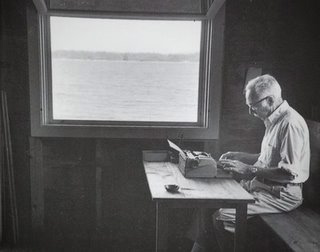
Vigor takes work

E.B. White, writing in Maine

I just reread Elements of Style, and several bits of wisdom have taken residence in my mind.  This was the first time I’ve read the fourth edition.  I found the updates to this edition helpful, in particular, some of the tidbits in the final section on style.  If you haven’t read it, do.

I’ve been working through a novel, editing, pruning, and rearranging.  Strunk and White remind me of point 22, on p. 32 of this edition: “Place the emphatic words of a sentence at the end.”  This can apply to sentences, paragraphs, lines of poetry, and even words: the beginning and end of these units carry the most power, the most weight.  The middle can be incidental, or worse, ignored.  Here’s a clever example (possibly urban legend, but interesting anyway) of how words can work with mixed up middles becoming invisible, and yet the content is still clear.  (Thanks to my friend Lara for digging this up when my human memory failed.):

“Aoccdrnig to a rscheearch at Cmabrigde Uinervtisy, it deosn’t mttaer in waht oredr the ltteers in a wrod are, the olny iprmoetnt tihng is taht the frist and lsat ltteer be at the rghit pclae. The rset can be a toatl mses and you can sitll raed it wouthit porbelm. Tihs is bcuseae the huamn mnid deos not raed ervey lteter by istlef, but the wrod as a wlohe.”

Beginnings and ends of these words are stable, are what we expect, and therefore they guide in reading through the garble.

Another thing that Elements of Style illustrates is more visual than literal.  Writers have to learn the twin arts of making a mess (making a creation, a draft) and then cleaning it up (editing, revising).  If you look at the layout of the examples in Strunk and White, you could consider the left column (before the makeover) as the making of the mess, and the right column (after the makeover) as cleaning it up.  I’m going to use this idea when I talk to students.  I think it helps to put the implicit and explicit judgment of Strunk and White into a context: all writing is a process, a walking through and then away from the muddy, toward the clear.  Start somewhere.  Edit as needed, strive to improve the mess, to communicate better.

Maybe the most important advice is point 17, on p. 23, “Omit needless words.”  An anthem for some people who write, an ideal to strive toward.  I’ve been polishing, weeding the needless, plucking extraneous words from overburdened sentences.  Sometimes it takes years to realize a word is needless.  Omit needless words is a noble mantra and practice.  With time, I could whittle this paragraph down even more than I have, but in the battle between how the blogosphere measures time and my tendency toward perfectionism, I go for speed and risk flaws.  This time, for the first time, I found (or noticed) the sub-mantra of Omit needless words on p. 19, under point 14.  “Note, in the examples above, that when a sentence if made stronger, it usually becomes shorter.  Thus, brevity is a by-product of vigor.”

It’s worth repeating: “…brevity is a by-product of vigor.”

That is such a beautiful fact, and beautifully put.  No wonder I am tired, this revision has been vigorous.  The novel is shorter.  And, I hope, stronger.

Writing in books

I just read an interesting article in the NY Times about marginalia.  I’ve been thinking a lot lately about “reading as a writer” and what that means, how interactive and not passive it can/should be… yet I have trouble writing in books, myself.  So I take a lot of notes, recopy passages, and do my work that way.  Maybe I need to rethink this, and break the water of the pristine book.

Read any good girls lately?

My daughter is three years old, and has gotten to the point of focusing on who is a “she” and who is a “he.”  This includes people she knows, toys, and musicians playing on CDs.  It also includes characters in books.

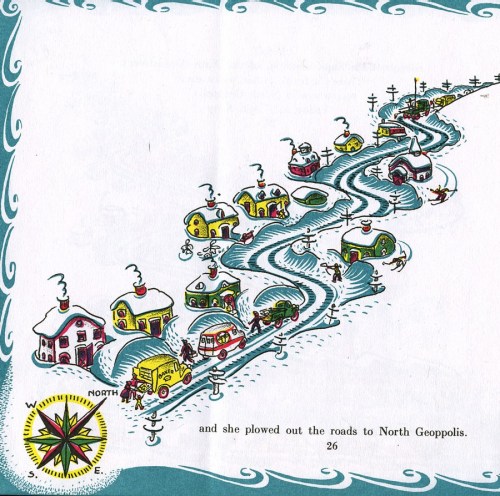
Without being obsessive, I’ve tried to ensure a balance of genders in her literary protagonists.  Fairly early, many of her favorite characters were male, among them: Else Homelund Minnarik’s Little Bear, and Peter of the Ezra Jack Keats books.  But giving her plenty of shes to think about was more challenging than it seemed.  To minimize gender stereotypes, and give her plenty of female heroes.  Her latest hero is Katy, from Virginia Lee Burton‘s book Katy and the Big Snow.  Following is from the Amazon.com review:

Katy, a red crawler tractor, “could do a lot of things,” Burton explains early on. In the summer she is a bulldozer, helping to build and repair roads in the city of Geoppolis. In the winter, she turns into a snowplow, waiting and waiting for her chance to be useful. Most of the winters, though, the snowfalls are mild and the town doesn’t need Katy. But when the big one finally hits, the town is buried in page after page of powder. The power lines are down. The doctor can’t get his patient to the hospital. The fire department can’t reach a burning house! “Everyone and everything was stopped but… KATY!” Suddenly, the entire community is dependent on one little snowplow.

I found the book in a jumbled shelf at Dark Star Books last week.  My daughter now fully identifies with Katy.  This is a snowy winter, and her Grandpa Mark drives a snow plow, so the story of Katy is not only relevant but personal.  At one point in the book, the highway department says of Katy, “Nothing can stop her.”  A couple days ago, my daughter repeated it, about herself.

I want to capitalize on this moment, so I’m looking for recommendations.  I like best the books where it feels incidental that the characters are female–not necessarily overtly political or socially aware (or please, not simply politically correct!) and I want books that have good stories, well written, and with lovely art.  I love old books that have held up over a long time.  And with strong females or girls.  Female animals are okay, but I want to make sure we have some good shes around.

Read any good girls lately?

The Year of the Tiny Frog

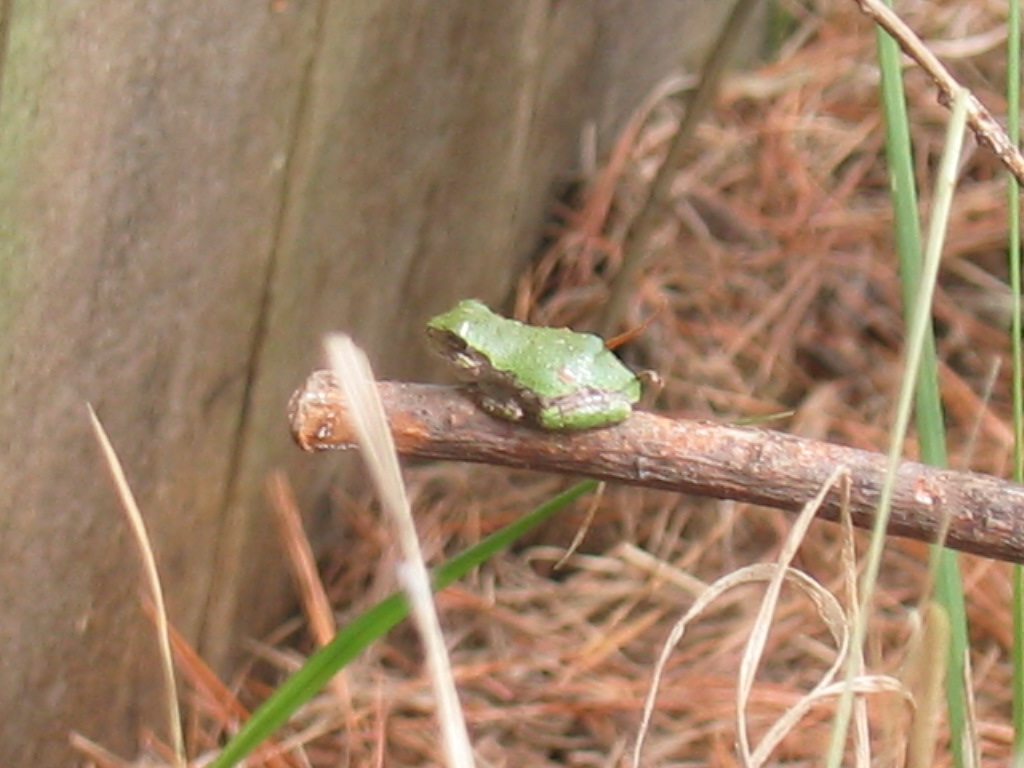
I took this photo (years ago) near Sanity Creek.

I am proclaiming 2011 The Year of the Tiny Frog.   In honor of the Tiny Frog, I intend to:

1) Read more of more interesting books;

2) Write more;

3) Sleep more;

4) Enjoy more of the real stuff and banish the fake stuff from my home, and life;

5) Spend more time with people, books, art, and music that give (rather than sap) energy.

The Tiny Frog would have it so.

How children learn that there are people called authors

Image stolen from pearlblossomhighway.blogspot.com

Reading to my daughter tonight, as usual, she chose the books.  First, she chose one called Reading Makes You Feel Good by Todd Parr.  “I really like books by Todd Parr,” she said.  She’d already been reading it to one of her babies when I came in.  [My daughter has a lot of babies.  Often, when I tell her the name of an author or illustrator, she says, “I have a baby named” (fill in the blank).]

In the rush of the day, it would be easy to just get to the meat and read the book, rather than taking a few seconds to name the author and illustrator.  Some books we have (and some she picks from the library) are so ugly, cheesy, and poorly written that I don’t feel like elevating the schmucks who created them by giving them name.  Meow.  (Though those schmucks are probably making a living at what they do, so I should refrain from sneering, at least from that whole “making a living by writing books” angle.)  But even with these stinky books, each time, when I read the title, then “written by…” and “illustrated by…” the child comes to know that there are people behind each book.

My daughter lives with two parents who are writers.  As she grows up, she’ll know a lot–maybe too much–about what it means to be a writer.  So many writers bemoan the current state of publishing…it’s a sad time for books, some say.  But we could do a lot to improve the morale of writers if we do this simple act: when reading a book to a child, include the name of the writer and illustrator.  Every time.  Every book.

If we do, maybe that lucky child who doesn’t know any writers personally will come to know that someone sat and thought about the book, someone chose words and painted images to tell the story that lulls her to sleep.

Swashbuckling, parkour, or something else?

"Peter sometimes came and played his pipes" from J.M. Barrie's Peter and Wendy, illustration by Mabel Lucie Attwell

Several weeks ago, I asked my daughter, who is almost three, if she would like to dress up for Halloween.  She said yes, that she wants to be a pirate.  (I think she was inspired by the Charley character in Lucy Cousins’ Maisy books, because several of the books feature him dressed as a pirate.)  I don’t think we’ll go pillaging for candy anywhere, unless it’s early enough to be before her bedtime, but I do think we’ll dress up and go out walking in our small town.  (Last year, she had a lovely time at pizza dinner with a dear old friend and her daughter–the daughter is a year older than mine, and was dressed as Sleeping Beauty, in gorgeous shiny regalia.  My daughter’s all purple ensemble: eggplant hat, fuzzy purple coat, shirt, pants, and purple Robeeze boots were cute but as a costume, it was a little abstract.  I admit to putting very little thought into it.  She was two!)  But this year, pirate.

How to build a pirate costume for a toddler?  I’m not going to rush out and buy a bunch of junk.  We’ll use stuff from home: bandana, some shirt and pants, boots, jewelry, and a stuffed parrot from the toy box.  I have no idea what a pirate mama should wear, but in my last-minute urge to be creative, I recalled a dream I had earlier this week.

So indulge me writing about a dream again.  (It’s my blog!)

I was at a writing convention, in a big hotel, or maybe it was a cruise liner.  Someone I used to work with at a regional theatre ages ago (who is not a writer) was there, and there was some craziness about him throwing a party that he invited me to but I didn’t have time to see the invitation, being too busy taking care of a sick toddler, but then later I saw him and some other men from his hallway dressed as women.  (If you knew the man I’m talking about, this would be a very amusing sight.  So we have a Halloween theme begun…)  Later in the dream, I was delightedly climbing, scaling really, the outside of what had now become a beautiful, very old, stone building (apparently now not a cruise liner, but still the writing convention).  Climbing the stone was exhilarating and effortless.  I was the opposite of afraid.  It was maybe as good a feeling as dreams of flying.  Someone inside the building asked what I was doing.  “SWASHBUCKLING!” I yelled.  It was how I imagine those parkour people feel when they are doing their amazing yet completely natural movements.

And then (just now) I remembered Peter Pan and the pirates in Neverland, Smee  and Hook and the gang.  I’ve long been obsessed with those characters, so took a nostalgic stroll through the images I used in grad school for a seminar on J.M. Barrie’s Peter and Wendy, where I found the image above.  (Not Disney.  No.  No.  Read Peter and Wendy.  Even if you are a grownup with no kids.  It’s beautiful.  If you have the time or money, look at the edition with illustrations by Mabel Lucie Attwell.  They are transcendent.)

So yeah, I am going to be a pirate this year.

The beginning of empathy?

My daughter, who is two-and-a-half, is developing a habit of hugging books.  When we’re reading a story and someone gets hurt, or might be scared, or sad, she embraces the book for a long moment.  When Madeline gets her appendix taken out, or when Sal loses her tooth (One Morning in Maine) and makes a bitter face “almost like crying,” my daughter leans in to hug.  She does this with her parents, too, when we stub toes or drop things, or are not feeling well.  In trying to raise a child who cares about other people, we’ve talked a lot about considering others’ feelings, reminding her that it hurts the cat when she yanks his tail.

Tonight, I was reading Harold and The Purple Crayon at bedtime.

“He was tired and he felt he ought to be getting to bed.  He hoped he could see his bedroom window from the top of the mountain.  But as he looked down over the other side he slipped–And there wasn’t any other side of the mountain.  He was falling, into thin air.”

Harold is shown upside down, with his purple crayon, simply falling.  My daughter leaned in to hug Harold, and then held and comforted him (the book) for a long time.  She said, “I’m going to hold Hamold” (as she calls Harold).

The wise people who write about child development tend to discount these early displays of empathy, and certainly my child does her share of throwing her dolls to the floor so that they cry, so that she can comfort them.  (I encourage her not to throw them to the floor–“It’s better if they don’t cry in the first place, right?” but that’s not the point.  She needs them to cry so that she can comfort them.)  It is heart-warming to see her hugging a book, especially when the child protagonist is in peril, or pain, but I don’t think my daughter is unusual in this way.

I read an article recently (I wish I could remember where!) about a book that was claiming there is too much fiction in K-12 curriculum, and that children need to learn how to read nonfiction, that it helps them learn about the real world more than fiction does.  Admittedly taken out of context, this notion really bothers me.  Yes, children need to learn to read all kinds of things, and it’s crucial that they learn the nuances and distinctions between fiction and nonfiction.  But how can I say that fiction doesn’t teach children about life in the “real” world?  Even putting “issue” books aside (in my generation, there was Judy Blume) it’s not fair to partition fiction out of what is real in the world.

We learn the world from stories, and through stories.

p.s. There is truth and fiction everywhere.