Stitches by David Small (how to deal with eyes)

Small print: “by my durn grandson DAVID SMALL Durnit…!!”

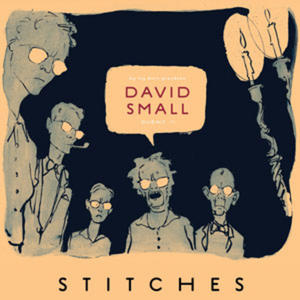
One of my students sent me a link to the ten best graphic memoirs, according to Time.  David Small’s book, Stitches, was included.  I find graphic memoir (graphic “literature” in general) fascinating.  (There’s that annoying question of whether anything created in the comic strip format can be considered LITERATURE, to which I say hell yes, but that’s another post.)  Many have commented about how writers contain the uncontainable within the tight frames of comic, and how useful that can be–similar to using tight poetic forms as scaffolding for what is huge, frightening, or unapproachable.

I was engrossed in Stitches, for many reasons, and I look forward to reading Small’s books for children.  One particular greatness of Stitches was Small’s use of eyeglasses to obscure eyes.  In the book, his elders who wear glasses usually have blank space behind the lenses, so their eyes are unavailable, erased, hidden.  It’s not until crucial moments in the drama, when truth is being told, or when the character is suddenly vulnerable, that eyes are depicted.  This is one of the things that graphic literature can do so beautifully–adding visual layers to the storytelling that cannot be done with words alone.

Among some pieces of wisdom I’ve been given by writers and teachers (and give, now, to my students) is to take care when writing about eyes.  I’ve included this advice in a handout I give to students.  The following may sound overly dogmatic, and in the whole document I do discuss  how rules can (and often should) be broken, if broken well and with foresight, but sometimes it’s necessary to remember:

USE CAUTION WITH EYES, FACES, AND FACIAL EXPRESSIONS

Be careful when you are describing how a point of view (POV) character looks, unless the person is looking in the mirror.  However, it can be a cliché to use a character looking in a mirror just so the writer can describe the character’s appearance.  Showing a POV character’s face (reddening, for instance) can sound stiff and inauthentic.  If you are going to describe how a character looks, focus on more interesting details beyond the data that would be listed on a drivers’ license (hair color, eye color, height, and weight) unless those details are integral to the story.  And these glimpses of characters should come naturally from the story, lest they feel pasted on to assist the reader imagine how the character looks.  (Readers like to use their imaginations!)

Another note about eyes

You can get into trouble when depicting ANY character’s eyes doing things, and describing facial expressions in general.  Eyes and faces, in real life, do convey nonverbal messages, but it’s difficult to translate these things into prose.  Be aware of how you do this, if you choose to do this.  It’s often better to let the actions and dialogue of your characters illustrate their inner states of being, rather than description from the outside.  It’s always good to be careful with the actions of eyes, for instance “his eyes followed her across the room,” because such descriptions, if taken literally, can draw the reader out of the story.

The Lucky Seven Meme

(Gratuitous photo of Jobs with Tangerine iBook because I wish I still had mine, unrelated to this post.)

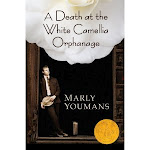
Marly Youmans, author of the freshly-released novel A Death At The White Camellia Orphanage, tagged me on her lovely blog.  Marly is a wonderful writer, and if you haven’t read her work, you should.  As for the meme, I’m playing.  Below is from my novel in progress, The Eight Mile Suspended Carnival.

Here are the meme rules:

  • Go to page 7 or 77 in your current manuscript
  • Go to line 7
  • Post on your blog the next 7 lines, or sentences, as they are – no cheating!
  • Tag 7 other authors to do the same

***

Mim stopped herself telling Cleopatra anything about Beede.  She wanted to hold him inside herself, alone, to hoard him, as long as she could.  If she told of him, it would water down his essence.  And there was something hungry about Cleopatra that made Mim not want to share Beede with her in particular.  Tonight Cleopatra smelled sharp and musty, like she had been cooking remedies, or maybe she had been outside with a man, but Mim couldn’t separate the smells to divine which man, and Cleopatra never told when or if.

“Where did you come up with alabaster?” Cleopatra asked.

“Suspenders.”  Mim wanted an answer.

***

So with no intention to annoy, I’m tagging seven friends who write…

  1. Elaine Gale
  2. Candace Kearns Read
  3. Chris Tebbetts
  4. Cyndi Pauwels
  5. Jennifer New
  6. Jaime Adoff
  7. Jennifer Bennett

The latest from Marly Youmans

Having read the first page of A Death at the White Camellia Orphanage by Marly Youmans, I’m eager to read the rest.  For me it’s a moment of “can’t wait, have to wait” because some work reading must precede this novel, but I hope time will expand so I can get to this novel sooner.  I had the pleasure of participating in Marly’s decentralized interview leading up to the novel’s recent release.  You can read that brief interview here.

“One of the savers”

Wilbur, Charlotte, and some of her work

I am reading my four-year-old daughter Charlotte’s Web, by E.B. White.  I had forgotten how great the book is–easily one of the best novels I’ve ever read.

The first line: “‘Where’s Papa going with that axe?’ said Fern to her mother as they were setting the table for breakfast.”   Seriously, I can’t think of a better hook.  When I took it from the shelf last week, my daughter was hesitant to read what, a year or so ago, she had with odd prescience named “the bacon book.”  I said, “I’m just going to read the first line.”  I did.

E.B. White’s hook worked.

I love reading this book aloud because it’s so easy to read aloud.  E.B. White did his work well.

Today, after reading her the chapter where Wilbur et al prepare to go to the Fair, my daughter acted out part of the story.  She needed a spider, and I remembered my husband’s wonderful Steiff spider, now known as “Charlotte.”

My daughter (“Fern”) quickly made a tent for Wilbur and Templeton (because, she informed me, they were going to kill Templeton, too).  She said that Charlotte was “one of the savers.”  Fern and Charlotte were saving Wilbur and Templeton.

So another reason to love this book: from it spins the truth that it’s not only males who do the saving around the farm.  Females do, too.  Children who hear animals talking are taken seriously by most adults, even the medical establishment, in the form of Dr. Dorian: “Children pay better attention than grownups.  If Fern says that the animals in Zuckerman’s barn talk, I’m quite ready to believe her.  Perhaps if people talked less, animals would talk more.  People are incessant talkers–I can give you my word on that.”

I can’t wait until bedtime, so I can remember what happens next.

Interview with Marly Youmans

I love what I’ve read of Marly Youmans’ work.  Her words remind me of snowdrops.  I’m using her story, “The Horse Angel,” for a class I’m teaching this spring.  The story is quiet, lovely, and tender without being sticky-sweet.  It’s also great example of how to do tricky maneuvers well, for example, using two points of view in a short story.  In the story, Youmans performs feats that new writers are often told not to attempt, but shows why rules should be broken, if broken well.  I am eager to read her forthcoming novel, Winner of The Ferrol Sams Award for Fiction, A Death at the White Camellia Orphanage from Mercer University Press.  I’m also honored to participate in the collective interview she’s giving at several blogs, in anticipation of the novel’s release on March 30, 2012.  You can order the novel from the publisher here.

 Rebecca:

As I re-read your story, “The Horse Angel,” I noticed a fascination with layers of orphandom.  Of the ghost in the mirror, you write, “…Edward and I thought that he looked as though he’d mislaid something of value and couldn’t think where it might be.  Or maybe it’s his family he’s mislaid. Maybe he can’t find his way back to them.”  The newly widowed Elsbeth dreams of her past, of being a sort of parent orphan: “…we are young man and woman again but changed, and often I hold my lost boy in my arms.”  And Mary, the younger neighbor of Elsbeth was violently orphaned when her stepfather killed her mother and then himself.  Your new novel, A Death at the White Camellia Orphanage, centers around the journey of a young orphan Pip Tatnell.  What is it that compels you to write about the orphan?

Marly:

Reading that quote from “The Horse Angel,” I immediately remembered the Rachel in Moby-Dick: how Stubb thinks that the captain of the ship has lost something, perhaps his watch, only to find that it is his precious son that he has lost to the sea. Some of my favorite characters are orphans—Ishmael is an orphan, and the indomitable Jane Eyre, and that other Pip from Great Expectations, and many more. “Orphan” is a state that often produces maximum trials and also may allow maximum freedom of thought and movement; it is automatically a condition set apart, a kind of state and place where dramatic things may happen. Fairy tales and stories often kill off the parents before or at the start.

I had not considered a relationship between “The Horse Angel” and A Death at the White Camellia Orphanage until you mentioned the two together. Perhaps one of your students assigned to read the story will read the book and tell me about it!

Although I am reticent about such matters and don’t care much for author talk about family or personal life (I have a distaste for the idea of misfortunes being used as a sensational marketing “hook,” though it is often done), I will say that my family suffered a death of one of its members in my childhood.  Such losses shape people and do not end or go away but leave traces. The sense that something is terribly missing can be quite strong and leave a child with the sense of being orphaned from the way the world ought to be. No doubt that childhood feeling colors “The Horse Angel” and A Death from the White Camellia Orphanage as well.

**

More about the novel can be found at Marly Youmans’ blog.

Comments from writers about A Death at the White Camellia Orphanage:

“A Death at the White Camellia Orphanage tells of a young boy’s travels through the black heart of Depression America and his search for light both metaphorical and real.  Writing with a controlled lyrical passion, Marly Youmans has crafted the finest, and the truest period novel I’ve read in years.”  –Lucius Shepard

“Marly Youmans’ new book is a vividly realized, panoramic novel of survival during The Great Depression. There is poetry in Youmans’ writing, but she also knows how to tell a riveting story.”  –Ron Rash

“In A Death at the White Camellia Orphanage, Marly Youmans gives us a beautifully written and exceptionally satisfying novel. The book reads as if Youmans took the best parts of The Grapes of Wrath, On the Road, The Reivers, The Adventures of Huckleberry Finn, and The Curious Incident of the Dog in the Night-Time and crafted from them a tale both magical and fine. Her rich language and lovely turns of phrase invite the reader to linger. Ironically, there is at the same time a subtle pressure throughout the novel to turn the page, because Youmans has achieved that rarest of all accomplishments: she has created a flawed hero about which we care. A Death at the White Camellia Orphanage is one of the best books I have read.” –Raymond L. Atkins

From the cover:

After a death at the White Camellia Orphanage, young Pip Tatnall leaves Lexsy, Georgia to become a road kid, riding the rails east, west, and north. A bright, unusual boy who is disillusioned at a young age, Pip believes that he sees guilt shining in the faces of men wherever he goes. On his picaresque journey, he sweeps through society, revealing the highest and lowest in human nature and only slowly coming to self-understanding. He searches the points of the compass for what will help, groping for a place where he can feel content, certain that he has no place where he belongs and that he rides the rails through a great darkness. His difficult path to collect enough radiance to light his way home is the road of a boy struggling to come to terms with the cruel but sometimes lovely world of Depression-era America.

On Youmans’ prior forays into the past, reviewers praised her “spellbinding force” (Bob Sumner, Orlando Sentinel), “prodigious powers of description” (Philip Gambone, New York Times), “serious artistry,” “unobtrusively beautiful language,” and “considerable power” (Fred Chappell, Raleigh News and Observer), “haunting, lyrical language and fierce intelligence” (starred review, Publishers Weekly.) Howard Bahr wrote of The Wolf Pit, “Ms. Youmans is an inspiration to every writer who must compete with himself. I had thought Catherwood unsurpassable, but Ms. Youmans has done it. Her characters are real; they live and move in the stream of Time as if they had passed only yesterday. Her lyricism breaks my heart and fills me with envy and delight. No other writer I know of can bring the past to us so musically, so truly.”
Into her drawers and shadows (Joan Didion’s Blue Nights)

Haunted Didion

As I read Blue Nights, Joan Didion’s repetition of images and phrases hypnotized me, as did her peeled and still-peeling layers of story.  As with The Year of Magical Thinking, here I felt Didion recounting memories in the way we actually experience them.  As if she set out to articulate against the linear necessity of language: one letter, one word, one thought at a time, arranged tidy in a row, which is one way we make sense.  The intentional fragmentation of narrative was accessible and didn’t fall off the page (or render me lost in the land of “what the fuck?”) because of Didion’s clarity.  Because of her sentences.  And perhaps because of the fact of what she was doing: the narrative act of slowing down, examining, opening drawers and closets brimming with iconic possessions.  As Didion names these ghosts on p. 45: “The objects for which there is no satisfactory resolution.”  The detritus of the lives of the people she loves best, and lost.  As she opens each drawer and tells the stories of what she finds, she assumes the role of docent in the Joan Didion Museum of Loss.

(In the essay “Slouching Towards Bethlehem,” Didion writes: “Someone works out the numerology of my name and the name of the photographer I’m with.  The photographer’s is all white and the sea (‘If I were to make you some beads, see, I’d do it mainly in white,’ he is told), but mine has a double death symbol.”  I read that passage again after I’d read The Year of Magical Thinking, and could not avoid thinking of her life story’s foreshadowing in that moment, the double death that awaited her.)

In addition to the quandary about what to do with all that stuff (and my own eventual stuff, should I live long enough, outlive someone I love) I felt the writer’s grief and discomfort at the ache of questions she turns over and over, things upon which she shines a light, unable to avoid the vast shadows of murk.

Shadows which, despite the fact that some people, including me, happen to believe Didion walks on water, do not flatter her.

There’s something about that peeling, that sad onion, those haunts, her willingness to shine light despite what might crawl out, which makes me feel more human.

Eating potatoes, greedily

Flann O'Brien, of whose prose I could not get enough last month

Like tucking into a vat of potatoes after long without food, during winter break, I read in rapid (rabid?) succession Flann O’Brien’s The Poor Mouth and The Hard Life. Truly when I finished reading The Poor Mouth, I was still hungry and needed more.  Good thing I stocked up on both books!

Anything I say about Flann O’Brien will clunk like a can down malnourished and decrepit steps into the void of my own unworthiness, but my evangelical urge I can no longer ignore.  So.

If you’re into the show “Lost” perhaps you’ve heard of or even read O’Brien’s The Third Policeman.  I didn’t watch many episodes of that show, so I’m blind to the connection, but I’m glad more people heard about (and possibly read) O’Brien’s novel.  (The which I need to re-read, and soon.  I first read it as part of a seminar in grad school with Rod Val Moore.  The book was suggested in preparation for a field trip to the Museum of Jurassic Technology.)

Reading The Poor Mouth (published in 1941) is like diving into a pool of hilarity and squalor (yes) and eating it all with a spoon.  Yum, hyperbole!  My favorite!  Among other things I hope to grasp as soon as I re-read The Poor Mouth, O’Brien becomes a sort of cantor, invoking lyrical phrases of misery, a tapestry of moments in which, for instance, we hear, “…generally no sound except the roar of the water falling outside from gloomy skies, just as if those on high were emptying buckets of that vile wetness on the world.”  A tattered weariness in which scenes begin with openings like: “One afternoon I was reclining on the rushes in the end of the house considering the ill-luck and evil that had befallen the Gaels (and would always abide with them) when…”  Reveling in this luxurious squalor and over-the-topness, I laughed loud and often as I read along, even more than while reading Wodehouse.  To rip a phrase from O’Brien and twist it terribly, each chapter is like a thesis, proving without doubt that the plight of O’Brien’s Gaels is a bad life “whose like will ever be there again.”  (Just read the book.  It’s short.  If you hate it, I’ll give your money back.)  I also need to read it again to see how it lines up with another hyperbolic novel on the topic of poverty, though not nearly as hilarious, George Orwell’s Down and Out in Paris and London.

Literary belly still grumbling, I took up The Hard Life.  Published in 1962, the story was more shaped and plotty than The Poor Mouth.  At intervals, two characters tussle in flappy rants about the shadowy political power of Jesuits within the Catholic church.  Their dialogue was so well written that I didn’t struggle, despite my lack of knowledge about the issues they debated.  To press these two characters into a modern context, their arguments could have been mouth-offs between two old school rappers, one-upping each other (mostly) good-naturedly, but with no self-censor.  They were funny.  And the mountingly bizarre plot twists were delectable.  (See, I’m still on this stuff as if it’s food!  And really, it is.)  The end was unexpected and brilliant.  I’ll say no more, so as not to spoil a good meal.

Bon appetit!

Joan Didion and her bits

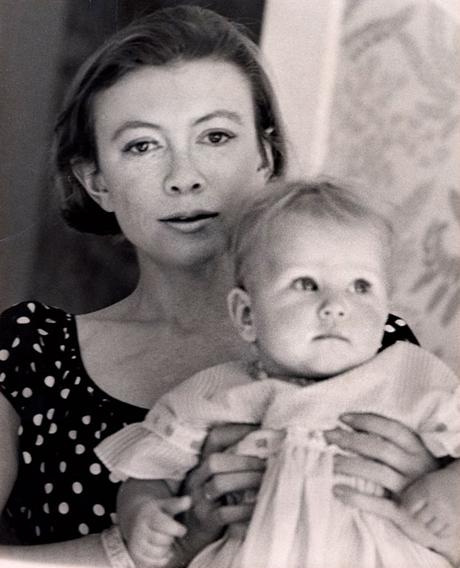
Joan Didion and Quintana Roo

“Only the very young and the very old may recount their dreams at breakfast, dwell upon self, interrupt with memories of beach picnics and favorite Liberty lawn dresses and the rainbow trout in a creek near Colorado Springs.  The rest of us are expected, rightly, to affect absorption in other people’s favorite dresses, other people’s trout.  And so we do.  But our notebooks give us away, for however dutifully we record what we see around us, the common denominator of all we see is always, transparently, shamelessly, the implacable ‘I.’  We are not talking here about the kind of notebook that is patently for public consumption, a structural conceit for binding together a series of graceful pensees; we are talking about something private, about bits of the mind’s string too short to use, an indiscriminate and erratic assemblage with meaning only for its maker.”

–Joan Didion, “On Keeping a Notebook,” Slouching Towards Bethlehem, p. 136.

I just began reading Blue Nights.  The passage above from Didion’s much older essay has been with me as I approach a still-too-tender writing project.  It’s stuff I will write about some day, though more time must first elapse.  I need perspective, and this is too messy and raw.  Meanwhile I put bits into a jar (or notebook) to save, to turn over, to approach for the quilt when it’s time.

Meanwhile, merely typing Didion’s words (and reading her new memoir) is a comfort and a privilege.

The kid-think of Room (novel by Emma Donaghue)

Many Moons Passed with the Wolf at My Door, by Angela Treat Lyon

The first book I read after fall quarter had dusted down was Emma Donaghue’s novel, Room.  I can’t avoid “reading as a writer,” and thinking about how the writer does and makes her thing, but wanted to immerse myself, so I refused the urge to take notes.

The narrative procedures used in this book are inseparable from the sensational story, which is, to quote the Wikipedia entry, “told from the perspective of a five-year-boy, Jack, who is being held captive in a small room along with his mother.”  The book is a page-turner, sure, but what kept me riveted was the grace with which Donaghue sustained the narrative told, first-person, in a young child’s words.  It’s of particular interest to me because I know it’s so damn hard to do.  (My novel, The Watery Girl, is told from the point of view of a seven-year-old, but I didn’t want to limit myself to her language.  So I used a close third person, still intimate, often imbued with thoughts and words directly mined from the protagonist Claire, but third person allows space to wiggle language.  First person really locks you in.  All writing is artifice, but if you want to convince a reader like this one, you better stick close to what a child would actually say.  And more than that, Donaghue’s Jack breathes the breath of childhood, lives out its logic.  I’m convinced her sentences are true kid-think.)

As I read Room, I kept holding my breath (not only because of the story) to see if Donaghue could sustain that thing with the kid.  She did.  There was not one moment when I disbelieved I was reading Jack’s true five-year-old thoughts.  Yes, Jack is precocious and smart, but the writer explained his particular intelligence so effortlessly when needed, and made clear that Jack’s mother worked hard to engage her son in his (albeit tiny) world.  Reading about their life in Room, I was enrapt and also exhausted, imagining how hard it would be to live in a single room with a child, non-stop, for five years.  (Putting aside the whole ordeal–the sheer exertion of the character’s work as a parent was amazing.  And yet believable.  I bought, without question, that Jack was her redemption.)

When I opened the book, I didn’t know the plot, just the premise.  As I read, I wondered how Donaghue would sustain the claustrophobia of one room for an entire novel.  When I realized their situation was about to change, the novel became “about” something very different from what I expected.  I was glad.  Thinking, as I have been this year, about brain plasticity and pinning many hopes to that idea, it fascinated me to read and consider about how Jack might (or might not) adapt to life outside Room.  And like many who have read the book probably have done, I wondered whether we each have a Room of some sort of other that’s shaped what we expect and want from the world.

I want to read more of Donaghue’s writing, soon, because anyone who can do what she did in Room is worth the time.

Where do hummingbirds go in a hurricane?

"...making a promise..."

Robert McCloskey’s Make Way for Ducklings was one of my daughter’s early favorite books.  Soon, my friend Maryellen recommended some of McCloskey’s other books, Blueberries for Sal and One Morning in Maine.  The Sal stories are fun, jaunty, and touching.   Sal loses a wobbly tooth while grubbing for clams with her father on the beach, feeling  for it with her muddy finger, the mud bitter in her mouth.  The stories ebb and flow with the tide as they follow Sal and her family on their bucolic adventures on the Maine coast.  (And I love how these stories depict strong, outgoing, capable girls, unafraid to roll up their pants and get dirty, carry heavy stuff, play with discarded spark plugs, and generally frolic freely through childhood.)

Then I found Time of Wonder  which continues the saga of Sal and Jane, but this time in a very different type of narrative.  My daughter just rediscovered the book, and so reading at “bed night” thrills me more than it usually does.

The book reads like a poem in places, and interestingly, rather than continuing to name Sal and Jane as the protagonists, Time of Wonder is written in second person, so it’s directed at “you.”  With beautiful illustrations of the seasons of coastal life, spring ferns uncurl and fade to make room for summer boats.  As the summer folks leave the island, there follows the uncertain skies, the time for being watchful.  The climax of the book is the hurricane, and the hypnotic rhythm of preparation builds with the repetition of characters’ lines:

“We’re going to have some weather./It’s a-coming!/She’s gonna blow./With the next shift of the tide.”

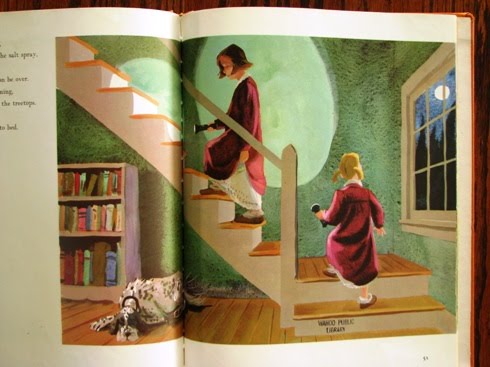
After the storm slows, the picture shows Sal and Jane creeping upstairs to bed.  The text on that page reads:

“The moon comes out,
making a rainbow in the salt spray,
a promise
that the storm will soon be over.
Now the wind is lessening,
singing loud chords in the treetops.
Lessening,
it hums as you go up to bed.”
The whole book is a joy to read.  McCloskey’s other books are, too, except I stumble with One Morning In Maine because it could use some editing, and has clunky dialogue tags, which cause me to cringe a little when I read it with my writer’s ear.  (And reading that book aloud is a reminder that reading aloud is crucial in catching clunkiness.) But I love reading Time of Wonder.  Maybe because of the catharsis of Storm (which is part of the natural rhythm of life there; even children know the rituals of preparation, one last trip to the island for groceries and gasoline).   Or maybe it’s simply the poetry.
Even if you’re not reading it to a child, read it.  You might like it.