Stories help make us more human!

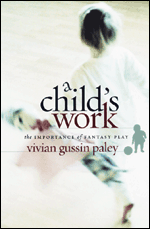
One of many fantastic books by Vivian Gussin Paley

And yes, I grant myself that exclamation point!

Here’s an interesting piece by Annie Murphy Paul about the neroscience of reading fiction.  It validates things that many know intuitively: among other things, reading fiction makes more empathetic humans.  (And it slashes through those conversations–conversations which, frankly, piss me off–about how nonfiction is somehow more important than fiction in helping people deal with “the real world.”  I love that the study corrects for things like whether people who are more naturally empathetic read more fiction.  Take that!)

Described in the piece is how we register sensations as we read descriptive language: how the evocative qualities of words like “cinnamon” work our sense of smell.  This aligns with something I heard the poet Cathy Smith Bowers discuss: when we read a word aloud, its sound affects us emotionally, but even when we read a word silently on the page, our bodies experience similar sensations.  As a writer of fiction, all this helps me understand why I care about what I do.  Why it’s important to make stories.  As a reader, it all sounds very true.

Last night, I finished reading Vivian Paley’s book, A Child’s Work.  Its emphasis is on the importance of fantasy play and stories in developing a young child’s ways of processing and coping with the world.  All the books by MacArthur Fellowship recipient Paley that I’ve read have moved me–she is a gifted writer, and her subject is so vital.  In her work, in addition to her observations as a wise teacher, she records and shares dialogue from real children in real classrooms, making sense of their real worlds and lives through fantasy and imagination.  In this book, Paley rightfully despairs at the push to bring academics to children too soon, leaving less and less time for preschool children to dream and do their natural thing.  Among many passages in this book that move me and are so true, Paley writes, on p. 102:

“Every day brought me new evidence of the preeminence of fantasy in children’s thinking.  It has reinforced my certainty that we perform a grave error when we remove fantasy play as the foundation of early childhood education.

We are going too far in the opposite direction.  Some school people feel that because young children engage in magical thinking we must pull them on to another track as early as possible; having added extra years of schooling to their lives, we are emboldened to counteract fantasy play with ‘reality-based’ activities.

Is this not the adult version of magical thinking?  To imagine that the purpose of early childhood education is to reorder the stages of human development is like the story of the prince who was turned into a frog.  In attempting to turn children into creatures that are unchildlike, we ignore all the messages young children give us as they play.  The frog turns back into a prince when the princess recognizes his need to be treated with kindness and respect.  In the case of our children, this would include the kindness of acknowledging that their perceptions and premises are not the same as older children’s or as our own.”

This idea of how we think we can reorder the natural stages of a child’s development haunts me.  Paley’s work speaks to me in particular now as the mother of a young child.  And pausing to read it has helped me slow down enough to more fully engage in the play my daughter is about.  So many of her sentences start with “Pretend that…” and I’m paying closer attention, and doing more active pretending with her.  (It’s good for adults, too!)  But anyone who is interested in stories and storytelling and their central importance to our humanity ought to read Paley’s books.  The Boy On The Beach is a really good one, too, and gets at why storytelling is important to building communities.

Now, back to my story in progress…

Interview with Marly Youmans

I love what I’ve read of Marly Youmans’ work.  Her words remind me of snowdrops.  I’m using her story, “The Horse Angel,” for a class I’m teaching this spring.  The story is quiet, lovely, and tender without being sticky-sweet.  It’s also great example of how to do tricky maneuvers well, for example, using two points of view in a short story.  In the story, Youmans performs feats that new writers are often told not to attempt, but shows why rules should be broken, if broken well.  I am eager to read her forthcoming novel, Winner of The Ferrol Sams Award for Fiction, A Death at the White Camellia Orphanage from Mercer University Press.  I’m also honored to participate in the collective interview she’s giving at several blogs, in anticipation of the novel’s release on March 30, 2012.  You can order the novel from the publisher here.

 Rebecca:

As I re-read your story, “The Horse Angel,” I noticed a fascination with layers of orphandom.  Of the ghost in the mirror, you write, “…Edward and I thought that he looked as though he’d mislaid something of value and couldn’t think where it might be.  Or maybe it’s his family he’s mislaid. Maybe he can’t find his way back to them.”  The newly widowed Elsbeth dreams of her past, of being a sort of parent orphan: “…we are young man and woman again but changed, and often I hold my lost boy in my arms.”  And Mary, the younger neighbor of Elsbeth was violently orphaned when her stepfather killed her mother and then himself.  Your new novel, A Death at the White Camellia Orphanage, centers around the journey of a young orphan Pip Tatnell.  What is it that compels you to write about the orphan?

Marly:

Reading that quote from “The Horse Angel,” I immediately remembered the Rachel in Moby-Dick: how Stubb thinks that the captain of the ship has lost something, perhaps his watch, only to find that it is his precious son that he has lost to the sea. Some of my favorite characters are orphans—Ishmael is an orphan, and the indomitable Jane Eyre, and that other Pip from Great Expectations, and many more. “Orphan” is a state that often produces maximum trials and also may allow maximum freedom of thought and movement; it is automatically a condition set apart, a kind of state and place where dramatic things may happen. Fairy tales and stories often kill off the parents before or at the start.

I had not considered a relationship between “The Horse Angel” and A Death at the White Camellia Orphanage until you mentioned the two together. Perhaps one of your students assigned to read the story will read the book and tell me about it!

Although I am reticent about such matters and don’t care much for author talk about family or personal life (I have a distaste for the idea of misfortunes being used as a sensational marketing “hook,” though it is often done), I will say that my family suffered a death of one of its members in my childhood.  Such losses shape people and do not end or go away but leave traces. The sense that something is terribly missing can be quite strong and leave a child with the sense of being orphaned from the way the world ought to be. No doubt that childhood feeling colors “The Horse Angel” and A Death from the White Camellia Orphanage as well.

**

More about the novel can be found at Marly Youmans’ blog.

Comments from writers about A Death at the White Camellia Orphanage:

“A Death at the White Camellia Orphanage tells of a young boy’s travels through the black heart of Depression America and his search for light both metaphorical and real.  Writing with a controlled lyrical passion, Marly Youmans has crafted the finest, and the truest period novel I’ve read in years.”  –Lucius Shepard

“Marly Youmans’ new book is a vividly realized, panoramic novel of survival during The Great Depression. There is poetry in Youmans’ writing, but she also knows how to tell a riveting story.”  –Ron Rash

“In A Death at the White Camellia Orphanage, Marly Youmans gives us a beautifully written and exceptionally satisfying novel. The book reads as if Youmans took the best parts of The Grapes of Wrath, On the Road, The Reivers, The Adventures of Huckleberry Finn, and The Curious Incident of the Dog in the Night-Time and crafted from them a tale both magical and fine. Her rich language and lovely turns of phrase invite the reader to linger. Ironically, there is at the same time a subtle pressure throughout the novel to turn the page, because Youmans has achieved that rarest of all accomplishments: she has created a flawed hero about which we care. A Death at the White Camellia Orphanage is one of the best books I have read.” –Raymond L. Atkins

From the cover:

After a death at the White Camellia Orphanage, young Pip Tatnall leaves Lexsy, Georgia to become a road kid, riding the rails east, west, and north. A bright, unusual boy who is disillusioned at a young age, Pip believes that he sees guilt shining in the faces of men wherever he goes. On his picaresque journey, he sweeps through society, revealing the highest and lowest in human nature and only slowly coming to self-understanding. He searches the points of the compass for what will help, groping for a place where he can feel content, certain that he has no place where he belongs and that he rides the rails through a great darkness. His difficult path to collect enough radiance to light his way home is the road of a boy struggling to come to terms with the cruel but sometimes lovely world of Depression-era America.

On Youmans’ prior forays into the past, reviewers praised her “spellbinding force” (Bob Sumner, Orlando Sentinel), “prodigious powers of description” (Philip Gambone, New York Times), “serious artistry,” “unobtrusively beautiful language,” and “considerable power” (Fred Chappell, Raleigh News and Observer), “haunting, lyrical language and fierce intelligence” (starred review, Publishers Weekly.) Howard Bahr wrote of The Wolf Pit, “Ms. Youmans is an inspiration to every writer who must compete with himself. I had thought Catherwood unsurpassable, but Ms. Youmans has done it. Her characters are real; they live and move in the stream of Time as if they had passed only yesterday. Her lyricism breaks my heart and fills me with envy and delight. No other writer I know of can bring the past to us so musically, so truly.”

What I thought inessential is essential

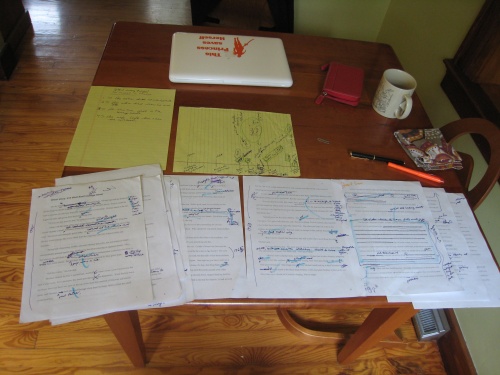
This is a different mess of mine, but looks similar

So I’ve been working on this terribly overwritten draft of my novel in progress.  Gone through the printed pages carefully, cutting, pruning, taking out piles of adjectives and phrases.  The typed pages are a mess now, not unlike this other mess from a previous project.  I keep thinking, “Which gremlin scribbled all over these neat pages here that I now have to type up?” though the gremlin is me.  This novel I have been writing since 2004.  Part of its problem is uneven terrain: while I was figuring out what it was, I was writing along, letting time pass in the story, and the story emerged like sourdough bread (a terrible metaphor!) that, 100 or so pages into it, actually begins to take shape.  So now as I comb through the years of words on these pages, I see where things need to be built up, and where torn down.  With this project, I pushed language and narrative beyond anything I’d ever done.  On purpose.  Because I could!  Here I gave myself license to write a really bad first draft, and use all the purple colorful clang I heard in my head.  (Knowing I would cut later.)

Too many adjectives!  Oy vey!  Too many phrases strung together that unwound from my mind and at one moment in time made sense but now hang like random junkyard decoration.  Get that egg beater out of there!  What did I just step on?  Is that stench overripe banana?  And so on.

Get it out of here!

I realize at least two things about this draft, both of which were essential to my authority in telling the story.  I needed both:

1) The self-indulgent “let everything be in there” messiness.   As author and creator of this world, I had to see how dingy and dusty and clangy and rotten the nouns were.  I had to see the layers of adjective like paint on an old carnival sign, repainted over crack and crumble.  How else would I know the patina of this place?  And;

2) The excessive phrases that are stage directions: “She put the scissors on the round table to the left of the door” and so on.  If it’s even important that she put the scissors down (question everything!) does it matter where?  She put them down.  Fine.  But the writer, again, to establish authority, must see the whole thing happening like a play, must know and track where the scissors are put down.  In case someone else needs to bob her hair!  And so on like that.

If I know this world I’m writing is dusty and clangy and I know where the scissors are, I don’t have to tell you (unless it’s important to the story).  If I am doing my job well enough, the reader will trust me.  She will thank me for sparing her unnecessary words.  Doing so will leave me more room for the things that really need to be there.  It’s like all the doing of research that doesn’t end up in the novel.  Having those things, knowing them, seeing and breathing them, is what allows me to tell the story in a way that will keep people reading.

I hope.

Eating potatoes, greedily

Flann O'Brien, of whose prose I could not get enough last month

Like tucking into a vat of potatoes after long without food, during winter break, I read in rapid (rabid?) succession Flann O’Brien’s The Poor Mouth and The Hard Life. Truly when I finished reading The Poor Mouth, I was still hungry and needed more.  Good thing I stocked up on both books!

Anything I say about Flann O’Brien will clunk like a can down malnourished and decrepit steps into the void of my own unworthiness, but my evangelical urge I can no longer ignore.  So.

If you’re into the show “Lost” perhaps you’ve heard of or even read O’Brien’s The Third Policeman.  I didn’t watch many episodes of that show, so I’m blind to the connection, but I’m glad more people heard about (and possibly read) O’Brien’s novel.  (The which I need to re-read, and soon.  I first read it as part of a seminar in grad school with Rod Val Moore.  The book was suggested in preparation for a field trip to the Museum of Jurassic Technology.)

Reading The Poor Mouth (published in 1941) is like diving into a pool of hilarity and squalor (yes) and eating it all with a spoon.  Yum, hyperbole!  My favorite!  Among other things I hope to grasp as soon as I re-read The Poor Mouth, O’Brien becomes a sort of cantor, invoking lyrical phrases of misery, a tapestry of moments in which, for instance, we hear, “…generally no sound except the roar of the water falling outside from gloomy skies, just as if those on high were emptying buckets of that vile wetness on the world.”  A tattered weariness in which scenes begin with openings like: “One afternoon I was reclining on the rushes in the end of the house considering the ill-luck and evil that had befallen the Gaels (and would always abide with them) when…”  Reveling in this luxurious squalor and over-the-topness, I laughed loud and often as I read along, even more than while reading Wodehouse.  To rip a phrase from O’Brien and twist it terribly, each chapter is like a thesis, proving without doubt that the plight of O’Brien’s Gaels is a bad life “whose like will ever be there again.”  (Just read the book.  It’s short.  If you hate it, I’ll give your money back.)  I also need to read it again to see how it lines up with another hyperbolic novel on the topic of poverty, though not nearly as hilarious, George Orwell’s Down and Out in Paris and London.

Literary belly still grumbling, I took up The Hard Life.  Published in 1962, the story was more shaped and plotty than The Poor Mouth.  At intervals, two characters tussle in flappy rants about the shadowy political power of Jesuits within the Catholic church.  Their dialogue was so well written that I didn’t struggle, despite my lack of knowledge about the issues they debated.  To press these two characters into a modern context, their arguments could have been mouth-offs between two old school rappers, one-upping each other (mostly) good-naturedly, but with no self-censor.  They were funny.  And the mountingly bizarre plot twists were delectable.  (See, I’m still on this stuff as if it’s food!  And really, it is.)  The end was unexpected and brilliant.  I’ll say no more, so as not to spoil a good meal.

Bon appetit!

Wes Anderson & the Buckaroo Banzai Principle

I wrote a post here nearly two years ago (at my yearly movie outing, so sad!) about Wes Anderson.  Today, I watched “The Life Aquatic” again on DVD and though I adore it, it was as if I had never seen it before.  Turns out I barely remembered the movie, though it’s my favorite of Anderson’s.  I noticed things this time I either saw and forgot or never saw.  I watched the background this time, allowed myself to look away from the principal humans and around the room, as it were, and linger in my tour of the Belafonte.

The film’s similarities to “Buckaroo Banzai” (another favorite film) were more beautifully apparent this time.  One Banzai moment with Team Zissou was the curtain call, which some loving film geek posted here in mashup.  (There’s also the Jeff Goldblum connection linking the two films.  And as my husband said, TZ would have mirrored BB and the Honk Kong Cavaliers more fully had they brought back Ned for the curtain call, as  W. D. Richter did with Rawhide.  But not bringing Ned back does a more authentic job of continuing and closing the film’s narrative rather than opening it up, so maybe in the lineage of collective filmmaker evolution, this omission makes some sense.)

But in addition to the visual homages that Anderson paid Banzai et al, much more fundamentally, he followed the Buckaroo Banzai Principle as outlined here.  It’s, briefly:

When a work of fiction is so confident in itself that the reader just enters the world and goes with it.

Applies equally to a written or cinematic world, but as I thought about it today, I realized how I’m not quite doing that with my new novel, and thought of one little way that I can follow the BBP more closely.  For which I owe Mr. Anderson a card of thanks.  If only I had some Kinglsey (Ned) Zissou corrsepondance stock.

(Dear Mr. Anderson, if you are reading this:  Thank you.  Thank you for caring enough about your audience to make something so fully realized.  Thank you for following your own obsessions and idiosyncrasies with such commitment and grace.  Thank you for Seu Gorge reinterpreting Bowie.  Thank you for your hard work, which looks effortless as breathing in and breathing out.)

The Rules

THE RULES:

1) NEVER UNDERESTIMATE EACH OTHER.

2) KEEP YOUR HANDS STRONG.

3) DON’T KEEP WHAT YOU CAN’T CARRY.

4) CLOSE YOUR EYES ONLY WHEN NECESSARY.

5) NO SPITTING.

6) NO PUGILISM.

7) A THING ISN’T YOURS UNTIL SOMEONE GIVES IT YOU.

8) MACHINES SHALL REMAIN PRISTINE.

9) DON’T BE TOO SUPERSTIOUS.

10) BE A LITTLE SUPERSTITIOUS.

11) TRUST US.

(From The Eight Mile Suspended Carnival.  Please abide by these rules if you ever have a chance to visit.)

The kid-think of Room (novel by Emma Donaghue)

Many Moons Passed with the Wolf at My Door, by Angela Treat Lyon

The first book I read after fall quarter had dusted down was Emma Donaghue’s novel, Room.  I can’t avoid “reading as a writer,” and thinking about how the writer does and makes her thing, but wanted to immerse myself, so I refused the urge to take notes.

The narrative procedures used in this book are inseparable from the sensational story, which is, to quote the Wikipedia entry, “told from the perspective of a five-year-boy, Jack, who is being held captive in a small room along with his mother.”  The book is a page-turner, sure, but what kept me riveted was the grace with which Donaghue sustained the narrative told, first-person, in a young child’s words.  It’s of particular interest to me because I know it’s so damn hard to do.  (My novel, The Watery Girl, is told from the point of view of a seven-year-old, but I didn’t want to limit myself to her language.  So I used a close third person, still intimate, often imbued with thoughts and words directly mined from the protagonist Claire, but third person allows space to wiggle language.  First person really locks you in.  All writing is artifice, but if you want to convince a reader like this one, you better stick close to what a child would actually say.  And more than that, Donaghue’s Jack breathes the breath of childhood, lives out its logic.  I’m convinced her sentences are true kid-think.)

As I read Room, I kept holding my breath (not only because of the story) to see if Donaghue could sustain that thing with the kid.  She did.  There was not one moment when I disbelieved I was reading Jack’s true five-year-old thoughts.  Yes, Jack is precocious and smart, but the writer explained his particular intelligence so effortlessly when needed, and made clear that Jack’s mother worked hard to engage her son in his (albeit tiny) world.  Reading about their life in Room, I was enrapt and also exhausted, imagining how hard it would be to live in a single room with a child, non-stop, for five years.  (Putting aside the whole ordeal–the sheer exertion of the character’s work as a parent was amazing.  And yet believable.  I bought, without question, that Jack was her redemption.)

When I opened the book, I didn’t know the plot, just the premise.  As I read, I wondered how Donaghue would sustain the claustrophobia of one room for an entire novel.  When I realized their situation was about to change, the novel became “about” something very different from what I expected.  I was glad.  Thinking, as I have been this year, about brain plasticity and pinning many hopes to that idea, it fascinated me to read and consider about how Jack might (or might not) adapt to life outside Room.  And like many who have read the book probably have done, I wondered whether we each have a Room of some sort of other that’s shaped what we expect and want from the world.

I want to read more of Donaghue’s writing, soon, because anyone who can do what she did in Room is worth the time.

Cornflowers and ghosts

A mess that might be grow up to be a story someday.

This morning, as I did my post-child infrequent and highly interrupted version of Julia Cameron’s morning pages (more like three quarters of a page, if I’m lucky) my daughter said, “My, look at all those words!  It’s like a giant nametag!”  Aside from making me laugh, her comment reminded me of the photo I took last weekend: the mess I was making with a ghost story in progress, whose birth story can be found here.  When I talk about making a mess, this is what I mean.  This is the kind of mess that I love.  It’s all my mess (no one else has read this story, and all the scribbles, highlighting, and editing is mine!  No judgement, no other voices in my head!) and here I’m trying to make order of it.  It’s the first draft of a messy story that came from a terrible essay about one thing which grew into an essay about something else.  Like the leggy cornflowers that we let go (“Let?”  Who has time to even consider “letting” weeds grow; they just grow taller when I’m not looking) that bloom into flowers, whose color is unmatched in the rest of nature.  The flower that needed to be.

I’m not saying this mess is good, and I don’t know if it ever will be.  But what else would I rather be doing?  Maybe weeding the other flowers to give the cornflower more room.

What about you?  What would you weed today?  What would you plant?

The end of a story?

It’s weird writing something when you don’t know you’re about to write the end of the thing.  This might be the end of the ghost story I’m writing.  We’ll see.  But it seems like the end.

This photograph faded with time, as he told the story to Cricket, as he counted to one hundred, night after night as he himself drifted next to his child, wondering how on earth such a tender thing could continue to survive.

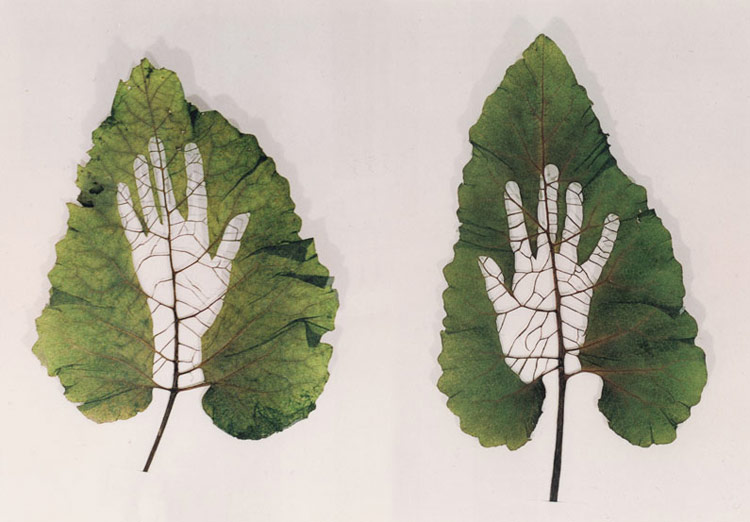
The hands of a storyteller

From http://www.janetpihlblad.com/pages/leafwork_thumbpage.html

“The first sentence of every novel should be: ‘Trust me, this will take time but there is order here, very faint, very human.’  Meander if you want to get to town.”

This is from Michael Ondaatje’s book, In The Skin Of A Lion, which I blogged about here.  When I first read this passage, years ago, I realized this is the kind of fiction I want to write, and this proclamation provides comfort.

There’s a beautiful feeling I sometimes get when I’m reading.  It’s the moment I realize I’m in the hands of a good storyteller.  I’ve had that feeling sometimes reading “great” books, and sometimes reading unpublished student work.  The feeling helps me relax and be along for the journey, and I crave it in everything that I read.  This is not to say that I want what I read to soothe me–on the contrary.  (As the fabulous Joy Williams wrote in her essay “Uncanny the Singing That Comes From Certain Husks,” “Good writing never soothes or comforts.  It is no prescription, neither is it diversionary, although it can and should enchant while it explodes in the reader’s face.”)  But that somewhat unnamable awareness that I’m in good hands as I read is always welcome.  It has to do, maybe, with an amount of confidence (and sincerity) in the writer, because I don’t get that feeling, usually, when I read an overly clever or cynical voice–a narrative stance that, to me, usually feels insincere.  I think the feeling I’m pondering can be called “trust.”  As I notice it, something changes in my body; I relax a little (even if the story is unsettling, exploding in my face) because I understand an agreement the writer is making with me, and I am making with the writer: I trust that she or he will uphold whatever rules and aesthetics the story (or poem) requires, and I trust that the writer’s choices were made in earnest, and with honor behind them.

I want to give that same feeling to my readers.  With my words, I want to craft a net, a web, or a hammock, to catch, or lull them into a place, a moment, a thought.  Myself I want to quiet down to what’s essential, and I want the reader to witness (with me) that silver drop of water on a leaf, or that strange knocking sound that’s just too far off to identify but too close to ignore.