The kid-think of Room (novel by Emma Donaghue)

Many Moons Passed with the Wolf at My Door, by Angela Treat Lyon

The first book I read after fall quarter had dusted down was Emma Donaghue’s novel, Room.  I can’t avoid “reading as a writer,” and thinking about how the writer does and makes her thing, but wanted to immerse myself, so I refused the urge to take notes.

The narrative procedures used in this book are inseparable from the sensational story, which is, to quote the Wikipedia entry, “told from the perspective of a five-year-boy, Jack, who is being held captive in a small room along with his mother.”  The book is a page-turner, sure, but what kept me riveted was the grace with which Donaghue sustained the narrative told, first-person, in a young child’s words.  It’s of particular interest to me because I know it’s so damn hard to do.  (My novel, The Watery Girl, is told from the point of view of a seven-year-old, but I didn’t want to limit myself to her language.  So I used a close third person, still intimate, often imbued with thoughts and words directly mined from the protagonist Claire, but third person allows space to wiggle language.  First person really locks you in.  All writing is artifice, but if you want to convince a reader like this one, you better stick close to what a child would actually say.  And more than that, Donaghue’s Jack breathes the breath of childhood, lives out its logic.  I’m convinced her sentences are true kid-think.)

As I read Room, I kept holding my breath (not only because of the story) to see if Donaghue could sustain that thing with the kid.  She did.  There was not one moment when I disbelieved I was reading Jack’s true five-year-old thoughts.  Yes, Jack is precocious and smart, but the writer explained his particular intelligence so effortlessly when needed, and made clear that Jack’s mother worked hard to engage her son in his (albeit tiny) world.  Reading about their life in Room, I was enrapt and also exhausted, imagining how hard it would be to live in a single room with a child, non-stop, for five years.  (Putting aside the whole ordeal–the sheer exertion of the character’s work as a parent was amazing.  And yet believable.  I bought, without question, that Jack was her redemption.)

When I opened the book, I didn’t know the plot, just the premise.  As I read, I wondered how Donaghue would sustain the claustrophobia of one room for an entire novel.  When I realized their situation was about to change, the novel became “about” something very different from what I expected.  I was glad.  Thinking, as I have been this year, about brain plasticity and pinning many hopes to that idea, it fascinated me to read and consider about how Jack might (or might not) adapt to life outside Room.  And like many who have read the book probably have done, I wondered whether we each have a Room of some sort of other that’s shaped what we expect and want from the world.

I want to read more of Donaghue’s writing, soon, because anyone who can do what she did in Room is worth the time.
Foody alert: easy faux fondue toast

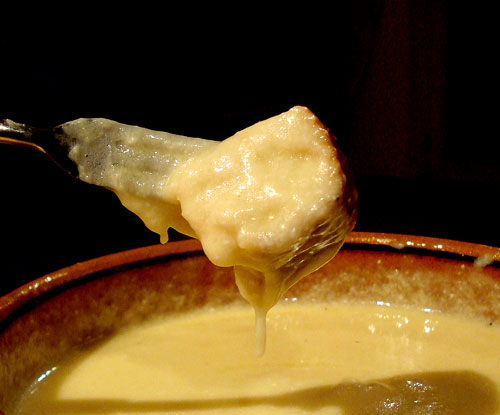
Don't have a fondue pot?  No worries.A year after I graduated from college, I backpacked by train through Europe with a girlfriend.  It was a five-week whirlwind: we visited Frankfurt, Florence, Venice, Corfu, Athens, Salzburg, Amsterdam, Interlaken, Switzerland, and a charming town in France whose name I’m forgetting, staying mainly in youth hostels.  I turned 23 at the Pink Palace on Corfu: no togas that I recall, but many shots of ouzo, and many subsequent plates smashed over my head.  At the time, I was a developing (vs. full-on) foody, but tonight I was yanked back decades and miles by an accidental flavor.

My friend K. and I stayed at a cozy, relaxing hostel in Interlaken with a modest dining room.  Interlaken, after the previous slew of cities, was like a mental rest, and we decided to stay most of a week.  Now, aside from the exhalation and the beautiful hikes and views, I remember most fondly the fondue.  It was such a casual thing there, not a production, simply part of the daily eating process, available downstairs in our momentary home.  I’ve tried to make fondue a few times since, and it’s been okay, but tonight I stumbled upon a great and easy way to fake it. Let’s call it an homage to fondue.

Here’s what to do:

1.  Get some cave-aged gruyere.  I don’t know why being aged in a cave is important, but you don’t have to go to a cave to get it–it’s everywhere these days, and it worked in this case.  (I used Trader Joe’s gruyere, but I’m sure any decent gruyere will do.)

2. Peel a clove of garlic.  (You might need more than one clove, depending on how much toast you are making.)

3.  Toast some slices of bread.  I used a good multigrain, bought from Emporium in Yellow Springs.  (Note: I often slice and freeze bread, then toast it unwrapped, or heat it, wrapped in foil, to good effect.  But for this project, you need to toast the bread fairly crispy.)  It might be good with white bread, but make sure it’s something with body.  Wimpy or mediocre bread would wilt under the next steps.

4. Rub the garlic clove on the bread, effectively worrying the garlic down to a nub–sort of a way of grating and distributing the garlic on the bread.  The garlic clove should disappear onto the bread.  (You’ll find if the bread is not toasty enough, it won’t have a rough enough surface to do the magic of grating the garlic onto the surface.  Experiment.)

5. Shred a generous amount of gruyere onto each piece of garlicked toast, and broil it–in oven or toaster-oven–until it’s melty and bubbly but not overly browned.

6. Eat it.  I bet it’s even more reminiscent of fondue if accompanied by a glass of wine, but it works fine on its own with a bowl of soup.

(For another wonderful (vegan) treat, you could stop after rubbing the garlic on toast, drizzle olive oil, salt and pepper to taste.)

Mmm, cheese…

Why I love words, and serendipity: “decimate”

I used the word “decimated” in an essay today, and decided to make sure it was the right word, so looked it up, lazily, on the web.  I’m using it somewhat hyperbolically in my essay, but this is among what I found:

1 : to select by lot and kill every tenth man of
: to exact a tax of 10 percent from <poor as a decimatedCavalier — John Dryden>
a : to reduce drastically especially in number <choleradecimated the population>
Just right.  When the word came to me, I hadn’t consciously remembered  the ten in “dec” but it is perfect.  So “decimate” is like the anti-tithe, kinda.

Excerpt from an essay I’m writing

In college drawing class, I learned about negative space.  If you look long enough at something, a shape forms around it: the thing where its object isn’t.  So I look and look at nothing, pining for the past, wanting to yank back that day when we planted the live Christmas tree in the yard, or that other day when the circus was in the park next door, and my parents collected elephant poop to fertilize our garden.  Elephants gone, dung gone too, no remnants now left.  I want back so many other days.  Memory provides only edges.  Pinning decrepit butterflies to velvet, I smell the dust, turn around, look back, and find another disintegrating wing of the few things I can recall.  I set out to order it all, by chronology, or theme; I make another list, “things that happened to my body,” such as falling down sixteen steps, such as running through the glass door.  Anything that helps me contain the mess.  But this story disobeys my desire for dramatic unity.  It won’t sit still.  Memory doesn’t fix itself close enough to truth, doesn’t allow our trust; the interior record is fuzzy, ephemeral.  I call the county office to gather facts.

I’d like to know, for instance, when my house was burned down, when it began its exquisite disappearance.

Where do hummingbirds go in a hurricane?

"...making a promise..."

Robert McCloskey’s Make Way for Ducklings was one of my daughter’s early favorite books.  Soon, my friend Maryellen recommended some of McCloskey’s other books, Blueberries for Sal and One Morning in Maine.  The Sal stories are fun, jaunty, and touching.   Sal loses a wobbly tooth while grubbing for clams with her father on the beach, feeling  for it with her muddy finger, the mud bitter in her mouth.  The stories ebb and flow with the tide as they follow Sal and her family on their bucolic adventures on the Maine coast.  (And I love how these stories depict strong, outgoing, capable girls, unafraid to roll up their pants and get dirty, carry heavy stuff, play with discarded spark plugs, and generally frolic freely through childhood.)

Then I found Time of Wonder  which continues the saga of Sal and Jane, but this time in a very different type of narrative.  My daughter just rediscovered the book, and so reading at “bed night” thrills me more than it usually does.

The book reads like a poem in places, and interestingly, rather than continuing to name Sal and Jane as the protagonists, Time of Wonder is written in second person, so it’s directed at “you.”  With beautiful illustrations of the seasons of coastal life, spring ferns uncurl and fade to make room for summer boats.  As the summer folks leave the island, there follows the uncertain skies, the time for being watchful.  The climax of the book is the hurricane, and the hypnotic rhythm of preparation builds with the repetition of characters’ lines:

“We’re going to have some weather./It’s a-coming!/She’s gonna blow./With the next shift of the tide.”

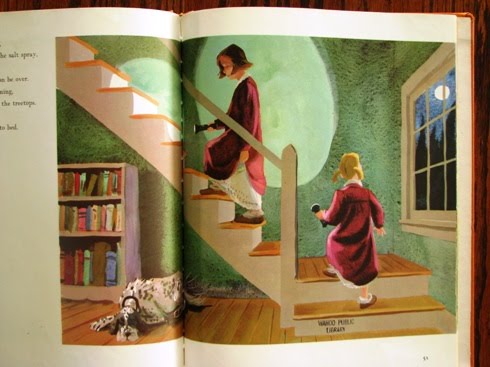
After the storm slows, the picture shows Sal and Jane creeping upstairs to bed.  The text on that page reads:

“The moon comes out,
making a rainbow in the salt spray,
a promise
that the storm will soon be over.
Now the wind is lessening,
singing loud chords in the treetops.
Lessening,
it hums as you go up to bed.”
The whole book is a joy to read.  McCloskey’s other books are, too, except I stumble with One Morning In Maine because it could use some editing, and has clunky dialogue tags, which cause me to cringe a little when I read it with my writer’s ear.  (And reading that book aloud is a reminder that reading aloud is crucial in catching clunkiness.) But I love reading Time of Wonder.  Maybe because of the catharsis of Storm (which is part of the natural rhythm of life there; even children know the rituals of preparation, one last trip to the island for groceries and gasoline).   Or maybe it’s simply the poetry.
Even if you’re not reading it to a child, read it.  You might like it.

Cornflowers and ghosts

A mess that might be grow up to be a story someday.

This morning, as I did my post-child infrequent and highly interrupted version of Julia Cameron’s morning pages (more like three quarters of a page, if I’m lucky) my daughter said, “My, look at all those words!  It’s like a giant nametag!”  Aside from making me laugh, her comment reminded me of the photo I took last weekend: the mess I was making with a ghost story in progress, whose birth story can be found here.  When I talk about making a mess, this is what I mean.  This is the kind of mess that I love.  It’s all my mess (no one else has read this story, and all the scribbles, highlighting, and editing is mine!  No judgement, no other voices in my head!) and here I’m trying to make order of it.  It’s the first draft of a messy story that came from a terrible essay about one thing which grew into an essay about something else.  Like the leggy cornflowers that we let go (“Let?”  Who has time to even consider “letting” weeds grow; they just grow taller when I’m not looking) that bloom into flowers, whose color is unmatched in the rest of nature.  The flower that needed to be.

I’m not saying this mess is good, and I don’t know if it ever will be.  But what else would I rather be doing?  Maybe weeding the other flowers to give the cornflower more room.

What about you?  What would you weed today?  What would you plant?

Three winter songs

These people know how to deal with winter...

The other day when the sun didn’t shine, and didn’t shine, and didn’t shine, and all my clothes that are not in the attic weren’t warm enough, I got jittery, wondering how I would make it through winter this year.  People say as you age, cold weather becomes harder to endure.  But the grey is too soon this year.  The rain.  Drear, she came early this year.

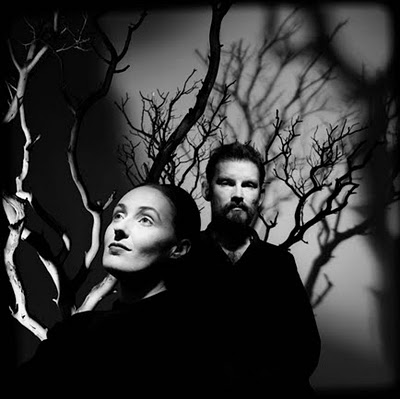
So as I do when I prepare for winter, today I listened to Dead Can Dance’s Toward the Within.  The live album includes perhaps the saddest song ever, Lisa Girard’s transcendent “Sanvean.”  You can see a long, beautiful version here.  (Her gown is worth a look, too!)  Lisa Girard just breaks my heart, and then fills up the broken pieces.  This week of grey skies needed true keening like hers.  It’s been a hard year.

Another cathartic winter song on the same album is the traditional, “I Am Stretched at Your Grave,” sung here by Brendan Perry.  (For a version with a funky backbeat that you might have heard, try this one.)

And now for something completely different.  This might be obvious to you raindogs, but “November” by Tom Waits is a worthy winter anthem.  Who else but himself could sing, “Go away, you rainsnout, go away, blow your brains out…”

Here’s hoping the sun shines soon.  But if not, you know what I will be listening to.

What will get you through the chill this year?

The end of a story?

It’s weird writing something when you don’t know you’re about to write the end of the thing.  This might be the end of the ghost story I’m writing.  We’ll see.  But it seems like the end.

This photograph faded with time, as he told the story to Cricket, as he counted to one hundred, night after night as he himself drifted next to his child, wondering how on earth such a tender thing could continue to survive.

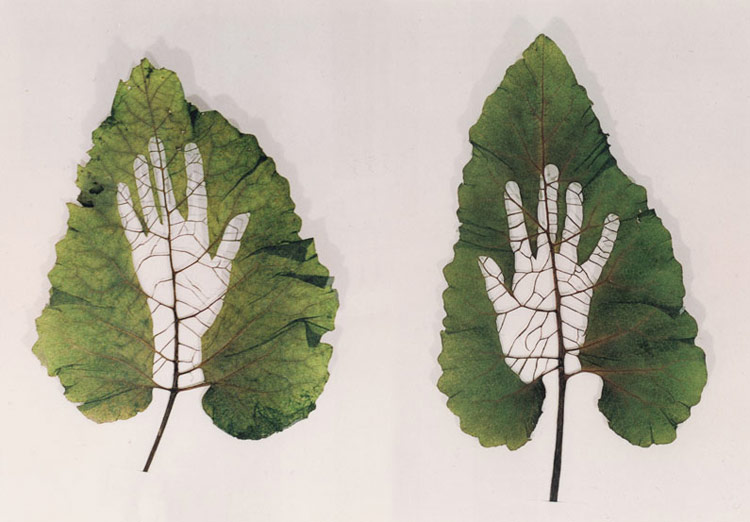
The hands of a storyteller

From http://www.janetpihlblad.com/pages/leafwork_thumbpage.html

“The first sentence of every novel should be: ‘Trust me, this will take time but there is order here, very faint, very human.’  Meander if you want to get to town.”

This is from Michael Ondaatje’s book, In The Skin Of A Lion, which I blogged about here.  When I first read this passage, years ago, I realized this is the kind of fiction I want to write, and this proclamation provides comfort.

There’s a beautiful feeling I sometimes get when I’m reading.  It’s the moment I realize I’m in the hands of a good storyteller.  I’ve had that feeling sometimes reading “great” books, and sometimes reading unpublished student work.  The feeling helps me relax and be along for the journey, and I crave it in everything that I read.  This is not to say that I want what I read to soothe me–on the contrary.  (As the fabulous Joy Williams wrote in her essay “Uncanny the Singing That Comes From Certain Husks,” “Good writing never soothes or comforts.  It is no prescription, neither is it diversionary, although it can and should enchant while it explodes in the reader’s face.”)  But that somewhat unnamable awareness that I’m in good hands as I read is always welcome.  It has to do, maybe, with an amount of confidence (and sincerity) in the writer, because I don’t get that feeling, usually, when I read an overly clever or cynical voice–a narrative stance that, to me, usually feels insincere.  I think the feeling I’m pondering can be called “trust.”  As I notice it, something changes in my body; I relax a little (even if the story is unsettling, exploding in my face) because I understand an agreement the writer is making with me, and I am making with the writer: I trust that she or he will uphold whatever rules and aesthetics the story (or poem) requires, and I trust that the writer’s choices were made in earnest, and with honor behind them.

I want to give that same feeling to my readers.  With my words, I want to craft a net, a web, or a hammock, to catch, or lull them into a place, a moment, a thought.  Myself I want to quiet down to what’s essential, and I want the reader to witness (with me) that silver drop of water on a leaf, or that strange knocking sound that’s just too far off to identify but too close to ignore.

Escape

Hugh Laurie (before “House”) and Stephen Fry

Near the end of the last century, I was traversing a difficult break-up.  It seemed the only thing that got me successfully out of my depths was watching “Law & Order” which aired incessantly (several times a day, but still not frequently enough) on the cable channel A&E.  Those gritty formulaic crimes and solutions, riding on the noble backs of wisecracks from well-worn characters like Lennie Briscoe, helped me survive my dark forest.  For an hour at a time, I was distracted enough to gain the relief called numbness–sometimes needed when real things are too hard to face.

Fast forward thirteen years or so, and I need another escape.  But we canceled cable last year, and now it wouldn’t be the classic L&O but instead one of its million children or grandchildren, the watered down spin-offs.  And I’m sure as beautiful as Mariska Hargitay may be, these pale descendents would not offer the comfort of long-ago Jerry Orbach.

So, to reading.  I’m enforcing a brief “vacation” from work-related reading.  First I picked up Animal Farm, which I  haven’t read since high school, and I love Orwell so want to read it again.  But quickly I surmised that wasn’t the right book.  Instead, on the beloved shelf I discovered a small gem called The Girl In Blue by P.G. Wodehouse.  A student had recommended it to me after a chat when we each admired Wodehouse (on whose birthday, incidentally, I was born).  I bought the book without knowing I wouldn’t have time to read it until now.  I’ve adored the Bertie Wooster stories since I read the first after watching their dramatizations with the unequaled (pre-“House”) Hugh Laurie and Stephen Fry.  But I’d never ventured outside the sunny, funny confines of Wooster and Jeeves.

The Girl In Blue stands alone, that is, it’s the only book he wrote about this set of characters.  But Wodehouse’s hilarious hyperbole rings like a carillon throughout, and will sound to anyone who’s read his other books like the verbal equivalent of tucking into a good silk robe and a mohair chair before the fire, belly full of Anatole’s cooking.  The perfect escape.  A rollicking plot, and many hilarious twists, unfolding in a world blessedly unfamiliar to mine.  But it was impossible to ignore the habit of reading like a writer, and this is good because this time, I found the novel better than escape.  It’s Wodehouse’s prose.

In grandiose trappings, his sentences dance through and around what could easily turn to cliché, but he saves them just before they tumble; his facility with the shades and nuances of English spins what could be a simple fun romp into much finer stuff.  To hell with the high art/low art debate!  To hell with that lofty, sniffing disdain for stories created with the intention of (gasp!) entertainment.  (I’ve never really cared about that fight anyway, but it’s fun to officially cast it off here.)

Could I please just spend a year reading through all of Wodehouse?  Don’t they award grants for stuff like this?  For 2.3 seconds, wild-eyed and laughing, I consider applying for Ph.D. programs, dream of researching a dissertation on the women in Wodehouse, if only so I could immerse myself in the genius of this man’s words.

(Okay, just one more book…)

Now that I have stepped from the safety of Brinkley Court, I will follow Wodehouse anywhere.