You Are My Sunshine (Who is my sunshine?)

“Sing the deer dear song,” my two-and-a-half-year-old daughter said, early this morning.

She has a cold, and wanted me to sing, “You Are My Sunshine” but with the phrase “dear deer” standing in for “Sunshine.”  (More on our familiar variant, “dear deer,” in a moment.)  No doubt she was seeking comfort in the song I used to sing to her when she was smaller.

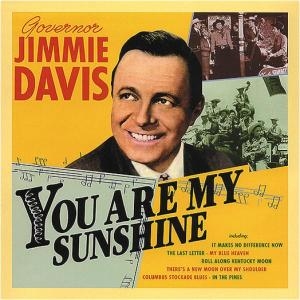
The writing of the song “You are my sunshine” is (questionably?) attributed to Oliver Hood.  But according to family legend, my grandmother’s uncle (does that make him my great-great uncle?) Herman C. Becker actually wrote the song.

Great-great uncle Herman was a composer, creating, allegedly, the words and music for “You Are My Sunshine.”  My great-aunt Evelyn recalled making fun of him as he played the song on the piano, because it was so silly.  Herman sent the manuscript  to a music publisher in Chicago (or possibly New York) and never heard anything back.

Until, hearing the song on the radio, my ancestors learned of the supposed rip-off.

Decades later, I sing the song to my child as she’s going to sleep.  My daughter substitutes beloved friends’ names in place of “Sunshine,” or, created in a sillier moment of wordplay, one which Herman C. Becker might have appreciated, referring to the dead deer carcass on the hiking trail across the street (last autumn’s flattening lump of roadkill that we referred to as “deer body” in a first attempt to explain death to the child) she begs me to sing our private lyrics:

“You are my deer dear, my only deer dear, you make me happy, when skies are grey, you’ll never know deer dear, how much I love you, please don’t take my deer dear away.”

I don’t know if she would spell it “deer dear,” reverse it to “dear deer,” or, in simple repetition, choose “deer deer.”

How many generations have been lulled by this song?  And wooed?  To whom does belong?  Is there a point after which the notion of ownership fades?

No one can deny it’s our song.

Stark Folk Interview (via Laconic Writer)

This is an interview that my husband, Robert Freeman Wexler, did with Brady Burkett of Stark Folk. Check out the interview; check out the band!

Stark Folk Interview It’s time for another installment in the Laconic Writer Central (LWC) sporadic interview series, this time with Brady Burkett of the Stark Folk Band. Stark Folk’s second album Well Oiled came out this month, following the self-title debut from 2008.  Both are available on cd and vinyl from Old3C Records and digitally on iTunes. The band is a collaboration between Burkett and Ryan Shaffer, plus other musicians to fill out the sound. LWC: Let’s sta … Read More

via Laconic Writer

Jason Dryden of Sleepybird

Jason Dryden died too soon.  Too soon because I needed to see him play more music.

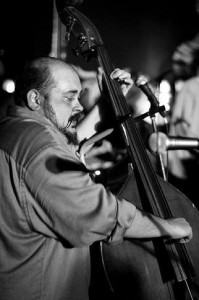
I didn’t know Jason well, but saw him perform often as part of the band Sleepybird. I am lucky to have seen them play as many times as I have.  But I am greedy.  I want more.  Jason on bass and theremin was something brilliant. The alchemy of Sleepybird I have written about before.  Jason was a huge presence, a performer among performers, down to his moustache.  When I first saw Sleepybird (in a friend’s living room) the musicians plucked and plunked and blew and soon, strains of their song, “Butter her up” warmed the air.  I was hooked.

I was lucky enough to see Sleepybird et al in “The Fruit for the Egg” at Stivers in February.  It was amazing.  My husband bid on and won a ceramic piece Jason made, a round white vessel with crackly grey fault lines, and a lid with a primitive white bird as handle.  It’s beautiful and delicate and ancient-looking.

In ways that are so close to my being that they are hard for me to articulate, Sleepybird (performing live, especially) gives me license to write fiction.  The inspiration that comes through them to me, to my inner creator, is tangible every time I hear them.  Something about the substance that they form with their individual selves and instruments, and all encompassed in the music, flows directly into the bloodstream of my creativity.  The inventiveness that I can sometimes muster in my fiction is buoyed by the phenomenon that is Sleepybird.  In particular, that potent energy has been embodied in the way Jason Dryden played the theremin… in the magic of watching his hand dance, ever so slightly, a delicate feather of motion, through the air, and the sounds that motion created.

Although I didn’t know him well enough to glorify him, or demonize him, Jason’s death is really affecting me.  People I know and love were very close to him.  Listening this week to the Sleepybird song, “Already Gone,” I was reminded of the impermanence of everything.  But if anything is important, then everything is important.

Send love to someone.  Do it with words, or clay, or music.  The person who receives your love may not know you, and you may not know them, but do it anyway.  You might do it unwittingly, as perhaps Jason did for me.  The magnitude, though, like the sadness, will last forever.  And even so, is worth it.

Ed Hammell was right

“It’s a land of many paths
There ain’t only one right way
And I will keep on rocking that
Until my dying day–
It’s a land of many paths
There ain’t only one right way
And I will keep on rocking that
Until my dying day…”

–Hammell on Trial, “Gonna Be a Meeting”

Susan Boyle…finally.

I kept hearing about the phenomenon named Susan Boyle. I read articles about her, but only today watched the video of her singing on “Britain’s Got Talent.”

Caveat: Fantine’s song from “Les Miserables” works on me the way that Judy Garland singing “Somewhere Over the Rainbow,” and Tom Waits singing “Somewhere” from “West Side Story” does. That is, just a few notes into the song, nearly every time, I am crying.

So watching Susan Boyle’s rendition was no exception. Something in those songs about the bitterness of still having dreams, despite living in the real-ness of the world. Knowing that dreams are sometimes impossible to achieve, and yet still having hope that some day, some how, somewhere…there’s a place for us.

Watching Simon Cowell watch Susan Boyle sing was almost as interesting as her performance. (I haven’t seen him on TV that I can recall, but I know the snark of reality TV precludes judges from gushing. Still, the look on his face as he watched her sing was sweet.) I have no idea if it was true surprise–I don’t know (and don’t really care) whether he feigned his reaction, and had already seen the contestants perform before broadcast.

Okay, so now I understand all the  frenzy about Susan Boyle. She has a beautiful voice, pouring from an unglamorous body.  I hope she can enjoy her life after all this hoopla.   And I hope that people stop judging others like books, by their clichéd covers.

Woody Guthrie was right

“I hate a song that makes you think that you are not any good.

I hate a song that makes you think that you are just born to lose. Bound to lose. No good to nobody. No good for nothing. Because you are too old or too young or too fat or too slim too ugly or too this or too that. Songs that run you down or poke fun at you on account of your bad luck or hard traveling.

I am out to fight those songs to my very last breath of air and my last drop of blood. I am out to sing songs that will prove to you that this is your world and that if it has hit you pretty hard and knocked you for a dozen loops, no matter what color, what size you are, how you are built, I am out to sing the songs that make you take pride in yourself and in your work.

And the songs that I sing are made up for the most part by all sorts of folks just about like you.”–Woody Guthrie

Burl Ives and Wes Anderson

I saw “Fantastic Mr. Fox” and loved it.  Though many people consider Tennenbaums the holy grail of Wes Anderson-dom, before seeing Fox, I was most fond of “The Life Aquatic.”  (It’s still my favorite.  Too many wonderful moments and quotable lines to be displaced, and Seu Jorge doing David Bowie is unparalleled in the world of adaptations.  And Klaus!  I want to watch it again right now.)

Early in “Fantastic Mr. Fox,” I recognized some music that I hear often these days: Burl Ives singing “Fooba Wooba John.”  What a funny treat!

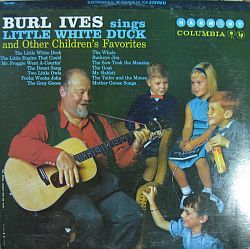
Although the adults at our house recoil at the sound of most music intended for kids, one beloved album is from my husband’s childhood–Burl Ives Sings Little White Duck and Other Children’s Favorites.  It might seem unlikely, but this morning I was actually craving that album.  Ives’ rendition of “The Little Engine That Could” made me a little misty-eyed over breakfast.  I don’t know why.  Maybe the wonder and hope of the two year old next to me, calling it the “sink I can song” or maybe just that I still believe that positive thinking is important.  (“I knew I could I knew I could I knew I could…”)

As usual, Wes Anderson chose perfect music for his latest movie.  There’s an earnest, post-cynical lens in that I love.  I see it in the Zissou saga, as I did in “Fantastic Mr. Fox” and so now I find myself tapping a foot, humming “Buckeye Jim” around the house, and now, in addition to the warmth of Burl Ives’ voice, that tune delivers me Anderson’s glorious sunset orange hues, and lovable, heroic foxes.  And I smile a silly, true smile.

How to get through winter

The leaves are mostly gone from the deciduous trees around our house, many of them stuffed in the gutter. (Have to do something about that.) It’s still sometimes warm enough to hike with only a sweatshirt, but that’s one of the false, temporary good things about climate change.

But the temperature can’t fool me–it’s almost winter.

This morning, my husband put on a CD by Ulaan Kohl, one of the incarnations of Steven R. Smith. (Smith is also responsible for Hala Strana.) Perfect choice. For me, fallintowinter is the season of Dead Can Dance and Hala Strana. I love the introspection and moroseness in this music; it’s so clashingly rich. Along with warm sweaters, extra cocoa, and stout beer, music like this weaves the tapestry I can hang on through winter.

In my house, there’s an imagined scenario. It goes a little something like this: At a family reunion, or holiday party, Lisa Gerrard‘s aged auntie says to her, “Lisa, can’t you write something a little more upbeat? You know, for the kids?” Lisa just looks at her.

These people will also be invited to teach in the department of Interdisciplinary Aesthetics. But only in winter.

Missing the Asylum Street Spankers! DANG!

DANG!

The Asylum Street Spankers usually play in Dayton at the intimate, excellent Canal Street Tavern the night after Thanksgiving. Before I had a baby, my husband and I would generally go see them. But this year they are playing the week before Thanksgiving, which is tomorrow night, and I just found out today, and I probably wouldn’t have been able to go anyway, but DANG! They are such a raucous, good time to see, so DANG, DANG, I say… if you’re in Dayton and want a sure thing, go see them.

I bet that this guy Nathan, who seems to turn up at their Canal Street Tavern shows, will be there. He always gets spanked. It’s a thing. Last time he completely dropped his pants. I think he was kinda drunk.

Tomorrow night, Christina Marrs will say, “Is Nathan here?” and he will be, and I won’t be. DANG!

Sleepybird: a major inspiration

(Watch, she’s writing about music again…)

There’s a really great band in Dayton (yes, it’s true) called Sleepybird. They are hard to categorize, and it’s best to see them live. Here are some things you should know about them:

1) The band includes rock staples like guitar, keyboards, and drums, but also trombone, upright base, and one of the coolest and most magical instruments I have ever encountered, a theramin.
2) While a lot of their songs ruminate upon the sinister, twisted, leftover crumbs of love, there is something (maybe in the music itself) that buoys, so despite the sometimes-cynical lyrics, you can feel the lift, the optimism in the song.
3) The Wigglebird turns up at a lot of their shows. You can sometimes catch plays and videos featuring the Wigglebird, including their collaboration with Zoot Theatre, “The Flight of the Wigglebird.”

A disclaimer: Nick Tertel, front man and songwriter, is a friend of mine. My husband and I first saw Sleepybird play at a mutual friend’s new year’s party. In the living room. There were kids running around, and maybe a dozen adults there to listen, and almost as many people in the band. They started playing, and the sound spun out in tendrils, rich and buttery, so different from anything I had heard before. Later on, we stood around outside by a fire, embers flying in the wind, strangely balmy for the change of the year in Ohio. We talked to Nick and his wife, Donna, and they were nice and cool and soon we were becoming friends.

That night, as 2006 opened into 2007, was a transformation of sorts, helping me step onto a path that I wasn’t sure I would go down. I could not know then that Merida would be born in December of that new year.

Another great moment of watching Sleepybird and Wigglebird…at the Cannery on March 2, 2007.

One thing I love about Sleepybird is how they bloom from within the world of art, interconnected, connecting, so that music and theatre and puppetry and paintings mush over into each other, and soon, the room is ringed with origami cranes, flying down toward you, letting you know that it’s all or all about to be beautiful, and strange, and for me, it warms the inner parts of the human who is watching, and listening.