Dear Inner Critic—Interview by Ariel Gore

sepia tone image of human, on the floor, with papers and material spread out, writing on a notecard.

I am so grateful for Ariel Gore‘s invitation to chat about Dear Inner Critic: a self-doubt activity book and other salient things. Read our interview here. Ariel’s Literary Kitchen (aka School for Wayward Writers) is where Dear Inner Critic was born, so to share the book’s story there warms my heart.

If you are like me, you know in your bones that these times call for much inspiration and fortification! So please do whatever you can to support independent, collective, human-scale publishing, and eschew the monsters of big capitalism!

Head over to the Literary Kitchen’s Underground Book Shelter to purchase fabulous, unique, humanity-expanding books.

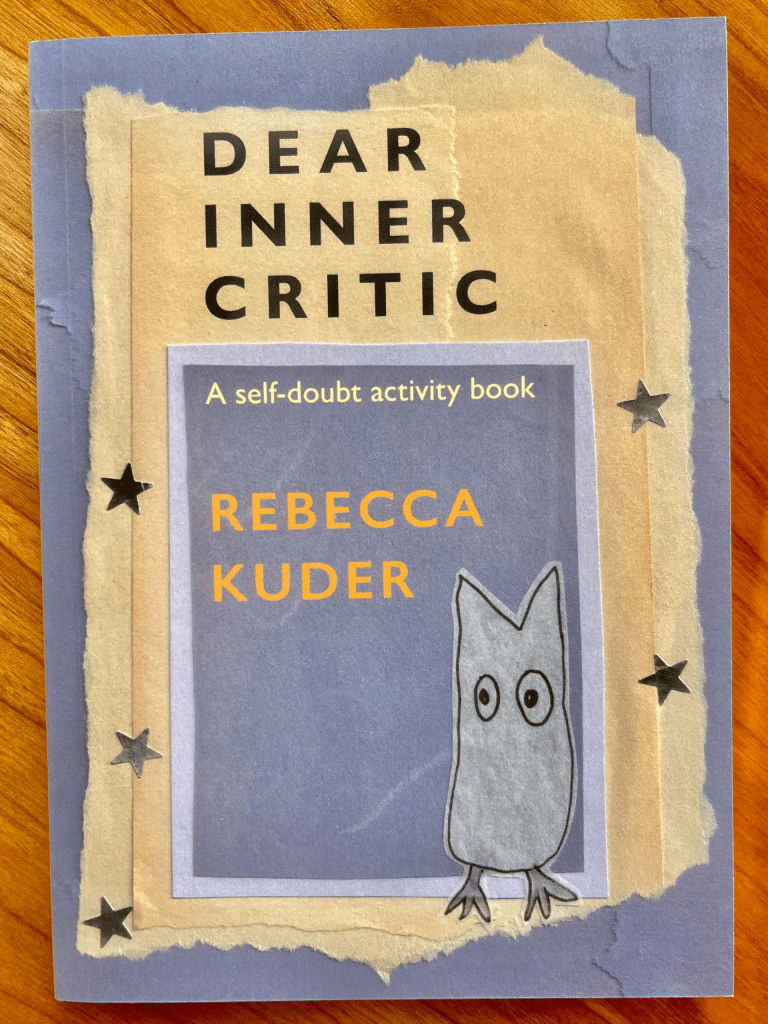
Dear Inner Critic: a self-doubt activity book

Dear Everbody,
Great news!
Dear Inner Critic: a self-doubt activity book is now available!
Read more about why you will want this book.
Learn how to buy online at Literary Kitchen, or visit the independent stores mentioned below.
Love,
Rebecca

NOW AVAILABLE:
at Epic Book Shop or Dark Star Books in Yellow Springs, OH
& at Secret World Books in Highland Park, IL
& Online from Literary Kitchen!
(Subscribe to the BLOG for updates.)

**

You’re invited to play!
Devote 30 days to creative freedom; unlock the long con of confidence; and dissolve self-doubt.

Even if you’ve been living with insecurity all your life, today can be different. This book offers a flashlight to guide you through the wilds of self-doubt. Between these covers you’ll find fun and creative strategies to quiet your negative self-talk.

You’ll write, draw, imagine, demystify—and maybe even befriend—the inner critic. You’ll set boundaries and gain room for creativity and joy. Using ingenuity and self-care, these activities let you play your way toward creative liberation.

**

Praise for DEAR INNER CRITIC: a self-doubt activity book:
“Rebecca Kuder writes magical fiction and memoir with a voice so confident and agile, you’d never imagine she struggled with an inner critic. When I heard that she was not only well acquainted with self-doubt but had found ways to befriend it and play with it to the benefit of her art and happiness, I knew I wanted in on the secrets. This guide is a gift. Let Rebecca Kuder’s genius guide you to ignite your own.”

—Ariel Gore, author of The Wayward Writer (Summon Your Power to Take Back Your Story, Liberate Yourself from Capitalism, and Publish Like A Superstar)

quiet, but things are happening

photo of cup of tea and boots overlooking pond

I’ve been quiet over here, but very busy.

In 2023, I took a fabulous year-long online writing class with Ariel Gore called Mavens of Mythmaking. Some highlights:

  • I completed a short story collection called What To Keep, for which I am seeking a publisher.
  • I finished a full revamp/revision of my novel The Watery Girl. This year, I will seek publication.
  • The memoir about my childhood home continues to emerge and evolve—in fragments and fractals—which, I am learning, is how this thing is meant to be written. Some day it will be a book.

My newest book, Dear Inner Critic: a self-doubt activity book, grew from years of renegotiating my relationship with the inner critic. Many readers have attended workshops and reframed self-doubt with me. Thanks for your good company! (Who knew a handful of tricks would grow into a real book?!)

  • This book is built from L-O-V-E. My keenest hope is that it will help people free the creative urge. (If I have anything to offer humanity, this book is it.)
  • On the journey toward creative liberation, I have trodden this self-doubt path myself. The tricks in this book have changed my life.

Soon, Dear Inner Critic will be available from the Literary Kitchen (literarykitchen.org). Please subscribe to my blog or follow my instagram for more information.

bookmark

Looking for a bookmark last night, I found an index card with a quote on it, from Michael Ondaatje’s In The Skin of a Lion, which is one of my favorite novels of all times.:


“The first sentence of every novel should be: ‘Trust me, this will take time but there is order here, very faint, very human.’ Meander if you want to get to town.”

Despite how elusive achieving “order” feels to me (and despite how much I prefer to just write lyrical ephemera), I want to be able to provide reassurance, order that is at least “very faint, very human” and I want the reader to trust the storyteller/narrator.

I want to learn how. I’m eager to learn how, as hard as it is and as much as (why?) it terrifies me.

“a shareable heat” (Alexis Pauline Gumbs interviewed by Ariel Gore)

I’m savoring the latest from Ariel Gore: her school-in-a-book called The Wayward Writer: Summon Your Power to Take Back Your Story, Liberate Yourself from Capitalism, and Publish Like a Superstar.

I’ll post about this book and what it helps manifest at intervals. Here’s a sliver of wisdom and heat for today.

On p. 31, Ariel Gore is interviewing Audre Lorde biographer Alexis Pauline Gumbs.

Ariel Gore: “What else should aspiring lit stars know about their lit star life?”

Alexis Pauine Gumbs: “Audre Lorde wrote a poem for her children where she said: 

‘Remember our sun

is not the most noteworthy star

only nearest.’

As ‘lit stars’ it matters where we are, it matters who we impact. It is not so much about our brilliance, or being the brightest and out shining other stars. It is about being close. Close to a shareable heat. It is about whether or not our communities can utilize the solar power in our writing to grow something that nourishes them for real.”

***

(I adore this notion of shareable heat. Here’s some shareable heat in sonic form, manifested by Damon Locks/Black Monument Ensemble, which you can enjoy here.)

rumination about writing (& revising) essays, before/during a pandemic

Below is some process-related rumination about an essay I wrote, which details an experience from 2018. (The “her” mentioned below is a person I met and subsequently wrote about.) In late 2020, the essay was accepted for publication, and was published in summer 2021. It’s hard to imagine that it was just over 2 years between the event and the acceptance, because of how different everything became. Looking at the essay again—mid-pandemic—brought up thoughts about how weird a gig it is, to write essays. I still feel like a novice, because the essay was my second form, after fiction. I didn’t study what it is to be an essayist (whatever that means) and the requisite sharing/exposing of self without the veil of fiction (even with a sculpted persona at the helm). I find it interesting to ponder/obsess about the intricacies involved. Thought this bit might be worth sharing.

Written on November 21, 2020 (from morning pages)
I started looking at the essay and wow, it’s kind of badly overwritten. It’s sort of cringey! I mean I need to pare down some of the language. I’ve gone really far in making it way too articulate or maybe it’s skirting clever. I don’t like the voice somehow. It’s weird that I am having such a strong reaction to it. I just need to make it good enough & send it back but it’s really hard. I would revise the whole thing (and maybe I will). Maybe it could be that it just feels self-indulgent because it’s pre-COVID, maybe I just need to let it be pre-COVID and not sweat it. It just sounds really full of myself, or something. I think I need to talk to MT about it. It will be helpful to sort it out. I guess I should have looked it over before I sent it. I’ll see if I can just simplify the sentences. Part of it is that with an essay, I captured & canned the feelings and specifics at the time, and I really would write it differently now, I think—? Maybe I can find a way through it without being weirded out by the finished product. Anyway, we’ll see. I wish I had learned her name, or something—I wasn’t really even processing it all, when I met them, how big a deal their story would be. And I don’t want to sensationalize their story, like make it into “disaster porn” or appropriate it. Anyway I’ll just look at the sentences & try to make it better. What’s weird, of course, is that the (name of magazine) will publish it, so in that way, I’ll be exposing the younger me as narrator—it just feels weird. Maybe it’s just the problem of an old essay. Maybe I should put the lens I have now on it, if that doesn’t throw things off. I feel like it needs a date stamp or something. I wonder if that’s relevant. I mean do I need to make clear that it’s pre-COVID-19? I’ll see what I can make of it so it’s still relevant. Or at least so I can stand the sentences & the voice. Such a weird-ass gig. I’m glad the editor accepted it & I will do my best. I know there’s something real in it, and maybe I will work The Body Keeps The Score back into it. I’ll see if that paragraph will work again—I liked having it in there. For one thing it shows a bit about how trauma works, and I think that’s useful. God, this is hard. I mean the decisions & lenses and all that. Having experienced whatever we have experienced, then the work of sorting it, making sense or at least a little bit of order, or observations about it. It’s actually fairly scientific. I don’t know if others think of it that way,  but it makes sense to me. I mean to think of scientific inquiry.