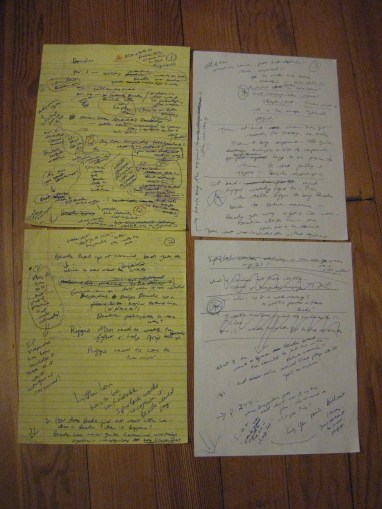
The life-changing magic of tidying up (a manuscript):
- Hold in your hand any paragraph, page, or chapter that no longer serves.
- Thank it for its service.
- Cut and paste it into a fragments file (because you never know).
- Move on with the story.
The life-changing magic of tidying up (a manuscript):

My husband Robert printed out the beginning of his novel for me to read. I printed the end of my novel for him to read. Loving this man, this work, this symmetry…

I asked the students in my creative writing class at Antioch College to try this. Because it was a good exercise for me as a writer to type up the sentences of these writers, I am posting it here.
**
Read Colson Whitehead’s “The Port Authority” and/or the fragment from Joan Didion’s “The White Album” (section 12, pp 44-45) again. Find a spot from which you want to take inspiration, and write for 10 minutes (or longer). This is a rather open-ended option.
OR, for a tighter frame:
Use one of these fragments below—You might even choose one sentence, or one image. Read it aloud, and then write for 10 minutes (or longer).
*
“It is the biggest hiding place in the world. The inevitable runaways. The abandoned, only recently reading between the lines. After the beauty contest this is the natural next step. All the big agencies are there. He saved his tips all summer and to see them disappear into a ticket quickened his heart. Not the first in the family to make the attempt. The suitcase is the same one his father used decades before. This time it will be different. The highway twists. She will be witty and stylish there. With any luck he will be at the same address and won’t it be quite a shock when he opens the door but after all he said if you’re in town. Hope and wish. In the light of the bonfire she realized the madness of that place and was packed by morning. They will send back money when they get settled, whatever they can. A percentage. Reliving each good-bye. Practicing the erasure of her accent, she watches her jaw’s reflection in the window. Wily vowels escape. No one will know the nickname that makes him mad. This is the right decision, they tell themselves. And then there is you.”
—Colson Whitehead, from “The Port Authority”
“During the years when I found it necessary to revise the circuitry of my mind I discovered that I was not longer interested in whether the woman on the ledge outside the window on the sixteenth floor jumped or did not jump, or in why. I was interested only in the picture of her in my mind: her hair incandescent in the floodlights, her bare toes curled inward on the stone ledge.”
—Joan Didion, from “The White Album”
*
“I believe this to be an authentically senseless chain of correspondences, but in the jingle-jangle morning of that summer it made as much sense as anything else did.”
—Joan Didion, from “The White Album”
*
“There is a crack in everything. That’s how the light gets in.”
—Leonard Cohen, “Anthem”
Here’s a statement I wrote last week for a grant application. I’m new-ish to personal essay, so it feels weird to proclaim anything about it (because I keep learning what it is!) but this piece describes some of my process and reasons for writing personal essay, so I thought it was worth posting here. It’s slightly edited toward blogginess. Cheers!
***
My essays grow from lived experiences (transitions and grief), but I wait to write them until I find a way to transcend my life and connect to something larger, something that might resonate for readers. Writing stories about life can be very therapeutic, but must stretch beyond the writer’s singular experience and have meaning to others.
In my experience, the process of writing personal essay is murky and chaotic. Sometimes I use the metaphor of an onion, as layer after layer I peel away to reveal what I really mean, to move toward something that feels true. (Some layers are just rotten, bound for the compost heap.) From there, I discover a shape, rendering that central image or idea in the stuff of lyrical essay. As I craft each essay, draft after draft, I interrogate myself repeatedly about what is relevant. When a story involves others, I ask myself which parts are mine to tell. I am careful in what I include, and what I protect. Writing personal essay means navigating these boundaries. Writing from life demands constant vigilance and integrity, lest the exercise and the writing itself collapse into mere therapy, or worse, narcissism.
With these essays, I intend to connect to others. Beyond that, I am interested in language, how to refine until even the vowel sounds help the reader feel what I mean to impart. It is life affirming when a reader tells me that something I wrote moved them, and it is satisfying as a creator when someone compliments the way I tell a story. It is these twin aims (reaching others, and artful storytelling) that keep me writing personal essay.
Specifically, in “The Bit Jar,” I wasn’t sure I was going to write about this topic for the public, but I felt called to encourage others who might be going through trauma. When the opening scene presented itself, I realized it could be the right frame to approach the material.
Sometimes finding a tight container is the way in.
In a similar way, “Love Letter (an avalanche)” arose when I sat and listened to a poetry reading. First I thought, “I have to write my ex a letter.” As the event continued, I thought, “Maybe this is a blog post.” Then finally I thought, “Maybe this is an essay.” The work-in-progress (“Hot Thing”) emerged because I wanted to capture in prose what it felt like to have a hot flash. The first draft began as a list, and eventually I kept the list form, steeping the essay in rumination about the tension between the facts and how it felt to me.
(Not much!)
But in reflecting on some of the work of my students, I wrote this in a narrative evaluation about gaining a deeper understanding of what it is to write and be a writer. I thought it was worth posting here:
It’s crucial to realize that if a piece of writing doesn’t come out perfect (and rarely does it come out perfect), it can always be improved. Knowing this (and living it) is much more important than any sort of inherent talent or inspiration. Doing the work is really the only thing a writer can control.
 To have written, to have made order from chaos: to have written about messy life stuff that defaced three pages of legal pad, scratched, abbreviated, rounding corners, lines written above below obscuring other lines, arrows pointing everywhere but straight forward. To have made some sense of that snarl, of that juice. To have expressed my self.
To say: today I am a writer.
 Rebecca Kuder