My beautiful, brilliant friend Elaine Gale wrote this article for the Sacramento Bee about where some of their local coffee comes from…and the labor involved…here’s a sip:
Chaves wants consumers to know that every bean you drink comes from a timeline equivalent to the birth of a child: nine months from blooming to picking.
I am so glad to have a great local roasting company, Brother Bear’s Coffee, in Yellow Springs. Otherwise I would have to move out to Sacramento and shack up with Elaine, which, come to think of it, might be kind of fun.
As I consider Barack Obama’s book, Dreams from My Father, which we are discussing in a class I’m teaching at Antioch University McGregor, a couple overarching things tug at me. I am going to try to leave current politics, approval ratings, and Nobel peace prizes out of this.
The first thing: Throughout, Obama writes with such candor. Having been elected president four years after the 2004 edition was published, I find it fascinating to read his thoughtful and (I assume) unvarnished critique of the power centers, and the role of president and government. The type of openness Obama presents in these pages is blankly missing in the speech and rhetoric of so many politicians. When he first wrote this book, before 1995, he couldn’t have dreamed how his life would unfold. Something in that is refreshing.
The second thing: There is a poet in the White House. In some ways, Obama seems like a frustrated poet, but so much of his writing is pure poetry, too much to note here. One that sticks out: the end of the passage on p. 315, talking about a waiter in Kenya:
“And so he straddles two worlds, uncertain in each, always off balance, playing whichever game staves off the bottomless poverty, careful to let his anger vent itself only on those in the same condition.
A voice says to him yes, changes have come, the old ways lie broken, and you must find a way as fast as you can to feed your belly and stop the white man from laughing at you.
A voice says no, you will sooner burn the earth to the ground.”
The flow, and construction, to me, it’s simply poetry.
I keep thinking back to a speech I saw on C-SPAN when Obama was first running for president, where he talked about the importance of various subjects in school… “And poetry,” he added. At that moment, my husband (who is also a writer) and I agreed, “He’ll never get elected.” And yet…
In this book, his poetry is in his words, and his focus, the corners where he chooses to shine a light. So often, the book reads like a novel. So I keep thinking: what are the implications for us creative people, many of whom have spent careers feeling marginalized and invisible, to have someone who understands doing the job of the president?
As a writing nerd who uses my (large) collection of fountain pens, I recommend that others who want to write try using good equipment. I know some people don’t use the the “good” china, but keep it for special occasions. But I ask: What are you saving it for? Enjoy life now. For me, using good pens and notebooks makes the tactile experience of what I do so much more lovely. It’s like a treat, even when it’s drudgery.
A (possibly superficial) parallel might be: practice dressing for the job you WANT, if it’s not the job you have. When I use my great fountain pens, I feel more like a writer.
I know plenty of writers for whom the instruments are not that precious–and some who actively use more pedestrian tools on purpose, so they feel okay making bad first draft. Everyone is different. Good.
Several years ago, my friend Nancy Jane Moore recommended a book that I keep coming back to. It’s called Necessary Dreams, by Anna Fels. The subtitle is “Ambition in Women’s Changing Lives” but less than ambition, what keeps recurring in my thoughts is our need for recognition. After I read the book, I was fired up, and decided to ask my boss for a raise. I worked in an all-male department, and while there was no duplication in job descriptions, I sensed that I was the lowest paid (which was probably not because I was a woman, but the idea was in my head). My boss was supportive, and the organization was not in the red, so I got a raise. Not as much as I asked for, but generous even so. It was very validating.
I often recommend Necessary Dreams to women who are grappling with what they want to do with their lives, or having mixed feelings about doing the work of raising children or taking care of life at home–a job that is often invisible, and certainly undervalued in larger society. It’s such important work, but if a person is a good parent (and not a bad one) it often goes unrecognized.
While I have lots of support from my immediate people, I have been yearning for broader recognition, both as a new parent and a writer. So maybe it is ambition, or “sheer egotism” (as Orwell said in his essay, “Why I Write”) that makes me want to finish my birth story and get it published.
Anyway, for anyone interested in these issues, I recommend Necessary Dreams. If you read it, let me know what you think.
As a writer, the story of my baby’s birth is the hardest thing I’ve ever written. The fact of the birth is alive; any any words I can arrange to convey what happened, inside my heart, soul, body, inside the room where Merida was born, inside my family, are limbless, lifeless. What I write should be as perfect and amazing as what happened. (Impossible.) What I write will never match the experience. The space between facts and feelings and any paltry words I can summon to convey them is too huge, so as someone who is a dedicated recorder of things into words, I am in worse shape than a non-writer. The words to tell my story become too precious, have too much weight, so it’s difficult to write them. They come out too detached, like clinical records, too tame and devoid of color: how can any sentence convey, capture, hold my experience? Many writers face this with life events and experiences. But every sentence I write tastes like weak tea. It only makes you have to pee. No flavor, no lift. This feels impossible to write.
Horace Mann, education reformer and founder of Antioch College, admonished the graduates in 1859, “Be ashamed to die until you have won some victory for humanity.” This banner sometimes feels like an unattainable burden, and becomes a curse. As a 41-year-old first time mother, within the current medical climate, being able to have my breech birth naturally felt like a victory of which Mann might be proud. And yet, women’s bodies are made to birth babies, even breech babies. So the paradox: my story should not be so unusual.
And I keep working on the draft of the story of her birth…
Although I used to work in information technology, I am ambivalent about the virtues of computer technology. Including blogs. But back before Facebook and Twitter and all that noise was born, the buzz was that in order to exist, one must have some sort of “web presence.” So I decided to buy the domain http://www.rebeccakuder.com, assuming some day I would need it. I created a website, really like an extended business card for myself as a writer. I also had a blog accessible from that website, and I decided against doing a purely personal weblog, but instead chose a somewhat rigid form: short nonfiction essays, exercises really, each inspired by something I had seen. Each with its accompanying image. I thought I would post something most days, but as a writer who is pretty concerned with well made sentences, my output wasn’t as bloggy as that of so many bloggers. (If you want to peruse those archives, they have been moved to the blog you are currently reading.)
My blogging was too precious, then, because I wanted time to reflect, time to draft and ponder before posting. My goal for each post, at that time, was to have a polished piece, so these little ruminations could accumulate into a published soapbox. As if each post would be something I might theoretically send to a magazine for publication. Or some day, collect into a book.
As part of an online class I’m teaching, we read George Orwell’s excellent essay, “Why I Write.” One of the reasons Orwell lists in the essay about why he writes is political purpose. He talks about how he was motivated to write, often, by something that angered him.
These days, writing out of anger is everywhere. It’s free and simple: just set up a blog and start yelling. And the glut of ME!-ME!-memoirs that continue to be published between portable covers speaks to the fact that there is an audience for certain types of yelling. But I’ve always thought that it’s important (at least to me) to let the anger simmer for a while. Sort it out. Go to therapy if you need to. Gain distance from the irritant. To extend that metaphor, let the pearl develop. While I like the immediacy of the technology, I want to see more pearls out in the blogosphere.
The line between public and private has disappeared. In fact, sometimes it seems like the membrane that existed between public and private has been turned inside out. I don’t want to hear others’ cell phone conversations in the public restroom, but I do, all the time. To paraphrase a friend who was ranting about the inanity of Facebook status updates, while I hope people eat good, interesting food, I don’t really give a rat’s arse what even my closest friends and family had for breakfast. (No offense.) But why do people think that the world cares about what they had for breakfast, unless it was something truly remarkable, like a freshly killed sparrow? I have enough email and things to do in the day, as I’m sure you do, too. Why would I want to wade through all that? I’ve thought about closing my Facebook account, because it’s so annoying (and yet embarrassingly addictive) but I like that I can occasionally find lost people, so I’ll keep it for now.
And if you’re reading this now, I guess my question, to blog or not to blog, has been answered.
“The Adventures of Buckaroo Banzai across the 8th Dimension” is near the pinnacle on my list of my top favorite movies, ever, of all time. It’s got everything a girl could dream of: brain surgery, aliens, a cornet solo, an unexplained watermelon, Rasta aliens carrying bubble-wrap glasses to view their leaders’ video-letters, a kid named Scooter who outsmarts the Secretary of Defense, John Bigboote… I could go on.
Those of you who know, know.
But for those of you who don’t know: In the film, Buckaroo Banzai and his band, the Hong Kong Cavaliers, are also stars of a very popular comic book. Early in the movie, Buckaroo and one of his entourage, a hot 80s blonde guy named “Perfect Tommy,” are walking down a cellblock, looking for “Penny Priddy” (played by Ellen Barkin) to bail her out. Someone from another cell reaches toward Perfect Tommy, he dodges the hand, and you hear a female prisoner’s voice say, “Oh my Gawwwwd, Perfect Tommy!”
There’s no room for doubting this world; we just accept that everyone knows who Perfect Tommy is. Of course we hear a woman calling after his tall, handsome, bleach-blonde self as he walks down the hall, because she’s probably just read the latest comic. We trust that someday, “Reno” will tell us later about that mysterious watermelon in the lab.
Meanwhile, NEW JERSEY and RENO NEVADA are searching another lab. They pass
racks of equipment, including a large watermelon clamped into some sort of
apparatus.
NEW JERSEY:
Why is there a watermelon there?
RENO NEVADA:
I’ll tell you later.
My husband and I refer to this phenomenon as “The Buckaroo Banzai Principle.” When a work of fiction is so confident in itself that the reader just enters the world and goes with it. I aim for that in my work, and hope, someday, to achieve it.
(Recently, one of my students informed me of something, so I should probably stop waiting for the sequel, billed at the end of this film thusly:
(Quoting Tom Waits before coffee is always good. I could do it in my sleep. Sometimes I dream about Tom Waits; it’s always some sort of message about myself as an artist. But that’s not what I was going to write about.)
I’m teaching this academic writing and discourse class at Antioch University McGregor and yesterday was the in-person kickoff. It’s filled with an amazing, inspiring group of students from several disciplines and programs, but the beauty was in how they found common ground, talking about an address given by Paulo Freire. The address was called, “The Importance of the Act of Reading.” (It’s great, you should read it.)
After the first part of the session, where I’d done a little spiel about Lynda Barry and my academic writing demons, this student asked me, “Rebecca, are you actually Tina Fey?”
I don’t know what prompted the woman’s question, was it because I was being amusing and silly? Was it my eyeglasses? My purple silk disco shirt? Or because I look like Tina Fey? (Do I?) Or maybe because I come across as anxious and neurotic? (Am I?) Whatever the reason, I will take it as a compliment. Tina Fey cracks me up; I think she’s pretty brilliant, though some episodes of “30 Rock” seem to be a bit like the creators are playing with their food, but I will forgive that. Everyone needs to play with their food sometime. And by the way, I wouldn’t mind Tina Fey’s salary.
But I said, “No, I’m Sarah Palin.”
I thought it was a funny and somewhat sophisticated comeback, which I’m not usually known for, but the student just looked at me. Which proves it: I am not Tina Fey. Tina Fey would have gotten a laugh.
My favorite place to write is Emporium Wines/Underdog Cafe, at 233 Xenia Avenue in Yellow Springs, Ohio. My friend Kurt owns the place, and it’s really the heart of our little hometown. There you will always find coffee and muffins and wine and art and music. It’s like the place in the song from Christopher Guest’s Mighty Wind, “Eat At Joe’s” but it’s real.
I love it here. I write here; I blog and procrastinate here. If you are in the neighborhood, stop by. Be nice to the people here. They are wonderful.
As my colleague, Susanne, and I were designing a class on academic writing and discourse for graduate students at Antioch University McGregor, we had some great conversations about writing. I am new to this faculty job, and while I’ve been around academic writing as a writer and teacher in various contexts, I have a lot of anxiety and baggage about it. Talking with Susanne about where our perspectives (hers as a social scientist and mine as a creative writer) have common ground and where they diverge, I started to think about my anxiety in terms of Lynda Barry’s excellent book, One! Hundred! Demons! I began to refer to my baggage as demons. And since we’ve asked the students to share personal reflections throughout this course, I thought I’d share some of mine.
(This is a photo of Lynda Barry, working on a demon.)
(I know the word “demons” has heavy connotations, so I want to acknowledge that right away, and make clear that I’m taking the word not from a Judeo-Christian context, but from the rather jovial or at least somewhat irreverent context of Barry’s work, which she began after reading about a traditional Japanese painting exercise.)
Writing used to be fun!
When I was a child, my creativity flourished at school and at home. Dr. Seuss was a major inspiration in my work at school. We had little stapled story books that we made, with drawings of characters and sayings, or lines, many could have been Dr. Seuss castoffs, such as “the Fog sat on the Log and saw a Frog.” In this picture, there would be a fog sitting on a log, with a frog hopping by. Sometimes the fog would say “Hi frog” and the frog would say “Hi fog” and things like that. I was attending the Antioch School (an experimental elementary school that began as part of the education department at Antioch College). When I was there, it was called the Antioch Free School. I remember another assignment when I was a little older. We went outside with paper and pencils and we were told to imagine being at our own funerals, in the casket, observing who was there and what they were saying. (This was in the early 1970s.) I went to the Antioch Free School until I was nine years old. At home, my parents encouraged me to tell stories. I made up a story about a girl and her pet mouse, and my father mimeographed it and we sold copies at the local sidewalk sale. The book was called The Hole in the Shirt. So clearly, I was encouraged to do this writing stuff.
In middle school, my teacher, Ms. Mapes, played classical music on a tape recorder while we wrote stories. I wrote something inspired by the movie “Fantasia.” We had to keep a journal. The rules where that we could write whatever we wanted to, but we had to turn it in occasionally, and it would not be graded. In retrospect, I realize that she was trying to get us writing, and to make sure we actually did it. I enjoyed this a lot.
In high school, I took a writing class. The first part of the year was creative writing, and the second focused on “modern trends in literature.” We had to write PAPERS! This was not as fun as writing stories. The way we were taught to write papers was:
1. Decide on thesis.
2. Write an outline.
3. Write paragraphs following the order of the outline, to support the thesis, and so on.
Much later, I realized this was the wrong way to write anything. It was like making a cake from the icing inward.
Because I was “a good writer,” I survived writing papers in college, but I didn’t enjoy the backwards process that seemed to be the way people expected you to write papers. Then came the Malvolio paper.
I was a theatre major. During my last term at college, I was directing my senior project, a fully staged production of “Strange Snow” by Stephen Metcalf. I was also taking a very challenging seminar on Shakespeare’s “Twelfth Night,” for which I was writing a paper on Malvolio. To complicate things further, in the school’s production of Twelfth Night, my seminar instructor was playing the part of Malvolio.
So not only was I making the cake from the icing inward, I was baking it in the shape of the person who currently inhabited the cake.
I didn’t spend as much time as I should have on that paper. My focus was on the play I was directing, the culmination of my four years at college. Subsequently, I was awarded a C on my Malvolio paper, which was a pretty low grade for me.
Fast-forward now, twelve years into the future. I began graduate school in creative writing. I was not a literature major in college, so I hadn’t written as many ACADEMIC papers as others, plus I felt, compared to the literature majors, I wasn’t WELL READ enough. (This also added to my general intimidation in graduate school: others, especially the students who had majored in LITERATURE, seemed to know how to discuss books ACADEMICALLY much better than I did. I was just a lowly writer, after all, thinking about things like craft. I brought truckloads of baggage about this.)
As part of my MFA program, we had to write a thirty page critical paper about an aspect that was important to us as writers. We were free to chose our topics. Because I was writing a novel with a child protagonist, but intended for adult readers, I chose to write about Henry James’ novel, What Maisie Knew. It had been twelve years since the Malvolio paper. Approaching Maisie, I had certainly never been this invested in an academic paper before. I was finally feeling that I could write my creative work with more ease, though it has never been easy per se. But the idea of a critical paper (something that had to be “SCHOLARLY,” whatever that means) was supremely unnerving.
Research and reading was okay. I took plenty of notes, used index cards, notebooks, made sure to write my initials in the margin of my notes when I was recording one of my own thoughts or questions. I opened a word processing file and formatted my paper before beginning to write; I procrastinated productively. I finally had to brainwash myself and stop calling it a (capital “C” “P”) “Critical Paper.” I started calling it an “exercise.” This helped, sort of. I even wrote “work on exercise” in my datebook. I bought a set of Legos to play with as I worked on the paper. I rolled a big length of butcher paper on the table and, with colored markers, began mapping the connections, themes, and ideas that I wanted to thread together. I took over the kitchen table. I bought treats. Of particular help was a jar of Nutella. I did not keep the jar at the table, but in the cabinet. When I got up to stretch, which was frequently, I ate a spoonful of Nutella as a reward. The nutty chocolate goodness seemed to help. Candied ginger was a motivating treat, too.
Like many people, once I began the actual writing, it went pretty quickly. (And I didn’t have a deadline chasing me; it wasn’t an all-night writing session or anything.) I realized that, with academic writing, I need to ruminate awhile, and then I can write. The draft was okay. My mentor sent back loads of good suggestions and questions, which helped me to tighten, clarify, and say what I actually meant. I survived writing the Maisie paper, and the process, though at times painful, was very empowering.
Through all this, I learned and keep learning and thinking about a couple things:
o How to decrease the tendency of academic writing to kill the FUN in writing.
o The erroneous and IMMOBILIZING idea of having to know the answers BEFORE you start writing.
And I realized that it’s okay, even as a teacher, to admit that I still have a lot of anxiety approaching this kind of work.
I am still biased against dead, dry academic “scholarly” writing. As a writer and reader, I enjoy and value creative, freer writing much more than “academic” writing. But I have come to believe that writers don’t have to exile their creative and authentic selves from academic writing. In fact, it seems to me the most beautiful writing (in any genre or field) is lead by the human writing it, no matter the audience, subject, or genre.
I do tend to prefer “academic” writing, or any writing, when it is clear and un-jargoned. This does not mean it has to be overly simple. But I prefer writing that includes rather than excludes me, writing that doesn’t require me to know a secret set of words. Or if it does, writing that gives me enough context and friendly help to lead me inside the story of the prose.
All writing comes down to practice. Writers practice observing and thinking, practice translating thoughts and observations into words, practice editing, strengthen sentences and rebuild structures: no matter what you’re writing, these are some common elements. I want to believe that the creative practice can inform and sustain the practice of academic writing. If reading and writing is a car, yes, some parts of myself need to sit in the front and drive when I’m doing some types of reading and writing, but I want to bring the other parts of myself along for the ride.
I love sentences when they are “good.” To me, a “good” sentence usually has something to do with ECONOMY and GRACE. I love it when I begin reading something and realize that I’m in the hands of a good storyteller. When that happens, something inside my soul exhales and I relax and ease into the story, no matter what story it is…
It seems to me that, particularly with graduate level work, we should write on things about which we are passionate. Things that interest us in a deep way, keep us awake at night. Something we need to know more about. Otherwise, why bother? Academic writing might not be comfortable, but it might as well be enjoyable, ideally for the reader as well as the writer.
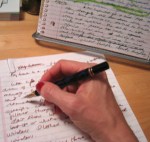 As a writing nerd who uses my (large) collection of fountain pens, I recommend that others who want to write try using good equipment. I know some people don’t use the the “good” china, but keep it for special occasions. But I ask: What are you saving it for? Enjoy life now. For me, using good pens and notebooks makes the tactile experience of what I do so much more lovely. It’s like a treat, even when it’s drudgery.
 Rebecca Kuder