Magic (might be) where you find it


I have been ruminating about Lynnell Edwards’ question on the Red Hen Press blog, and wanted to post my thoughts here.

I don’t have a policy on vampires. I have read beautiful, strong, amazing prose in a variety of genres, including “literary realism.” I haven’t read Twilight or Harry Potter, but I have read Lord of the Rings. And though I don’t want to compare a television show to a novel, I do love “Buffy,” because the writing is excellent, the characters rich and complicated, and the issues they deal with (ethical, moral, metaphysical) are important and paradoxically what I would consider “real.” These are some of the same characteristics I would look for in a good novel or story.

Different genres have different sets of expectations from the readers, and publishers. It can be hard to run a workshop or a class with a mix of genres–if only because other writers, leaders or teachers aren’t necessarily familiar with all genres. That can make things tricky, especially when students are just learning how to operate within a workshop setting.

One problem is that writing students (and readers in general) may be reacting to having been fed more visual media or media tie-in books than original books within the fantasy and science fiction genres. But as small children, most of us read plenty of fantastical things. Dr. Seuss, Harold and the Purple Crayon are a couple things that come to mind. It makes me sad that so many adult readers lose access to what is magical in literature by way of shedding childhood and heading into the “real world.”

Ursula LeGuin has some interesting things to say about the genre silos, and the “literary” biases against fantasy. If this problem interests you, check out her essay collection, Cheek By Jowl. I find a lot of bias in academe against work that is other than literary realism. Magical realism is acceptable, usually, and a few other lucky or pushy writers who have slipped with their novels into the list of acceptable, despite the fact that they write science fiction. I am thinking of Margaret Atwood. She has protested long and loudly enough to have convinced many readers (who might disdain other works of “science fiction”) that she’s not writing it. If something can be translated or packaged as allegorical, it “transcends” the genre. (Even the word “transcend” bothers me here.)

Overall, I don’t care where my students aim to publish their work. If it’s good, it’s good. I strive to help students learn about what I think makes fiction work, what makes it strong, what might make it transcend whichever box it ends up being placed in by a publisher.

Or, to quote Shakespeare’s Juliet:
“What’s in a name? that which we call a rose/By any other name would smell as sweet…”

And: There’s a Library of America collection of Philip K. Dick’s novels. So I guess he is another who slipped through the cracks.
On making a mess


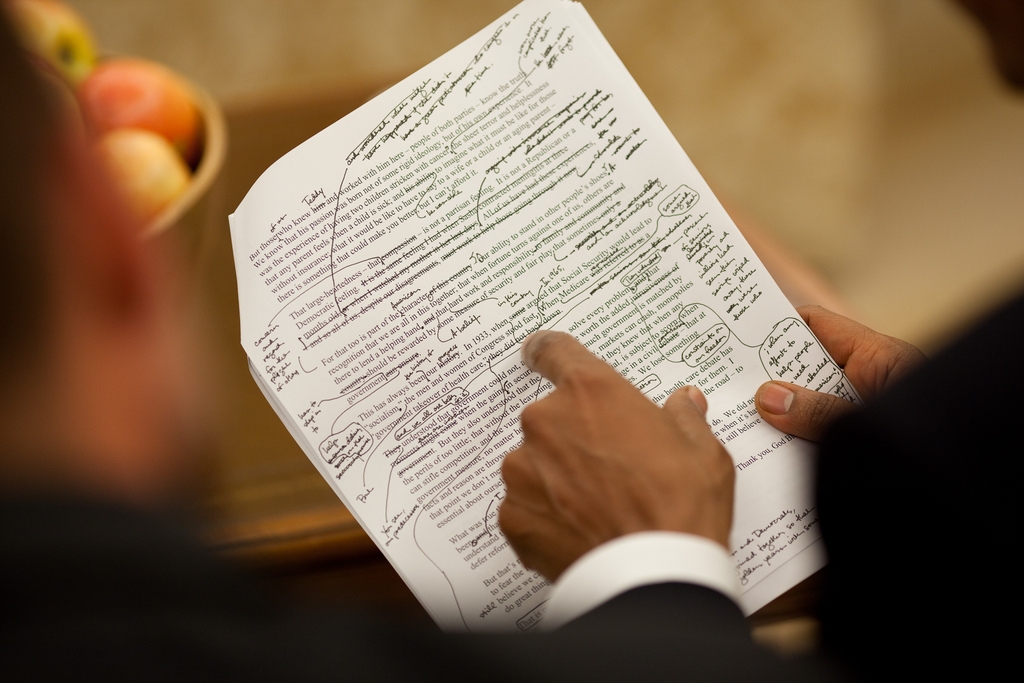
I saw this photo of Obama’s speech and was inspired.

The following is from Writing Your Dissertation in Fifteen Minutes a Day, pages 33-34:

“How does one really begin to write? William G. Perry Jr. has described the process succinctly: ‘First you have to make a mess, then you clean it up.’ If you think about the implications of this statement, you quickly realize that how you write is up for grabs: no more neat outlines with Roman numerals to follow, no elegant topic sentences for each paragraph, maybe not even any clear sense of where you’re going.”

I use that idea when I teach writing courses. I believe it applies any type of writing. Once people accept the premise, it frees the writer to do what is needed. To write something.

Clearly Obama knows this. I’m glad to know that someone still uses a pen. And that the person “running the country” cares about what he says enough to make a mess.

The Interweb (a poem)

The Interweb
is like a big, bright store
that I enter to buy just a couple things, like
the pizza delivery number, or
the definition to a word
but I can’t find the right aisle
and other carts keep bumping into my cart
and my cart bumps into other carts
and all the carts are singing arias
in various strange languages

which are very interesting, in a way,

and I keep getting distracted by aisles that are full of things like
an AP headline
or virtual bubble-wrap

and then

I look at my watch:
I don’t even wear a watch but
an hour has passed,
an hour

which I will never regain,
even if I keep the tags on
and don’t lose the receipt.

On not being a poet

Writers of all forms say they feel not simply drawn, but called to write.  But when I was in grad school, I noticed something about the poets.  Many seemed more mystically attached to what they did than the writers of prose.  Those poets were not pretentious, but watching them, I got the feeling there was something purer, maybe gnostic, about the practice of poetry.  Could poetry be a more athletic practice than prose, if only in the necessary distillation and economy of words?  (I don’t mean to make too many generalizations about forms and writers: there are certain novelists who are or might as well be poets, or whose prose feels like poetry.  I love reading a novel that feels like it was written by a poet.)

I’ve written poetry most of my life, but I always feel timid taking my poetry seriously.  When it comes to poetry, I know I am a hobbyist.  Not a real poet, but someone who visits the land of poetry on vacations, wearing garish clothing and the wrong shoes, talking too loud, and taking snapshots of the pretty sites.  With a straight face, I can call myself a writer, but not a poet.

I need to work some light into that dark corner.  I need to read and write more poetry.

MAKE ART NOT WAR (Part 2)

So the project was approved.

More details: Coordinated by Dayton Visual Arts Center, eight area artists were commissioned to create art for the new emergency department renovation at Children’s Medical Center in Dayton, Ohio.  My piece will be a diorama of three sock monkeys, called “The Triplets of Sanity Creek.”  As many of you know, I make sock monkeys under the auspices of Sanity Creek Sock Monkeys.

More as the project evolves (pun intended) but meanwhile, please pardon my more frequent absence.

Wexler reading, Burkett to accompany (March 9)

From a press release someone sent me the other day…I hear he’ll be reading in English, not French.

Robert Freeman Wexler will read from his novel The Painting and the City, Tuesday, March 9, 7 pm, at the Yellow Springs Library, 415 Xenia Avenue, 937-352-4003. He will be accompanied by Brady Burkett of Stark Folk on electric guitar. The Painting and the City tells a story of art and its conflict with commerce, the way art can (literally) reshape the world, and the consequences of such a reshaping. Wexler’s surreal cityscapes combine with Burkett’s guitar improvisation to create a unique listening experience.”

The Lorax, revisited

What do we think of Dr. Seuss’ The Lorax these days?

I recall the book from my past, though I don’t exactly remember it from my childhood.  I’m not sure if I read it back then.  Being someone who cares about the environment and loves Dr. Seuss on what feels like a cellular level, I bought a copy (printed on recycled paper) for my two-year-old daughter.

She discovered it last week.

Discovering a book, for her, usually means that she wants her parents or any other literate person who happens to be around to read the book several times per day.  But the Lorax is long, and we didn’t make it to the end of the story for the first few days of its discovery.

But my husband and I both want to hide the book, and dread it being handed to us by the little waif who lives in our house.  I think there are two reasons for this.

1) It’s really, really too long.  I think it could be cut down by half, and would be a much stronger book.  The number of clunky sentences in this book is astonishing, considering who wrote it.  And I think this is because:

2) The genius of Dr. Seuss seems to be squelched, choked, or otherwise obscured by HAVING AN IMPORTANT MESSAGE.  Sure, there are messages in plenty of his books, and even though I agree with most of the message in this one (rampant, irresponsible industry=bad, trees=pretty) his message seems to have bent the tree of his narrative over too far, so that in a way it resembles a dying version of one of the book’s skewed, leaning, tufted trees.

As a writer, this is a really good lesson to learn (over and over again, each time my little cherub brings me the dreaded book).  If you have AN IMPORTANT MESSAGE (which is fine, and has its place) please make sure that the message doesn’t wilt the narrative.

And cut everything down by half.  But not the trees.

On writing a manifesto

I wrote my manifesto.

(Warning, hyperbole ahead.)

It was something I’d been thinking about for a long time, this writing a manifesto. Artists have artist statements, and musicians have anthems. Corporations and organizations have mission statements. They are everywhere. Plenty people, practicing living mindfully, talk about “intention.” I do, too. But without being too precious or writerly (please, please!) I wanted to proclaim my place in the world of words. Why I think it matters, what I do, what writers do. A manifesto seemed the thing to do.

It took a long time to write, because I kept thinking it would need to be perfect: like something that I would engrave on a plaque and hang on my wall. Fixed and permanent. But I finally realized that a manifesto will probably change, and probably should change, as I continue to learn about writing and what it means, to me, to be a writer. And you know what? That’s okay. It’s mine. I can change it. As many writers know and believe, any piece of writing is never really finished, you just stop working on it.

Still, it feels very strange to have written it (and now to be writing a blog post about it). The process was sort of like sitting in the passenger seat of a car going pretty fast on the highway, or maybe not that fast, maybe ambling on a more interesting road, maybe in the country, with trees that have lost their leaves, that stand like thin, silhouetted people, but at any rate, going fast enough in the car for there to be some wind when you open the window. And then the feeling of that burst of air–maybe you had to open the window because you were feeling carsick, or just too hot, or claustrophobic on a long road trip, canned in that weird car air, like you’ve been rolled into a can of sardines, without the oil and fishy smell.

Writing the manifesto was kind of like that. Posting this now is kind of like that. The exposure, which also sets you free.