What we are fighting against

What NOT to buy (Look for Corolle Mini Calins instead)

Here’s a video introducing “My First Princess” baby dolls by Disney.  I saw some of these dolls at Target today.  Oy vey!  I don’t even know where to start!  What’s next?  A Disney partnership with pharmaceuticial to develop and manufacture shots for each girl fetus in utero, ensuring her first word will be “Belle”?

Though my daughter loves her “babies,” Cinderella will not eat my daughter.  I just hope Merida doesn’t see these creatures at the store.

Want a better splurge?  Buy yourself Peggy Orenstein’s book.

And if you want a really cute baby for little kids, find a Corolle Mini Calin.  I think Corolle doesn’t make them anymore, but you can find them in various skin colors on eBay or other online shops.  They are machine washable and very sweet, perfect for small hands and imaginations.  Uneeda makes cute little babies, too.

Into her drawers and shadows (Joan Didion’s Blue Nights)

Haunted Didion

As I read Blue Nights, Joan Didion’s repetition of images and phrases hypnotized me, as did her peeled and still-peeling layers of story.  As with The Year of Magical Thinking, here I felt Didion recounting memories in the way we actually experience them.  As if she set out to articulate against the linear necessity of language: one letter, one word, one thought at a time, arranged tidy in a row, which is one way we make sense.  The intentional fragmentation of narrative was accessible and didn’t fall off the page (or render me lost in the land of “what the fuck?”) because of Didion’s clarity.  Because of her sentences.  And perhaps because of the fact of what she was doing: the narrative act of slowing down, examining, opening drawers and closets brimming with iconic possessions.  As Didion names these ghosts on p. 45: “The objects for which there is no satisfactory resolution.”  The detritus of the lives of the people she loves best, and lost.  As she opens each drawer and tells the stories of what she finds, she assumes the role of docent in the Joan Didion Museum of Loss.

(In the essay “Slouching Towards Bethlehem,” Didion writes: “Someone works out the numerology of my name and the name of the photographer I’m with.  The photographer’s is all white and the sea (‘If I were to make you some beads, see, I’d do it mainly in white,’ he is told), but mine has a double death symbol.”  I read that passage again after I’d read The Year of Magical Thinking, and could not avoid thinking of her life story’s foreshadowing in that moment, the double death that awaited her.)

In addition to the quandary about what to do with all that stuff (and my own eventual stuff, should I live long enough, outlive someone I love) I felt the writer’s grief and discomfort at the ache of questions she turns over and over, things upon which she shines a light, unable to avoid the vast shadows of murk.

Shadows which, despite the fact that some people, including me, happen to believe Didion walks on water, do not flatter her.

There’s something about that peeling, that sad onion, those haunts, her willingness to shine light despite what might crawl out, which makes me feel more human.

Joan Didion and her bits

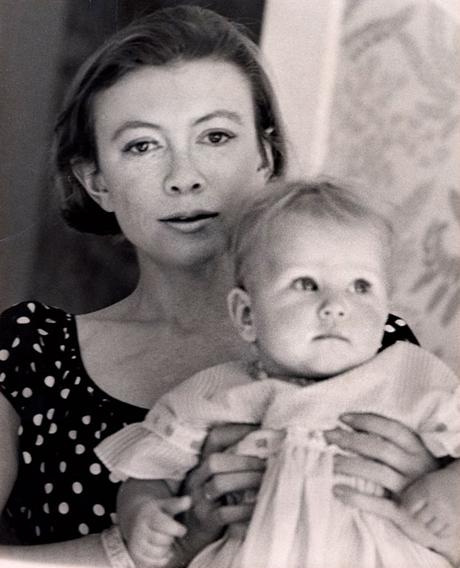
Joan Didion and Quintana Roo

“Only the very young and the very old may recount their dreams at breakfast, dwell upon self, interrupt with memories of beach picnics and favorite Liberty lawn dresses and the rainbow trout in a creek near Colorado Springs.  The rest of us are expected, rightly, to affect absorption in other people’s favorite dresses, other people’s trout.  And so we do.  But our notebooks give us away, for however dutifully we record what we see around us, the common denominator of all we see is always, transparently, shamelessly, the implacable ‘I.’  We are not talking here about the kind of notebook that is patently for public consumption, a structural conceit for binding together a series of graceful pensees; we are talking about something private, about bits of the mind’s string too short to use, an indiscriminate and erratic assemblage with meaning only for its maker.”

–Joan Didion, “On Keeping a Notebook,” Slouching Towards Bethlehem, p. 136.

I just began reading Blue Nights.  The passage above from Didion’s much older essay has been with me as I approach a still-too-tender writing project.  It’s stuff I will write about some day, though more time must first elapse.  I need perspective, and this is too messy and raw.  Meanwhile I put bits into a jar (or notebook) to save, to turn over, to approach for the quilt when it’s time.

Meanwhile, merely typing Didion’s words (and reading her new memoir) is a comfort and a privilege.

Cinderella, what big, sharp teeth you have!

Because of my recent rants about princess stuff, a friend recommended Cinderella Ate My Daughter by Peggy Orenstein.  I finally read it.  It was great.

It was great even through the lens of Orenstein’s preaching to the cliched choir (me).  It was great despite how depressing it was to read what inspired the Disney Princess phenomenon–in 2000, a new executive at Disney went to see Disney on Ice, and noticed, to his horror, that the girls wore HOMEMADE princess dresses.  In the small gowns, rather than creativity at the hearth, he saw a missed merchandising opportunity.  Thus the Disney Princess brand was born.  (And now we have girls clad in shiny, generic, made-in-China garb, rather than homespun results of someone’s invention.)

I live in Yellow Springs, Ohio, a bubble like Orenstein’s city of Berkeley, both places relatively more immune to over-the-top materialistic madness than much of the U.S.  This book was great because it was reassuring to read someone thinking about how to revolt against the default definition of femininity as only and always about what girls look like rather than what they do.  And not only is Orenstein thinking about how to revolt, she’s done her research.  She backs up her arguments.  As a journalist, she seems responsible in her work.  Her credibility as a person in the narrative is crucial to how therapeutic this book was to read.  Throughout, she’s grappling in plain view with the same questions other parents are.

It’s overwhelming to consider how to fight the subtle and unsubtle corporate power of entities like Disney.  My four-year-old daughter saw the Disney Princess undies at Target, and it’s all she wanted.  She could not be easily dissuaded.  (I bought them.)  The other day at Goodwill, I steered her away from the shelf of half-clad Barbies in the toy section.  I lured her to the books, figuring that was safe and we could get out without her wanting to buy yet another “baby.”  (She has always loved her “babies” and it’s often a struggle to convince her she has plenty of plastic mouths to feed.)  In the book section, she found a shiny pink Barbie book called Little Sisters Keep Out.  She does not know what Barbie is, though she’d seen them on the shelf.  She saw the book’s cover and said, “It’s a princess book!”  Ironically, I had just finished reading Orenstein’s book the night before.   I stood there, holding my own literary find–a gorgeous illustrated Aesop’s Fables–and reminded myself I had grown up with Barbies, and I turned out okay.  (Yet, like Orenstein, my self esteem was not helped by Barbie, nor by Seventeen Magazine, nor that iconic, tarted-up teen, Brooke Shields.)  Like the “I grew up watching too much TV and I turned out okay” argument, my Barbie excuse thins when I think too hard about it.  I bought both books, though I refused to read the Barbie book to her.  I told her that I didn’t like the kind of story inside it.  She said, “I love it.”  I told her those kinds of stories say girls can only do certain things, like brush their hair, not run and jump and climb and do fun things like that.  “But they go to the playground,” she said.  (One picture shows the dolls sitting on swings.  She decided she would read the book to her babies.  She makes up stories about the plastic dolls in the photos, and we have a compromise.)

Now that we grownups realize what TV does to a young person, or what all-pink-all-the-time (not to mention the focus on how a girl-to-woman looks rather than how she feels) does to the feminine psyche, we have the power (the responsibility!) to make better choices.

Let’s!  Let’s.

For me, all roads lead back to Buffy.  A slayer, a killer of demons.  Always fashionable, sometimes wearing implausible slaying footwear (but hey, she’s the slayer!) she takes care of herself and by “takes care of herself” I do not mean a pedicure.  In a dark alley, Buffy is the one kicking ass.  The final paradigm shift of the end of the TV series still makes me cry, every time I think of it:

“From now on, every girl in the world who might be a Slayer, will be a Slayer. Every girl who could have the power, will have the power. Who can stand up, will stand up. Every one of you, and girls we’ve never known, and generations to come…they will have strength they never dreamed of, and more than that, they will have each other. Slayers.  Every one of us. Make your choice.  Are you ready to be strong?”

Buffy wasn’t taken seriously at first.  She grew from a blonde teen cheerleader to a strong woman who changed the (fictional) world.  She spawned a small academic field called Buffy studies.  (And yet I found a Buffy dress-up game, where you can change Buffy’s clothing as if she were a paperdoll on the screen.  Sigh.)  The size of the problem of raising a strong, confident female person amidst well-funded and deeply entrenched corporate sinisterness makes me tired.  I have no answers.  But Orenstein’s book gave me hope.  Maybe parents will read it and meet together, talk about alternatives to the madness.  Maybe this kid’s parents read the book.  Maybe this kid can help start the revolution.

Maybe we will start making our own costumes again.

The kid-think of Room (novel by Emma Donaghue)

Many Moons Passed with the Wolf at My Door, by Angela Treat Lyon

The first book I read after fall quarter had dusted down was Emma Donaghue’s novel, Room.  I can’t avoid “reading as a writer,” and thinking about how the writer does and makes her thing, but wanted to immerse myself, so I refused the urge to take notes.

The narrative procedures used in this book are inseparable from the sensational story, which is, to quote the Wikipedia entry, “told from the perspective of a five-year-boy, Jack, who is being held captive in a small room along with his mother.”  The book is a page-turner, sure, but what kept me riveted was the grace with which Donaghue sustained the narrative told, first-person, in a young child’s words.  It’s of particular interest to me because I know it’s so damn hard to do.  (My novel, The Watery Girl, is told from the point of view of a seven-year-old, but I didn’t want to limit myself to her language.  So I used a close third person, still intimate, often imbued with thoughts and words directly mined from the protagonist Claire, but third person allows space to wiggle language.  First person really locks you in.  All writing is artifice, but if you want to convince a reader like this one, you better stick close to what a child would actually say.  And more than that, Donaghue’s Jack breathes the breath of childhood, lives out its logic.  I’m convinced her sentences are true kid-think.)

As I read Room, I kept holding my breath (not only because of the story) to see if Donaghue could sustain that thing with the kid.  She did.  There was not one moment when I disbelieved I was reading Jack’s true five-year-old thoughts.  Yes, Jack is precocious and smart, but the writer explained his particular intelligence so effortlessly when needed, and made clear that Jack’s mother worked hard to engage her son in his (albeit tiny) world.  Reading about their life in Room, I was enrapt and also exhausted, imagining how hard it would be to live in a single room with a child, non-stop, for five years.  (Putting aside the whole ordeal–the sheer exertion of the character’s work as a parent was amazing.  And yet believable.  I bought, without question, that Jack was her redemption.)

When I opened the book, I didn’t know the plot, just the premise.  As I read, I wondered how Donaghue would sustain the claustrophobia of one room for an entire novel.  When I realized their situation was about to change, the novel became “about” something very different from what I expected.  I was glad.  Thinking, as I have been this year, about brain plasticity and pinning many hopes to that idea, it fascinated me to read and consider about how Jack might (or might not) adapt to life outside Room.  And like many who have read the book probably have done, I wondered whether we each have a Room of some sort of other that’s shaped what we expect and want from the world.

I want to read more of Donaghue’s writing, soon, because anyone who can do what she did in Room is worth the time.

Brave

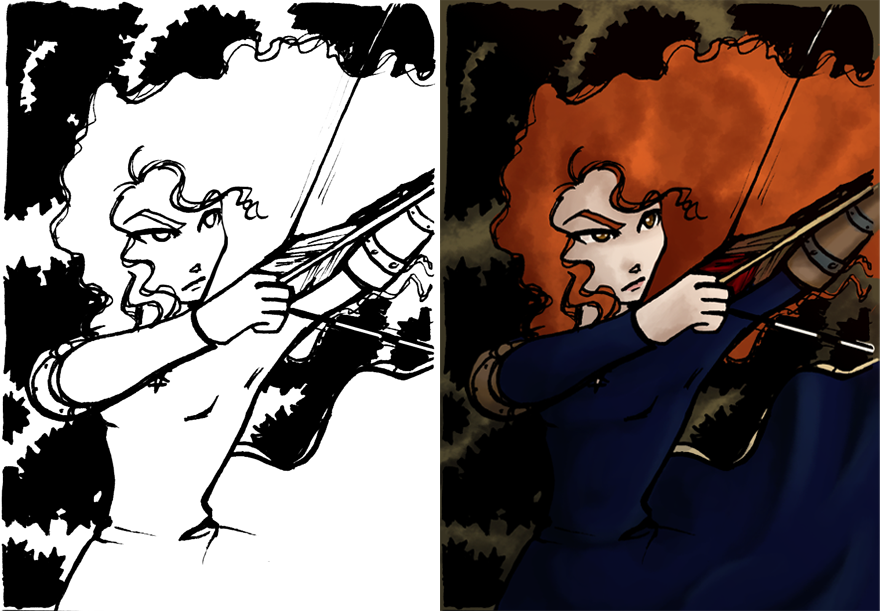
sketches of Princess Merida in "Brave"

Before my daughter Merida’s accident, I might have (hyperbolically) called what happened today my worst nightmare:  Shopping at Target, I asked her which underwear she wanted to choose.  While I suggested Hello Kitty or Paul Frank monkeys, she grabbed the Disney Princesses.  I suggested several other options (“Look honey, these have the days of the week!”) but she was certain of what she wanted.  I bought them.

All her life, my husband and I have worked to keep her away from TV and mainstream junk.  I know, everyone says the Pixar movies are great, and I have seen a couple of them (not bad) but Merida thinks movies are the things we watch on youtube, most often short videos of the band Hot Club of Cowtown, or Mark Bittman cooking.

But next year, Disney/Pixar will release a film called “Brave“.  The heroine is named Princess Merida.  Princess Merida!  When I first found out about this last spring, I was horrified.  How dare they steal my child’s name?!  And how badly will they mispronounce it, adding to the confusion we already face each visit to the pediatrician’s office, when she’s called “Muhr-Ida” and other versions that are not her name.

Then came the accident.  Through the entire process, and still, my Merida has been unbelievably brave and strong.  A little warrior, future slayer.  (I’ve always wanted to raise a slayer, but that’s another story.)  Swirled in now with all the ambivalence I have about Disney and skewed, commercial images of what girls and women should be, I am now, strangely, okay with the naming of next summer’s princess.  I’ll take it!  If it gives my daughter a little pop culture validation that she is awesome and strong and amazing, who am I to argue?  I told Merida and a friend of hers about the movie, and was quickly convinced to take them both to the theatre next summer.  (It’s a date!  Robbie Coltrane does one of the voices, so it can’t be all bad.)

But next time she’s getting  the monkey underwear.

Our children

They have their own thoughts, they have their own thoughts

Hardly an original thought, but I am starting to understand how much “our” (=all) children need nature.  Even the grownup children.  In my mind, this thought, which is so simple, connects to this song.

Lyrics by Khalil Gibran, Music by Ysaye M. Barnwell

Your children are not your children
They are the sons and daughters of life’s longing for itself
They come through you but they are not from you and though they are with you
They belong not to you
You can give them your love but not your thoughts
They have their own thoughts
You can house their bodies but not their souls
For their souls dwell in a place of tomorrow
Which you cannot visit not even in your dreams
You can strive to be like them
But you cannot make them just like you
Strive to be like them
But you cannot make them just like you

It is impossible to overstate how bittersweet it is to watch a child grow up.  The process is so slow that it becomes invisible, and then one day, the infant is walking, the toddler is speaking, the child is telling stories.  She runs and stumbles and gets up and isn’t scared and she climbs to the top of the blue jungle gym.  When she stands there, realizing where she is, she says, “Mama, help me,” and while I calmly coach her to find a place to put her feet, I am not breathing, I am “please don’t fall!”ing, and I am trying to know with my own body that she is balanced and strong and wise and that even if she falls, this is the work she needs to do on this day, at this moment.  It is exactly right.

(I can house her body but not her soul…For her soul dwells in a place of tomorrow which I cannot visit not even in my dreams, and this fact is what is so beautiful and this fact is what breaks my entire heart.)

She finds her feet, she climbs down, she smiles with exhilaration and now she has done her work of this day and I have not done it for her, I have resisted even trying, and this means that she knows she can do it herself.  She can do it herself.

And you know what?  I do not want the children to be just like us.  Please no!  I want them to find a better way to live here on this earth.  Meanwhile, let’s help them learn by stepping aside and letting them put their bare feet on the earth, letting them feel the mud and water and prickly grass, and letting them pay attention and do all those beauteous things that surround us every day, those things we forget have such significance in the constant rush of rush rush rush.

One by one

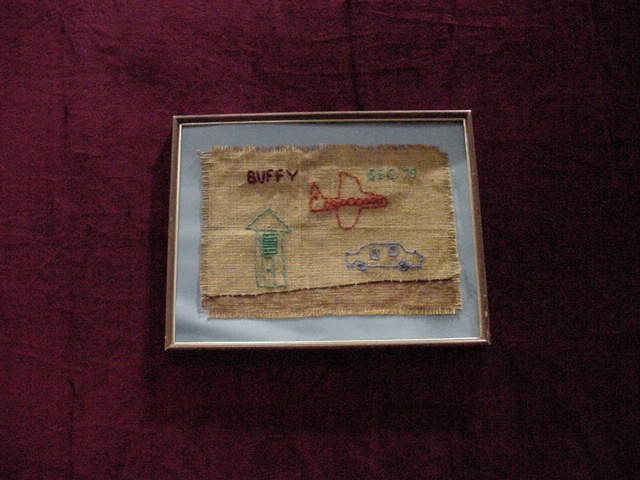
Buffy made this when she was a kid.

A few years ago, Buffy said:

So here’s the part where you make a choice. What if you could have that power, now? In every generation, one Slayer is born, because a bunch of men who died thousands of years ago made up that rule. They were powerful men. This woman is more powerful than all of them combined. So I say we change the rule. I say my power, should be *our* power. Tomorrow, Willow will use the essence of this scythe to change our destiny. From now on, every girl in the world who might be a Slayer, will be a Slayer. Every girl who could have the power, will have the power. Can stand up, will stand up. Slayers, every one of us. Make your choice. Are you ready to be strong?

Fear

Gary Perkins survived the 1974 Xenia tornado by hiding under a desk.

In 1974, I lived in Yellow Springs, Ohio, ten miles from Xenia.  One of the worst tornadoes on record hit Xenia that spring.  I remember only a few things about that day: hiding under a heavy blanket in my bathtub; a hail-ball the size of a softball (maybe smaller: I was a kid) that kept for a long time in my freezer; the way Xenia looked like a clearcut forest for years afterwards.  Even as they recreated buildings, they couldn’t rebuilt trees.

I still live about ten miles from Xenia, a town that has traditionally been  plagued by tornadoes.  I’ve been processing my fear of tornadoes ever since 1974.  They haunt my dreams and fiction.  Last summer I wrote a poem (or something that might some day be a poem) about those springs of childhood, memories of many green skies.   So, knowing there’d be “weather” tonight, upon hearing a continuous tornado warning siren, I interrupted bedtime reading to take my daughter, who hadn’t napped, down to the basement.  I took the flashlight and phone, and my laptop, which is the only source of live information (live streaming TV station audio, as we don’t have cable) and explained calmly why we had to go down there, trying not to scare her.  Within a few moments, she said, “I’m afraid!”  She seemed to be trying on the costume of “afraid” more than feeling real fear.  The storm passed (three-inch hail through Xenia, in fact) and we went back upstairs.

I imagine my fear of “weather” is something like what children of the Cold War grew up with: the duck and cover mentality.  (You want to see something interesting, go here.)  I need to work it out, find a way to let go of the freak-out while keeping myself and my family sanely safe.  I don’t want to be alarmist about green skies.  Just because I have a visceral memory of that time, I don’t want to pass it along to my daughter.

But how?

How things need to be said

How do you say "apple"?

This morning, my daughter was talking about how one of her friends says words.  He’s about two, and words are emerging from his little being.  My daughter said, “He says ‘apple’ how it needs to be said!”  Apple, that powerful and delicious word, its expression  with rewarding payoff in fruit.

I love the phrase “how it needs to be said.”  I wish I knew better how things I need to say need to be said.  All I can say is I’m working on it, working toward it, meanwhile watching the delectable round red fruit of finding the right word, often out of reach…