This morning, my daughter was talking about how one of her friends says words. He’s about two, and words are emerging from his little being. My daughter said, “He says ‘apple’ how it needs to be said!” Apple, that powerful and delicious word, its expression with rewarding payoff in fruit.
I love the phrase “how it needs to be said.” I wish I knew better how things I need to say need to be said. All I can say is I’m working on it, working toward it, meanwhile watching the delectable round red fruit of finding the right word, often out of reach…
Oh, where to break the paragraphs, how to expunge some one sentence paragraphs, justify some two sentence paragraphs, avoid too many short paragraphs, how not to be jarring, or coy, and how to trust the reader to know where I mean to place emphasis, how to trust my intuition, the flow of the words, the lightning bolt that tells me to end or begin a paragraph…
Understanding, maybe a little bit, how poets work.
I just reread Elements of Style, and several bits of wisdom have taken residence in my mind. This was the first time I’ve read the fourth edition. I found the updates to this edition helpful, in particular, some of the tidbits in the final section on style. If you haven’t read it, do.
I’ve been working through a novel, editing, pruning, and rearranging. Strunk and White remind me of point 22, on p. 32 of this edition: “Place the emphatic words of a sentence at the end.” This can apply to sentences, paragraphs, lines of poetry, and even words: the beginning and end of these units carry the most power, the most weight. The middle can be incidental, or worse, ignored. Here’s a clever example (possibly urban legend, but interesting anyway) of how words can work with mixed up middles becoming invisible, and yet the content is still clear. (Thanks to my friend Lara for digging this up when my human memory failed.):
“Aoccdrnig to a rscheearch at Cmabrigde Uinervtisy, it deosn’t mttaer in waht oredr the ltteers in a wrod are, the olny iprmoetnt tihng is taht the frist and lsat ltteer be at the rghit pclae. The rset can be a toatl mses and you can sitll raed it wouthit porbelm. Tihs is bcuseae the huamn mnid deos not raed ervey lteter by istlef, but the wrod as a wlohe.”
Beginnings and ends of these words are stable, are what we expect, and therefore they guide in reading through the garble.
Another thing that Elements of Style illustrates is more visual than literal. Writers have to learn the twin arts of making a mess (making a creation, a draft) and then cleaning it up (editing, revising). If you look at the layout of the examples in Strunk and White, you could consider the left column (before the makeover) as the making of the mess, and the right column (after the makeover) as cleaning it up. I’m going to use this idea when I talk to students. I think it helps to put the implicit and explicit judgment of Strunk and White into a context: all writing is a process, a walking through and then away from the muddy, toward the clear. Start somewhere. Edit as needed, strive to improve the mess, to communicate better.
Maybe the most important advice is point 17, on p. 23, “Omit needless words.” An anthem for some people who write, an ideal to strive toward. I’ve been polishing, weeding the needless, plucking extraneous words from overburdened sentences. Sometimes it takes years to realize a word is needless. Omit needless words is a noble mantra and practice. With time, I could whittle this paragraph down even more than I have, but in the battle between how the blogosphere measures time and my tendency toward perfectionism, I go for speed and risk flaws. This time, for the first time, I found (or noticed) the sub-mantra of Omit needless words on p. 19, under point 14. “Note, in the examples above, that when a sentence if made stronger, it usually becomes shorter. Thus, brevity is a by-product of vigor.”
It’s worth repeating: “…brevity is a by-product of vigor.”
That is such a beautiful fact, and beautifully put. No wonder I am tired, this revision has been vigorous. The novel is shorter. And, I hope, stronger.
When a songwriter at Jack Hardy’s weekly songwriters group would explain what he or she was about to sing, Jack Hardy would say, “Shut up and sing the song.” Abrupt, and to some, rude, but a valid procedural point for a workshop, even more notable in its good advice to the writer.
Let the work speak for itself. If something is important enough, yet is not on the page, or in the lyrics, put it in there. Rework or revise it later if you need to, if what you mean is not conveyed through your magic lattice of words, sounds, syllables.
I’ve stolen Jack’s line when approaching fiction workshops: it applies. I feel very rude ever telling someone to “shut up,” and usually preface it with context. As an imperative to action, “Shut up and sing the song” is simple and worth doing. (I’m talking to myself, too. For years, I whined about how I wanted to write and yet was not doing it.) Shut up about what you want to do, wish you could do, mean to do, intend to do.
Having gained sufficient time and distance from the sentences in my novel, I’m cutting. Many sentences have too many words. Some need words rearranged, the most important word relocated to the end of the sentence, emphasizing the point. There is something so refreshing about this process of paring down, pruning to make a thing flourish. The trick is balance: how to tell when you’re tinkering to tinker, when the first way was better. Breathing with each sentence, the comfort of making them stronger, the comfort of those moments when I know I’ve made them better.
I got this trick via Jim Krusoe, who attributes it to Carol Emshwiller. (Thanks, Jim and Carol!)
Writers of fiction: Take the first and last words of a piece, then put them together. The idea is that the resulting phrase might somehow relate to the whole. Here are mine.
The Watery Girl: “Something emerging.”
The Eight Mile Suspended Carnival (which is rough and will surely change): “Mim hands.”
I just read an interesting article in the NY Times about marginalia. I’ve been thinking a lot lately about “reading as a writer” and what that means, how interactive and not passive it can/should be… yet I have trouble writing in books, myself. So I take a lot of notes, recopy passages, and do my work that way. Maybe I need to rethink this, and break the water of the pristine book.
(The following might be the final paragraph of The Eight Mile Suspended Carnival. It will make no sense without the novel that comes before it. It might not even make sense with the novel that comes before it. But what the heck. It’s my blog, I can post if I want to.)
Ladies and gentlemen. Jettison what you can recreate. Take the essentials: bolts, wire, rope. Other parts can be found elsewhere. Take what you most need. Take the things you can use: arms, hands, legs, and sometimes other parts. Hands.
What a day. What a lilting, bourgeois opera, but I have yet to write the libretto. The highlight:
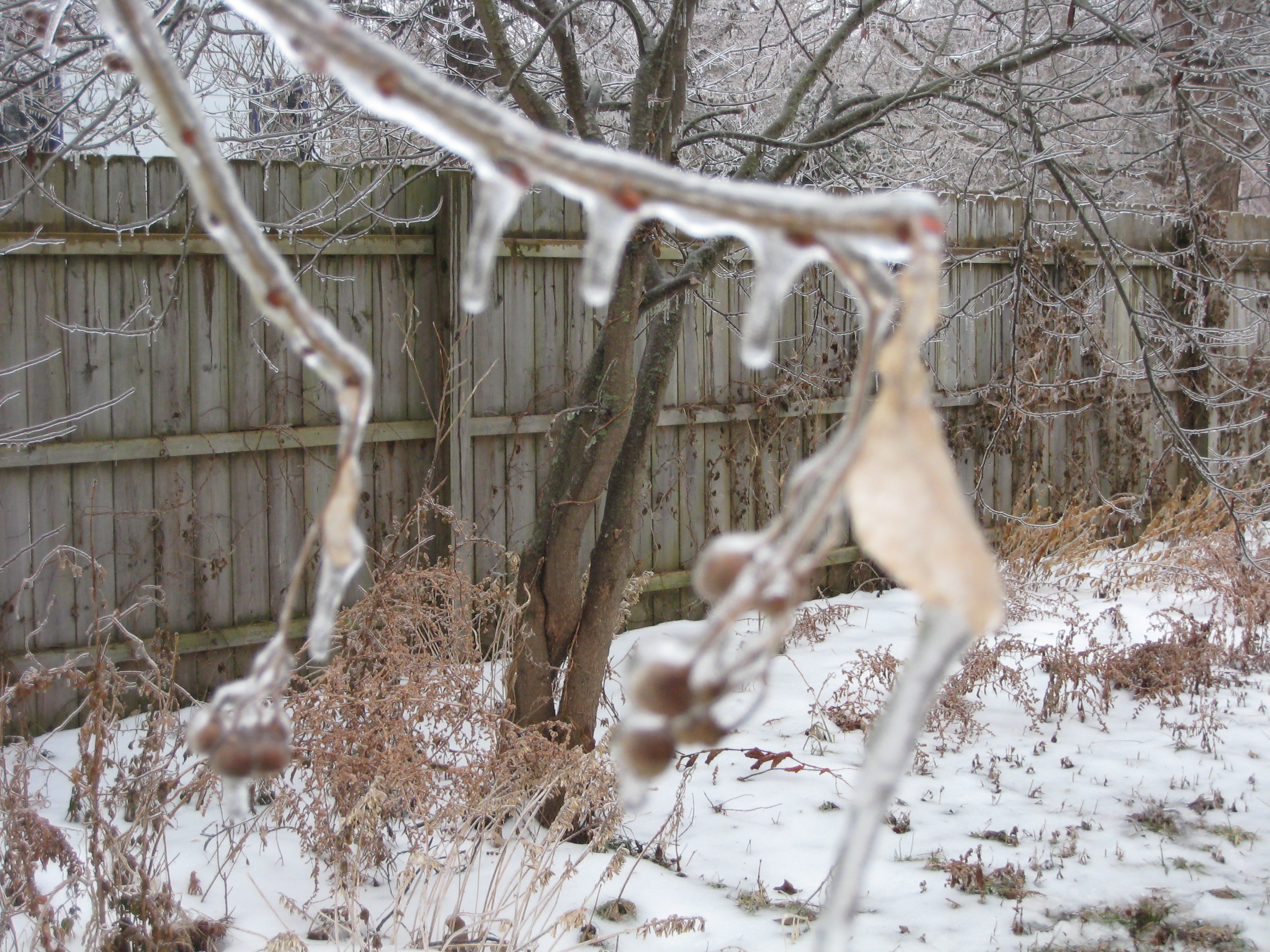
1) I finished my novel today. The ice storm helped, offering time at home, and sound effects. That crackle of ice on limb on wind opened something and let me let it be done. The end of the story was very simple. Ends are weird, and I don’t know if this is the right one, but it came clear and natural, so I will let it be for now. There’s still a passel of work to do, but I got to the end of the story! This novel took me ages, what feel like lifetimes, to finish–the first note I have with the germ of idea is from 2001, and I’ve been writing it since 2004. But for now I’m done. In a way.
To celebrate, I opened the week-and-a-half-old bottle of wine from the fridge (a very good wine that my friend Kurt, owner of Emporium, recommended) and put on The Black Rider by Tom Waits. (Sounds from Tom Waits have been partially to blame for the novel.) My husband celebrated with me; my daughter said she didn’t like the music but didn’t insist I turn it off.
After dinner, I noticed the dripping from the picture window (a leak, we need to figure out why, and have it fixed) was tap tap tapping with a tad more force than it had been this afternoon into the yogurt containers there to catch the drips…still is, but now fortified by towels, and other vessels to catch the water…saw a thin line of shine, so just in case, I emptied the cabinet below of myriad cups, saucers, tea, cocoa, and other important detritus…all dry…so for now, all I can do it sit back and wait to see if this really is the storm of the season, and see if the power will go out.
And probably best to eat some ice cream, which is still frozen. That’s the most obvious bourgeois bit, the ice cream. Because I’m not trapped in an ice-covered wonderland without it.
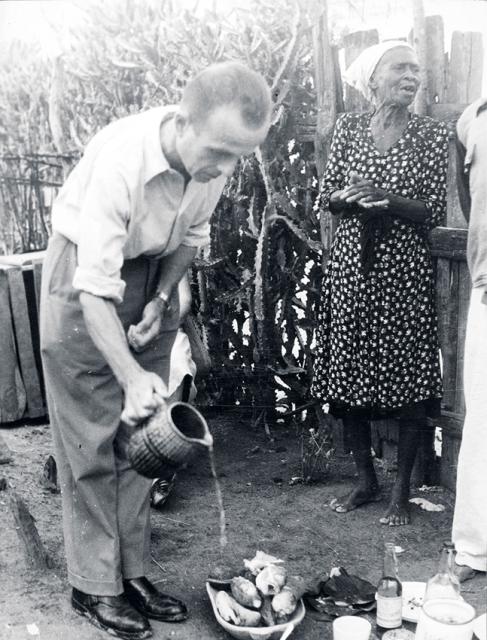
"Michel Leiris faisant une libation ; à droite, la mambo Lorgina Delorge"
Today, I sit at the precipice of WHAT HAPPENS NEXT in the plot of my novel, and have to write some new stuff, in other words, I’m looking into the abyss. Which means I need inspiration.
I have this interesting book of dreams of Michel Leiris. It’s from the Eridanos Library, whose books I’ve found at various used book shops through the years, and every one I’ve read has been completely worth the time. They have these quiet, considered covers that jump off the shelf because they are not screaming orange, twirling batons, and otherwise displaying excessive narcissism. This book in particular is a wonder to open at random. It’s a collection of short entries, thirty-seven years of a person’s dreams. Leiris hung out with the Surrealists, and this book is rich with imagery and the ineffable. (Clearly someone whose dreams should be considered.) Here’s what I found today, on p. 56, from an undated dream, probably sometime between 1926 and 1929:
“I am going on a trip, so I have to move all the books in my library from one room to another.
Since the occasion calls for me to show one of my manuscripts to some of my friends, I go down to the street, rip what appears to be streetcar tracks from the pavement, and go back up to the apartment, dragging meters of rails behind me that bang on the stairs with every step I take. I then realize that this load is in fact made up of a series of large glass objects similar to those coasters that used to be placed under the feet of pianos in middle-class living rooms to protect the carpet or the floor. Because this is indeed my manuscript, I am fairly annoyed. But I manage to console myself, given the fact that my arrival provokes the following comments: ‘He’s quite something, that Leiris! You as him for a manuscript, and he drags the rails up from the street.’ On the other hand, though, these objects finally reveal themselves to be melting ice, and although the chain quickly dissolves, I hope I will be able to reconstitute some of its elements.”
What a dream! What an image! I post this not only to procrastinate (a noble end in itself) but because I love typing up words from other writers. It’s a way of getting inside the artist’s soul, physically. (I’ve sometimes wondered if it’s different, because I’m typing on a laptop, while Leiris, for instance, was probably writing by hand, so maybe I’m having a closer experience to getting inside the typesetter’s hand, in 1987, but if I ponder this question too long, my brain will fold into an origami crane and I will never get anything done.)





 Rebecca Kuder